Sunday, November 4, 2012

Mashup Artists

As I'm here at #edcampgr, I am struck over and over today by the idea of teaching as a mashup art. People talk a lot about teachers 'stealing' from teachers or other equivalent expressions, but it's more creative than that. It is amazing listening to these edcamp teachers.  The kind of teachers that give up a Saturday for free professional development, are willing to present when they didn't come here to do that, are here explicitly to take control of their own PD - these are amazing people.

It's really cool how much these teachers have in common, and yet have so much of their own to add, also. They share so many values, yet are implementing them in different ways. Being such a twitter-savvy conference, you see ideas intermingling from concurrent sessions.  Over the course of several sessions, you see people applying immediately what they heard from multiple sources in the next conversation.

Not actually math-positive.
Someone was talking with Dave Coffey and I about Khan (that happens), and that essential nature of teaching was part of the conversation. Constructivist teachers get frustrated with students asking us to tell them what to do, but then those teachers can ask that same thing. Tell me what to teach or how to teach. Or, worse in my eyes, teacher educators tell novice teachers (or, arrogantly, inservice teachers) Teach Like This.

Not the teachers at edcamp. Even when they hear something amazing, they think 'how can I adapt?' or 'what will this look like in my classroom?' or 'how does that relate to what someone else was talking about?'

A persistent idea for me is the student/learner distinction (if you haven't, watch these videos, please. I went there, used caps), but I feel like we need a similar distinction for teacher of students vs teacher of learners. This relates to another word-confusion, the Skemp idea of instrumental vs relational. We need a way to talk about these different ideas in a way that supports all teachers in improving.

That happens at an edcamp.


Some of the resources from the day:
Sessions I was in:
@benrimes Tech Savvy Ed website
Video Story Problems vimeo channel
@kiemanha's Inquiry Google site
Project Zero's resources
Thinking Routines for Numeracy
Neato Comprehension Continuum framework (pdf)
Edward Burger, Williams prof, author of 5 Elements of Effective Thinking
Burley School's iPad blog
K-12 open source eTextbooks 
@anthonydilaura's Innovative iPad blog

Others: (twitter lets you eavesdrop)
@taramaynard shared @kfouss' GeoGebra and Google Forms
@delta_dc shared Project Based Learning explained (YouTube)
@sjunkins How Twitter is reinventing collaboration among teachers
@Packwoman208's Flipped resources

More? Check out the #edcampGR twitter stream.


Thursday, October 18, 2012

Exponential Potential

It really struck me listening to Shawn Cornally in this week's #globalmath session on SBG (click on the Recording tab) how his perspective as a physics teacher leads him to approach his math lessons as experiments. Starting with an experience that makes us want to model or makes modeling useful is definitely the start of some of my favorite math lessons. (While I'm writing this he tweets: "Leaf-Blower soccer went over *really* well today in physics. (vectors, f=ma)")

Starting exponential functions with my preservice teachers, I love to use this lesson adapted from a 5th grade Math in Art lesson. (From my pre-blog webpage.) The idea is the multiplicative patterns present in a Sierpinski Carpet.


(Also in Word format if you want to edit.)

One of the interesting discussions in the initial exploration is the 9 or 17 issue. 9 squares if we count the number of squares as distinct shapes, 17 if we unitize to the smallest level square. For algebra students there's some good opportunities for equivalent expressions, regression and even deduction of function rules. This is a good opportunity for sharing how recording how you're getting your answer can be more powerful than recording answers. The 17, for example, is 1·9+8, then the next level is 9·(17)+8·8. But later, most write it as \( 9^n–8^n \) - which can lead to a pretty neat binomial expansion. Maybe even more interesting and accessible is the 9=1+8, so the next step is 73=1+8+8·8, and gives them a way to generalize this pattern besides recursion.

Once we get to the design your own carpet, there are so many new patterns to find. Here are some samples from this week:


Note that these last two aren't really Sierpinski patterns - but they still raise interesting patterning questions that are extensions of what we already noticed.

Probably easy to see why this is one of my favorite lessons. I also have seen the power of adding in places where students who have not traditionally been strong in math class can do amazing work.

The next lesson to follow up this one has some other opportunities to gather/generate multiplicative data.


It always strikes me how even college math majors find things to be surprised about in this data. Especially the penny balancing one. This class made some neat displays of their data - but I haven't taken the pictures yet. (Didn't know I would be blogging this, as I thought I already had! Maybe I was thinking of the quadratic simulations?) I'll add them at first opportunity.

First Opportunity:


Next we'll look at modeling this data symbolically using technology, and asking questions that raise the need for logarithms. Since, of course, every exponential data set is logarithmic when seen through the looking glass.

Sunday, October 14, 2012

Angle Acquisition

Quick game idea. I've had a few bustling around, and I've got to get started writing them down.

Observing student teachers is a great job. I get to see and have in depth teaching discussions with lots of hard-working, talented teachers.  And see a broad range of content. We use a coaching model, which helps these be positive exchanges and ratchet up the interest level of the dialogue.

I was observing Terry Austen (the class he writes about here) and realized that once students knew the terminology well for parallel lines they were correctly identifying and applying the relevant properties.

That gave me the idea for a game. I thought it would be neat if students used the terminology to capture points. My first idea was to have a parallel line puzzle - I like those as practice, too - and have the players build it and then take the pieces. That's a lot of set up, though, so I decided on cards to make for less preparation. There's name cards to cut out, still.


Let me know what you think. I'll try it out with the PSTs this semester and post an update.

Friday, October 12, 2012

3rd Degree

I Love Charts, constant source of fun graphics, had a fun temperature comparison chart. temperature graph, complete with fun. I did share my graphs finally. I used GeoGebra to make them, of course, because that's the best accurate mathematical image maker. Easy enough to make all three variations. Which, of course, lead to wondering what features would you put in a dynamic sketch for it? How could you make the sketch switch between the three ranges?
But it wasn't to scale, so I started thinking about what that would look like. Just lengths? What's the norm? Then Shawn Cornally shared his oneupped

So I had to make it then. Obviously. It's on GeoGebraTube: for download or use as an applet.

Instead of checkboxes, I knew I wanted a slider to switch amongst Kelvin, Fahrenheit and Celsius as the input. I thought about adding an input box for conversion, but those still don't work on the iPad, and I'm trying to think about that more.

The idea came to make the segments for the 0 to 100 degree temperature range where the endpoints were a function of the slider. Then I just needed a particular value for three different inputs, so it would only have to be a quadratic. I started to go to Wolfram|Alpha to do the regression, when I realized that, of course, GeoGebra would do it more easily. So with the slider at values 0, 1 and 2, the range for Fahrenheit, for example, is just determined by
F0(x)=FitPoly[{(0, -459.67), (1, 0), (2, 32)}, 2]
F100(x)=FitPoly[{(0, -279.67), (1, 100), (2, 212)}, 2]
a=Segment[(3, F0(n)), (3, F100(n))]
I was struck again by how nice GeoGebra is as a source of activities for students, but also how rich the task of making things in GeoGebra is, and wonder: how do I encourage more sketch creation from students?

Having sunk the time into making the sketch, I did think about what activity could go with it, and whipped this up:


I'd be interested in feedback on the sketch. Does it have the features you'd want for your students to use? Should it have more cute doodads? What do you think about the design of such a sketch as a task? How far should the students be past the material before trying to design the sketch?

Tuesday, October 9, 2012

Why Questioning?

Found at From-Student-to-Teacher Tumblr
From Joy of Literacy

Last week became questioning week with student teachers. It came up in two action plans and we were able to have some really interesting discussions about it.

A lot of what I'm writing about here is from work with David Coffey, inspired by Kathy Coffey, and processed from Mosaic of Thought (link includes Chap.1 as a sample) among other books. Neither Dave nor I can remember the actual origin... which is sometimes symptomatic of having done it yourself.

In my own growth as a teacher questioning is definitely one of the places where effort and reflection have helped me improve. The first level was just asking better math problems. More open-ended, that required more problem solving. When the problems are better, there's more interesting things to ask the students about later. The next was to ask more appropriate questions. Some of those excellent problems I gave to students were too much for students. This is a zone of proximal development idea. When it was too much, I needed to scaffold. Later I learned about rephrasing the question instead of narrowing it. Later still I learned about demonstrations of how I think about a problem, sometimes more appropriate than guiding students through it. Then you ask 'what did you notice?', which is - of course - one of the all time great math questions.

One of the best things I ever learned was to stop being the authority. I don't say what is right or wrong. I ask the students if they 'agree or disagree?' That might start an actual conversation. 

One of the first things I really noticed about teaching was that students would tell me that they couldn't do it (whatever it was at the time) but when I asked them questions they could get from beginning to end with no difficulty. So, obviously, I needed to teach them to ask those questions of themselves.   It was difficult. Really difficult. Shifting from asking them 'how to do (next step)?' to 'now what?' and 'how do you know?'

Literacy learning experts are good about this idea of questioning as a process, with the idea that questions are how we move ourselves forward. I like this framework to help me think about the kinds of questions that I'm asking.


Obviously, we have had a tendency to ask too many literal and application questions in math class.  I think about inference questions being predictions, reading between the lines, hypothetical questions and the like. Analysis questions are reflections, synthesis, connections, recommendations and so on.

What I shared that seemed to tie it together for the student teachers is a simple idea: ask to find out what I want to know about. I don't need to ask for answers - I know those. I don't need to ask right or wrong. I need to ask about what they are thinking. Students know when a question is genuine, and this simple idea has improved my assessment more than anything else.  I'm more persistent in getting answers when I really want to know them, also.
From A Softer World
Some good student teacher writing on questioning:

Sunday, September 30, 2012

Greater Than

Previously: planning and coaching on inequalities.

The origin of this game was trying to think about a game that helped give students enough experience to intuit the rules for how operations with signed numbers affect inequalities. I think this is doubly hard for students because they don't have much intuition for signed numbers, and learn both integer operation and inequality rules by memorization rather than understanding.

I love playing cards as a material for signed numbers because the red and black make such a nice positive and negative visual. (For more integer games, see this collection elsewhere on the blog.) I thought about students somehow constructing expressions, but I couldn't think of anything not clunky. I knew we wanted comparison, and I like War as a comparison structure. That made me think of the exciting moment of war, playing down extra cards on a tie.

When I played around with the cards, though, it didn't get at inequalities because each player was changing the value of only one side of the comparison. A big no-no in the context we want. So the played cards had to effect both players' values. It seemed confusing to have both players reveal at the same time, so I decided that - at least to start - players should take turns, even though that makes the optimal strategy pretty determinable. (If it's not a word it should be.)


After students get the strategy, go to the variation where both players flip at the same time or the dealer has one less card. If playing with middle schoolers for integer operations practice, try the flipping off the top variation.

I think this is a good educational game, but only close to a good strategy game. I can't quite figure out what's missing, so if you have a variation or adaptation to try, please let me know.

Evaluating this on my game design framework:
  1. Goal(s). Gain experience with effect of integer operations on inequalities. Works well. Also good for gaining experience with integer computation.
  2. Structure. The game generates a lot of these situations and the cards guarantee a mix of operations and values.
  3. Strategy. Pretty simple. On variation becomes a pretty nice bluffing game, but not intensely strategic.
  4. Interaction. What you do completely depends on opponent.
  5. Surprise. Hidden information and opponent plus randomization of cards helps here.
  6. Catch-Up. Victory is almost always possible.
  7. Inertia. Might be too simple for loads of play, but good enough for the objective.
  8. Rules. The idea of applying your card to both is non-intuitive, and remembering suits-operations connections is hard. You might want specialty cards
  9. Context. No context, but all the variations generated engagement from the preservice teachers.
One thing I want from this experience is a deck with operations for suits. Not sure if it should have all 4 operations, or multiplication and addition with positive and negative numbers or some other variation. What do you think?

Photo credit: Abulic Monkey @ Flickr

Friday, September 28, 2012

Put Me in Coach

I took my new inequality game (that was the fruit of my planning last post) to Dave Coffey's and Hope Gerson's student teacher assistant seminar. The idea was to teach a lesson, and then get coached as a model for the TAs.  GVSU has a great education program where our student teachers have a full semester of being in the schools all morning before a more traditional student teaching semester. They get supervisors from the College of Education and, for secondary, from their major content area for both semesters.

Inspired by the Learning Network and the Cognitive Coaching model, as well as the Instructional Coaching model from Jim Knight et al, we've moved away from an evaluative assessment model for observations to a collaborative improvement model.  Dave has written a few excellent posts on coaching. One of the things we try to do for the TAs is a coaching demonstration, where they can see what this process is like. Very understandably, they are nervous about being observed. This semester, I've came in and taught a lesson as if to my preservice secondary teachers, and then we debriefed for the demonstration.

We ask the students for whatever they're using for teaching notes (as opposed to expecting a lesson plan) and for them to fill out an action plan. My lesson plan is pretty bare bones... many student teachers wanted to know if that was okay. Yup. The principle is do what is helpful to you. What I brought:
Greater Than Lesson Plan
Math 229, 9/26/12

Objective: understand nature of inequalities and their interaction with operations; apply to measurement

Agenda
5 Start Up, DOS, share HW
45 Greater Than Game
SA: Fill in blanks: 3 ___ 10; -3 ___ 2; -1 ____ -3;
F: explain game rules, play a round vs whole class
A: they play; pose question “what effect did operations have on inequalities?”
R: (10 min) discuss
•    what effect did operations have on inequalities?
•    strategies in game
•    suggestions for improving the game

50 Error analysis investigation
SA: Measuring a line with +/-
F: overview of measuring stations; introduce contest
A:
-they measure volumes and areas
-class-wide table of results
R: explain how did they compute errors for their measurements
5 Contest reveal; debate winning conditions if there’s an opportunity
5 Concerns/ Wrap Up

To Do:
Observation Journal WS
101qs.com how many/how much investigation

Materials:
playing cards
rulers/measuring tape
contest jar
I realized I omitted the lesson objective of analyzing an activity as a teacher, and put that in for the teaching of the lesson 'for real.'  We only did a representation of the first part of the lesson for the coaching. Here's the action plan:


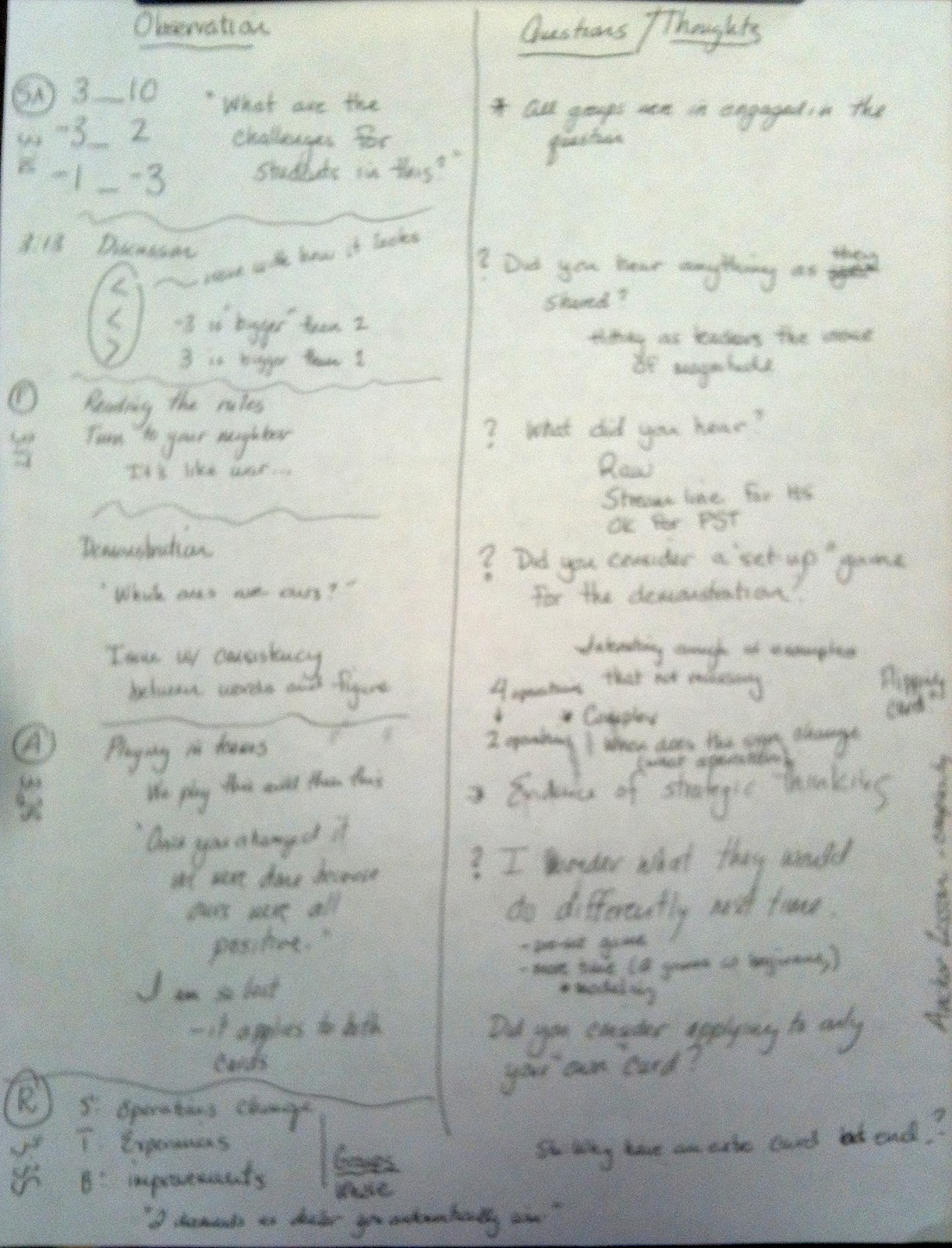
Dave took notes while I was teaching. (He may produce a sharper version of this.) When we're taking notes we often make note of other things to talk or think about aside from the action plan, but don't necessarily bring them up unless it is something that could greatly help the observed.

The dialogues following an observation are some of my favorite times at work. Discussing teaching with another professional based on something that we both just saw happen is amazing. Exciting as a teacher and satisfying and growing as a colleague.  We've tried to think of a way to encourage this kind of teacher to teacher interaction at the university, but it hasn't happened yet.


The video of this coaching isn't exactly like what it is when not for demonstration, but what is here is pretty authentic. (For one thing, the discussion is usually 30 min to an hour.) I did make some of the changes that were suggested here or in the discussion afterward with TAs participating in the coaching. They recognized the value of positive feedback, seemed less intimidated by the prospect, and were interested in how the person being coached does more of the talking.

What: the game does work for generating experiences to consider inequalities. I think it also works on the level of an activity for novice teachers to evaluate for use in class. It raises the issues of materials, effort to implement, and when a game might be good in class.  (Some of this is based on my use of the game with my PSTs.) I did hear a couple things that made me think about how do I make sure more of the connections that I'm thinking of get shared in class, for example the connection to War.  I do like the structure of the game.

So what: I want to consider the idea of generating a good demonstration game vs authentically playing a game to model.  I feel hesitant to stage a game, and I'm not sure why.  I want to think more about when should a game be well-determined and cleanly set, and when should a game be something that you kind of unroll over a few days.
        The idea of being clearer with preservice teachers about the difference between how things work in our college classroom and how it would be with K-12 students is definitely a valuable one. 

Now what: I did clean up the instructions as they suggested. I think the game is good as is for high school. The choice of cards vs flipping off the top helps emphasize that the only thing that flips the inequality is multiplying by a negative. The flipping is a nice variation for younger students who are focused more on operations with signed number. As a game I have to think more about the full strategy version. Is there a way to make it a real game?
        It's a constant danger that PSTs will decide our experiences are irrelevant when confronted with the schools as they are. So thinking about this transition and connection piece from teacher education to teacher reality should always be considered.  I also want to continue to be sensitive to the idea of big shifts and subtle shifts. Subtle shift - questioning, medium - finding a game online, big - designing your own game or writing your own curriculum.

Note: I'll shortly have a post up that's just about the game with the current version.

Image credit: By Sgt. Robert Adams [Public domain], via Wikimedia Commons