Happy Tiling!
Our 2nd annual World Tessellation Day, celebrating the birth of
Maurits Cornelus Escher on
June 17, 1898.
Pat Bellew has a good quotation in today's On This Day in Math:
By keenly confronting the enigmas that surround us, and by considering and analyzing the observations that I have made, I ended up in the domain of mathematics, Although I am absolutely without training in the exact sciences, I often seem to have more in common with mathematicians than with my fellow artists. - M. C. Escher, Quoted in To Infinity and Beyond, E Maor (Princeton 1991)
The best post I saw in advance was Evelyn Lamb's
Look Down. (Which also sounds like it could make a good horror movie.) Also note the founder of this here holiday's post, Emily Grosvenor's post on
making the holiday. Also also note that Eric Broug's
TED-Ed on Islamic Tessellations came out in time for today.
Best way to see what is happening is probably the twitter hashtag
#worldtessellationday. Lots of groovy there.

I had to make something, so
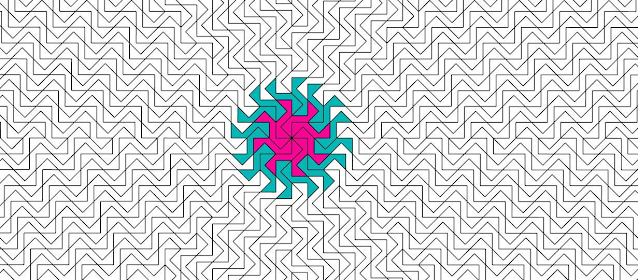
here's a GeoGebra applet. Instead of an Escher-style, I made a square you can fill and then fill the plane in three different ways. The matching conditions make for some cool patterns to me, like infinity tiles. If you want an Escher style applet, check my
collection of tessellation sketches.
My most recent tessellation work was with Heather Minnebo's art students. I helped some work out the mathematics, but got interested in her art directions.
I was having to eavesdrop while taking to other students, and we'll talk more about. But what I got was her talking about size of the tile compared to the final paper (encouraged to be quite large, like a meter by 1.5 m.) She talked about the designs within the tile, that were going to have to fill the whole paper. It struck me that the same things she was looking for are what I would want to emphasize the mathematical structure. Plus some nice visual estimation. Afterwards, she was highlighting craftsmanship as a growth area for some students, and I was wondering what that looks like in the math classroom. Heather says "craftsmanship for my kids (excluding some of my quirky friends who are owned by their ideas) comes down to ownership and then honing skills." She notes that at least half-ish of them were able to mesh conceptual understanding with some solid technical skills and creativity.
Heather notes: I have more questions than observations. I've taught this lesson now half a dozen times, how long before I really get a handle on how to best teach it? Every time I get an idea for how to improve the instruction and pacing, but it's a long ways from solid. (A solid chunk of this weakness/uncertainty is the knowledge that I don't have the full breadth of understanding of the mathematics behind it.) How do I get them to keep the spontaneity of their creativity and experimentation, but add in the understanding that this game has rules to follow. For instance, when I say midpoint I mean get a ruler and find the midpoint.
The enthusiasm and interest is palpable from the introduction – their minds are blown by the Islamic architecture and Escher's work – to their own initial trial and error. How do I encourage that same level of interest and enthusiasm all the way through to the end? I have two groups of kids who are able to do this from beginning to end: the ones who get it, own it, and have the discipline and mastery of skills to carry out their vision, and then there are my creative geniuses who are owned by their ideas and they are consumed with fulfilling the vision in their heads and I don't believe they see the issues of craftsmanship or skill we see. The bulk of the kids are in the middle – their enthusiasm and effort peters out (in varying degrees) as the repetition of shapes try their need for instant gratification, brains. This harsh judgment includes myself as I too often fall into this low attention span category.
Lastly and most complex, how do I convey the challenge to see each individual shape as a separate defined image/area, yet also view and plan them work together as a whole? Unbelievably, More than a few kids ignore the pattern they've established by tracing their shape, and they add color and additional patterns over all – sometimes obliterating the tessellating pattern they created. This blows my mind. I struggle against being frustrated as I think they absolutely must be missing something to choose to do that.
Those are just a few challenges and questions I have… I'm sure there are many more this was just off the top of my head.
Wow. These are some of the biggest teaching questions that there are! Any suggestions or comment from readers?


I always love how bold elementary students are (compared with college) and willing to try when college students often need to know if it will work first.







 Posts


