Showing posts with label pattern blocks. Show all posts

Sunday, July 12, 2015

Dodecatiling

Probably mostly pictures this post.

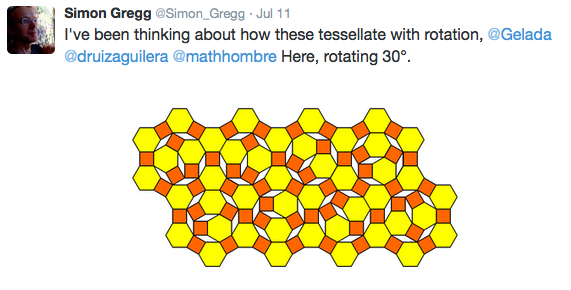
On twitter and their blogs, Daniel Ruiz Aguilera and Simon Gregg have been pattern block crazy. Daniel recently did a very cool class and a presentation about it (see more) and Simon is always breaking reality with his students and pattern blocks.

Simon:


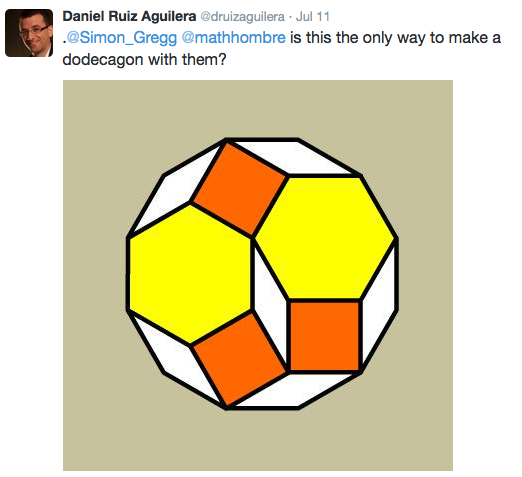
So Daniel tweets:
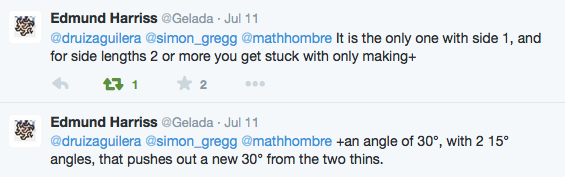
Edmund answers:
And then I got wondering about a tile with maximal dodecahedrons. I really liked the result of four 90o rotations. 


But I was having trouble extending it using the pattern blocks. So I fired up GeoGebra and starting playing with the regular polyhedron tool, and came up with a pattern I liked. If felt like 2x4 rectangles of dodecahedrons, that had the rotating 4 block in the middle, and met in a rotating four block.


That left the gap to figure out. Here is the pattern with the gap (fill in how you want). [Math Toybox is the site I used to play with the blocks. Not the satisfying click of wood, but I love the save feature!]

Here's how I filled in the gap. I had blue rhombs where the triangles matched up, but that blurred the lines of the dodecahedrons. And I wanted it to look like it was overlapping. (On Math Toybox.)


This was a little maddening, but also fun. By the end these arrangements just made a deep kind of sense and I could see the pattern and replicate it easily - definitely not the case at the beginning. So thanks/gracias/merci to Simon and Daniel.


Thursday, September 5, 2013

Creative Pattern

So, like most semesters in most of my teacher prep classes, we started out by watching Sir Ken pose the question, "Do Schools Kill Creativity?" Especially for preservice elementary creatures, who often have trouble seeing themselves as math teachers, who often have had very negative math school experiences, and will even sometimes bust out with "I hate math" in front of their math teacher.

This semester's group got pretty into it: the story of Gillian Lynne was high impact, the idea that things need to change had traction, several recognized that they had been subject to this, and the desire to incorporate movement really resonated. (We have a drummer in class, so that might happen.) Some students wrote about creativity for their weekly work: Lauren and Kyrstin, for example.

One of the ways I'm trying to encourage creativity is a work structure (syllabus) like this:
Daily Work: I’m asking you for 1 hour per class. Document what you did somehow and keep in a binder. It is not evaluated on correctness, but on percent completed. Keep an index/table of contents for which days you have work for. This work should either be doing math or learning about the teaching of math.  It is okay to double dip - use daily time for Family Math or weekly work. Just keep track of getting in your hours. I will offer suggestions, but this is your responsibility. It’s a good opportunity to practice generating ways to meaningfully work, which will be an important part of your work as a teacher.

Creating: from our work each week I am asking you to put an additional hour or two into deeper work of your choice. Revise or extend a daily work, play or make a math game, make some math art, find and read something in an area of interest, work on a math problem of interest or create a mathematical task… there is so much different work that teachers do. If you can connect it to our course work, it’s probably okay. Each week’s work will get feedback in terms of our rubric and qualitative.  But those aren’t grades. At the end of the semester this weekly work will be evaluated ⅓ on completion (did you complete work for each week) and ⅔ on exemplars. You will pick two examplars of your doing math, and two examples of your preparing to teach math.
There's a urli.st of their weekly blogs The list helps me in finding them all for giving feedback, but I ask them to link posts to our Facebook group as well. That gets more readership amongst the class than I've ever had before. One of the purposes of blogging their work is to increase their sense of audience. So if you do take a peek, please comment!

The math content we paired with this is patterning. Our first activity (close to this previously blogged one) got us playing with the appropriately named pattern blocks, trying to get at the idea of what makes a pattern a pattern instead of a design. Our ultimate idea was that it needs to be extendable. Not necessarily predictable, but when you see what comes next it should make sense with what came before. They built and then we talked about repeating patterns and growing patterns and then sequential patterns. To emphasize the extendable idea, we built patterns, then rotated to have someone else add on. Clearly - time for pictures.
Clear to everyone
No discussion


People accepted extension,
but felt like 3rd red block
could go "anywhere"

Generated interest because
the start was in a line, and the
pattern was extended 2-dimensionally

Patter creator admitted they
didn't know what came next, but
liked the extension. Next: 3 blues
top and bottom.
Arguments! Pattern creator wanted the trapezoids
double each step, extender focused on blues
"adding one" each time.


Is this a pattern? Designer claimed it was just a design.
Extender felt like the red-blue-green were lines
extending out each direction. All agreed: lovely!
Here's the handout, if you're interested.

The next day I wanted to build on the idea of the sequential growing patterns with explicit connections to algebra. My colleague Pam Wells has the best activity I know for this, adapted from a Mathscape activity. Here's my version. (As a Word doc, if you want to edit. Wasn't displaying correctly...)


Everytime I've used it the lesson has been engaging, provoking discussion, and very supportive of symbolic representation with the visual. Students wanted to work through all the letters on the front, though I only asked them to pick a couple. Many wanted to jump to building their own pattern immediately. Most glossed over the verbal description, so I pushed for that. In general with our pattern work, visual to verbal has been uncomfortable. This is a good activity for the connection between rate of change and the symbolic rule, as several students made that jump. Some students went from data to rule, and some from the visual.

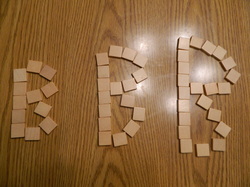
A couple students extended this for their weekly work. I based my sample weekly work on the letter patterns, so I expected more, actually; but that's why we give students choice. Brett extended the letter idea to his whole name, which is actually a pretty nice context for adding functions. (File that one away!) Emily did a really interesting project, making some mathart that  had layers of patterns.

The lesson after this was dominoes - but that's clearly a story for another day. Later in the semester we'll do more patterns using ideas of perimeter, area and volume.

Saturday, September 3, 2011

Pattern Generators

I like the theme of the first week of my Math for High School course to be teaching for creativity.

This semester's group did a nice job with Dan Meyer's Toast video. I had them ask questions and record what they noticed. There was a neat dichotomy: the WCYDWT responses were all pretty traditional math textbook questions. The what they noticed branched far afield, wondering what would make a good soundtrack, wondering about darkness of toast and toaster design.

We followed that with a workshop (I think based on an Esther Billings and Pam Wells workshop) based on verbalizing and algebrafying number patterns.
Is this a pattern?

The last workshop of the day was planned to be this, which in the past has been a pretty good activity:
Objective: TLW develop mathematical patterns from the teacher’s perspective.

Schema Activation: when (if you do) do you notice patterns in real life?

Focus: What we talked about in Class 01 was really curriculum. What are we going to teach? Here’s the NCTM’s take:

The Curriculum Principle
A curriculum is more than a collection of activities: it must be coherent, focused on important mathematics, and well articulated across the grades.  A school mathematics curriculum is a strong determinant of what students have an opportunity to learn and what they do learn. In a coherent curriculum, mathematical ideas are linked to and build on one another so that students' understanding and knowledge deepens and their ability to apply mathematics expands. An effective mathematics curriculum focuses on important mathematics—mathematics that will prepare students for continued study and for solving problems in a variety of school, home, and work settings. A well-articulated curriculum challenges students to learn increasingly more sophisticated mathematical ideas as they continue their studies. (From the Principles and Standards for School Mathematics (PSSM for short), NCTM.  All these principles have expanded information and explanation at the NCTM website.)

As we discussed, there are small shifts and large shifts. This activity applies to both: it’s an easy activity that allows for creativity (subtle shift) but may lead to you designing your own problems and questions for students (big shift).


Activity: we have blocks. Play with them!
1. Make a pattern of images with the blocks. A successful pattern for this task is one in which the next shape is determined, or is reasonable.
2. Describe your pattern in words. What’s happening, what’s changing? What can you say about the next step compared to the previous? What will the 10th step be like? A general step?
3. Describe your pattern mathematically. What can you say about the next step compared to the previous? What will the 10th step be like? The Nth step?
4. What connections do you see amongst 1 (the visual), 2 (the verbal), and 3 (the symbolic or mathematical)?
5. Repeat as time allows.

Reflection: choose 2
• Was this task too open-ended? Does it need more structure?
• Was this task engaging? Was it mathematically worthwhile?
• What were the strongest or most interesting connections you saw in a step 4?
But we didn't have time for that! (Not to butter them up, but they were jamming on the toast and I didn't want to cut that short.)

So what we did was:
Schema Activation: whole class discussion - what makes a pattern a pattern?

Focus: Pattern blocks, make what you consider a pattern.

Activity:
1. Make patterns.
2. Put a piece of scrap paper by your pattern with a Y and an N.
3. Gallery walk. Put a hashmark by yes or no if you consider that a pattern or not.
4. Stop by someone else's pattern, add three blocks.

Reflection: whole class discussion about what happened.Record your personal definition of pattern as it is now.

I'm kicking myself now that I didn't take more pictures. Most students made repeating linear patterns, some tessellation patterns, one person made a circular pattern, and then there was...


This was the only pattern that students did not see as a pattern. It was described as just random fitting together, and someone asked about the yellow.  "They were supposed to be orange." And then the author shared how they were lines of blocks fit together. Another student shared how to her it was a skewed checkerboard. Then the class unanimously agreed it was a pattern. I thought that was really interesting and asked how they would verbalize it. Good descriptions followed. Could they capture it symbolically? No, not that I expected it. So I shared a bit about the wallpaper groups, and how mathematicians seek the power of good notation so they can symbolically manipulate. I also shared how I had thought the yellow was a pattern in a pattern.

The characteristics of patterns they thought most important was that it can be explained (there is an idea or structure) and someone who understands it can extend it or fill in a missing piece.

If one week determines a pattern, it's going to be a good semester!

Photo credit: The tremendous image up top is from Tanya Khovanova, in this post. The original question was rather brilliant: "Which one of these things does not belong?" Many thanks to Sue, who pointed out the author below.

Thursday, September 17, 2009

Angles

What do you see as the big ideas with respect to teaching angles?

To me:
  • filling around a point, no gaps or overlaps between two boundaries
  • connection with a circle (filling all the way around a point) - important for units
  • size of the angle corresponds to how open
So I love to begin teaching angle with pattern blocks. The activity I start with is adapted from one taught at GVSU by Jan Shroyer, don't know where she got it or whether she wrote it. The activity as a Word .doc is here. If printing from the web, try to size the pattern blocks so they are life size. (Doesn't affect the angles, of course, but makes it much more natural.)

A Very Special Blossom

A blossom is a special pattern in mathematics when copies of the same shape are arranged to fit together all the way around a point. Try to blossom the following shapes. Record how many fit around a point. Sketch either the shapes or the edges that meet at the point.


What do you notice?

Would the blue or red pattern blocks blossom?

Teaching notes: the white rhombus is chosen especially, since the wide angle doesn't blossom. The narrow angle will provoke a little discussion, 11 or 12 to blossom, because if they're tracing one block, the thickness of the drawn lines add up. The wide angle will draw responses of 1, 2, 3, 4, and 8. 4 will usually be two wide and two narrow angles (tessellating the rhombus) and the 8 is from filling the rest with the narrow angle. The red trapezoid and blue rhombus will sometimes have the students seeing blossoms with the narrow angle but not the wide.

After the connection of 360 degrees with filling all the way around, these blossoms can be used to deduce the measures of the pattern block angles. This is nice in conjunction with measuring practice with a protractor or angle ruler.


Filling Time

Use pattern blocks to measure the following clockwise angles. (Start at 12, and then measure in clockwise direction to the other edge.) Use all of the same unit for each angle. Measure each angle twice using different units, if possible.


Teaching Notes: You will see students make a lot of connections with congruent angles doing this. Also, there will probably develop an appreciation for the smaller angles as units. There is a natural tendency to measure the smallest direction, so that will bring up the clockwise/counter-clockwise thing, which is a nice connection with rotations, which will be a great way to teach angle to kinesthetic learners. The middle left angle brings up the idea of partial units, as it is not a whole number of pattern blocks for any of the shapes. The scientific standard is to measure to half of the smallest unit, so a good answer is 1 1/2 white rhombus (small angle) or 1/2 square. How many green triangles is a nice discussion.

The next activity I'm including the way I work it for preservice or inservice teachers. Easy to adapt for 5-12th grade students, though. The Word .doc version is here.

Telling Angles

Objective: TLW expand their understanding of angles, connect with the angles on a clock face, and use reasoning to find angle measures by comparison with known angles.

Schema Activation: What do you know about angles, measuring them and degrees? List your top 3 facts or bits of relevant knowledge.


Activity:
1) Forget the time, what angle is it? Record the angles made by the clock hands below. Add one sentence of justification for how you know.


2) Teacher question: why might I have sequenced the clocks the way I did?


3) Record the angles made by the clock hands below. Add one sentence of justification for how you know. Notice the hour hands are no longer pointing directly at a number.


4) 11:50, 1:10, 3:20, 7:40. For each time, draw in the hands precisely, and then determine the angle between the hands. Describe your process for each time. Start with the one you think would be easiest.


Reflection: What 3 ideas do you most want your students to understand about angles and angle measure?


Extensions: Challenge questions:
a. Is there a time for any angle?
b. Is the clock more likely to have an acute, right, or obtuse angle when you look at it?
c. How many degrees does the angle change in 1 minute? 5 minutes? 10 minutes? Does it depend on what time it is at the start?