Showing posts with label Fractions. Show all posts

Saturday, December 20, 2025

13 Fraction Games

 As a part of Michigan's restructured elementary certification, we got the opportunity to restructure our two math ed courses for elementary into an introduction with geometry and measurement (Statistics has a companion course on data and statistics.), Number and Operations, Fractions and Decimals, and Early Childhood Mathematics. Most students will take all four, depending on grade band certification, and those with a math emphasis have 3 more. (I'm teaching the statistics one next semester for the first time in Winter 2026.) I taught the fractions course for the first time this fall, and thought I'd share the fraction games we used. It's a community-based learning course, so we met at an elementary school and taught kids twice a week, one 4th and one 5th grade lesson. So these are kid tested! Mostly they are shared elsewhere or modifications of games I hope you know already. Games without a creator name are mine or my variation on another game, though most of these are pretty simple so I'm sure they're out there from others!

The course begins thinking about fair share problems in context. 3 brownies to share between 2 friends. How much does each get? And trickier and trickier from there. The pictures learners make from these problems are our first models.

Then we start exploring a more formal linear model of fraction bars for 1/2, 1/4, 1/8 and 1/16. Sometimes I'll have them make their own from construction paper, sometimes cut and decorate from a print out. On card stock if that's a possibility. With these two classic Marilyn Burns games, there's so much to notice. Composition and decomposition, equivalence and more. But they start where I want to start. Fractions are quantities in relation to a whole. Fraction numbers are inherently confusing. A 1 and a 4 and it means something different... division is involved somehow? 

Fraction Cover Up
By Marilyn Burns

Fraction Kit for each player/team.
Die with ½, ¼, ⅛, ⅛, 1/16, 1/16 or a spinner set to the same.

Put the whole down. The goal is to cover up the whole EXACTLY with the pieces you roll.

On your turn: roll or spin. Add that size piece to the whole. If the piece is too large to fit in the space remaining, pass the turn.

First team to cover exactly wins.

Example: You have ½, ⅛, ¼… and you roll ¼. Too big, pass the turn.

Fraction Uncover
By Marilyn Burns

Fraction Kit for each player/team.

Die with ½, ¼, ⅛, ⅛, 1/16, 1/16 or a spinner set to the same.

Cover the whole with two 1/2s. The goal is to uncover the entire whole exactly.

On your turn roll the die. If you have that size piece, remove it. If you don’t have that size, you have an option. You can break up a piece into any pieces which equal it. You can also choose to keep the pieces you’ve got.

Example: You have two 1/2s, and roll a ¼. Bummer! You choose to replace a ½ with ¼, ⅛, and two 1/16. 

Example: You’re down to just a ¼ and 1/16. You roll a ⅛. Bummer! Do you break up the ¼ or keep it?

Extras:

Eighths vs Sixteenths

One team gets the eighths and the other the sixteenths from the fraction kit. The eighths team has a spinner with 1, 2, 3, 1, 2, 3, and the sixteenths has a regular 1-6 die. On their turn, they spin or roll and get that many pieces. Trying to make exactly one. If you need 2/8 and spin ⅜, you pass your turn.

On the replay, switch sides.

Be sure to ask teams how much they have and how much they need. This works on iteration, adding with like denominators, and sums to 1.

Another early fraction game I love that can be repeated later is I Spy a Fraction.

I Spy a Fraction

Stand in a circle so you can see one another.

One person in the group says I see something true about ____ of us, filling in the blank with a fraction. Others, starting to the right of the spy, try to guess what characteristic you’re describing. Once someone has guessed (or there are no more guesses) invite another person to spy a fraction. (I often start with glasses.) To choose a next spy, you can go around the circle in order, or have the person who guesses correctly be the next spy. Play several rounds.

Depending on student experience, you can try giving a reduced fraction. You may have to specify whether you are included or excluded to get a total that can have simplified fractions. Students new to the game or to fractions, keep fractions unreduced.

Fraction More

One game board.
Each team needs 12-16 squares of one color. (Or any markers you can tell apart!)

Before playing the game the first time, it is a great idea to see what some of the fractions look like. Roll the die, and practice making 1/16, 1/8, 1/4 and 1/2. Look for how repeating those amounts divides the board into that many pieces.

Start: both teams roll the fraction die (or spinner marked ½, ¼, ⅛, ⅛, 1/16, 1/16). The SMALLER roll goes first and fills that fraction of the squares.

Then teams take turns rolling the die and adding that fraction of their color to the grid. If there is not enough room, you lose your turn.

When the grid is full, the team with more than half wins.

Look for opportunities to describe the state of the board with fractions. What fraction of the whole board is blue? Is empty? Is red? Is filled? We’re looking for being able to use fraction names for quantities sensibly.

16ths Nim
Draw a 4x4 grid. 
On each team’s turn, they can fill in one, two or three sixteenths. Count as they fill in the total part of the board filled.
The team that fills the board LOSES! Losing team chooses to go first or second in the next game.

Good for naming amounts, and getting to iterate. Kids typically find this pretty engaging. A bit easier than the fraction bar Nim. 

Kids almost immediately started drawing other size grids, which is awesome! Work on naming those fractions.

The Deck
Over the course of the semester, the teachers work on building a deck of fraction cards. At first just number cards and bar model, then adding area and discrete models and more fractions over the course of the semester. (Here's a GeoGebra applet I made to help.)

Concentration (Memory)
A deck of about 20 fraction cards from two halves of an index card. On one half of the card, the symbol for the fraction, like 12, and on the other a fraction bar representation. 
I might make: ½, ⅓, ⅔, ¼, 2/4, ¾, ⅙. 2/6, 3/6, 4/6, ⅚, ⅛, 2/8, ⅜, 4/8, ⅝, 6/8, ⅞ or a subset of those.

Lay out the cards in a grid. On a player’s turn, they flip over 2 cards. If they match, they score them. In memory/concentration at home, you probably take another turn, but I recommend NOT doing that in school games, as it leads to less turns for the kids you want practicing more!

There is some strategy to concentration, in terms of flipping over a new card or known card first. You might talk about why you’re doing what you’re doing as you play. 
It sometimes helps to have the kids make all the pairs before the first game, so they can see the matches.

This game was surprisingly popular with the kids, with them often requesting it up until the end of the semester.

Fraction Go Fish

Use your full deck of cards. At least 8 cards for each player.

Deal each player 4 cards. On your turn, ask ONE player for one fraction. If they have it, they give it to you. If they don’t they tell you to GO FISH, and you draw another card. At the end of your turn, if you have a match, you can play one match. No extra turns!

Play continues until someone goes out, or you run out of cards. If you run out of cards, everyone gets one more chance to ask for a card.

Be clear that you can match two pictures if they show the same fraction.

Equally popular with memory. Some groups focused on a set of numbers and one model for each number so players new if they were asking for a number or a picture.

1s Go Fish

Instead of looking for different representations, players look for fractions that add to one. Eg. ¾ and ¼. They don’t have to be the same representation. As usual, it’s good to practice making pairs before trying in the game. Make sure that all the cards in the deck have a match! Remove any that don’t.

Fraction Path

Make a path with 6 spaces on it, and a clearly marked start and finish. The goal is to fill in your path from smallest to biggest fraction. Once you place a fraction, you cannot move it.

Players take turns drawing a card. If you can, you have to write it in a spot. If you don’t have a spot that works, you lose your turn.

First player to fill their path from smallest to largest wins.

Great after activity: make a number line 0 to 1 with the numbers in your path, placed as accurately as possible.

I am a huge fan of path games. Once learners are comfortable with the quantities and representations, it's great to move on to comparison, and even relative magnitude like the number line post activity. You can adjust the number of spaces, but 6 made for a game quick enough for our instructional time frame.

More or Less

Players each have a hand of 3 cards. On your turn, you call whether more or less wins. Players choose a card and hold it out face down. Everybody shows their card at the same time. If there’s a tie for least or most, just those players play another card from their hand with the same rule. Draw back up to 3 cards. After once through the deck, players with the most cards win.

Nothing wrong with War for number comparison, but this simple modification adds a lot of choice and strategy.

Fraction Dice War

Using the fraction dice from earlier in the semester. Teams roll two dice (or one twice). The team with a higher total gets a point. First team to five points wins. 

Very simple. Encourage pictures to compare, or use the 16 grid and counters to show the fractions. A good early adding with different denominators game because you only have to change one one of the addends.


A Little Bigger

Materials: a deck of fraction cards.

Deal 5 cards to each player or team.
Player to the left of the dealer plays their smallest card. 
Each subsequent player has to play a card greater or equal to that card. For example, if the card is ¼, you could play a picture of ¼ or a ⅓ or ½ or…
If you can’t play a bigger card, draw a card or take the top card off the pile.
When no one can play a bigger card, discard the stack. The last player who played starts the next stack with their smallest fraction.
First person out is the winner! (Or play until there is only one player left.)

Here We Go

Next semester I have a new class working with the same kids, so we'll be needing some new games. I'll still have them make a deck of fraction cards. But we'll need new games for fraction equivalence and more operations practice. 

What are the fraction games you like? Share some back.

Thursday, September 25, 2025

Jaxon's Part Way

Illustration by Ysabela Golden

0/12

The sun is up, the door is open, the path beckons.

Jaxon sighed deeply. 

They had a long way to go, and not starting the journey felt more free. They didn't have to go. Yet. But even one step, started the journey. They thought of the start as 0/12 of the way, for some reason. But it could be 0/1, 0/how many steps, 0/hours it will take. But as long as they didn't start, they could just not go. Once the journey was begun, it remained begun. 

Jaxon stepped out of the door. It's begun! Some small measure past 0/12. Or maybe it was a big measure, as hard as it was to begin.

And then actually they did step back, because they had forgotten their water bottle. As usual. 3/7 times this week. 

1/4

Smooth sailing, if sailing was walking. Hmm, if sailing was walking, their staff was the rudder? Their hat was the sail? "I guess there's a reason metaphors aren't allegories." 

"I never met a 4 I didn't like."

"Hello!" said Jaxon, "have you met many fours?"

The ... cat? they wanted to say ... was on a branch overhead, and Jaxon never would have noticed them if they hadn't spoken, which was a good argument against catness as they had never met a talking cat. Or, if cats were generally capable of speech, a cat Jaxon had met had never spoken to them before. Maybe they had met many talking cats!

"Petit 4s, what 4s, where 4s... speaking of which, where 4 art thou?" asked the Cat?, "and who 4 art thou, as well?"

"Jaxon, I am, and I think I'm about a quarter of the way."

"Quarter master! Pleased to meet you."

"And you are? And are you a cat?"

"I am Checkershire. I'm not so much a cat as an obvious reference." 

"A reference to -"

"A reference 4," Checkershire interupted. "I'm here 4 a question. Without an answer, I'm afraid you can not pass."

"Is that a threat?"

"It's more of a service. With an answer I'll open a sweet shortcut."

Hmm. "I'm not sure there are shortcuts on a journey."

"If you get where you're going, then the journey's done," Checkershire advised. "Are you game?"

"OK, I'll try."

"Trying is the start, young one. If you take my path, my compatriot awaits you a nickel short of half way. How far have you to go?" 

"A nickel? 5? 5 less than half, so maybe 45?" 

"Be that your answer?" the not cat asked.

"Just thinking out loud," Jaxon said. "But 45 what? Halfway sounds like a portion, so maybe I need an answer less than a half. A nickel is 5 cents, 5 hundredths of a dollar. So that's a twentieth."

"Is that your answer?" 

"Just a waypoint! A twentieth less than a half, which is 10 twentieths, so 9 twentieths. Not my answer! Be 4 you ask." The creature which had started to ask, just smiled. "Give a person time to think. So 9/20 is possible, but I'm not starting from zero, well I did start from zero... wait. What was the question?"

"If you take my path, my compatriot awaits you a nickel short of half way. How far have you to go?" 

"Ah hah! Not where is your compatriot, but how far do I have to go. I told you I was a quarter of the way, which is 5 twentieths, so I am 4 twentieths away! That is my... wait, let me check. I'm 1 fourths, which is 5 twentieths. 4 twentieths more would make 9, then one nickel, 5 hundredths or 1 twentieth more for 10 twentieths, which is halfway!" Whew! Jaxon felt that buzz of things clicking together.

9/20

"Hey! I think I can see halfway from here," Jaxon exclaimed, as they topped the hill. They'd be glad for some down time as it had been a lot of climbing.

"In a rush?"

"Who's that?" Jaxon was caught out, looking around.

"Weren't you talking to me? I certainly didn't mean to startle you."

Finally Jaxon located it. A wee red ... imp?  "Well, hello!"

"Hello yourself. Some call me Tenlodectl, a diminutive yet distinguished daemon of numerical persuasion."

"A demon! Keep away!" Jaxon cried in alarm.

The imp held up calming red hands. "Easy, there! I am no threat. Not a demon, a daemon. Related, but well intentioned. We tempt people -"

"Don't tempt me!"

"- with intellectual pursuits, I was going to say. Puzzles, connundrums, a nice poem... rather fun at a party, if I say so myself. Are you headed to a party?"

"Well, that sounds, not dangerous at least."

"To be honest, there are puzzles that will lead to a lifelong obsession. That's a dream. Speaking of which, is this a dream?"

"I think I'm awake." Jaxon pinched themselves. "Definitely awake. If that works! I am on a journey."

"A journey! All well and good. I have stepping stones for you." With a complicated tiny gesture, Tenlodectl, seemed to summon stones from the ground. Each was labeled with a fraction. Even one below Jaxon's feet, labeled 0/1. The others were 1/5, 2/5, 3/5, 4/5, 1/4, 2/4, 3/4, 1/3. 2/3, 1/2. 

"Thank you, I guess. But I was getting along fine." And raised their foot, about to step onto 1/2. 

"HOLD!" shouted the imp. "A mistep here will cost you a nap, during which I will give you delightful dreams of Farey numbers." 

"A forced nap? Faerie numbers?"

"Farey."

Jaxon couldn't hear a difference. "But my journey! Maybe I'll just walk around." 

"Well..." Tenlodectl looked sheepish. "I'm afraid that's not an option, either. You have to solve my puzzle, or suffer the sleepquences. The stones must be traversed in order."

"What's the order?" Jaxon reasonably asked. 

"I can't tell you that!" Tenlodectl said. "It's a puzzle!"

"OK." Jaxon thought there was no use in protesting what seems to be their fate. I"n order, you said." Tenlodectl nodded encouragingly. "That could be a lot of things. Alphabetical. But numerical order seems most likely." And with that, stepped strongly onto 1/5th. Still awake. Jaxon knew a fifth was smaller than a fourth or a third, because a whole split into more parts means the parts are smaller. But what about a fourth, a third and 2 fifths. All less than a half... and a third is more than a fourth. But where does 2 fifths fall? "I used twentieths before, talking to Checkershire."

"Ooh I like that cat!" 

"I knew it! I asked if they were a cat."

"I just meant it like, cool cat, hipster, ..."

"Oh. Anyhow, a fourth, split into 5 pieces would be twentieths, so 5 twentieths. But the fifths into four pieces, so 4+4, 8 twentieths." Jaxon stepped onto the 1/4. No nap! "But what about the third? Twentieths are no help. Hey! I split fourths into 5 pieces and 5ths into 4 pieces. Fifths into 3 pieces would be fifteenths, and thirds into 5 fifteenths. So 5 fifteenths and 3+3, 6 fifteenths. So close." Jaxon toed onto the 1/3, glancing at the daemon. Ten was not giving any hints! So Jaxon strode from there to 2/5. Awake! "2/4 and 1/2 - they're the same. Better take 1/2 to be safe." Awake!

Jaxon looked back. "I think I can reverse it! If I'm half way, then it's like a mirror." And Jaxon stepped confidently onto 3/5, 2/3 and 4/5, then hopped both feet onto 1/1. "Tah dah, Tenlodectl." 

"Well done, Jaxon. No necessary nap, but may I bring you a number dream some night?"

"Please do!" And with that, the imp was gone and the path continued.

2/3

The post-daemon path was rather uneventful by comparison. Lovely sights, though. Perfect little binary bushes, each branch branching twice. A hill where they could see Funville. Lots of playgrounds! And then they heard it.

"174,000."

"139,500."

"227,000!"

Then Jaxon saw a distinguished looking bearded person in great turquoise robes with a hand resting on the trunk of a small tree, gazing up into the branches. "78,000, little tree. Keep growing!"

"Hello!" Jaxon said. "What is the meaning of these fabulous numbers?"

"I am counting, or rather, estimating the leaves." Bowing deeply, he said, "I am he who counts."

Jaxon bowed back. "I am Jaxon, currently journeying. Pleased to meet you." 

"And I you, my friend. Would you care to count leaves with me?" 

"Unfortunately, I think I should continue on." But they noticed the path diverged in the wood. And it might make a big difference. "By any chance, do you know which path I should take?"

"Indeed I do, for I have calculated their length. If I am correct, both lead to your destination."

"Excellent!" And Jaxon prepared to flip a coin to pick.

"However," the counter countered, "one is approximately 7 thirds the length of the other." 

"Which is the shorter?" Jaxon noted the slightly sad countenance of the counter and guessed, "or do I have to solve a problem to get the information?"

"You mean you get to consider a question! As you may have surmised, I am a enthusiast and appreciater of computation. As such, I just wish to know, were you to take the longer path, how much longer would your journey be than if you took the shorter path?"

Jaxon almost blurted out 7/3, thinking that the answer had already been provided. "It will help me to think out loud. May I?"

"Please do! Mathematical thinking is my very favorite thing."

"I thought maybe you had given me the answer, 7/3. But that was comparing the path remaining, and you asked for the whole journey. The right path would be a 1/3 of the whole journey, so does that mean I want 7/3 of a third? A third in three pieces makes ninths, and then seven of those would be 7/9."

"Is this, then, your answer? Truly you understand the partitioning of parts."

"I don't think it is my answer." Jaxon picked up a stick and broke it into thirds. They were tempted to break it into the significant parts, 1/4, 9/20 and 2/3 but that wouldn't help this problem. They got another stick and broke it into the size of the third. Broke that into three pieces to make ninths. And then laid out 7 ninths. "So the whole path is 2 thirds and 7 ninths. So 6 ninths and 7 ninths, 13 ninths."

"Is this then the answer?" asked a smiling counter. 

"Wait. How does 13 ninths compare to 3 thirds? Wait! 3 thirds is 9 ninths, so it's comparing 13 ninths to 9 ninths, so it is just 13 to 9. So yes it is my answer! 4 ninths longer, which is almost half again as long!"

"Well done, Sahib! Please continue to your right."

12/12

As Jaxon rounded the last curve, they were surprised to see they were back home. A whole journey just to get where they started! Although, they thought, isn't that usually the case. Regardless, it was quite a day of amazing sights. They prepared a bowl of minutes and seconds for their watch dog, and some crackers split into fourths, just the size to match their cheese cut into sixteenths. How many crackers did they need?

"I'm just going to eat until I find out."


Tuesday, January 2, 2024

Boxzee - Flexible Computation Game

All this month I'll be posting games from the Fall 2023 GAMES seminar at GVSU. This senior capstone was begun by Char Beckmann. See many of the games in this YouTube playlist. Many of the games completed in my seminar are in this playlist. In the seminar, we play lots of games and math games, the future teachers make a first video to promote a class math game that already exists, we develop a group game (a monster-themed middle school Desmos escape room and Math Heads, a number mystery game), and they develop a game of their own.

Jordan Burnham selected Close to Zero, and integer addition game for her first video. Handout and original blogpost.


Jordan's original game Boxzee crosses one of my favorite classroom games, Number Boxes by Jenna Laib, with the classic Yahtzee. What follows is Jordan's explanation of the game and thoughts on why play games in math class.


Boxzee

When I was first brainstorming games, I had absolutely no idea what kind of game I wanted to make. It wasn’t until one day when I was sitting on my bedroom floor that the starting ideas of Boxzee came to me.

Originally I imagined the game to have more moving parts. I first had players each being dealt 4 cards. From there they would roll a dice twice to determine a specific operation they would be using (odds = subtract, evens = add). Then after finding out those operations you would choose 3 cards from your hand to find a largest total value for that specific round. I found that this became a little confusing and players wouldn’t necessarily be able to truly “compete” if all of their rounds operations were different than each other. If one player only rolled odd values then they would be predetermined to loose solely because the other players would have a better chance of having larger numbers if they rolled more even values. 

Moving on from here, I decided to instead come up with the number box sets. Rather than using the dice to determine operations I decided this was a more structured way that players could still affect the total value by the cards they put in without having so many moving parts. I first came up with the idea to have four different rounds. The players would both have 4 cards in their hands and needed 3 to fill into the number box sets. I also decided that they would both fill in the top box row, then move downward. After playing this a couple of times I realized it could be very common to tie. So then I chose to create a number box set that would be the final round and would use all of the cards in the players hand. I liked this much more. 

Then to incorporate more of a feel of Yahtzee, I decided that players should be able to substitute their cards into any of the top 4 number box sets of their choice in any order. This gives them more of a chance to use higher cards and lower cards when they have them for specific rows that those cards would be more valuable for each round. 

Some final touches were made after play testing with Professor Golden and my classmates. These included allowing players to chance any of the cards they have in their hand. I really enjoyed this change because it gives players more risk opportunities. The queen card was introduced as being a wild card during this time as well. I appreciated this idea because I feel like it allows players to more strategic and intentional about where they substitute certain card values into the number boxes. Finally I made a coupe of variations. I came originally came up with the addition and subtraction version of the game. I then decided to toy around with the idea of multiplication and division and made the multiplication and fractions versions.

I think that teachers should play this with their students because it makes basic operations more exciting. I think that allowing students to have so much control over placing values into expressions and solving these is something they will enjoy. I also believe that it allows students to grasp where they may rather place a larger value versus a smaller value. Since the goal is to have the largest total value for each number box set, it will look different for each set. Placing a 9 in the same value that you place a 1 or a 0 has much different affects. 

I believe that this game can be adapted and used for so many reasons. The framework of the rules and rounds is something that creates such a great skeleton to then use with multiple content areas. I have thought about creating a Binomial Boxzee and think that this would be a great next step as well.

Why Play Math Games?

Math can sometimes be a very intimidating subject area for some students. Because of this, I believe that it is important to keep the classroom environment exciting and reassuring that every student has the ability to be a mathematician no matter what level of skills they may think they have. To do this, incorporating games into the classroom can be very beneficial.

Math games are a great resource for teachers to use to introduce and practice content. When playing games in the classroom in allows students to learn content in a more relaxed environment. This allows students to feel less pressure when making mistakes. This is important because students will be more likely to try and continue trying even after making mistakes which will help them master content areas. Similarly, playing these games allows students to build their strategic and problem solving skills. They want to perform their best and win, so they are able to develop strategies that can help them succeed throughout the game.

I also believe math games are beneficial in the classroom because they can be interactive. This allows students to also help each other in teaching the math skills. By not only performing the skills needed for the game, but also using their skills to help teach their classmates they develop a deeper understanding for the content. 

Finally, playing math games allow students to build a love of math. When students are engaged and having fun playing these games, this is when they will be doing the most learning. Exposing students to games that are centered around math subjects, they will be able to see that math is more than just what they may be learning to compute in class.

Now seeing some of the benefits associated with math games, it is also important to identify what makes a good game. One of the biggest things that I believe makes a good math game is having minimal time constraints. When students are practicing their math skills within a certain amount of time some may start to feel discouraged if they are not as fast as their other classmates. With this in mind, choosing games that give students the same opportunity to be successful at completing the game whether they are fast thinkers or need some extra time is very important. 

I also believe that a good math game allows for catch up. This means that even if a student is “down” in a game or is behind, there are aspects of the game that allow the players to quickly catch up and still have an opportunity to win. Since some students may not succeed right away, offering an opportunity for them to catch up and still have a chance to win this makes the game more fun for all players. This also makes students more likely to want to play and in turn allows them to practice and learn without the fear of losing. 

In conclusion, math games being incorporated into the classroom that I urge many educators to try. Not only to practice content, but also to help build up students’ love for the subject and confidence in their own skills.


Sunday, September 4, 2022

Fraction Reaction

Some years I'm fortunate to be able to lead a capstone seminar where future teachers research math games and develop a math game of their own.

Gretchen Zeuch developed Fraction Reaction to be a simple to learn, easy to play, fast game that works on fraction magnitude and mixed number fraction equivalence. 

She writes:

The process of making this game had many stages. The first stage was deciding what kind of materials I wanted to use in my game. I decided to use a standard deck of cards because I really wanted to make a game that was accessible to every classroom. I then had to pick the mathematical content I wanted my game to be based on. I started by just laying out all the cards in a standard deck and brainstorming different mathematical content. I finally landed on fractions because I liked the students being able to physically see it. I then decided that making the connection between improper fractions and mixed fractions would be the most helpful. I then went through a lot of trial and error by playing the game with a variety of people. This helped me decide how points would work, specialty cards, and general playing rules.

This game is great to teach in a classroom when students are learning about improper and mixed fractions. It is very easy to teach to students as well as all students will be able to play at the same time because of the accessibility of the materials. This game will help students make the connection between an improper fraction and a mixed number. They will also be able to compare the sizes of mixed numbers and improper fractions so identify which is larger and which is smaller. Overall, this game is simple to understand and helps to solidify students' understanding of improper fractions and mixed numbers.

There are a few different uses for this game in a classroom. The first use is that, while students play, you can have them record all of their improper fractions turned into mixed numbers and then have them sort them on a number line. Another use is for students to record their answers during the game and then answer some comparison questions at the end. Lastly, another in class use for this game is to have students discuss the differences between fractions and mixed numbers and how they relate to each other.


Rules - https://bit.ly/FractionReactionRules

In addition, Gretchen made a video to promote the integer game, Zero Rummy. She  writes: This is a great game to use with young children to get them working on their addition and subtraction or to help introduce the concept of negative numbers. This game should be used as a fun exercise rather than to teach a skill. The great thing about this game is that it is stimulating for children so that they are doing math without knowing they are. It is very easy to use in the classroom with minimal materials and does not take up a large chunk of time. Children really enjoy this game and it is a very easy game to play for many ages with multiple variations.


Rules: https://bit.ly/ZeroRummy-rules


Sorry, It's Fractions

 Some years I'm fortunate to be able to lead a capstone seminar where future teachers research math games and develop a math game of their own.

This is Alaina Murphy's game, Sorry, It's Fractions. She was really persistent in the playtesting for this game, and did a lot of work to make it fun while keeping the math content front and center in a natural way.

She writes:

When coming up with this game, I knew I wanted to make a game that dealt with some aspect of fractions. In my opinion, fractions are one of the first aspects of math that students begin to lose interest, lack understanding, and start to hate this subject. So fractions it was. Next, I wanted the game to peak their interest, while having some mechanics that they might be familiar with. Thus, I chose to utilize a board game that many kids have played at some point in their life - SORRY. This would allow kids to focus more on learning the math of this game in comparison to first trying to figure out how to play the game. So, I had the content area and the mechanics. The next step was deciding how this was going to work. I wanted to make sure that thirds and fifths were included in this game because I believe these are the scary fractions to students. I find that students have an easier time with even numbers, but give them an odd denominator and they are out. The best denominator for including halves, thirds, fourths, and fifths was 60. So what better way to help students understand the numerical value of fractions and become more comfortable with them than using a clocklike numberline! 

The rest of designing this game involved play testing to decide how exactly I would apply the mechanics and actually designing the game board. The best way to get students to want to do the math and find the most reduced fraction was to make the fractions they landed on special, rather than the cards. I wanted to ensure that the materials of this board game would be resources a teacher could acquire. So, the board can be printed or they can have students make their own, place markers can be anything - sticky notes, erasers, beads, paper clips it doesn’t really matter - and I either wanted to use dice or playing cards to move around the board. By using a deck of playing cards, students would be able to draw larger numbers and make it further around the board to larger fractions, because the probability of getting a card with a higher value is higher than if they were to roll dice. Plus, the probability of getting any value is equivalent between cards where it is not when rolling dice. In order to make the game faster for classroom use, I incorporated four entrances to home that all players can enter and reduced the number of place markers to two, requiring only two pawns to make it home for the game to end. I incorporated a lot of DRAW AGAIN fractions as a way to make it further around the board and as a catch-up mechanic. Bumping, swapping and sorry’s are also catch-up mechanics and they make the game more competitive, creating more interaction and discussion. Lastly, I wanted to use the colors of SORRY, but I also wanted to create a board similar to Prime Climb where the colors have meaning. So based on the factors of 60 I wanted to color coordinate the prime denominators.

  • ½ is blue which is a primary color because 2 is a prime number.
  • Thirds are red which is a primary color because 3 is a prime number.
  • Fourths are a dark blue because 4 = 2 x 2 so it is the combination of two blues, producing a darker shade.
  • Fifths are yellow which is a primary color because 5 is a prime number.
  • Sixths are purple because 6= 2 x 3 so it is the combination of blue and red, producing purple.
  • Tenths are green because 10 = 2 x 5 so it is the combination of blue and yellow, producing green.
  • Twelfths are a dark purple because 12 = 6 x 2 = 3 x 2 x 2 so it is the combination of red and two blues or red and a dark blue, producing a dark purple.
  • Fifthteenths are orange because 15 = 3 x 5 so it is the combination of red and yellow, producing orange.
  • Twentieths are teal because 20 = 10 x 2 = 5 x 2 x 2 so it is the combination of yellow and two blues or green and blue, producing teal.
  • Thirtieths are gray because 30 has many factors so it is a combination of many colors but one less than 60 making it gray.
  • Sixtieths are black because 60 also has many factors so it is a combination of many colors and they are irreducible so I wanted it to be the same color as the outline. 

This is a great game for all types of learners to become more comfortable with fractions. Visual learners will be able to utilize the clock model and color scheme, hands on learners will be able to use the structure and game aspect, auditory learners will be able to use the discussions and verbal addition and reducing, and if teachers had students make their own boards it would be useful for those who learn from writing. 

This game is a great way to get students excited about adding and reducing fractions while becoming more familiar with factors of 60, exploring prime numbers, and ultimately improving their understanding of fractions. Other applications of this game would be to refine subtracting fractions skills by playing the game counter clockwise and subtracting the value of the drawn card, rather than adding. In order to incorporate more unlike denominators, the game board could be labeled in the most reduced form (i.e. rather than 30/60, label it as ½) and the students would add the cards in the same way. This board could be used at a younger age range to better understand adding or subtracting and number sense by labeling the board with whole numbers and playing in a similar way - this variation could be useful for learning to read a clock as well! Lastly, this game could be modified to the unit circle with pi/12 radians or 15 degrees and played with dice - here it would be beneficial for students to create their board as they go using trig to come up with the value of each position. 

Some problems that apply to this context:

  • Reduce 24/60
  • Reduce 13/60
  • Which fraction is closer to one, ⅔ or ⅗? 
  • If there are 60 people at a party and 12 are vegetarian and 4 have a nut allergy what fraction of people at the party have a dietary restriction.
  • If it takes me ⅚ of an hour to get ready for school and the bus leaves in 48 minutes, do I have time to make it to the bus if it takes me 1/15 of an hour to walk to the bus stop? If not, how much time do I have to get ready?
  • If I am 3 minutes away from the bus stop and it takes the bus 1/10 of an hour to get to my stop, and my sister walks 11 minutes home from school. Who will get home first? What fraction of an hour will it take each of us to get home?


Rules: https://bit.ly/SorryItsFractions-rules

Board: https://bit.ly/SorryItsFractions-board


The teachers also made a video for a math game they wished to promote. While there are other videos for games called Guess My Rule, Alaina wanted to share her own take. I heartily endorse this, and have used it myself from 2nd grade to university. She writes:

There are various reasons why Guess My Rule should be used in your classroom. First of all, this game requires little to no materials - no printing, cutting, or random pieces needed. As long as students have a way to record numbers they will be set. Games, such as this one, will get students thinking about math in a fun, hands-on way that encourages collaboration and critical thinking. With this version of the game, students are encouraged to explore functions and identify patterns that will allow them to predict outputs and eventually deduce a rule. This game will give students an opportunity to experiment with expressions, practice solving equations, and familiarize themselves with symbolic representations. 

If you are not convinced yet, there are so many ways that we can apply the framework of this game to learn and practice math!  If you plan to use this game in an algebra class you will not be wasting your time, because it can be applied to any algebraic function and even graphs. In geometry this game could be used for guessing what axiom a figure or statement applies to or for learning terminology by grouping correct shapes. It can also be used with younger kids to learn simpler arithmetic. Lastly, we can extend this problem to higher level learners and explore various rules at the same time, not limiting the rule keepers to linear functions but allowing them to pick from any range of functions. So why not use this game?

Standards: 

  • CCSS.MATH.CONTENT.8.F.B.5 Describe qualitatively the functional relationship between two quantities by analyzing a graph (e.g., where the function is increasing or decreasing, linear or nonlinear).
  • CCSS.MATH.CONTENT.8.F.B.4 Construct a function to model a linear relationship between two quantities. Determine the rate of change  and initial value of the function from a description of a relationship or from two (x, y) values, including reading these from a table or from a graph. Interpret the rate of change and initial value of a linear function in terms of the situation it models, and in terms of its graph or a table of values.
  • CCSS.MATH.CONTENT.8.F.A.2 Compare properties of two functions each represented in a different way (algebraically, graphically, numerically in tables, or by verbal descriptions). 
  • CCSS.MATH.CONTENT.8.F.A.1 Understand that a function is a rule that assigns to each input exactly one output. The graph of a function is the set of ordered pairs consisting of an input and the corresponding output.1


Rules:

  • Rule Keeper makes a rule
  • Rule Guessers take turns giving an input
  • Rule Keeper records input, calculates output (secretly), and records the output
  • Rule Guessers continue to one by one give inputs until they feel they have found the rule
  • ON THEIR TURN, Rule Guessers must say I would like to guess, then they must give an input AND predict the output of their given input.
  • Rule Keeper informs the guesser if the output is correct
  • If the output is CORRECT, the Rule Guesser guesses the rule
  • If the output is INCORRECT, the next Rule Guesser continues giving an input or they can choose to guess.
  • If the Rule Guesser successfully guesses the rule, they will become the next Rule Keeper and the current Rule Keeper becomes a Rule Guesser

Link to John's version of the game.


Thursday, December 3, 2020

Fractions vs Decimals

 From the things you forgot you wrote file...

Fractions vs. Decimals

The Battle of the Century


Ringside Announcer (RA): Welcome ladies and gentlemen to the Battle of the Century:  Fractions vs. Decimals!

Old Man Fractions has been king of the hill for so long he can remember the pharaohs.  But relative new-comer decimals has been rocketing through the ranks past previous contenders like Mixed Numbers and Percents, buoyed by the rise of science and handheld technology.  Tonight they settle the issue once and for all, mano a mano.

Color Commentator (CC):  That’s right, Jim.  And they have both clearly prepared.  Fractions has developed his upper body so much he looks positively improper.  Decimals has emphasized speed work, and is awfully quick to the point.  Hey, looks like they’re ready to start.

>ding<

RA:  They come out swinging!  Fractions looks like his strategy is to corner decimals and work his weaker visual representations.  Oh there’s a pie model and a fraction strip combo!  Decimals finally lands a 100 grid haymaker and gets back out to the center of the ring.

CC:  Looks like that speed work is paying off, Jim.  Decimals is coldly calculating without having to hit any special menu buttons on the calc, if you know what I mean.

RA:  Not really, Howard, but I’m used to it.  Oh!  Decimal made a rounding error and Fractions lands an uppercut.  

CC:  That’s exactly the answer, Kid Decimals!

RA:  The traditionalists are out of their seats, cheering on Fractions.  Even the French are into it!

CC:  He’s certainly got that je ne sais quoi, eh, Jim?

RA:  Huh?  Back to the action, Fractions is pressing his advantage.  But decimals sees an opportunity and – oh! The referee calls time!

CC:  I don’t think it was intentional, but that was definitely below the vinculum.

RA:  The referee gives Decimals a warning and they’re back in.  Fractions still looks a little wobbly, and Decimals presses the advantage, really working over Fraction’s arcane and misunderstood algorithms.  

CC:  Invert and multiply that!  Whew!

RA:  Fractions gives a nice example of unit fraction multiplication and is back in the fight.  Oh, and lands a nice left hand on a complicated long-division problem.

CC:  Decimals looks like he doesn’t know if his point is going left or right, Jim.

RA:  It’s back and forth at this point folks.  Fractions simplifies nicely, and catches Decimals a good one.  Decimals lands a nice easy comparison, but Fractions hits a unit confusion counter-punch.  

CC:  That’s half of something, alright.  

RA:  Then Decimals comes right back with a repeating combination!  Oh, and a non-terminating, non-repeating wallop!  Fractions has no answer for that.

CC:  Right in the Pi hole!  Practically transcendental ring work, Jim.

RA:  They’re really taking a beating out there.  Howard, I think the crowd’s getting confused about what’s important here.

CC:  I think you’re right, Jim, there’s kind of a baffled silence.   Not that unusual at a rational battle like this one, though!

>Ding<

RA:  That’s time.  The fighters move to their corners.  The judges communicate their decision to the ref.  It’s pretty close on my scorecard, Howard.  What do you think?

CC:  Did you double check your answer, Jim?  Nothing would surprise me –

RA:  The ref is ready and brings both fighter’s to the center of the ring.… he pulls up both fighter’s hands!  It’s a draw!

CC:  The judges have called them equivalent!  Oh the equality!  Looks like we’re in for a rematch.


Wednesday, August 19, 2015

Making Whoopee at TMC15

Whoopee means games, of course. (For the song, Ella or Ray are the best options. Though I suppose I should go with Dr. John - no relation, despite the resemblance.)

Spoiler: I got rambly here. If you're going to not read this, here's two quick takeaways: the four new games and James' start of a game/curriculum alignment.

I was delighted when James Cleveland asked if I'd do a Twitter Math Camp morning session (meaning three 2 hour sessions) on math games with him. He'd led a one hour session at TMC13, and Sebastian Speer led another at TMC14, but this would be the first one with time to really make new games.

The format seemed pretty natural and intuitive: look at some games together, introduce a few principles, and get making. Just in case, we each had some ideas for games in case people didn't have any urges, and James had a couple of neat statistics games ideas burning a hole in his pocket in particular.  I had a mechanic; my family recently discovered Sushi Go, which has a simple and elegant drafting mechanic. There was also this Tug of War that I had been discussing with Nora Oswald  based on a Daniel Solis idea.

The plan:
  • Day 1 - play good games and discuss.
  • Day 2 - start design.
  • Day 3 - playtest.
Writes itself, eh? Materials from the first day are mostly here on the TMC wiki, and the 2nd & 3rd days in a Google doc. (Including rules for the developed games.) 

Day 1 Games
I brought Linear War  , but we didn't actually play! I considered it for day 1 because I like how the students make the cards for the game (learning part one) and then play (learning part two) working on vocabulary, concept, quick recognition and computation. We did play: (in order of complexity)

  • Product Game: Illuminations, handout (original & integers), post (decimal). My nominee for best math game ever. Comes at the content from multiple ways, amazing replay value due to the deep strategy, quick to learn, structure supports students in learning the content, adaptable... The only thing missing is context, but this would distract from it as a strategy game. Teachers thought of several different uses for this immediately.
  • Quod Game/Metasquares (app not currently in US app store) All you need is a grid, and the strategy is deceptively deep. Subtle approach to content, though, as there is a great mathematical structure, but it's more about noticing it than learning it.
  • Factor Draft, James' great game. Interesting in that you can parallel play or interact a lot. Really requires the mathematics that it concerns. Needs its own pieces manufactured, but they can be used for multiple purposes. Great example of development in balancing the pieces for interesting play. High cognitive load game, lots of challenge.
  • Domain Ranger, post 1 and post 2. Norah's serious game. It's an intense strategy game, for which you need the math ideas of domain and range, and the ability to compare different graphs. Participants had awesome suggestions about this. Recognizing the difficulties in learning such a complex game, they thought about doing a 1-dimensional board set up learning game. And also the great idea of doing a preset first game, Settlers of Catan style. I'll try to work one up the next chance I have to use the game.
It became clear pretty quickly that this was going to be a good couple of days. We picked these games because they all are content focused. I do not have any problem with review games that fit any content. (In fact, here's my list.) Instead of that, we were looking to design games for specific content. Where the game play was the learning activity. Day 1 was promising because the group as a whole was really able to focus on what aspect of the content the games addressed, and where in the lesson/unit on that  content it would be appropriate.


Harvey Mudd had CHALK boards. Deja view.

Day 2 Design
We started off this day with a look at Decimal Pickle, maybe my best game, with a focus on desing thinking, the mathematical goal, and how the mechanic works in the game. One of the most interesting parts about preparing with James was thinking about classic game mechanics are use of them in math games.

Classic Game
Math Game version: K-7
8-16
Apples to Apples, Dixit

Blackjack

Connect 4/Tic tac toe

Exponent & factor block game
Guess Who

Racko

Rummy/Concentration
Taboo

Uno

War

Wits & Wagers

 
There's a lot of room for addition in there. I'd also like to hear your thoughts about what's missing. Even just writing this I got thinking of Farkle and Yahtzee. (King of Tokyo is an example of a tabletop game that uses that great Yahtzee mechanic. I have an upper el math game that's a direct rip off adaptation of Yahtzee, too.)

For design principles, I have this goofy list of 9 I use as a framework (adapted from Mark Rosewater of Magic fame). We emphasized just a few-
1. Goal(s). Design starts with objectives. (Whole point of Day 1.)
4. Interaction.
5. Surprise.
6. Catch-Up. As you start to playtest, these two are important to attend to for good design.
 
What's really promising from the prep for this day, though, is James' start of a spreadsheet for curriculum aligned games. Here's  a Google spreadsheet version - open for editing. If you know of things to fill in, PLEASE DO. If you have a hole you especially want addressed, let us know on Twitter.

People got designing pretty quickly. We divided into 4 groups, working on statistics (James was in this group), Fraction operations, Arithmetic Sequences, and Unit Conversion. I floated amongst the groups. This was a bit of a breakthrough for me. I design mostly in isolation. But (like for most things) collaboration was energizing, powerful and fast. Between this part of day 2 and some wrap up on day 3, we finished four good games. 2-3 hours of work. My contributions floating were questions, connections with other game experiences, and the occasional idea.

Day 3 Playing
Also today, we took time to do some rule writing:
  1. Rules. For me this comes late; kind of a synthesis step as you think about how to communicate the game. It will often result in design revision, though.
 James knew of a good blank template for rules writing.

People needed a little time to finish. We had a good Skype chat with Nora, who shared her experiences playtesting, took people's questions, then discussed some of their interesting feedback on Domain Ranger. Dave Chamberlain (participant) shared his published game of Team Up! which is a 4-12 common core review board game, and some of his process. Also what it took to get it in commercial finished form. 

James gives a good write up of the statistics game, Fighting for the Center. Use playing cards, players build a data set that meets some goals (measures of central tendency) hidden from the other players. It's great at making players think about how changing a data point affects those measures. Lots of interaction, since you both are playing on the same data set, catch up is not an issue, and students will find more means and medians than they ever would in a homework set.

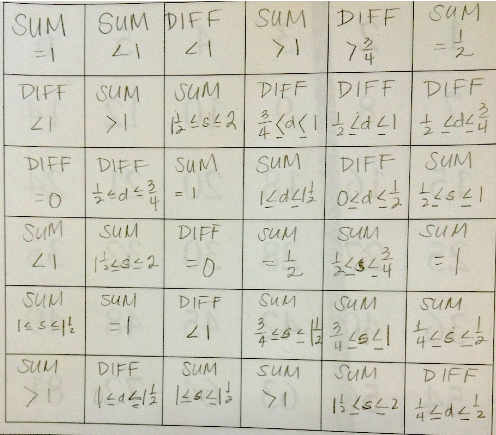
The fraction game is about addition and subtraction, modeled a bit on the Connect 4/Product Game framework. The board is really interesting, by asking for ranges, which really leads students to using representation (on the fraction cards we had). The teacher may want a way to get students to add precisely. I think there's some more playtesting to do here, too, as the placement of the various squares was more about coming up with them. 


Honeycomb Madness, unit conversion game. This is a classic board game, and the closest to being a general review game. You start in the outer ring, and are trying to get to the inner ring by answering questions. The ring level serves as a kind of rubric, though, and might support some kind of awareness in students as to different levels of understanding of the material. There's a nice bit of randomness that's reminiscent of Trivial Pursuit. I liked that it is not the kind of game I might design; I think it might be quite popular with students, too.


Arithmetic Sequence Game. This one is right up my alley, though. Deck of playing cards. Deal three: starting value, common difference, step number. That determines a target. Each player is dealt 5 cards, and tries to get as close as possible. Then the idea that complete changes it: you bet on your play, 1-6 points. Closest gets the points everyone bet. 2nd closest gets their bet back.  Wow. Plays great. I'll be trying this out, next algebra class for sure. I made a GeoGebra sketch to help with the calculation and to practice. 

Thanks to James and all the participants. I feel like I learned a lot about collaborating in game design, and broadened my tastes a bit, too. This more than ever makes me want to get students designing games, so if you're in the area and wouldn't mind a mathematician in the room...