Showing posts with label data. Show all posts

Tuesday, September 5, 2017

Top Ten Favorite Numbers

What numbers are the favorites of the people who have favorite numbers? I decided to ask on a lark, expecting a few responses, and it went crazy. (For my relatively quiet corner of social media.)

The idea had been bugging me since Joseph Nebus (who has a great weekly review of #mathcomics) linked to this comic from Cavna:
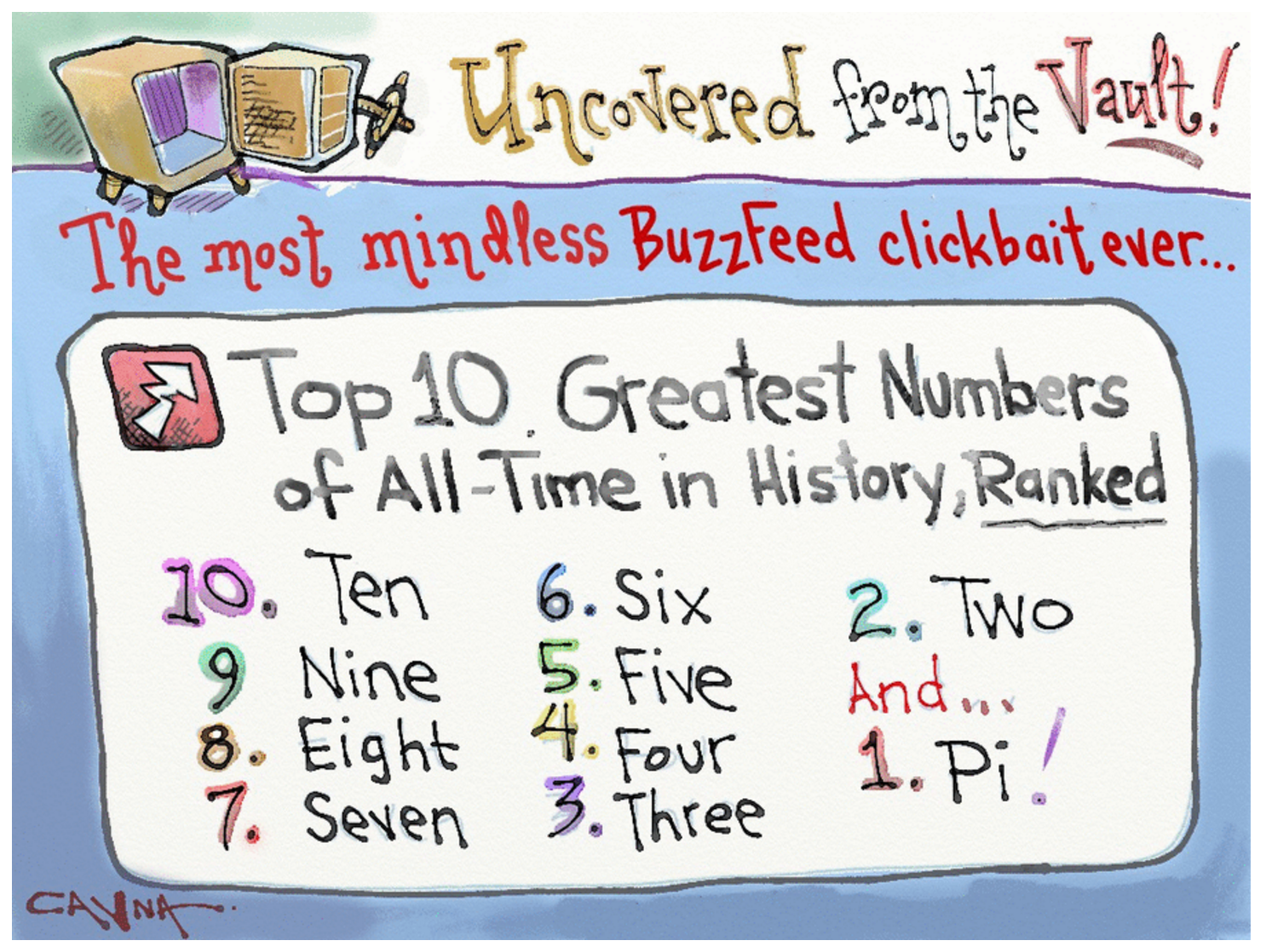
NO WAY are those the greatest, nor even the most popular. I can't even remember what tweet I saw that put this mild annoyance over the edge into asking out loud, but now I have a bunch of data on math teachers' favorite numbers.

This experience has taught me that our people care about numbers. They are more than quantities, they connect to ideas and stories.

Some things I noticed:

  • 18 is the first natural number not to appear.
  • Ironically, 2 is no one's 2nd favorite number, but is some people's 3rd or 1st favorite.
  • Having a symbol or name makes you a Big Deal number.
  • For about the top 20, number of mentions correlates to the Borda count (3 points for 1st, 2 for 2nd, 1 for 3rd).
  • No one loves negative numbers. Come on people. Transfinite numbers got more love.
  • 73 was the largest prime mentioned. Nope 163. Nope, 8675309. That number!
  • 6 was the last single digit to be mentioned. 
  • 42 did not show up for the first several hours, then stormed up in popularity.

I'm going to show this list to learners and ask them to think about why some of these numbers might be on here. In particular the larger numbers...

My top three (not included in the data) would probably be 4, 0, and Φ. 4 was my first ever favorite number. I explained to several adults how it was both 2+2 and 2 x 2. As a joke I'd get people to continue the pattern 2, 4, ... and if they said 6 I'd say 8 and vice versa. Little pain in the neck I was. (Except I was never little, as the family joke went.) 0 is the competitive spot. 10 - the first number to show place value? -1 - the huge discovery or invention? Something with a slick math history, like $sqrt{2}$, e, 1729 or 163? Something exotic, like Graham's number, a googol, or τ? In the end I have to go with 0. The digit that became a number, with cool Bahmagupta connotations. Փinally, the number about which I sometimes tell students that it was invented by my great, great, great grandfather. Even if there was no name connection, even if it wasn't so marvelously algebraic, even if I hadn't seen 3rd graders discover it through the amazing Fibonacci connection, I would have to pick it for the spiral connections.

The question elicited some great stories and tweets...


I can be pretty dense.


Bob Lochel shared this perfect kickoff to the top ten, from the show that made Top Ten a thing. Also, when asked early in my career for what I wanted to be like, I often cited David Letterman. I apologize to my students then, and to their grandchildren.


So from the home office in Grand Haven, Michigan,

Math Teachers' Favorite Numbers

10.  It's the answer to Life, the Universe, and Everything...


9. Not really...

8. Moving up one space,

7.  Lucky for us, lucky for you, this prime is one better than perfect. It's been up, it's been heavenly, it's been deadly, it is in 7th place with 7 points,


6. Often considered the first number, and still the...


5.  Pythagoras may have called this number the root of all evil, and it still gets a lot of hype. It is geometric and irrational, ...

4. Move on, folks.

Nothing to see here. Except the number that makes our place value system so craaazy good; Brahmagupta made it work. Often mistaken for a vowel, sometimes seen wearing a fashionable sash. Er, slash.

3. Fee or Fie? You won't fo-fum when you contemplate this 3rd place number, unless you go to the point where you're crazy and see it every where. Favorite of the Egyptians, the Greeks and God if you believe all the hype, it's....


2. Popular choice among mathematicians, who have denoted it after the greatest ever to be called one of their number. It turns up everywhere, and has all your base.
1. As surprising as Alabama football, we find here the number with not one, but two days dedicated to it. Half the number some claim it should be, but twice what it takes to be right. A great big slice oooooof - no. I hate pie jokes. And what's with everybody focusing on irrational, when it's transcendental?


If you want to dig more deeply, Carolyn Frye recommended the great RadioLab show on favorite numbers.

If you want to math more deeply, here's the data in a Google sheet. Thanks to everyone who participated, and sorry for clogging up your twitter feed.

I think sometimes I protest too deeply the stereotype that math is all about numbers. Maybe there are times to just go with it, and geek out.

Thursday, March 14, 2013

Turn Me Right Round

What makes for these mathematical mini-obsessions?

Whenever I put something up on 101qs.com, I make sure that I pose questions on
at least 10 posts from other people. (I also never skip. [So will I ever have questioned everything? #anyqs] Though for some it can be hard to find mathematical questions. [Orange.]) On a recent trip I saw Alex Shum's cool revolving door picture.


It reminded me of the problems where you're trying to take a sofa around a corner. (Which reminded me of my very first favorite screensaver, inspired by Douglas Adams, of trying to fit a sofa down a staircase.) Whatever the reason, I immediately wanted to make a GeoGebra sketch.

I made a first pass. That got me wondering how big are those openings? In particular, would a revolving door ever have and opening straight through like the one in the diagram to the left? (Seems to defeat the purpose of a revolving door.)


What are the standards for revolving doors? Thanks to Google and the International Revolving Door Company, I now know more than I ever knew I wanted to know.

In particular:
Data!

So much to wonder about these. I love the idea of describing circles as circumscribing a rectangle and it makes perfect sense for construction. But now I want to know about this data. What kind of function is it? Does it make it so the opening is always more narrow the one sector of the door? Is the angle of the opening from the center constant? How do you choose between a 3 wing and 4 wing?

First pass on the data was pretty curious.
Good for making the sketch, but weird. Why would the three wing doors have narrower openings?

GeoGebra sketch for
download or mobile applet
I made a weird little function to give the door openings, 2*radius (0.475 + 0.21 (doors - 3)), so that the ratio is .475 for 3 wings, .685 for four wings.

I liked the opportunity for modeling that this turned into, and it's also a good problem to show where modeling either supports calculation or is more efficient than calculations. Constructing the model in GeoGebra required data fitting, and some algebra to find the appropriate boundaries for the geometric objects.

And it helped me understand why 3 wing doors have narrower opening than 4 wing doors.

Thursday, October 18, 2012

Exponential Potential

It really struck me listening to Shawn Cornally in this week's #globalmath session on SBG (click on the Recording tab) how his perspective as a physics teacher leads him to approach his math lessons as experiments. Starting with an experience that makes us want to model or makes modeling useful is definitely the start of some of my favorite math lessons. (While I'm writing this he tweets: "Leaf-Blower soccer went over *really* well today in physics. (vectors, f=ma)")

Starting exponential functions with my preservice teachers, I love to use this lesson adapted from a 5th grade Math in Art lesson. (From my pre-blog webpage.) The idea is the multiplicative patterns present in a Sierpinski Carpet.


(Also in Word format if you want to edit.)

One of the interesting discussions in the initial exploration is the 9 or 17 issue. 9 squares if we count the number of squares as distinct shapes, 17 if we unitize to the smallest level square. For algebra students there's some good opportunities for equivalent expressions, regression and even deduction of function rules. This is a good opportunity for sharing how recording how you're getting your answer can be more powerful than recording answers. The 17, for example, is 1·9+8, then the next level is 9·(17)+8·8. But later, most write it as \( 9^n–8^n \) - which can lead to a pretty neat binomial expansion. Maybe even more interesting and accessible is the 9=1+8, so the next step is 73=1+8+8·8, and gives them a way to generalize this pattern besides recursion.

Once we get to the design your own carpet, there are so many new patterns to find. Here are some samples from this week:


Note that these last two aren't really Sierpinski patterns - but they still raise interesting patterning questions that are extensions of what we already noticed.

Probably easy to see why this is one of my favorite lessons. I also have seen the power of adding in places where students who have not traditionally been strong in math class can do amazing work.

The next lesson to follow up this one has some other opportunities to gather/generate multiplicative data.


It always strikes me how even college math majors find things to be surprised about in this data. Especially the penny balancing one. This class made some neat displays of their data - but I haven't taken the pictures yet. (Didn't know I would be blogging this, as I thought I already had! Maybe I was thinking of the quadratic simulations?) I'll add them at first opportunity.

First Opportunity:


Next we'll look at modeling this data symbolically using technology, and asking questions that raise the need for logarithms. Since, of course, every exponential data set is logarithmic when seen through the looking glass.