Saturday, April 23, 2011

Division into Decimals - Undone

This is a pretty focused game and it is undone.  Even the fifth graders couldn't help me finish it... maybe a reader can help?  We were playing Manga High games with my preservice middle school teachers this week, and they noticed something.  The context can be completely silly.  They liked "the penguin game" in particular.  They thought it was mathematically worthwhile, teaching estimation.  They found the problems worth doing in the game and felt like it could help students improve their estimation and computation.  But we never really have to chuck penguins to safety.


There's something appropriate to the context.  We're approximating, acting quickly, there's the idea of what fraction of the way across are we... but it doesn't bear much scrutiny.  It's just silly and a bit of fun.  I think that's an element missing from some of my practice games.

The Game
The game premise is complete simplicity: race from one end of the paper to the other (25 cm) by drawing rectangles with area = 10 sq.cm.  Each turn your rectangle is determined by rolling the width with 2 dice.

That's it.

The Lesson
I shared that we were playing a game that had no name and no context.  I needed their help.  Immediately they began shouting names and ideas.  If I were a game designer, I would do this.  Just get a bunch of kids and let them throw ideas at you.  Holy cow were they enthused and specific.  Sadly, I had to tell them I wanted ideas for this game, and we'd have to play it first.  Me versus the entire class, like we usually do.

I showed the graph paper and explained that the goal was to get to the top by drawing rectangles with an area of 10 sq. cm.  I drew a 1x10 rectangle.  But that wouldn't be very interesting. So instead we're going to roll the width of the rectangle.  I rolled a 2 and asked, "how tall should it be?"  A couple students quickly jumped to 5, so I drew it and we checked - there were 10 squares.  We rolled for them.

Aside: that worked well enough that I would fake a 5 if doing this again.  (Faking a 2 is greedy.)

Their roll - a 7!  That's how wide it should be, but how tall? "3!" kids are quick to say. Hmm - that makes for an area of 21.  "1!"  That's only 7.  "1 and a half!" Let's check.  They talk me through 1.5x7. (Not a few couldn't recall.) Hmm, 10.5, too much.  "1.4!" They walk me through that... so close! 9.8. "1.45?" We try it and get 10.15.  Wait, I say, aren't we really doing division?  What times 7 equals 10? We started an saw that 7 goes into ten once.  "It doesn't work," someone said.  Another student said, "add a zero!" I used the notation my son has been using, which I like.  We got to 1.428, and then realized that was close enough for drawing the rectangle.  "Is it point-4-2-8 repeating?" "Will it ever repeat?"

We finished our practice game, and recorded our calculations on the white board.  When they played for themselves (mostly 2 on 2, with a few 1 on 1's), they referred to the ones we had calculated, but had also several others that needed to figured out.

In the summary, they thought the game was fun enough to play, and had good math.  25 cm made for about the right length of game.  (Hah!) They really got into trying to come up with a context. REALLY.  "Monkeys climbing!" "Monkeys escaping from sharks!" "Tiger sharks!" "People escaping from sharks!"  "You're escaping evil aliens."  "It's an alien trying to climb to the moon!" "It's ..."

OK... it should connect somehow to what we're doing.  I see why the climbing.  But why sharks?  Where is the shark chasing?  Could it connect to what we're stacking? What would you stack that has different sizes? "Students escaping an evil teacher by stacking homework!" "Books!" 

OK... maybe the game remains undone.  Maybe it should be unfinished?

Reflection
The game made a good context for modeling the division on which they needed practice.  The representation of the rectangles was supportive.  We talked about the connection between 10/2 and 10/4, for example.  They got the indirect variation aspect of it, and were rooting for small numbers for themselves and large numbers for me.  The familiarity with common division computations was good.  For such a vanilla game, it might be a nice aspect to keep it vanilla, and keep the game design aspect to the lesson.

If I was developing this into a video game, the subsequent levels would introduce some variability of the dividend also.  I also think you could have kids estimate the division.  If they overestimate, no block.  Increased decimal places would get you farther faster.  One variation that I ruled out was to have the game be a race to 2.5, so that the kids were dividing 1 instead of 10.  But then the area is .1 sq. units - not nearly as intuitive.  My next lesson would be how you can use these results to get at other computations, and to strengthen that multiplication connection.  I'm convinced that 99.9% of kids do not see the partial product connection with the division algorithm.

My 1cm graphpaper (pdf) is at Scribd if you'd like it.

Sunday, April 10, 2011

Twitter Conditions

I had the good fortune to win a bet recently (well, best 2 out of 3) by the performance of the Yukon Huskies (jk) in the 2011 NCAA Division I men's Basketball Tournament.  My prize? A guestpost from Dave Coffey, @delta_dc.  (I was actually rooting for Butler, but that's a quality consolation prize!) This is Dave with Juneau.  Juneau is asking, "How could you bet on bulldogs?  Have I taught you nothing?  Haw!"

A few weeks back, one of our teacher assistants said, “You just started on Twitter this semester. I never would have guessed.” I wasn’t sure if she was talking about my quantity or quality. I chose quality and explained that it could be traced to Cambourne’s Conditions of Learning (a Foundational Framework of our Teacher Assisting Seminar).

This reminded me that John, my co-teacher, had asked me about blogging about the Conditions. I turned to him and said, “I’m thinking about writing about how the Conditions of Learning helped me to communicate using Twitter.” I thought this would be a good example of authentic learning in action.

The teacher assistant chimed in, “Maybe you could describe each condition in a Tweet.” John laughed, understanding that she had issued me a challenge without knowing it. Well, “challenge” accepted…

[Note from John - t was very tempting to put this in twitter-typical reverse order... but that would make it less readable.  Please forgive the lack of verisimilitude.]


Thanks, Dave and Jim Calhoun! And Brian Cambourne, of course.  The Reading Teacher has put the article introducing the Conditions online for download.  Or you can read the whole story in his book The Whole Story.  Also, I put the date on the cartoon at '95, the date of the RT article, but 1988 would be more accurate.

Photo Credit: Kathy Coffey, Rosaura Ochoa @ Flickr

Tuesday, April 5, 2011

Sites, Gadgets and Widgets

Warning: entirely a novice.  Trying to give that perspective on using these tools.

My university, Grand Valley State University, is in Michigan, a famously economically hard-pressed state.  Much like Wisconsin, any kind of education funding is suspect and under inspection.  We have think-tanks requesting faculty emails, and newspapers and TV stations soliciting financials.  (The financials are public info - no worries.  The emails - creepy.)

We got an email from the administration with some information to contest the spin being put on the data, and I started wondering about making it a webpage.  So I used it as a chance to practice with Google sites, embed a Google spreadsheet, and a Wolfram|Alpha widget.  Unfortunately, you can't embed a W|A widget directly, you have to wrap it in a Google gadget, then embed it in the site.  This site was very helpful, and the whole process boiled down to pasting the W|A javascript code in the Google gadget builder. I was using the builder at this page, just adapting their most basic example.


The W|A gadget was pretty easy to manufacture, following their steps.  After entering a request, you'll see options for sharing.  The far right W|A sigil starts the widget builder.


The thing that took me the longest to get was just me being dense.  To get at component properties, select a component in your proto-widget.  And then the settings will show in the bottom left.


Then to get the embed code to paste in your blog (will work directly) or to put in the gadget to put in a google site, click on the code button in the embed box on the finished widget.


The (sort of) finished project is here: Facts and More: How does GVSU stack up?

And, of course, I'd happily take any suggestions for improving that page. 

Thursday, March 31, 2011

The Man Who Counted

The Man Who Counted is an enchanting math story book.  Originally published in 1949 in Portuguese (O Homem que Calculava), it was presented as a translation of a 13th century (Islamic calendar?, 1942 CE, maybe?) work by Malba Tahan, who is typically listed as the author, translated by Breno de Alencar Bianco.  Both of whom are fictitious.  The real author seems to be Júlio César de Mello e Souza from Brazil.

A student in Calgary gave me first copy, correctly deducing that I would LOVE it.  You can find a pdf of the entire thing online, and the copyright is complicated enough that I can't figure out if it's legal.  There's a current publication of the book, too, and it's a nice one to have.
All this is by way of introduction, as one of our promising preservice teachers, Cassie Becker, wrote up some very nice problems from the book, and was willing to share them here.  She did this for a choice workshop, where students have freedom to follow up or pursue an item of interest.  In general, I find that the students make amazing choices.

The Man Who Counted
(Chapters 1-9)

Beasts of Burden
Close to an old half abandoned inn, we saw three men arguing heatedly beside herd of
camel. Amid the shouts and insults the men gestured wildly in fierce debate and we could
hear their angry cries:
“It cannot be!”
“That is robbery!”
“But I do not agree!”
The intelligent Beremiz asked them why they were quarreling.
“We are brothers,” the oldest explained, “And we received thirty-five camels as our
inheritance. According to the express wishes of my father half of them belong to me, one-
third to my brother Hamed, and one-ninth to Harim, the youngest. Nevertheless we do
not know how to make the division, and whatever one of us suggests the other two
disputes. Of the solutions tried so far, none have been acceptable. If half of 35 is 17.5 if
neither one-third nor one-ninth of this amount is a precise-number, then how can we
make the division?"
“Very simple,” said the Man Who Counted. “I promise to make the division fairly, but
let me add to the inheritance of 35 camels this splendid beast that brought us here at such
an opportune moment.”
Can you explain why this would be a good idea?

Food for Thought
Three days later, we were approaching the ruins of a small village called Sippar when
we found sprawled on the ground a poor traveler, his clothes in rags and he apparently
badly hurt. His condition was pitiful. We went to the aid of the unfortunate man, and he
later told us the story of his misfortune.
His name was Salem Nasair and he was one of the richest merchants in Baghdad. On
the way back from Basra a few days before bound for el-Hillah, his large caravan had
been attacked and looted by a band of Persian desert nomads, and almost everyone had
perished at their hands. He, the head, managed to escape miraculously hiding in the sand
among the bodies of his slaves.
When he had finished his tale of woe, he asked us in a trembling voice, “Do you by
some chance have anything to eat? I am dying of hunger.”
“I have three loaves of bread.” I answered.
“I have five,” said the Man Who Counted.
“Very well,” answered the sheik. “I beg you to share those loaves with me. Let me
make an equitable arrangement. I promise to pay for the bread with eight pieces of gold,
when I get to Baghdad.”

Then Salem Nazair said to us, “I take leave of you my friends. I wish however to
thank you once more for your help and, as promised, to repay your generosity.” Turning
to the Man Who Counted, he said, “Here are rive gold pieces for your.
To my great surprise, the Man Who Counted made a respectful objection. “Forgive
me, O Sheik! Such a division, although apparently simple, is not mathematically correct.
Since I gave five loaves, I should receive seven coins. My friend, who supplied three
loaves, should receive only one.”
“In the name of Muhammad!” exclaimed the vizier, showing a lively interest. “How
can this stranger justify such an absurd division?”
Each piece of bread was divided into three portions and each man ate an equal portion of bread. Can you justify this division?

The Four Fours
“Did you notice that this shop is called The Four Fours. This is a coincidence of unusual importance.”
“A coincidence? Why?”
“The name of this business recalls one of the wonders of calculus: using four fours, we
can get any number whatsoever.”
Can you make 2,5,17,26,34,91,135, etc using only four fours?
dweekly @ Flickr

Going to Market
And the shopkeeper told the following “Once I lent 100 dinars, 50 to a Sheikh from
Medina and another 50 to a merchant from Cairo.
“The sheik paid the debt in tour installments, in the following amounts: 20, 15, 10 and 5 that is
Paid 20 and still owed 30
Paid 15 and still owed 15
Paid 10 and still owed 5
Paid 5 and still owed 0
Total 50              Total 50
“Notice, my friend, that the total of the payments and the total of his debt balance
were both 50.”
“The merchant from Cairo also paid the debt of 50 dinars in four installments, in the
following amounts:
Paid 20 and still owed 30
Paid 18 and still owed 12
Paid 3 and still owed 9
Paid 9 and still owed 0
Total 50            Total 51
“Note that the first total is 50—as in the previous case—while the other total is 51.
Apparently this should not have occurred. I do not know how to explain the difference of
1 in the second manner of repayment; I know that I was not cheated, as I was paid all of
the debt, but how to explain the difference between the total of 51 in the second case and
50 in the first?”
Can you explain to the shopkeeper why this happened?

Pennington @ Flickr
Seventh Heaven
The sheik addressed the three of them: “Here is the esteemed master calculator.” And.
to Beremiz he added, “Here are my three friends. They are sheep rearers from Damascus.
They are facing one of the strangest problems I have come across. It is this as payment
for a small flock of sheep they received here in Baghdad, a quantity of excellent wine, in
21 identical casks:
7 full
7 half-full
7 empty
They want to divide so that each receives the same number of casks and the same
quantity of wine. Dividing up the casks is easy—each would receive 7. The difficulty, as
I understand it is in dividing the wine without opening them, leaving them just as they
are. Now, calculator, is it possible to find a satisfactory answer to this problem?”
Can you find a solution to the problem?


Three and Thirty
“Your total bill, with your food, is 30 dinars,” was the reply. Sheik Nasair wished to
pay the bill, but the men of Damascus refused, which led to a small discussion and an
exchange of compliments, with everyone speaking at once. At last it was agreed that
Sheik Nasair, a guest, should pay nothing and that each of the others should pay 10
dinars; so 30 dinars were handed to a Sudanese slave for his master. A few moments
later, the slave returned and said, “My master says he made an error. The bill is 25 dinars,
and he has asked me to return 5 to you.”
“That man of Tripoli is most honorable,” remarked Sheik Nasair. And taking the five
coins, he handed one to each of the three men, so that two remained. After exchanging a
“lance with the men from Damascus, the sheik handed them as a reward to the Sudanese
slave who had served them food.
At that moment, the young man with the emerald rose and, looking gravely at his
friends, said. “This business of paying over the 30 dinars has left us with a serious
problem.”
“Problem? I see no problem.” replied the sheik, astonished.
“Oh yes.” said the man from Damascus. “A serious and seeming ridiculous problem.
A dinar has disappeared. Think now. Each one of us paid 9 dinars. Three times nine is 27.
Adding to these 27 the 2 that the sheik gave to the slave, we have 29 dinars. Of the 30 we
handed over to the man from Tripoli, only 29 are accounted for. Where, then, is the other
dinar? Where has it disappeared to?”
Can you explain to the men where the 30th dinar went?

Tuesday, March 29, 2011

Engagement with a Purpose

Trying to document our senior student teacher seminar. Lesson by Dave Coffey, (@delta_dc, Deltascape)

Dave’s quote for the day:
You must be the change you wish to see in the world. – Mohandas Gandhi

We watched part of Alan November’s TEDxNYED talk (picking up after the barbershop, about 6 min in):


What do the novice teachers notice?

Overheard snippets:
I’ll do extra work all the time. Write a letter…
Empowering students…
Present the idea of what they are learning…
Could give them a topic, send them to research, and what do you get.

Whole class discussion:
A student shares: I’m at a progressive school, and it’s hard to think about going back. The book isn’t example, example, exercise. They’re an idea, a goal, an objective, and then it’s an investigation. The problems guide you through finding the information about the topic. The parent would have to do the whole investigation to help. I did a demonstration of communicating what you’re doing, and then the students were responsible for being able to do that. Putting the work on the students is what we’re doing, and we’re there to guide them.  On the test had a check question and 19/20 had the quadratic formula right.

Q:  What’s a way for this to work in another classroom?
Dave wonders about:
Platform Audience Purpose
class blogs Parents here’s what we’ve been doing
class blogs Peers here’s what you missed
letter ... ...

Student response
  • Home or class work? Up to you.
  • Thinking of students that don’t have access to a computer… we had a designated note-taker. If someone missed they could copy.
  • Saw a student teacher have learners come up to be a scribe.

Not about can do or can’t do. About can do and not yet.

One student opines:  I wish they’d say this in their videos. They come off as you have to change everything. He mentioned that students say they’ll do things for their fiends, and I will, too. But is that what you want from me as a student? But if it was just me, I wouldn’t do this portfolio. (No offense.) To totally allow students to do what they please. “It’s so nice, it’s a great metaphor…” But in reality it’s crazy. Are you kidding?

The teacher of the JK Rowling fanwriter said – she’s not a good student. Could the teacher meet her halfway? There are probably things desired for her that are not met by writing like Harry Potter.

Teachers are more important than ever, to provide that structure.

by Priki @ Flikr
A student shares:  I covered triangles and they constructed definitions, and classifications. Homework was a brochure or a puzzle. Had to have name and properties and a picture for each kind. Non-homework doers was cut in half. Next day quadrilaterals. They could make a bumper sticker or a questionairre for interviewing a quadrilateral. Ask questions, but you can’t ask the type. Again the majority of kids turned that in.

What is working? What isn’t working? What will increase engagement? This example had choice, a framework, a purpose…

We then offered a choice to work on portfolios, presentations, or cooperatively planning engaging lessons.  No one chose the lessons, with so much hanging over there heads.  (A mini-lesson for us.)  Still, it was a lively discussion and helped us process Dr. November's TED talk.

Saturday, March 26, 2011

Learning Math Anchor Charts

Anchor charts are a way to summarize learning that you wish to preserve, build from, or be able to reference.  While they started out in my classroom as lists or concept maps, students building from previous students' work have started edging into metaphor territory as well.  I had the camera with me to capture the charts, and the students wanted to present them, so I taped it.  I think it would have been more valuable to capture them working on it.  The worked very intently, quickly going from "what does he mean?" and "what did we do about this?" to debating relative importance and discussing key features.  Very cool.

The research they're referencing includes:
The video with the students explaining their posters is below the poster images.


This is a solar system model - a little hard to see. They had fun developing the metaphor and the extending it. Used the idea of earth, other planets, the sun, constellations to all symbolize different roles.


(Students knew they were being taped for publication, and had a later chance to withdraw.)

Friday, March 25, 2011

Product Game... again!

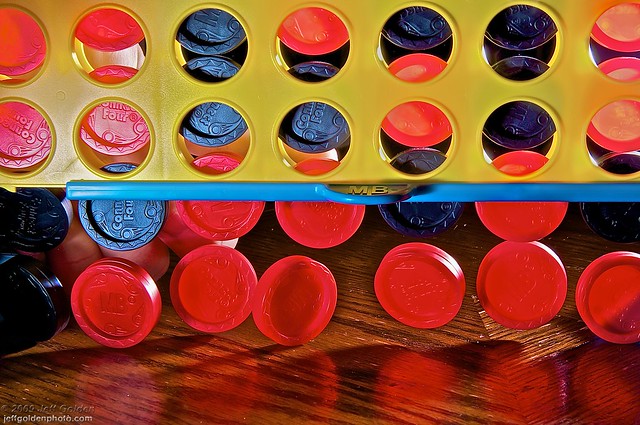
It is no secret to my students how much I love the Product Game.  It is fun, not just fun for, you know, a math class.  The strategy required is at least as good as Connect Four, which is a surprisingly deep game.  The practice value is huge, as students have to compute many, many more products than would ever be done on worksheets.  The mathematics has connections, as the products lead to factorization, which enhances the strategies available.  But even the pedagogical structure is nice, as you consider moving one factor leads to considering families of multiples that are good for learning multiplication facts in a way that promotes fluency and efficiency.  The first I saw of it was from the Middle Grades Mathematics Project, the precursor of the excellent Connected Mathematics Project middle school curriculum.  (Which still has the game.)

So I love to adapt it.  It's never quite as good as the original, but often the great structure of the original allows new features to come to light.  Here's a previous handout that has the original Product Game and and Integer variation.

The fifth grade class I'm working with is beginning multiplication of decimals, by considering whole number times decimals that include tenths.  They're starting the whole counting up the decimal places routine, without much though of unitization.  If you have 5 bags with 4 apples each, you've got 20 apples.  If you have 5 groups with 4 tenths each, you've got 20 tenths... it's just that we don't often look at 2-point-OH as 20 tenths.  With my class I'd be looking for a context to start at this - probably money.

This class expects games from me, though.  I thought we had played the product game already (that was last year, Mr. Golden!) - oops.  In this version of the game, there's markers to make for your team.  I didn't have my usual two color counters available, but I've also learned that making markers or game pieces is a point of engagement and pride for some of the students.  Others are content with a quickly scrawled initial, and that's okay, too.  Mr. Schiller set a time limit of 3 minutes for making your markers, which was a good idea and the right amount of time.

We were to start by playing me vs. the class, so I could model some of the multiplying strategies I wanted to share.  But my son made me some excellent University of Michigan and Michigan State markers, and, being a proud alum, I had to be State.  There were students who couldn't bring themselves to being on U of M's team, and how could I argue?  So we played Spartans vs. Wolverines.


Product Game Decimal


The group play got us through all the rules and allowed us to model a lot of the whole x tenths.  But we never got up to the hundredths.  So we discussed how to get those.  I think they knew on some level it was tenths times tenths, but had a bit of the 'we haven't been taught this yet' syndrome.  I used the analogy of a dime being a tenth of a dollar, so what's a tenth of a dime? "A penny!" And what part of a dollar is a penny?  How many does it take to make one dollar?  It is terrific that they are used to seeing one cent written as .01

It was interesting seeing them play.  They started out almost entirely in whole x whole, and then were forced to the whole x tenths by the game play.  And if the game went on long enough, to the hundredths.  Several people got calculators to explore this, and a couple got to the calculators and then beyond them in the space of the hour.  Some students were done with the game after one session, but others were definitely up for more.  Hope you get a chance to try it and get a little bit addicted.

Photo credits: From Flickr, jeff_golden, 24oranges.nl and fireflythegreat.