Friday, February 28, 2014

Math and Inequality

Got this email, and I'm wondering how a math educator should respond:
Dear Colleague,

A teach-in is being planned for the purpose of mutual education among students, faculty and staff of the GVSU community.  The teach-in is designed to address topics related to inequality and systems of oppression, as well as social justice and liberation.  Recognizing the multi-faceted dimensions of these topics, we are planning this teach-in as a day-long event.

The details are as follows:
Date:                     Wednesday, March 26th
Time:                     8am – 10pm
Location:              Exhibition Hall, Mary Idema Pew Library  (Room 040)

The learning objectives of the teach-in are to raise awareness, share knowledge, and create dialogue.  Therefore, in an effort to involve as many students, faculty and staff as possible, we will be adhering to the MWF class schedule, with the possibility of fourteen 50-minute sessions, each starting on the hour. 

We hope that you will attend as many sessions as your schedule allows and encourage your students to attend.

If you’re interested in taking a more active role, you’re encouraged to work with other colleagues around campus to propose a 50 minute session. Please keep in mind that a teach-in is practical, participatory and action oriented. We especially encourage contributions with an intersectional framework (race, class, gender, sexuality, religion, ability, etc.).  Sessions may include student leaders as co-presenters or panelists.
I love that the university is doing this. Will you help me brainstorm how to participate?
I have an intro to math class, and a grad class on secondary math education issues that meet during this time.

Thanks for any ideas!

Lucky Duck is a recurring character
in Tom the Dancing Bug by Ruben Bolling


Tuesday, February 25, 2014

Capstone Book Club

One of the courses I'm teaching this semester is a capstone course for our majors. Rather than me picking the book, I let them choose from a list that the Math-Twitter-Blog-o-Sphere helped me put together. Last summer, The Mαth Book and Joy of X were the big hits, this semester, they made some very different choices. (Here's the list and their choices.) Having them choose makes me feel a little less like this:


My notes of the discussion, with links to some of their blogposts. Since they're notes of a discussion, pretty terse. Also, not my point of view, this is the students'. The people who got the most new students interested in their book were those reading The Mathematician's Lament and e: the Story of a Number.

Euler: Master of Us All. History at HS level, proofs at graduate school. Felt outclassed reading it. Simplify or explaining the proofs would have helped. Averaged a paper per week. Very dense.
Review: Alex

Visions of Infinity. Each chapter is a different idea, then has history and the author explains the important proofs about the idea. How mathematicians think vs what they thought about. Eg. squaring the circle, explained why you couldn't do it. Was advanced, but not frustrating. Recommend it to someone who knows about math. Last two chapters… where math is going. Strongly the author's point of view.
Review: Kristine, Emily

The Math Book: one discovery per page. Good if you like quick little synopsis of many topics. Different big discoveries. Learned a lot of little things, but so rudimentary in some places. There were some over your head, too. I would recommend it. Gives sources to dig deeper. Easy to make connections. Biased towards white Christian males.
Pro reviews: Kenton, Erin. Con review: Brittney
Journey through Genius: history, picks important results and proves them. No non-western mathematics. Tries to justify why no islamic mathematicians but comes across as a cop out. The Greeks asked why, but the Egyptians were satisfied with just working. Did give a personal view of the mathematicians. Recommended to people who want to get to know the mathematicians well.
Review: Biz looks at it from a multicultural perspective.

Accessible Mathematics: 10 instructional shifts. Works with field experience, works with math ed classes, what happens when you don't use these. Multiple representations, number sense. Good to examples and non-examples. Recommended to anyone going in to teaching or to teachers who need to change.
Review: Danielle, Becky, Keegan

Concepts of Modern Mathematics: overview of the math classes you have to take here. Like 310, statistics, history on those areas. People who have made significant work in that area. Some new to us, like topology. Pretty dry and boring. First chapter was the peak, then funniness ran out. Long lines of equations. Not a bad book for someone in 210, to know what's coming, but then it would be hard to understand. Examples are pretty simple - maybe even dumbed down. Pretty dull read. Good at explaining ideas like 1 to 1 and onto. Large scale review.
Review: Bryce. Killer line: "Mr. Stewart slowly became less of my friend who I wanted to hang with and more of a dreaded professor whose class you have to sit through every week."

Godel Escher Bach. It's about cognitive science, psychology, computer science, math. The Godel part is the most on math. You think because you are, but you have to be to think. Need a lot of time to dig in. Hurts to read, in a good way. Challenges the way you think. Connections with taoism and Buddhism. Isomorphisms and symbols… uses all these metaphors. Kind of like A Brief History of Time by Hawking or The Elegant Universe by Brian Green.
The Joy of X. Goes from things people have been told is true to why they're true. Negative times a negative, infinity… goes further at the end.
Short review but long notes: Jennifer
Sensible Mathematics, sister to Accessible Mathematics. Written more to administrators than to math teachers. Why it's good to have students explore more. Convinces teachers and parents to go with modern views of learning and teaching mathematics.
Review: Kerry
Love and Math. Hard to understand because it's so into physics. His life story is interesting, discrimination against Jews in Russia as a backdrop.
Kate's review says that you should like physics and math to pick up this book.
The Mathematician's Lament. Talked about how math is an art. It's about discovery, and we need a big do over in education. We're just handed formulas, not told where they're from or who made them. Can't teach teaching. Recommend to any future teacher.We take away the art of math.
Powerful review from Sara.
e: the Story of a Number. I didn't know where e came from. That's why… the math amazes me more. Everything I learn unites math more. This book did that and combined it with physics, through the number e. Pascal's triangle, derivative of e^x is itself. My optics class is about that. The challenging thing the author had to face. Pi could fit in a few pages, but e, there's no place where it came from. Napier and his tables, and how logarithms require e; when you extend to continuous cases… Book does a good job of balancing history, different contributions. His jumps are really strange and don't make sense until you finish reading. Balances history with math, saves all the proofs for the appendix. Bernoulli's conversation with Bach about the space between notes, a logarithmic increase... that was amazing.
Review: Duncan
There wasn't a whole lot of discussion in the whole class setting, but the individual discussions among students who read the same books were deep and intense. Even the group of people who all had read unique (in our class) books.

What do you think of their reactions? Any disagreements? Is there a new book in which you're interested?

Wednesday, February 19, 2014

Followers Beware

Smarter Balance has released several items for the fast approaching Common Core assessments. One really caught my eye as a dynamic context: safe following distance. I can't find a way to link to the specific item, but it is #43060 at http://sampleitems.smarterbalanced.org (CCSS: F-BF.1a, F-LE.1b). The sketch is on GeoGebraTube, as well.

How far should you drive behind the car in front of you?


GeoGebra notes: With the spirit of Jennifer Silverman hanging over my shoulder, I got real car images to use. The trickiest thing was sizing the images to look right since the scale was not 1:1. I like the flexibility of looking for feet (sigh, USA) or for car lengths or for time separating the vehicles.

The actual assessment question:
 Pretty complex problem, as illustrated by the rubric:
Just a quick post to encourage you to think about using some dynamic visualization with your math work. Many of the released items have a little gif like animation instead of text.

Sunday, February 16, 2014

Fibonacci Week: Spiral Curriculum

We were discussing Leonardo of Pisa, Filius Bonacci, this week in class, and despite it being the least of his accomplishments, THE sequence always comes up. I finally wised up and, rather than fight it, separated out the sequence stuff into a day of its own.
Our Agenda:
  • The original puzzle
  • And Pascal, too?
  • Spirals & Golden Ratio: what is going on?
    • Vi Hart awesomeness: Part 1 of 3. WATCH at least part 1.
  • Extensions

Puzzle
The puzzle appeared in Fibonacci's momentous The Book of Calculation. In addition to lots of fine mathematics, examples of calculation algorithms, and applications, it has entertaining puzzles and activities. One of these was deeper than he could know.
“A certain man put a pair of rabbits in a place surrounded on all sides by a wall. How many pairs of rabbits can be produced from that pair in a year if it is supposed that every month each pair begets a new pair which from the second month on becomes productive?”
The students were awesome with this. They knew the sequence already, of course, but did a nice job fitting the sequence to the situation. What impressed me were their objections. What if the rabbits weren't split males and females? What about mortality? What about that rabbits can be pregnant with to litters at once? (Impressive. Turns out they can conceive the day they give birth, also impressive, and giving credence to LoP's 1 litter per month.) Also a student who tried to think about all possible pairs. Just good math thinking. The emphasis I tried to convey was making sense of the two representations: the tree diagram that helped most make sense, and the usual expression of the sequence summing two terms to get the next.

Pascal
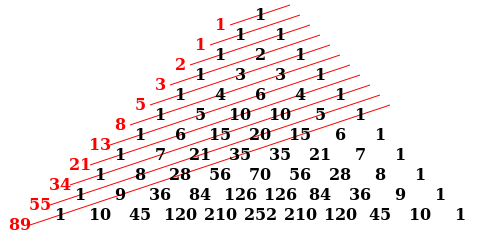
I love that the sequence shows up in diagonals of the other mystical math favorite: Pascal's Triangle.I challenged the students with the more important question: why? They both have the add two to get one idea - is that related?
(This image from mathispun.) Does anyone know ow to phrase a probability question that brings up this relationship?

Spiral
Ever since Susan Walborn and I did this with 5th graders for the Math in Art festival (art connection: Mondrian) I have loved this. It so naturally ties in with the near similarity, and then the fabled Golden Ratio.

One of the things I love is how fast the sequence converges even if you don't start with a square. Start with a very non-square 1x10 and ... well, just look. You can play with the spreadsheet on Google docs.


If you're talking Fibonacci Spirals, you have to watch some Vi Hart. They were properly amused and impressed.

Lastly
Explore on your own, of course. Ideas:
  • explore one of the connections
  • look into closed form generation of the numbers
  • explore golden ration connections
  • make Fibonacci themed art (Jennifer Silverman or a skyscape)
  • Prove a Fibonacci Proposition

Extra:

People tried more with the spiral, including on isometric dot paper.  Some played with the sequence and ratios.

Some tried to prove the provided propostions:  (senior math majors)
My extension
I was interested in the spiral, too. (It's a minor obsession.) One interesting thing is that it is an approximation of the Golden spiral (the logarithmic spiral built on Φ), but it has a beginning. However the Fibonacci sequence extends backwards, ...8, 5, 3, 2, 1, 1, 0, 1, -1, 2... so what would that look like for the Fibonacci spiral?

I made a tool in GeoGebra for adding arcs and the center of the next arc for a spiral growing counter clockwise without too much trouble. But it was hard to find a way to do the backwards step that was robust. I wound up going with a vector approach instead of geometric, to better simulate those alternating terms going backwards. It made for some pretty interesting curves!
This gif is showing the same curve depending on the starting ratio of the first two steps. 1:1 to 2:1. Sometimes you get cycles - that's what those four petal flowers are: like 0, 2, 0, 2, ... If you want to play with it yourself, the tools are in this sketch on GeoGebraTube. (Sometimes tools don't work well in the student worksheet and you have to download the .ggb file.)
 

I also fooled around to make some art for myself. That's in a Tumblr post.

Thursday, January 30, 2014

Don't Pay the Ferryman

I love story problems that look like they don't have enough information but they do.

The Futility Closet, an excellent source of puzzlers, had a beauty today. I wanted to dynamicize it to make a visual, and to allow for new numbers and a mechanism to provide for guess and check strategies. Here's the applet, which is also on GeoGebraTube.


What makes this solvable?

I have older sketches of two other problems, an escalator problem, via Bowman Dickson, and a burning candle problem, originally from NRICH.

Does the visualization add to the problems for you? Or does it not make a difference? Do these kind of problems engage you? I do worry about the frustration barrier with these, and am interested in how you might scaffold them.

The GeoGebra was fun. The most complicated piece was building a piecewise function that modeled the movement of the ferries. After the numbers are randomly generated, the sketch has the times for the ferries to cross, and then it's a point-to-point parameterization modified with graph transformations. It was fun to figure out as it took a lot of wee algebra bits to fit together.

The title is a nod to this Chris de Burgh song from the heyday of music videos.

Wednesday, January 29, 2014

Making Competition

One of the benefits of a college teaching job is the constant stream of high energy, bright, creative students with oodles of initiative. But it can keep you busy.

Math-Team-Matics is one of those things.

Andrew Otten and Sarah Jamison, two preservice teachers graduating next fall, came by with an idea for a math competition. They had seen the competition at Grand Rapids Community College for 9th and 10th graders. It's a little ironic as I am not competitive myself (though we had a big family discussion about this recently) and spend most of my time thinking about how to support struggling students. In addition to supporting Andrew and Sarah I thought it would be good for me to spend some time thinking about the other end of the academic success spectrum. Plus there's a bit of the game aspect to this - something I'd love to increase in future years of the competition.

In addition to Andrew and Sarah, who also provided most of our ideas on what the events should be, the key players on the Math-Team-Matics-Team were:
  • Chelsea Ridge, Regional Math and Science Center math coordinator. Great organizational skills and administrative support as well as event design.
  • Karen Novotny, full prof in the math department, amazing math knowledge, teaching and problem design.
  • Ruth Meyering, affiliate instructor in the math department, former high school teacher and coach of math competition teams. She was the last person to join of this group, but her experience with the competitions helped immeasurably.
All of us and several great student volunteers put in a long, hectic day on the competition to make it a reality. In designing the event, we put a lot of thought into making it an actual team event. Our lack of familiarity with the existing competitions led to some nice variation on how they usually proceed. The competition was open to 7th to 10th graders, but the content was open through some high school geometry.

Volunteer needed to try out this problem herself.

First Event: Team Challenge
Karen came up with this problem and next year's possible team challenge in 20 minutes of brainstorming. We knew this was pretty stiff, but wanted to come up with somethingthat they would need teamwork to do. Many students had not been exposed to isometric drawing and - as Ruth warned us - geometry was a challenge throughout the day. The staircase pattern can often be one of those problems that people either know because they have seen before or find it a stumper.

PDF directly

Second Event: Individual Test
How do you make this about a team? Andrew, Sarah and Ruth saw this as essential and a key part of other competitions. So we made the scoring a bit novel: drop the high and low score for the team. But to include the benefit of having an exceptional individual performer, also add a team score that awards a point for each problem that someone on the team got right.

PDF Directly

Third Event: Relay Race
Ruth runs a relay with coach cooperation.
I had never seen a structure like this before. One student does a problem, then hands back a numerical solution that is needed in the next problem. Ruth helped me understand these with a bunch of relays she uses for review in her algebra classes.  There's no need for the problems to be connected, but obviously it's more aesthetically pleasing if they are. I was particularly fond of the number-themed set here, as students think numbers are the simplest. However, these were the problems with which students struggled the most, and I learned that they should scale in design and complexity. Next year these will be easier overall, and gauged to make the most of the different amounts of time students on the team have to work.

PDF Directly

Fourth Event: Quiz Bowl
Waiting to steal.
(Psssst, it's Archimedes.)
There was a bit of a panic with these, as the slides were made up to use Classroom Response System as buzzers, which then did not work with the classroom computers. But here is where the coaches and teams proved their kindness and good spirit: they helped us determine a system of hand thumping to determine who had responded. Though I had arranged a Swiss structure (like chess or Magic tournaments) I had neglected to include tiebreakers! The points for this round were too swingy also, so we're modifying for next year. Winning three quiz bowls was pretty much a guarantee of making the finals. Since that was also quiz bowl - quite an advantage. Andrew got some old fashioned proper buzzers working for the finals, and that added a lot. As well as having all the players and parents to watch.

Top two teams in the younger Division 1 finals.
Since we originally didn't know if students would be age-mixed, as we didn't know how many teams to expect, we designed these to be mostly asked in turn, with a chance to steal if the team answers incorrectly. That worked pretty well, and will probably be a keeper. (Also be careful with these questions - there were some incorrect answers on the key (!) and I'm not sure they all got fixed.) People were doubtful about the Sometimes/Always/Never questions, but they inspired a lot of student reasoning in practice. There's also some math history here. These were tough, even though I tried to write those Jeopardy style where the actual question was distinct from the historical tidbit. We have a culture, people!

PDF directly

We're definitely interested in feedback, but since Math-Team-Matics 2 will be November 8th, 2014, it's even more beneficial than usually. Suggestions and questions, please!
And if you're anywhere nearby, we'd love to see you there! 

Division 2 Camps and Runners Up from the same school?
People will be gunning for Coopersville next November.

Friday, January 17, 2014

Geo-Albers-a


On Tumblr today, geometric aesthetic had this innoculous little image...

Wow. These are so elegant.  But there were no notes! What are these from? Google image search found this composite image all over, but also tipped me off that this was Josef Albers, a (literally) Bauhaus artist who moved to the US in 1933 (when the Nazis closed the Bauhaus) and became one of the 20th century's most influential artists (geometric abstract) and educators. Check out his quotations, frothing over with wisdom.  As much as I love art, there are these huge, gaping holes in my art education... I was even mooning over some of his paintings in the last year at the Hirschorn Museum in Washington! (By the way, the Hirschorn had a great retrosprective exhibition on Albers, and still has a lot online.)

The piece in the bottom left, ‘Structural Constellation, Transformation of a Scheme No.12′, particularly got my GeoGebra-juices flowing. (I found a nice image of it in a nice ArtBlart blogpost covering the Hirschorn retrospective.)  There is so much geometry to notice. But then to start to think about how to dynamicize it was the real mathart fun.

My first idea was to just make two overlapping rectangles, and see which of these proportions are consequences of that. It was much harder to make than I thought at first! This version is pretty robust; robust to me is about durability, keeping the constructed properties regardless of how you move the free points and whether you can make all the possible varieties. (For example, if you make a chevron, is it always concave, always a kite, and can it make any chevron?)

Play with the blue points to change the image. (This is an example of GeoGebra's new HTML5 embedding. Easy from GeoGebraTube on any platform that lets you edit the HTML. [I.e. not Wordpress.com, unfortunately.])


Here's the direct link to GeoGebraTube. I made the overlap by starting with one rectangle, then determining the angle of intersection for the second rectangle by specifying the intersection points. Hmm, now reflecting, I should have continued that! But I wanted the rectangle controls to be at the vertices, so it's probably unnecessarily complicated. I do like how it lets you play to find some of Albers proportions. In particular I got an appreciation for how the vertices of the colored parallelograms come in collinear sets of three, and the symmetries that makes.

My next effort was making a version that built outward from the innermost parallelogram. I thought that would still allow for some dynamic variation, but capture more of the symmetry that makes Albers picture so gorgeous.


I used the center of the parallelogram as a symmetry point for the corners of the rectangles. This one is at GeoGebraTube, too.


Because of adding in the rotational symmetry, only two extra points are needed to determine the rest of the figure. But the control over that inner parallelogram gives a large amount of variety still. (Especially if you turn it inside out.)

Lastly I wanted to figure out what exactly were the proportions that Albers used. As I looked, I realized that you could either build it from two squares divided into thirds, or build the whole thing outward from a single isosceles triangle. I also noticed his exquisite framing... just a flawless image in design and proportion. This one is also on GeoGebraTube, though it's not very dynamic.

Art is a such a good entry into some wonderful mathematics. Look at all the angles, shapes, similarity, proportions and symmetry in this Albers design. I hope you take the time to explore more of Albers work - you won't regret it!