Thursday, September 5, 2013

Creative Pattern

So, like most semesters in most of my teacher prep classes, we started out by watching Sir Ken pose the question, "Do Schools Kill Creativity?" Especially for preservice elementary creatures, who often have trouble seeing themselves as math teachers, who often have had very negative math school experiences, and will even sometimes bust out with "I hate math" in front of their math teacher.

This semester's group got pretty into it: the story of Gillian Lynne was high impact, the idea that things need to change had traction, several recognized that they had been subject to this, and the desire to incorporate movement really resonated. (We have a drummer in class, so that might happen.) Some students wrote about creativity for their weekly work: Lauren and Kyrstin, for example.

One of the ways I'm trying to encourage creativity is a work structure (syllabus) like this:
Daily Work: I’m asking you for 1 hour per class. Document what you did somehow and keep in a binder. It is not evaluated on correctness, but on percent completed. Keep an index/table of contents for which days you have work for. This work should either be doing math or learning about the teaching of math.  It is okay to double dip - use daily time for Family Math or weekly work. Just keep track of getting in your hours. I will offer suggestions, but this is your responsibility. It’s a good opportunity to practice generating ways to meaningfully work, which will be an important part of your work as a teacher.

Creating: from our work each week I am asking you to put an additional hour or two into deeper work of your choice. Revise or extend a daily work, play or make a math game, make some math art, find and read something in an area of interest, work on a math problem of interest or create a mathematical task… there is so much different work that teachers do. If you can connect it to our course work, it’s probably okay. Each week’s work will get feedback in terms of our rubric and qualitative.  But those aren’t grades. At the end of the semester this weekly work will be evaluated ⅓ on completion (did you complete work for each week) and ⅔ on exemplars. You will pick two examplars of your doing math, and two examples of your preparing to teach math.
There's a urli.st of their weekly blogs The list helps me in finding them all for giving feedback, but I ask them to link posts to our Facebook group as well. That gets more readership amongst the class than I've ever had before. One of the purposes of blogging their work is to increase their sense of audience. So if you do take a peek, please comment!

The math content we paired with this is patterning. Our first activity (close to this previously blogged one) got us playing with the appropriately named pattern blocks, trying to get at the idea of what makes a pattern a pattern instead of a design. Our ultimate idea was that it needs to be extendable. Not necessarily predictable, but when you see what comes next it should make sense with what came before. They built and then we talked about repeating patterns and growing patterns and then sequential patterns. To emphasize the extendable idea, we built patterns, then rotated to have someone else add on. Clearly - time for pictures.
Clear to everyone
No discussion


People accepted extension,
but felt like 3rd red block
could go "anywhere"

Generated interest because
the start was in a line, and the
pattern was extended 2-dimensionally

Patter creator admitted they
didn't know what came next, but
liked the extension. Next: 3 blues
top and bottom.
Arguments! Pattern creator wanted the trapezoids
double each step, extender focused on blues
"adding one" each time.


Is this a pattern? Designer claimed it was just a design.
Extender felt like the red-blue-green were lines
extending out each direction. All agreed: lovely!
Here's the handout, if you're interested.

The next day I wanted to build on the idea of the sequential growing patterns with explicit connections to algebra. My colleague Pam Wells has the best activity I know for this, adapted from a Mathscape activity. Here's my version. (As a Word doc, if you want to edit. Wasn't displaying correctly...)


Everytime I've used it the lesson has been engaging, provoking discussion, and very supportive of symbolic representation with the visual. Students wanted to work through all the letters on the front, though I only asked them to pick a couple. Many wanted to jump to building their own pattern immediately. Most glossed over the verbal description, so I pushed for that. In general with our pattern work, visual to verbal has been uncomfortable. This is a good activity for the connection between rate of change and the symbolic rule, as several students made that jump. Some students went from data to rule, and some from the visual.
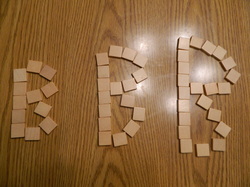
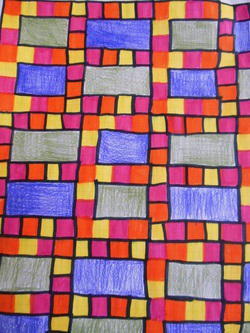
A couple students extended this for their weekly work. I based my sample weekly work on the letter patterns, so I expected more, actually; but that's why we give students choice. Brett extended the letter idea to his whole name, which is actually a pretty nice context for adding functions. (File that one away!) Emily did a really interesting project, making some mathart that  had layers of patterns.

The lesson after this was dominoes - but that's clearly a story for another day. Later in the semester we'll do more patterns using ideas of perimeter, area and volume.

Monday, September 2, 2013

Sonia Sotomayor

Sonia Sotomayor at Berkeley Unified Schools
Photo: Berkeley USD @ Flickr
Out of respect for Justice, I'll eschew my usual pun post titles.

I just finished My Beloved World, a memoir by Sotomayor of her life up to her first appointment as a judge. It is a well-written story, and she will impress you with her positive attitude, perseverance and grace. It makes me extremely glad to have her on the court.

By why blog about it here? Because there were a few bits about education to share. Her experiences in poor (low SES) schools, transitioning to Princeton, the importance of role models and mentors, the impact of service work, and addressing bias throughout her life are all worth reading. Her success in overcoming adversity (family alcoholism, diabetes, etc.) are inspiring.

This story made me think about the importance of genuine assessment, and the necessity of important objectives.

... Teachers, I was finally realizing, were not the enemy.
Not most of them, anyway. There was this geometry teacher nicknamed Rigor Mortis. Word had it that she'd been at Cardinal Spellman since before the invention of the triangle ... I was shocked when she called me into her office and accused me of cheating. The basis for her accusation was my perfect score on the Regents geometry exam. No one in all of her centuries of experience had ever scored a hundred on the Regents.
"So who did I cheat from?" I asked indignantly. "Who else got a hundred that I could have copied from?"
She looked flummoxed for a moment. "But you've never scored higher than eighties or low nineties on the practice tests. How could you get a hundred?"
The truth, as I explained, was that I'd never once got an answer wrong on the practice tests; points had been deducted only because I hadn't followed the steps she had prescribed. I had reasoned out my own steps, which made sense to me, and she had never explained what was wrong with them. On the Regents exam we only had to give the answer; no one was checking the steps.
What happened next truly amazed me. She dug out my old tests and reviewed them. Acknowledging the validity of my proofs, she changed my grades. Even Rigor Mortis, it turned out, wasn't quite as rigid as all that.  (Chapter 11)
One of her high school teachers expounded the value of critical thinking, but she had never learned to do it. Justice Sotomayor's first taste of argument came in a good forensics experience. (Itself a good story.) Then, at Princeton, freshman year:
Professor Weiss told a familiar tale: although my paper was chock-full of information and even interesting ideas, there was no argumentative structure, no thesis that my litany of facts had been marshaled to support. "That's what analysis is - the framework of cause and effect," she said. Her point was a variation of what Ms. Katz had been getting at, though now it was coming across more clearly and consequentially. Obviously, I was still regurgitating information. It was dawning on me that in all my classes I was so concerned with absorbing the facts in the reading that I wasn't marshaling them into a larger argument.  By now, several people had pointed out where I needed to go, but none could show me the way. I began to despair of ever learning how to succeed at my assignments when quite unexpectedly it occurred to me: I already knew how. (Chapter 15)
This is a call to me, again to emphasize what is important in mathematics, and to support students in achieving that. There's also a lot here for me about the importance of transfer, giving learners the oppportunity to apply math in their other work and to bring in their successes in other areas into the math classroom.

And she makes a nice plug for numeracy when discussing her diabetes, as well as a nice demonstration of questioning in problem solving.
I test my blood sugar and give myself shots five or six times a day now. When deciding what I'm going to eat, I calculate the carbohydrate, fat and protein contents. I ask myself a litany of questions: How much insulin do I need? When is it going to kick in? When was my last shot? Will I walk farther than usual or exert myself in a way that might accelerate the absorption rate? If I weren't good at math, this would be difficult. (Chapter 28)
There's also stories about K-8 teachers dissuading students from their dreams (Chapter 10), an interesting exchange about a teacher listening to her students about what a Spanish course should be (Chapter 11), a good interaction with a psychology prof at Princeton over a failed experiment (Chapter 15; rats!), how learning programming influenced her thinking (Chapter 15), the law as a way of thinking (Chapter 20) and more.

Of course, I'm interested in your thoughts, if you'd care to share them on Twitter or in the comments.

Sunday, July 28, 2013

Geometric Landscape

I got shifted from my usual (of late) secondary student teacher supervision to elementary preservice teacher prep this fall. (We have an unusually low number of student teachers this fall.) I love this teaching, too, so it will be a treat. Pam Wells, David Coffey and Jon Hasenbank were already coplanning a revision to the course, so it gave me a chance to dive in and collaborate. And gave me my first chance to look in detail at the K-5 Geometry common core. So I thought I'd share what I saw:


First I collated them, then tried to look for a way to organize them more sensibly. They are pretty unevenly written. From vague generalities to hyper-specifics. The best common threads I saw were the action verbs about what the students were supposed to be able to do.

Our assignment was to sort them into a concept map or landscape of learning.  I'm very fond of the landscape of learning model for teachers. I first saw the idea in Fosnot and Dolk.  In addition to those Young Mathematicians at Work books, they are involved in the great Mathematics in the City project and the excellent curriculum Contexts for Learning Mathematics. Here's a sample chapter from the YMAW: Algebra book. This sample chapter from Contexts for Learning has a Multiplication Landscape of Learning (page 16).

A landscape emphasizes the many paths through understanding that students might take, and are loosely organized from bottom to top in terms of students development. (Read also Christopher Danielson on landscapes. Here's a landscape from years ago I developed with novice teachers for teaching money.)

Here's what I came up with. I'd love feedback on ordering from top to bottom, what you would add, and classification into strategies, concepts and models.
(Here it is as a PDF.)

There's things that are quite sophisticated present (hierarchical structuring, Van Hiele level 2 and level 3 reasoning) and very accessible things missing (motions, congruence and similarity). Even though they are not included, of course, you can still teach them; use those ideas to help students access the ideas that are required.

As I develop and revise activities for the course I'll be sure to share them. Again, if you have feedback about the landscape, shout it out!

Friday, July 12, 2013

Projects


What makes a good project? Teachers argue over how much they should be predetermined or up to student direction, the difference between problem-based learning and project-based learning and other aspects.  The summer capstone course I just finished teaching had an opportunity for maximum openness. It had the context of the history of mathematics, so any mathematical topic is fair game. One of my weaknesses as a teacher is not giving students enough structure - I'm so interested in what they'll do with freedom that I provide more than many want.

The condition of learning that this connects to the most, for me, is employment. Brian Cambourne explains employment:
Employment. This condition refers to the opportunities for use and practice that are pro- vided by children’s caregivers. Young learner-talkers need both time and opportunity to employ their immature, developing language skills. They seem to need two kinds of opportunity, namely those that require social interaction with other language users,  and those that are done alone.
    Parents and other caregivers continually provide opportunities of the first kind by en- gaging young learners in all kinds of linguistic give-and-take, subtly setting up situations in which they are forced to use their underdeveloped language for real and authentic pur- poses. Ruth Weir’s (1962) classic study of the presleep monologues of very young children is an example of the second kind of opportunity. Her work suggests that young learner-talkers need time away from others to practice and employ (perhaps reflect upon) what they’ve been learning.
    As a consequence of both kinds of employment, children seem to gain increasing control of the conventional forms of language toward which they’re working. It’s as if in order to learn language they must first use it.

Brian Cambourne, Towards an Educationally Relevant Theory of Literacy Learning, Reading Teacher, v 49 n3, Nov 1995.
The project directions were minimal - instead I tried to communicate the idea in discussion, having the whole class talk about the kinds of things into which they might look, and who might be interested in that also. This worked pretty well
Project Possibilities: a project should show an investment of 16 or more hours. You might want to keep a log.
  • developed mathematical writing on content of your own working
  • historical profile of period in mathematics or of significant mathematician
  • series of lessons that includes historical connection or context or connects significant math content to the Common Core.
  • video or video series on any of the above
  • mathematical art that explores any of the above
Since this capstone class had an emphasis on writing for an audience and sharing work, more of this is available to share than in a usual semester. So... here's some student work! Hope you enjoy it, and that it gives an idea of what the exemplars are about.

Several of the teachers in the class put together lesson plans or a unit. For example, Erika, Kyndra and Kelsey made a website, the 3rd Grade Brigade, with lessons and resources for the 3rd grade common core in mathematics.

Bre Zielinski and Jessica Bracey went the farthest out there. One got interested in the platonic solids and the other in tessellations so they tried to combine the two to make tessellated polyhedraa. Lots of neat photos of their results in what was definitely the most artistic project.

Jeff Holt investigated something near and dear to my heart as he tried to make a new statistic for studying Magic: the Gathering. I may have egged him on, but he was genuinely interested in studying this or World of Warcraft.  (He also did a history of the mathematician who invented Magic, Richard Garfield, for a weekly assignment.)

The project that had the most impact on their colleagues was this dandy from Ryan Garman and Joe Kargula. Ryan is a baseball coach at Grand Valley, and a former star player. He had the idea to dig into Sabermetrics and got some fascinating results:
If you enjoyed these you might be interested in the student-chosen exemplars from this same course.

Monday, July 8, 2013

When They Work


One of the conditions of learning traditionally not well represented in math classrooms is approximation.  Not as a math practice (also traditionally under-utilized), but as set forward by Brian Cambourne:
"When learning to talk, learner-talkers are not expected to wait until they have language fully under control before they’re allowed to use it. Rather they are expected to “have a go” (i.e., to attempt to emulate what is being demonstrated). Their childish attempts are enthusiastically, warmly, and joyously received. Baby talk is treated as a legitimate, relevant, meaningful, and useful contribution to the context. There is no anxiety about these unconventional forms becoming permanent fixtures in the learner’s repertoire. Those who support the learner’s language development expect these immature forms to drop out and be replaced by conventional forms. And they do."

Brian Cambourne, Towards an Educationally Relevant Theory of Literacy Learning, Reading Teacher, v 49 n3, Nov 1995.
One of the reasons that article made such a huge impact on me when Dave Coffey first shared it was this idea of approximation.  It both supported some of the things I was trying to do in my classtime, and convicted me of many of my grading practices.  The grading structure in many of my classes involves the choice of exemplars.For example, the summer capstone course on math history I just finished teaching had daily work that was just to be done. Their choice, ungraded, noted for attempt. From that they chose, expanded or made anew some weekly work, which they submitted for feedback. Then at the end of the semester, they submit their choice for exemplars, with a short description of what makes it exemplary. We had four main themes in the class, and they submitted an exemplar for each:
  • Doing Math
  • Communicating Math
  • History of Math
  • Nature of Math
Mathy, no? In the end of term evaluations the students felt like we were strongest in class on history,  and weakest on the nature of mathematics. People were divided on whether some of what we did counted as doing math or not. 

Since this capstone class had an emphasis on writing for an audience and sharing work, more of this is available to share than in a usual semester. So... here's some student work! Hope you enjoy it, and that it gives an idea of what the exemplars are about.
Calvin needs some choice in his school work.


Jamie Paolino is probably more of the inspiration for this blogpost than any other, as she did a nice job presenting her work all semester. Here's two of her exemplars:
  • Doing Math - Hypocycloids (Google doc)
    "What makes this piece exemplary is it displays my thought process and inquiry while working with hypocycloids and the student worksheet created with geogebra. I spent a substantial amount of time working on this weekly writing and discovered a lot about their creation with the use of a combination of variables. I think this type of work is often overlooked in the school setting because there is sometimes more of a focus on the finished product as opposed to the route that was taken to reach that final product and really having an understanding of something means more than simply being able to do it."
  • Nature of Mathematics - What is an Axiom?
    What makes this work exemplary is my understanding of an axiom and the many roles they play in various proofs. I had a big misconception of axioms prior to investigating them further  and was able to clarify my misunderstanding. After researching more on this topic and looking at different examples the meaning of the term “axiom” started becmoming more clear and didn’t seem so scary as it once had.

Ros Rhodes - Desmos (All her exemplars are in one Google doc; this is the first.) Totally new tool to her, and she really got into exploring with it. HT to Daily Desmos for the class activity that helped engage students in exploring with Desmos online graphing calculator.
  • Doing Math - "Why is this considered my best work?- A lot of mathematics is done through the use of observations. My experience with working with Desmos was an incredible experience to encounter and taught me a lot about how powerful hands-on computer programs are. With the hands-on experience that I have encountered with this program advanced my understanding of the relationships of how various functions operate with each other. I think with this work, not only was my work creative, but I was able to articulate how I created such a powerful piece of art using mathematics."
Erin Jurek - Rascal's Triangle (Google doc) One downside to having so much to cover is all the stuff we don't get to talk about in class. I like this as an example of a learner following up independently on something she found interesting.
  • Doing Math - "I am using this piece of work as an Exemplar because I feel as though I explored this topic very deeply and I was able to bring myself into the work by actually doing the math that these students did in order to determine the next rows of Rascal’s Triangle. I really enjoyed reading about these students and the hard work they did in order to come with the diamond formula."
Luan Huynh - Chinese Numbers (Google doc) After discussing the development of Hindu-Arabic numbers pretty extensively in class, Luan got interested in Chinese numeration and I learned a lot from his work. Several students chose number systems explorations for a communicating exemplar, mostly about Mayan numerals.
  • Communicating Math: "this can be an exemplar for math communication since it gives us an introduction to the Chinese number system, which allow us to understand how the Chinese learning and doing math."
Bri Zielinski - Modernizing Euclid. (Google folder of all her exemplars; this is the 1st.) Brianna took the proof from one of my all time favorite pieces of mathematics - Oliver Byrne's Euclid's Elements, 19th century full color visualization of  - and wrote it up as a modern written proof. (Her 4th exemplar is a quite nice essay on math as a language, also worth a read.)
  • Communicating Math: "I consider myself pretty good at writing proofs, so this Weekly Writing kept my attention and focused my ideas."
 Milli Brown - What is Doing Mathematics? (Google doc)
  • Nature of Mathematics: What is Doing Mathematics? "What makes my work exemplary is the way I described my journey to deciding what “doing math” means to me. I included my research, past experiences, and a summary of what I have arrived at for a definition of what “doing mathematics” is to me." 
Erika Bidlingmaier - What is Elchataym?   I developed a new appreciation for Leonardo of Pisa while preparing this course. Reading some of the Liber Abaci convinces you of his great place in mathematics.
  • History of Mathematics: "In this writing I let a simple curiosity lead into a full-out study of the historical method of elchataym used by Fibonacci. Although I left it open at the end (and would have built a stronger piece if time permitted), I still exhibited my understanding of a very influential part of math's history."
Alyssa Boike - The House of Wisdom (Google doc) Our time spent studying Islamic mathematics seemed to make a big impression on students.
  • History of Mathematics: "Week 3 is a good exemplar because I was able to concisely note a few of the most important people who worked at the House of Wonders and include their significance in the development of mathematics as a field. "
Anna Krivsky - Tessellations
I like her personal connections here and the nature of mathematics. Is making a tessellation a mathematical act? (Hard to choose between this and her Magic Square.)
  • History of Mathematics:The following is exemplary of my learning about the history of mathematics during this semester because it discusses the historic development of a branch of mathematics that was new to me this semester: TESSELLATIONS. Furthermore, this work shows my ability to research about the history of mathematics.
If you enjoyed these, you might be interested in some of the student-directed projects from this same course.

Monday, June 17, 2013

IB

IB, you be, we all be...

The Wall Street Journal had an article on schools going International Baccalaureate by By Caroline Porter and Stephanie Banchero. Joan Smith, a good family friend is a former principal of IB schools (including having started one) and now travels the country training teachers in schools that are becoming IB. I sent the article on to her and she had cogent comments. (As you would expect.)

The article is behind a soft pay wall. (My access came through ASCD's SmartBrief (free sign up), which is often worthwhile.

Some salient points and figures:
  • Houston, Chicago, Tampa, Fla., and other cities are embracing the International Baccalaureate program
  • there are 1,651 IB programs in the U.S.—including 1,493 public schools—up from 503 in 2003. About 90% of them are in public schools
  • IB programs emphasize individual and group projects governed by a philosophy of "international mindedness."
  • some parents are concerned that IB programs are too theoretical. "It's frustrating to see that instead of doing spelling bees or history reports, they are spending about six weeks of time focusing on poverty or saving white tigers"
  • Schools typically incur a cost of $150,000 or so to prepare for the program, which could include expanding lab or library space. They also must pay the IB group about $10,000 in annual fees plus $700 per student for tests given in 11th and 12th grades, as well as teacher-training fees.

Joanie responds:
This is true--the programs are growing very, very rapidly across the US and Canada. It's a pretty good interview, though the reporter misses the reality that the content of the curriculum is dictated by the district; the IB teaches teachers how to deliver it through inquiry and higher level thinking so that kids actually learn. I have never found a state or district curriculum at odds with the requirements of the IB, which are broad expectations in all subjects and the Primary program and the Middle Years program do not have outside assessments like the Diploma does.
Any news on GV engaging in this? I'm glad to help in any way you need.

The parents who complain about not having spelling bees and other things they remember from when they attended school are pretty clueless about how little is learned from those activities. The kids who excel and enjoy those are the linguistic learners, who represent about 15% of any classroom! The rigorous expectations of the IB programs raise test scores without the rote memorization, mindless skill and drill, etc. that is happening in so many of our failing schools today.
I would add that the costs incurred vary by program. The fees are most expensive for the Diploma Program (11th and 12th grade) because there are external as well as internal assessments over the two years of the program. The assessments are balanced with 50% of the final mark dependent on the exams in May of each year. The papers set are usually two or three separate exams including essay, multiple choice, etc., not unlike A.P. exams. The beauty of the program is that teachers are involved in the marks on internal assessments. The Primary and Middle Years Programs are less expensive but are amazing programs! (added here from the comments)

What I often see in successful professional development is a vision that is shared by the teachers and an increased sense of agency, that they have the authority to make changes that result in deeper learning. IB isn't magical, but it does connect to what we know about motivation and learning.