One of my favorite courses to teach is our embedded elementary whole number and operation teacher prep course. Typically they teach every course day, twice a week. This semester, one section taught 1st and 3rd, and the other 2nd and 3rd. Pairs of teachers work with small groups of elementary learners for 30-50 minutes. Mostly our lessons are a number talk (or other instructional routine; WODB, same but different, Slow Reveal Graph, ...), a story problem and a game. But we try to do a couple of other formats, a three act lesson, a data collection lesson, etc. At the end of the semester, I like to have a math and art lesson as a kind of celebration, and to get to experience making with the kids.
In the past, we've done Hundred Face (handout), but time-wise that was not going to work this year. I do recommend that lesson highly - always fun, so many ways to see 100 and think about exchanging different combinations to make the same number, great opportunity to do real art with significant restraints.
When I was thinking of a new lesson for the 1st and 2nd grades, I wanted something that involved counting, and could be done pretty quickly for the class with the time limit.
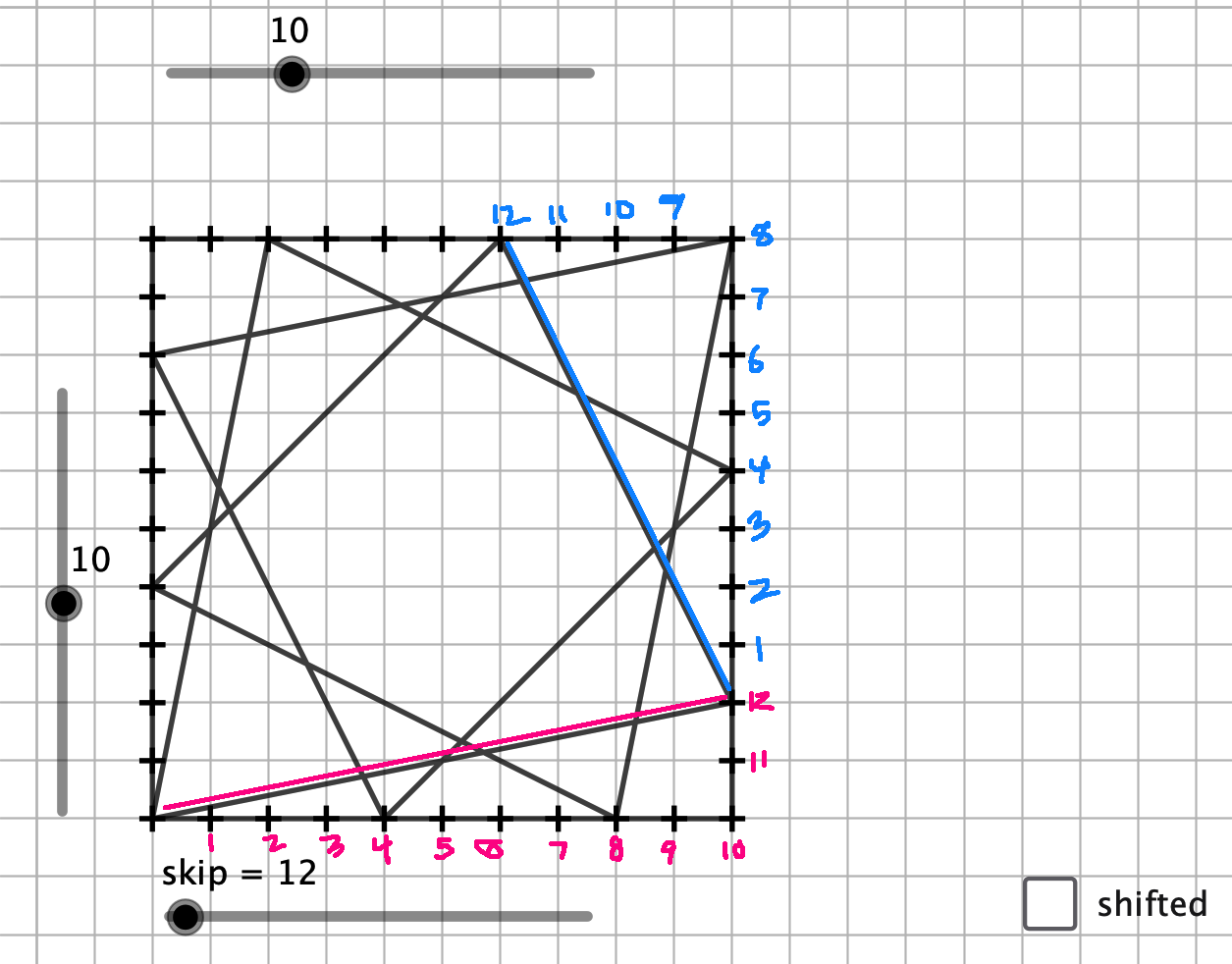
Eventually I landed on string art. I like this in general, I love all the things there are to notice. The mechanism is simple enough to communicate to young learners: choose a skip number and a place to start, connect those vertices, repeat.
I made a GeoGebra applet for the teachers to play with, and, if time allowed, they could share with kids. We got the teachers to make some conjectures about the string art patterns from their noticing and playing. When does the pattern hit every node? When are there gaps? What difference does a smaller vs a larger skip number make?
For a couple years, I've been lucky to be able to do these lessons with the teachers during school spring break and have my son Xavier join us. He's a high school art teacher and the author/artist of our graphic novel. He talked to the teachers about line, as an element of art, and developed this slide show to share about Emma Kunz and Bridget Riley.
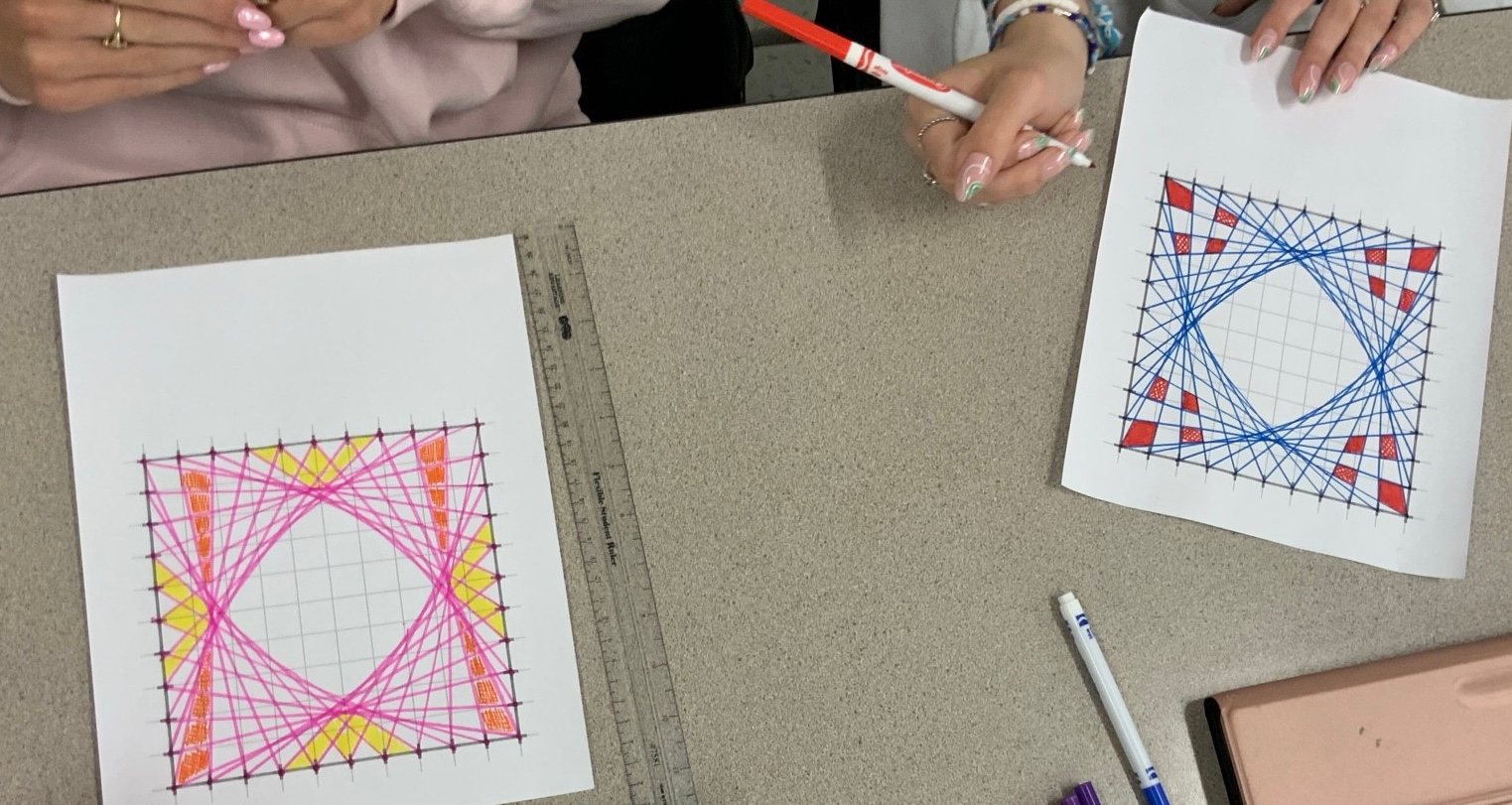
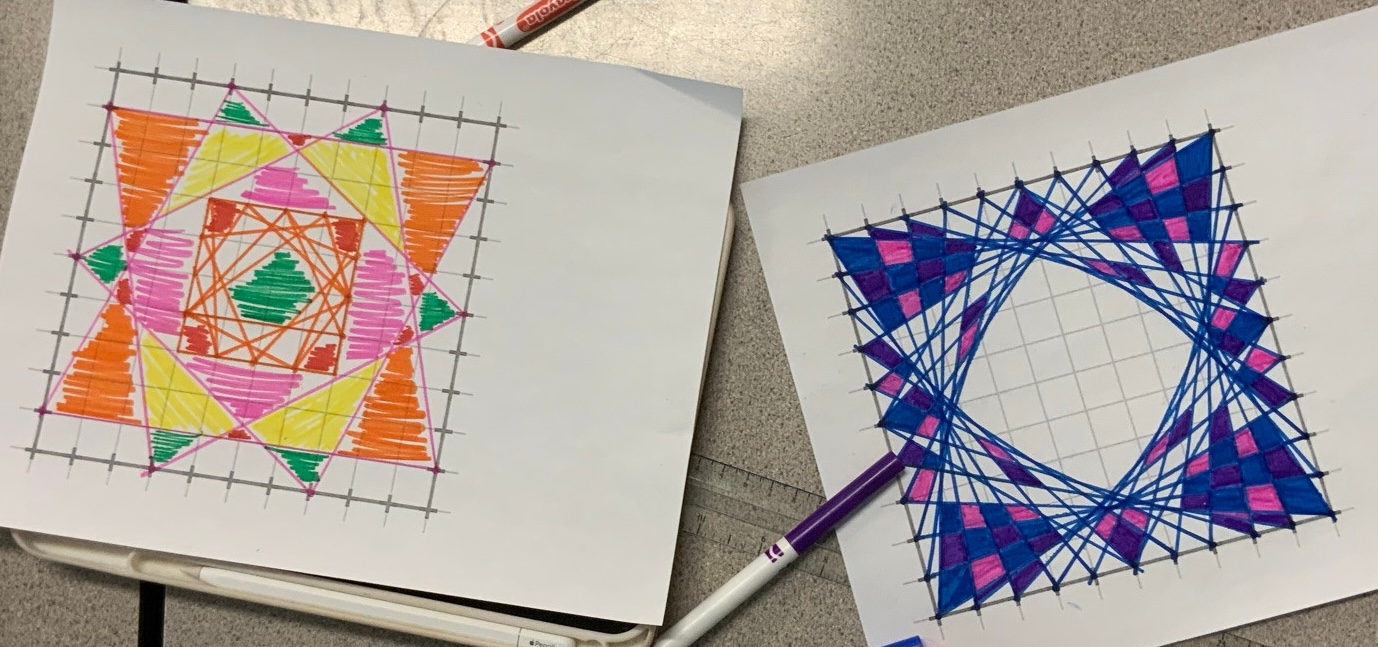
We talked about different ways to use the pattern to make art. Xavier suggested coloring so that not two adjacent areas shared a color.
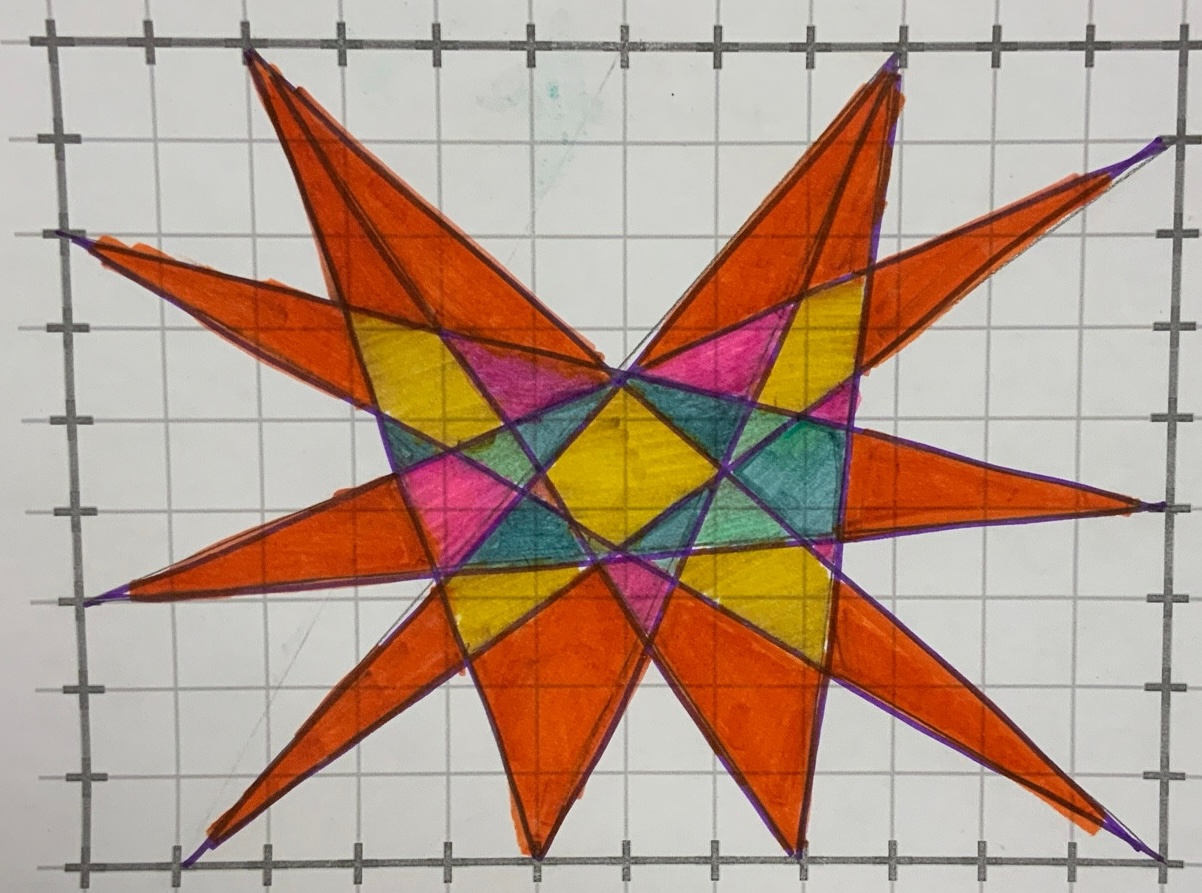
Teacher art was interesting:
One of the things that I love about combining math and art is being able to address mistakes as happy little accidents. We adjust, incorporate it, use fix up strategies.
The lessons went very well with the 1st and 2nd grades, most kids were highly engaged. When we finished, we set out all the art work and did a gallery walk. Then the artists shared something they liked about someone else's work. Lots of great noticing, and they were very pleased when another kid found something in their work. There were a lot of great predictions about where the count was going to take them next, and some kids were confident enough to just draw the pattern. The physical skills of using the ruler and coloring were relevant. Xavier had given the teachers some tips about careful coloring and precision.
Altogether, this is one I'll use again. It would be interesting as two part lesson in middle school, with the first an investigation into the patterns, with connections to factors and multiples. The math was great, and the preservice teachers were impressed with the kids' interest, focus and creativity. As usual, the art connection engaged kids who are less interested in traditional math lessons.
Lesson Plan Crib Notes
Part 1
Share your examples of rectangle string art. What do they notice and wonder?
Part 2
Have them pick a starting grid and a skip number. (Handout) Help them get the first few lines. As they work, see what they notice about the pattern. Help them use the grid to count - especially on the 10x10 square. The bigger a factor the skip number shares with the total perimeter (40 for 10x10, 42 for 9x12) the fewer lines until it meets up with itself. So skip 13 will hit every point, skip 12 will have fewer lines. Pick any starting point - some people like starting in a corner - and continue connecting lines to the point your skip number of points away. You can do colored lines, black ink or pencil. Talk to them about the counting math, patterns they notice, what they see. DON’T WORRY ABOUT PERFECTION.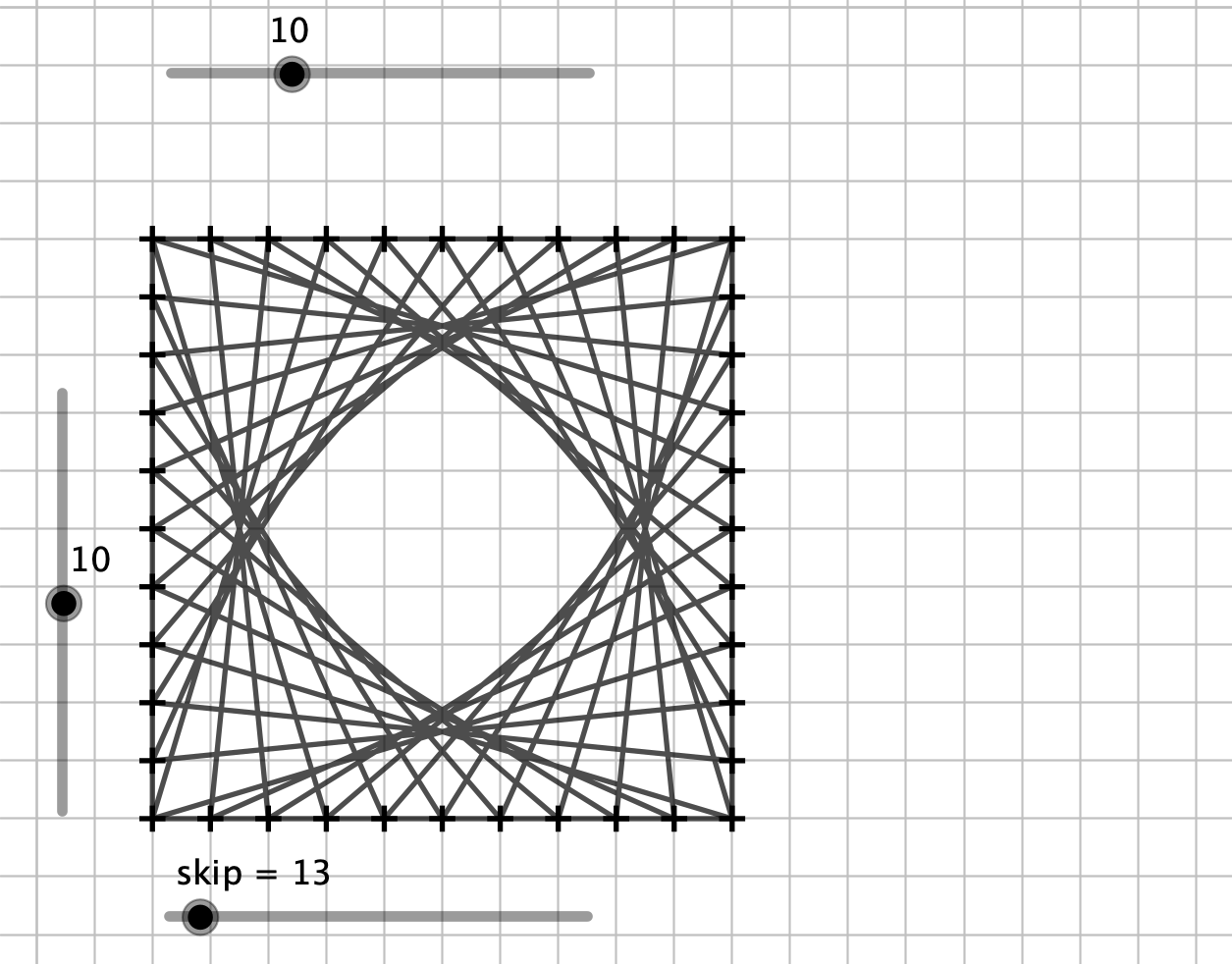
Part 3
Decorate!
Summary
Find out what they like about their art. Get a picture. Tell them something positive that you saw about them or their work. Be authentic!







 Posts
Posts


