Showing posts with label assessment. Show all posts

Saturday, May 7, 2016

A Few Problems of My Own

Some of my favorite assessment problems from this semester in College Algebra. Each problem is labeled with the standards it mainly addresses. The main function families for our course are:
  • Q - quadratics
  • P - polynomials degree 3 and higher
  • R - rational functions
  • E - exponential
  • L - logarithmic
And then there's a category of function concepts and special functions.

For each function family, there's four repeating standards:
  1. Basics - vocabulary, characteristics
  2. Representation - being able to move amongst table, graph and equation
  3. Symbolic - traditional algebraic skills, solving and simplifying.
  4. Context - solving in application. Being able to mathematize situations.
I like having a structure, as students getting used to the Standards Based Grading is one of the big hurdles in the course. That's why all the problems are labeled with standards, too.

These problems are different than the ones I use in class or for homework, with more scaffolding, and often reminiscent of things we've tried in groups. They also choose problems on which they're ready to be assessed. They can write up longer responses at home to turn in on problems that they do not do in class.

This first one's not mine. They read a Glen Waddell post on the Exeter method, so I thought it was a nice connection to put on an assessment.  The element of the cup really made clear which students understood what the height function was saying.


We did a fun activity in class on sound frequencies that you can hear at different ages (due to hearing loss/damage) in class when we were talking about decibels. Frequency is not logarithmic, of course, but I love using a topic as arcane as logarithms to make sense of something they've heard of (get it?) as much as decibels.

One of their favorite application problems in the semester was using exponentials to model weekend movie grosses, which are roughly exponential decay. But of course the sum of geometric sequences is also a transformation of an exponential. This problem unfortunately highlighted careful reading or the lack of it, which is not super-useful, so that some people tried an A*k^x model. But it did show the people who were making sense of that not working, and the people who blindly accepted the results. Desmos reliers (as opposed to Desmos-only-if-my-calculator-can't-do-it) did better on this.

This problem was another great one for function notation. The difference between evaluation and solving was crystal clear. And it was such a nice pattern for the people who correctly interpreted the problem that there was a good payoff.

The top problem here is also not mine, of course, coming from WODB.ca. Well, originally. The task of making a function to look like it is a great representation prompt. Students who made sense of marble slides were really able to strut their stuff.
 It was the second and third problems that were really interesting to me here. They were open middle-like in the variety of different methods people used to solve them. Recursive rules, which we never used in class, really, excellent table use, some regression... such a nice mix.

I liked it enough that I wrote a follow up for the last SBAR opportunity. (AKA the final.)
One thing that we never addressed directly that we got to the last time I taught this course is that the sum of a certain degree polynomial sequence gives the next degree. Much like the differences give the next lower degree. I LOVE that structure.

For the special function types they only had to demonstrate one of the four kind of standards that they did for the main function families. Both of these offered a lot of opportunities for sense making. In particular the normal distribution question highlighted whether people understood mean and standard deviation as descriptors.


If you have feedback on writing assessment questions for SBARs, I'd love to hear it. Whether it's modifying these or a whole different direction. Here's all my assessments from the semester in a Google folder, if that could be of help or interest.

PS. Thanks Ann and #MTBoS30 - I've now blogged more in May than I did all January to April.


Wednesday, August 27, 2014

Dan as Assessment

First day in a class on high school math with preservice secondary teachers. A rambly story, to be sure.

From The Duplex by Glenn McCoy
 We started making nameplates and forming groups of 3 or 4.  While that seems inconsequential, I leave the markers and materials up front. And it's just the tiniest bit of culture setting when someone asks "we do that now?" and "should we come up to get the stuff?" And letting them know if the groups don't meet the parameters: facing each other and 3 or 4 members. Am I really going to be a stickler? "We have 5 is that okay?" "Nope." Student 4k+1 walks in; I ask "so what are you going to do now?" I have several occasions to say, "good thing we're a room full of problem solvers."

The next activity, Piece of Me, is robbed adapted from David Coffey. I'm now calling it 2 Questions. Each person comes up with two questions to ask the person on their left in their group. Once everyone has them, ask away. Everyone has the right to decline to answer. Some of the questions were generic (how was your summer), some were trivia (Michigan or Michigan State) (Answer was Notre Dame and a story about her family) and some sparked good discussion: "why be a teacher?" or "middle or high school and why?"

The second phase is they each come up with two questions for me, one about me one about the course. Then the group picks two of those questions. As Dave documents, answering and discussing just what the students are interested in is a vast improvement over teacher ramble or reading the syllabus. (That's homework.) This day they asked about the observations they do in high school, what homework would be like, how much reading, etc. about the course. They asked if they would be teaching in class... that hasn't come up before. About me they asked about family, education, why be  a teacher, etc. Favorite question this time: "do people say you look like anyone?" They used to, when I was skinny, but fat now, so... Then the student said he asked because I looked so much like Francis Ford Coppola.

Alright!

Our first math activity was one of Sadie's Counting Circles. Regardless of how you think math should be taught, you must know what people think about math now. I shared how Jo Boaler and others have experimented with number talks to change people's beliefs about math. And how Sadie's counting circles are a good context for a number talk.

The idea of the counting circle is two-fold. One is that it helps to build a positive learning culture where it's safe to speak up, mistakes are acceptable, multiple approaches are valued, and thinking is what we want to share, and the other is to develop number sense. Sadie would probably disapprove of my choice of starter value, but I thought too easy would actually disengage this group of math majors. So we did up by 97, starting at 235. It wound up being just a little uncomfortable for a couple of people - 99 might have been better. After 1.3 times around, at 2175, I put on the pause, and asked what would Amanda say (5 people further around the circle.) When everyone indicates they have an answer, I asked for volunteers for their thinking, and then just recorded it as they spoke it, eliciting details. And I didn't take a picture!The shared strategies included noticing that the ones place went down 3 each time, adjusting from adding 100 and multiplying 97x5 and adding it to 2175. Even the computation can be interesting. 97x5 used partial products to get 485, and then he added the 5, the 400 and then the 80.

With that set up, we moved to watching Dan Meyer's TEDx talk, Math Curriculum Needs a Makeover. (It's a classic for a reason.) They were very engaged, and had intense small group discussions after watching. One of the students led the whole class discussion, which became a good assessment for me. Their beliefs about teaching stood out sharply, thanks in part, at least, to their contrast with what Dan was saying.

My notes:
Not enough time!
-planning
-class time
Some time gained from students being able to do math practice at home. Tech helps with this. 
What stus know on tech is not always helpful.

Kids need too many basics to do this kind of work

Problems like this won't be on the standardized tests
I learned this way and the standardized tests were so easy. If you're taught this way, your understanding filters through standardized fluff.

Less memorization because you've created the formulas yourself.

We missed part of the process. This leads to more general methods because of questions like: How would you figure out for a tank ten times larger? Or is there a short cut for figuring it out more easily. In a class one time, for a question on the volume of a vase, why not just fill it and see? Prof answered: "what if it was 100,000 gallons?"
This kind of activity gets across the idea that you're not always going to be right. This is just one way to do it.

Grounds the math in reality. You know students are always asking 'when are we going to use this?'
I would summarized their talk as: "It would be more engaging, but..." I maintain that I do not want this course to be about me telling them how to teach, but giving them experiences that can equip them to construct their own vision of teaching and learning. Resources, reflection and a focus on student understanding lead to good teaching. But this experience helped me understand where we are starting and some of the barriers to where I want us to get.

We continued class by looking at 101qs.com and generating some questions. (Aside: read Pershan on learning to ask questions. We'll be tackling this later.) 

This led into launching the meatball three acts. We watched the video, and got to our estimates, and low and high guesses.


This was cut short because we had a presentation on Lisa Kasmer's excellent study abroad program in Tanzania .  I'm interested if anyone worked farther on it.

I was moved to write this up, because I tend to think of asking questions to get assessment data, and this wasn't intended to be assessment. I might not have noticed as well if I was running the discussion, but as an observer, it put me into notice-mode.

Postscript:
Part of the homework was to look for a 101qs prompt they found interesting. What they found interesting is in turn interesting to me! Here's a few:
  • Jennifer: Bowling for Pennies. "Would this be cheaper to make than buying a 'mirror ball'?":  Nicole Paris asked: Would this be cheaper to make than buying one?
  • Brittany: Waterkracht "centrale". Water power plant. How fast is the stream flowing?
  • Greg: Beatlemail "How many letters would each band member have to answer?"
    Ken Meehan asked: How many pieces of fanmail?? What is the first question that comes to your mind?
  • Sam: Brita How many water bottles are need to go around the earth once?
    Dan Meyer asked: How many times around the world would all those bottles wrap?
  • Kevin: NFL JumboTron HDTV's How many 60" televisions does it take to fit in the Texans television?
    Nathan Amrine asked: How many 60" TV's would equal one Texans TV?
  • Molly: Packing Box What is the total area of all boxes?
    Elaine Watson asked: What combination of small boxes and medium boxes can fill a large box?? What is the first question that comes to your mind?
  • Joshua: Angry Birds Can knowledge of quadratics improve your Angry Birds accuracy?
  • Jerry: Okay, this is the first one I found: Stuck Truck This reminded me of a story I once heard of about a semi-truck that came to the opening of a tunnel only to realize it was a couple of inches taller than the opening. Having to stop in the lane with no way to turn around, the truck had traffic backed up for miles as everyone had to consolidate down to one lane and everyone slowed down to gawk at the truck to see why it was stopped there. The police and the truck driver were all standing around the truck trying to figure out how to get the truck through the tunnel or turned around and had discussed numerous things but none of them seem to be the right answer. Then a little boy leaning out of the window as his dad drove by yelled out, "Why don't you just let some air out of the tires?" The question the original poster seemed to be thinking along the same lines, "How much beer would he have to drink to allow the driver to get the truck free?" However, my question had to do with how often this happens at this spot. Either it happens often and they should fix it or there is a sign and the driver just did not see it.
    Fred Jaravata asked: How much beer would I need to remove to help free the truck?? What is the first question that comes to your mind?
  • Dakota: Cylindrical Tunnel How many windows are in this tunnel?
    statler hilton How much glass is needed for this?
  • Jim: Pickle Stack How tall can you build a pickle tower?
    Krista Keats asked: What is the question?
  • Brody: Keep 'Em From Fallin' How tall is the main structure?
    Michele Thomareas asked: How wide apart are the columns?? What is the first question that comes to your mind?
  • Amanda: Waterworks at Legoland How far will the water spray?
    Rod Bennett asked: What happens to the trajectory of the water if she pedals faster?
  • Christopher: Roulette Wheel What are the odds of that many 19's in a row?
    Joe asked: What are the odds of the same number coming up 7 times in a row?
  • Anika: Circle Square How many circles are there?
    John Golden asked: What is the function for number of circles after each step?
  • Nick: 2010 Guatamalan Sinkhole How deep is the hole?
    Robert Kaplinsky asked: How much material will they need to fill the sinkhole?? What is the first question that comes to your mind?
  • Brooke: Firing Range How many lasers are there?
    statler hilton asked: How far away is the target they're shooting at?? What is the first question that comes to your mind?
  • Leesha: Perfectly-timed photo How high is the plane?
    Johanna Langill asked: How high is the plane?? What is the first question that comes to your mind?

Wednesday, February 19, 2014

Followers Beware

Smarter Balance has released several items for the fast approaching Common Core assessments. One really caught my eye as a dynamic context: safe following distance. I can't find a way to link to the specific item, but it is #43060 at http://sampleitems.smarterbalanced.org (CCSS: F-BF.1a, F-LE.1b). The sketch is on GeoGebraTube, as well.

How far should you drive behind the car in front of you?


GeoGebra notes: With the spirit of Jennifer Silverman hanging over my shoulder, I got real car images to use. The trickiest thing was sizing the images to look right since the scale was not 1:1. I like the flexibility of looking for feet (sigh, USA) or for car lengths or for time separating the vehicles.

The actual assessment question:
 Pretty complex problem, as illustrated by the rubric:
Just a quick post to encourage you to think about using some dynamic visualization with your math work. Many of the released items have a little gif like animation instead of text.

Tuesday, October 9, 2012

Why Questioning?

Found at From-Student-to-Teacher Tumblr
From Joy of Literacy

Last week became questioning week with student teachers. It came up in two action plans and we were able to have some really interesting discussions about it.

A lot of what I'm writing about here is from work with David Coffey, inspired by Kathy Coffey, and processed from Mosaic of Thought (link includes Chap.1 as a sample) among other books. Neither Dave nor I can remember the actual origin... which is sometimes symptomatic of having done it yourself.

In my own growth as a teacher questioning is definitely one of the places where effort and reflection have helped me improve. The first level was just asking better math problems. More open-ended, that required more problem solving. When the problems are better, there's more interesting things to ask the students about later. The next was to ask more appropriate questions. Some of those excellent problems I gave to students were too much for students. This is a zone of proximal development idea. When it was too much, I needed to scaffold. Later I learned about rephrasing the question instead of narrowing it. Later still I learned about demonstrations of how I think about a problem, sometimes more appropriate than guiding students through it. Then you ask 'what did you notice?', which is - of course - one of the all time great math questions.

One of the best things I ever learned was to stop being the authority. I don't say what is right or wrong. I ask the students if they 'agree or disagree?' That might start an actual conversation. 

One of the first things I really noticed about teaching was that students would tell me that they couldn't do it (whatever it was at the time) but when I asked them questions they could get from beginning to end with no difficulty. So, obviously, I needed to teach them to ask those questions of themselves.   It was difficult. Really difficult. Shifting from asking them 'how to do (next step)?' to 'now what?' and 'how do you know?'

Literacy learning experts are good about this idea of questioning as a process, with the idea that questions are how we move ourselves forward. I like this framework to help me think about the kinds of questions that I'm asking.


Obviously, we have had a tendency to ask too many literal and application questions in math class.  I think about inference questions being predictions, reading between the lines, hypothetical questions and the like. Analysis questions are reflections, synthesis, connections, recommendations and so on.

What I shared that seemed to tie it together for the student teachers is a simple idea: ask to find out what I want to know about. I don't need to ask for answers - I know those. I don't need to ask right or wrong. I need to ask about what they are thinking. Students know when a question is genuine, and this simple idea has improved my assessment more than anything else.  I'm more persistent in getting answers when I really want to know them, also.
From A Softer World
Some good student teacher writing on questioning:

Friday, March 9, 2012

Math Memoirs

There's one of my favorite math teaching videos up in Keith Devlin's most recent blogpost.  (Thrilled that it's now on YouTube with several other of her interviews.) It's from the wonderful Marilyn Burns, who has really done more for math education than anyone in recent decades. Her stuff was good enough to get word of mouth sharing before there was an internet. (Dan Meyer is quite reminiscent of her in several ways.) Devlin uses the video to make the point that apparent understanding is not proof. A better assessment can uncover the truth, and Burns is excellent at questioning to get an accurate picture.


As a novice teacher I quickly found that the students giving an answer did not tell me whether they understood or not, and I moved to asking for how they got it. It took me years, however, to get to understand that how is better, but also does not get at understanding. It's their thinking that I want to hear. Then I should ask for it! Unfortunately, even spoiled university teachers don't have time to sit down and interview students over all of our major objectives. I can, however, ask questions to which I really

Dave Coffey found this excellent solution by Carl Barnard, a high school student, to the painted cube problem that crossed the line to be a memoir. We often introduce the idea of a memoir by having our students read it and comment on it. (Here's my most recent version of the workshop; Dave was almost certainly the original writer of it.) It's a start to learning how to communicate your thinking. While it's important and beneficial for any math student to do this, it is unbelievably crucial for math teachers, and a big part of pedagogical content knowledge to me.  Most students on end of term evaluations comment that this is an area where they grew significantly.

I wanted to experiment with what this looked like in elementary school, so I asked my daughter to give it a go. These are from the summer between her 4th and 5th grade. She was a bit precocious with her writing, but had had pretty traditional math instruction. (And not interested in talking with me about to a large extent.)

Just writing the method. A first attempt at memoir. I supported with a kind of questioning framework.


She was game enough to try twice more.


This is the sort of information that I want from an assessment. I get so much more an image of what ideas she has about number and operation. And it is far more interesting reading than traditional assignments where I'm looking for what I expect or not.

Friday, December 30, 2011

Two Final Problems

Trig Problem 2
For my preservice high school teachers' "final" (really a last Standards Based Grading opportunity), there were two problems that while similar in many respects were quite different in results. All of the problems were listed by one standard, but typically could be used for other standards. It's the student's responsibility to describe what standards they are demonstrating, though I will help if it demonstrates something well that they need.

Trig Problem 2. (Standard: Law of Sines, Law of Cosines and applications)

Figure out some of the missing information in the diagram.


The pictures were made in GeoGebra, which I highly recommend for mathematical image creation, as well as more active uses.


Geometry Problem 1. (Standard Lines: parallel, perpendicular, properties of angles)

Find more angles.

Geometry Problem 1

Similarities: visual, finding connections, geometry, students have previously done and been assessed on similar problems.

Have to love easy-to-draw memes.
Differences:  throughout the semester students saw trigonometry as something difficult, and had much less confidence on them.  Students were very successful with the angles problem, able to find all the angles, and be able to justify their results. Why vertical angles are congruent, why there are 180º in a triangle, etc. On the "trig" they quickly resorted to visual inference (like the angles at A were all 60º), supposition, and ignored contradictions (such as finding that the length of CD was less than 6 units), and did almost no extension to other standards from circle geometry.

It was fascinating to read their work, and I wish we had more class time to look at the results. It felt like direct confirmation of the Van Hiele levels, and convicted me that as much time as we devoted to trigonometry, I need to find more ways to increase their experience.  While I thought the circle diagram was more subtle, I didn't realize the great difference in how students would see it. Only one student realized CD must be 6 units, which is the entry to me for many of the possible values that can be determined.

Thursday, December 1, 2011

SBG Resources

From Rainbowcatz @ Flickr
I was gathering Standards Based Grading (SBG) resources for a colleague and thought that would be worth sharing.  Maybe this should be a LiveBinder? There's a definite math focus to my selections below, those it's not strict. Many people refer to SBG as Standards Based Assessment and Reporting (SBAR), which gets the whole 'grade' idea right out.

People: (Name links to Twitter)

Fundamentals and Further:
Twitter discussion
  • #sbar - find more SBG folk, or people trying it in your discipline, by a Twitter search.
  • #sbarbook - book group that 'meets' weekly for discussion about a particular book on assessment. Doesn't look like this semester's book is very engaging, though.

For completeness sake, here's my 2 (so far) SBG posts. Hey, this makes 3! If there are more examples of SBG in college, especially college math, please help me find them.

Thursday, September 29, 2011

Patterning

I gave an algebra assessment this week (in SBG style) and a student really surprised me. So I thought I'd share.

The assessment:
Possibly relevant standards.
A. Algebra: representation, operations and modeling
  1. Linear equations and functions 
  2. Quadratic equations and functions 
  3. Exponential and logarithmic equations and functions 
  4. Higher polynomial and rational equations and functions 
  5. Functional representation and operations. 
The problems: take 10 to 15 minutes to consider the following problems. You may do 1 a couple or all. Your SBG score will not depend on a correct answer, but rather on showing your understanding of the ideas involved. (Of course, good understanding helps find solutions, so it’s not totally unrelated; but it’s easy to give an answer and show no thinking.) Since the answers are not the central issue, be sure to communicate your thinking, process and understanding. If you read these instructions, clap your hands once.


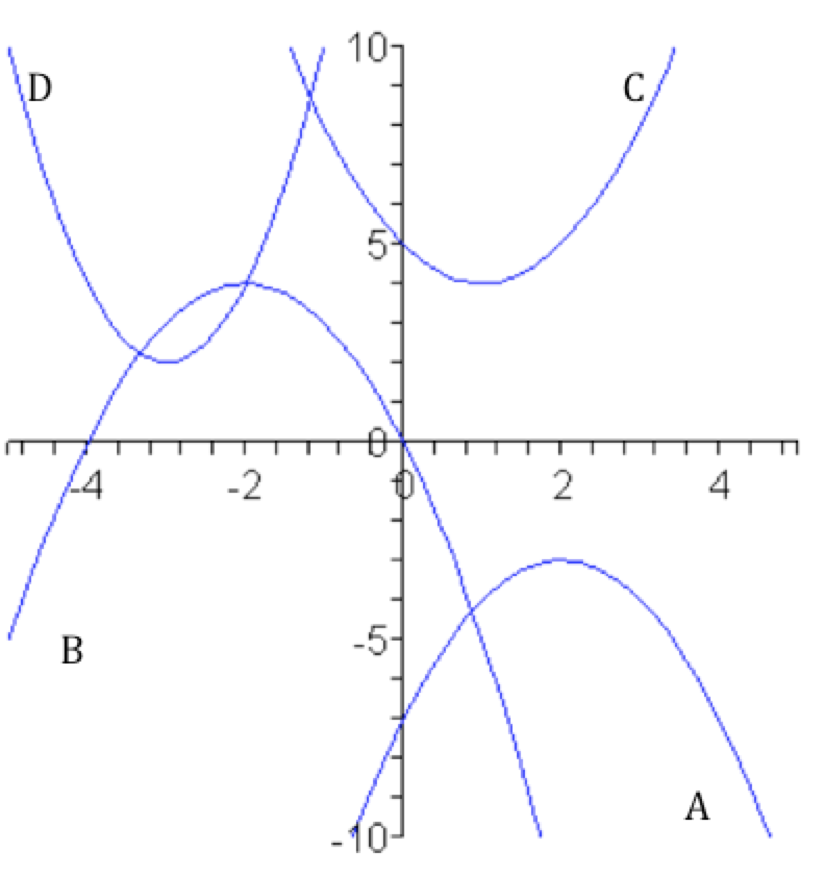
1. Using the parabolas at right, estimate the equations of the curves.
2. Discuss: how do you recognize a quadratic pattern from a table, and what does that have to do with the familiar parabola shape of the graph?
3. Use the idea of parallel and perpendicular slopes to give the coordinates for vertices of a square that has no sides parallel to an axis or to y=x. What is the area of your square?
4. Find a symbolic rule for one of the patterns below and look for connections between the symbolic and the visual. Extend the pattern one step to check your rule.


Analysis:
Problem 1 gives lots of nice information. Whether the student uses standard (harder) or vertex form, what the coefficients mean to them, and if they are consistent in applying that understanding amongst the different parabolas. Almost no one uses the roots, and I've yet to see someone apply regression to points.

Problem 2 pointed out that students over-identify parabolas with quadratics, as most students who struggled talked about increasing slope and symmetry as opposed to first or second differences. (Also that there was a homework that they didn't get to!)

Problem 3 was interesting in that no one started with the points. Everyone who tried it gave linear equations, established parallel and perpendicular, and struggled with how to get the sides to be equal length.

Problem 4 was the surprise. Most people chose the pattern on the left, and used visual identification of pieces to generate a direct rule. Only one student tried the pattern on the right. But instead of finding the quadratic pattern I intended, she noticed that each element was as long as the three previous elements summed. Definitely true for the picture... and got me to wondering if it would be quadratic. Nope. but definitely non-quadratic. I made a Google spreadsheet to compare, and this was unusual that the quadratic matched the sum of the first three pattern so well. I got interested in the ratios as they seemed to be converging. (Here's the spreadsheet if you want to play around for yourself.)


Finally I gave in, and looked up the sequence in the On-line Encyclopedia of Integer Sequences, where it is known as the tribonacci series. (Cute, eh?) This limit ratio is the solution of x^3 - x^2 - x - 1 = 0. I think I'll call it the Golden Ratio.

May your quizzes ever surprise you!

Monday, June 6, 2011

Grading: SBG and U

Math Monster
by Mister Awesome @ Flickr
Standards Based Grading to me is the idea that the teacher lays out what students are responsible for demonstrating ahead of teaching, and students have a long period during which to demonstrate them, possibly up until grades are finalized.  And students have multiple opportunities to demonstrate.  (This is a Part II to the previous grading post.)

Other people describe it better and more thoroughly.  Especially Sam Shah and Shawn Cornally.  Also please check out the beginner's wiki started Elissa Miller and the SBG gala hosted by Matt Townsley. (Note that you could be interacting with these outstanding professionals on Twitter: @samjshah, @thinkthankthunk, @misscalcul8, @mctownsley) Frank Noschese is thinking about it powerfully, too, in physics, but I haven't had the chance to interact with him about it.

I will say that I've only used it with preservice teachers so far, but they were mostly an appreciative audience for it, and would like to see it in their content classes.  I will be doing it in my content classes, starting with a graduate calculus class in the fall, but we're so pinched for math educators right now that I don't get to teach any straight content courses.

The preservice teachers have been helpful for improving my practice of it with their feedback.  If you're making the change, I'd encourage you to discuss it with your students, give your reasons, and involve them in the process.  I was only going to do it through in class assessments and similar things in office hours, but I added an SBG option to portfolio submissions and added an interview option for office hours.  The biggest remaining thing is how to communicate it better at the outset, with which the resources in the second paragraph will help.

Another Speedbump Classic
The most powerful concept to the shift has been giving the students a clearer purpose on the assessments: to demonstrate what you understand by communicating your thinking.  Much of the emphasis on the right answer is gone, as is the expectation that test questions will be trivial repeats of tasks already done.  Not that my tests were like that lately (have to go back over 20 years for one of those), but it was a bone of contention with students.  Now it makes (more) sense to them that they couldn't show understanding on a question like that.  I've had a few students reject a problem because they knew how to do it already.  (That's not the majority, but some day...)

It's different from K-12 use because in the university we see the students so much less. We give up class time for independent work outside of class, which minimizes time for summative assessment.  I struggled to provide multiple assessment points.  Put lots of former standards on assessments as choice, and polled students as to what previous standards they wanted on.  My standards were much broader than they would be in a content course, as math ed classes wind up covering things like "all of high school mathematics."  So I made my standards pretty broad, but we looked at examples of more focused grade level standards.  In the future as I reuse, I'll try to add some of those specifics as ways to demonstrate the broad standards.  I also let them know that the final grade would take into account which standards we had covered and assessed in class.  Some of the content I don't set until the preassessment is in, so it's hard to know ahead of the semester.

Here's the policy on my middle school math syllabus.
Standards Based Grading: SBG is a relatively new way to assess students that seeks to get a higher correlation between grade and understanding. On each of the objectives below, you will have opportunities to demonstrate your understanding. These objectives are a bit broader than you would expect in a secondary classroom, since we are seeing content from three years of schooling. In a secondary classroom, the teacher identifies the standard demonstrated, but in this preservice teacher preparation course you will also be trying to identify which of your work is evidence of which standard.

Scores do not mean an answer is right/wrong, but are meant to reflect how much understanding was demonstrated. It is possible to demonstrate good understanding of a concept without even finishing a particular problem. The score for each category is the average of the 2 highest scores. If there is only one score it is discounted by 1; a single A becomes a B, etc. You can reassess on specific objectives during office hours or at arranged times.

A+ complete understanding and can extend on your own
A complete understanding, can apply when appropriate
B some small difficulty applying or missing a small point of understanding
C significant difficulty in application or missing a major point of understanding
D mechanical application of ideas without understanding
F little to no understanding or evidence of understanding

Mathematical Content Objectives
A. Number: representations and operational concepts
1. Integers
2. Operations on integers
3. Rational numbers: fractions
4. Operations on fractions
5. Rational numbers: decimals
6. Operations on decimals
B. Algebra: representation, operations and modeling
1. Patterns: recognizing and generalizing
2. Variable: as unknown and changing quantities
3. Linear and exponential relationships
C. Geometry
1. Similar figures and proportional reasoning
2. 2-D figures: characteristics and sorting
3. 3-D figures: characteristics and sorting
4. 3-D representation
After a messy fall semester of trying to run parallel SBG and traditional, and a messy winter semester of struggling with full implementation, I'm very happy I came down this road.  I have four basic goals for my grading:
From Comically Vintage
Don't be a Dodo!
  • fair - reassessment helps this.
  • measures real understanding - move away from non-problems helps this.
  • not fear or anxiety inducing - students said this was a big improvement.
  • measures where the student is at the end of the course - clear improvement.
While I didn't get a lot of out of classroom reassessment until the end of the semester, I did get people using the in class assessments to reassess.  Students were more responsible for their own marks than ever before, and rather than tracking grades, they were attending to objectives. Broad over-generalized objectives, but I had to start someplace!

I strongly recommend you consider SBG, whether you be K-12 or 13-19.  If you do, let's talk!

Wednesday, October 13, 2010

Practice Problems

I'm trying to shift towards standards based grading (SBG) this semester for the content grade in my geometry class, and so I'm paying a lot of attention to the kinds of problems I write. My tendency is to write big, open, sprawling problems that cross many standards, but I haven't yet worked out how to do that and SBG.  I know that I want problems where students can show understanding without necessarily getting to a correct answer.  Mathematicians are wrong a lot. What distinguishes us, I think, is that we often know whether we are wrong or right.

My students asked to have the time before the test to practice, instead of the book group I wanted to do. (110 min class and a 1 hour exam.) Very reasonable.  But that meant that I had to come up with practice problems! I'll post those now, then the test when all students have taken it.

Photo by scrappy annie @ Flickr
Do you give students practice?  What's the relationship between practice and the assessment problems?  This was a big topic in my student teacher observation this morning also.  

 322 Midterm Practice

The Standards
A. Analysis of characteristics and properties of
2-D geometric objects: number of edges; side length; angle size; parallel; perpendicular; convexity, etc.
1. concept: definition and recognition
2. application: use to sort and characterize, build or draw
3. combination: consider multiple properties in a single object
4. familiarity with examples: triangles, quadrilaterals, polygons

D. Distance, area, angle
1. concept: definition and key properties
2. formulas: use and derivation
3. connections among formulas

Try your choice of the following problems. Look for problems that allow you to problem solve and share your thinking.

Which standards could you demonstrate on which problems?


1) Connect each side property to an angle property and draw a different polygon to match each pair.
(at least) 3 congruent sides no adjacent congruent angles
pair of perpendicular sides (at least) 1 angle > 180 degrees
3 parallel sides pair of adjacent congruent angles
Draw 3 different connections and try again!

2) Sometimes quadrilaterals are defined by their diagonals rather than by sides and angles. Determine which quadrilateral goes with which definition below, and make your argument. If no quadrilateral goes with a definition, state why.
a. Diagonals both bisect each other.
b. At least one diagonal bisects the other.
c. Diagonals are equal length.
d. Diagonals are perpendicular.
e. Diagonals do not intersect.
f. Diagonals are perpendicular bisectors.

3) On our Area on a Grid class workshop, find the areas of the shapes using formulas.

Area on a Grid


4) On graph paper, divide a square up into exactly 7 triangles with as many different triangle types as possible. Can you get all 7 types?

5) Area
a) Make an area formula for a trapezoid, or prove the one you know, using the formulas for rectangles and triangles.
b) Make an area formula for a kite.
c) Make an area formula for a chevron, using the diagonal lengths.

6) On graph paper, find squares with areas listed or argue why you can’t: 1, 2, 3, 4, 5, 6, 7, 8, 9, 10.
a. Note: 5 is possible.
b. Find the edge length for each square you found using the Pythagorean Theorem. What do you notice?

7) Draw a 2 circle Venn diagram with the labels only in your mind (eg. a line of symmetry and at least one pair of parallel sides). Write in the quadrilateral types where they go, and give to a tablemate to figure out the labels.

Friday, July 23, 2010

Growth Model

Dweck.

Last summer, my colleague Dave Coffey's summer reading revolved around the idea of a growth mindset and its relationahip with learning.  Carol Dweck is the most often cited researcher in this field.  There's a pretty good piece on her and the related research in a recent Chronicle of Higher Education article.  Some of her ideas have been popularized by Daniel Pink.  (Jamie Feild Baker has a post about that connection.)  There's a commercialization of her work by Brainology, that seems to be based on proving to students that this brain research is true by showing them it's how their brain works.  (Brainology is also on Twitter, it turns out. Not bad linkage.)

The oversimplified summary of the research is that people's growth is limited by their own assessment of their possibility for growth.  People who think ability is fixed find it hard to grow.  People who think it's possible to grow find it hard not to.

My response was to try asking Dr. Dweck's questions of my future teachers and see what happened.  It was definitely interesting, and the discussion of the growth mindset idea was definitely a great discussion.  But there's always so much to do, that I just let it slide.

Recently Sue Van Hattum (aka Math Mama Writes) posted that she was thinking about it also and put up a sample questionaire.  I dug up the one I had given last fall to send her, and then started thinking about making it more math-centered.  And that's what I wanted to share today.  I merged them with some mathematical process questions I had used before, and a few other math attitude chestnuts.  I am more and more convinced that assessment and evaluation is where I need to concentrate so that I can teach my actual students and not figments of my imagination.

Dweck's original questions (2 forms)

Implicit Theories of Intelligence Self-Eval.v2 by goldenoj


Modified for math

Implicit Theory of Mathematics Learning by goldenoj

Monday, June 28, 2010

A time problem

Wrote this problem for my spring final and fell a little too in love with it.  Has some fun algebra behind it.
Jane glanced up at the clock and noticed that when the second hand was on the 12, the three clock hands divided up the clock into a right, acute and obtuse angle.  What time was it:
  • 3:30, 
  • 5: 43, 
  • 1:22, 
  • 9:15, 
  • more than one possibility or 
  • none of those  
Remember the hour hand moves during the hour.
When grading, many students ignored the idea of the hour hand moving in between, so I evaluated based on their assumptions.  In general on the test, I was trying to create the possibility of seeing some problem solving, where they could demonstrate understanding of ideas without necessarily having to get a right answer.  It was partially successful.

As I was trying to write the problem, I posed myself this question: 
If it is y o'clock and x minutes past the hour, what is the angle formed by the clock hands?
If you're considering either, I'd love to hear what you think in the comments.  How do you evaluate the first?  In the second, would you expect the equation to be linear?  Why?

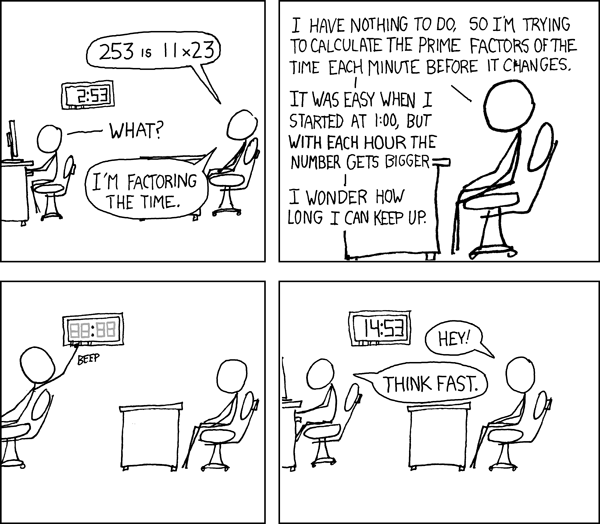
Cartoon from xkcd, of course.


Some of the exam problems were pretty open-ended, like:
1.    Find an L-shaped figure with an area of 84 sq.cm and a perimeter of 44 cm.  Is there more than one?
2.    What kind of triangles can be made by connecting vertices on a regular octagon?  Specify the side-angle type.  Did you find all of the types? 
And some were more closed, but hopefully with multiple ways to do them.
5.    Sort the quadrilaterals into two overlapping Venn diagram circles: one for rotational symmetry, one for reflectional symmetry.  Quadrilaterals that don’t fit either should go outside.
6.    A Hershey’s chocolate bar is 43 g.  A kiss is 4.56g.  You remember that 1 pound is 454g and 1 pound is 16 oz.  How many ounces is a Hershey bar?  A Hershey kiss?  How many kisses in a bar?  (Make a joke if you want.)
Nobody made a joke.  How many kisses in a bar?  Come on!