Showing posts with label To Understand. Show all posts

Wednesday, November 17, 2010

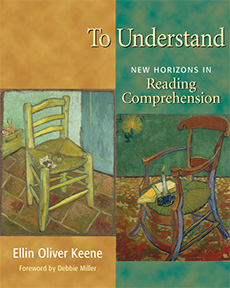
To Understand, Book Club 3

Ellin Oliver Keene
Today my preservice K-8 teachers are discussing Chapters 5 and 6 in To Understand.  I gave them four focus questions to try and help guide discussion:
  1. What is the author's main point in the chapter?
  2. How does she support that point?
  3. How does this idea apply in mathematics?
  4. What's your reaction or connection with this.
Chapter 5 - To Savor the Struggle
Mentor: Reynolds Price, author and poet who has written and spoken eloquently about his response to an inoperable spinal tumor, as well as just been more artistically productive than he was before.  (Sample of his poetry available at Google Books: The Collected Poems.)  What enables some people to flourish in adversity?

  • Greatest gift to a student is the experience of struggle leading to understanding.  We don't do it in younger grades; students may not experience struggle till college.  
  • Intentional struggle for students requires time and modeling.
  • Teaching kids how to learn to think more critically requires struggle, versusthe students just doing without reflection.  In math, struggle leads you to know why you're solving, and where the answer comes from.
  • Part of conceptual understanding is problem solving.  If it's too easy there's no problem solving.  Struggle requires problem solving.
  • How do you motivate students to struggle?  They'll sit there until someone else does it.  One student, or the teacher, or.. (several stories to back this up).
  • Once you get them willing to struggle, then they can gain understanding.  They will know why they got that answer.
  • A lot will blow off the work b/c of the struggle.  They didn't have a need to struggle until college.
  • When you conquer through struggle you're more likely to remember how, remember your process, and be able to use it again.
  • Does more struggling now mean less struggling later?  It means you will be less frustrated with struggle later.  Got through it, rather than going through it.  
  • Frustration is a problem.  You have to continue to struggle to add new understanding.  My elementary struggles make me able to struggle for a long-time now.  
  • With struggling comes a work ethic.  It was a shock in college to have to learn to do the work.
  • Struggle motivates me to want to figure it out.  
  • How much is too much struggle?  Different for every student.  Know your students and differentiating.
  • Mixed emotions.  Why don't we want to find a way to prevent struggle, for them to get it without struggle.  What happens in real life?  Remember waiting for others to solve and just get this lab done; later on, on my own, I had to do it for myself.  Want our students to get content, but more so to be able to solve their real problems in life.  They will have struggles, I want first struggles to be in the safety of my classroom.  Help them now or help them later?
  • Isn't a struggle enough now? Some of the kids struggling will ask, but some just shut down.  Do nothing.  How motivated is each student? 
  • Why don't we have leveled math problems like leveled readers?
  • How does it happen - when a student moves from resisting to engaging struggle? 
  • If you create struggle, what about that 10% that cannot even begin.  Everyone's different. 

She discusses these systems in literacy instruction, and I think it would be worth investigating in math.
  • Semantic System - word meaning and use
  • Schematic System - process focus on what it means to read
  • Pragmatic System - what do you do with the content

Leonardo's horse at Meijer Gardens, Grand Rapids

Chapter 6 - A Renaissance of Understanding
Mentor: thinkers and artists of the renaissance.  Considering the idea of intellectual liberation.  What conditions are necessary for a renaissance?
  • Allow the students to go beyond your expectations.  Challenge my students.  A teacher who designed tests so no one could get an A - that's not challenge.
  • Be interesting to see reading levels transferred to math.  A math corner... and then science.  Time and effort from teachers too much?  Maybe they don't have the background to do it.
  • Choice is a part of the answer to this.
  • The title renaissance: something new.  The testing is a problem because it's based on a norm.  Students should be awarded for original thinking.  Writing you can imagine this.  What is it like in math - original thinking?
  • Grading is fear inducing, restricts creativity.  Especially when it rewards conformity.
  • Are you going to take the classes where you struggle, or where you can get an A.  It looks good on your GPA.  Could grade technical difficulty and performance.

In this chapter she considers the importance of text and genre in literacy instruction.  What are these things in mathematics?  Is it our content areas?  Problem types?  Different processes?  Different uses like investigation, homework, tests?

The Chapter 5 discussion was energetic and purposeful.  Definitely one of the reasons to use this book.

Photo by cliff1066 @ Flickr

Monday, November 1, 2010

To Understand, Book Club 2

Discussion of Chapters 1 and 2


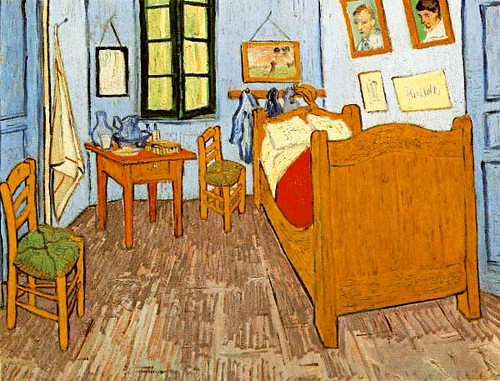
`This time the K-8 preservice teachers were discussing Chapter 3 - Driven to Understand, and Chapter 4 - Dwelling in Ideas.  Van Gogh was the art connection for driven to understand.  He said "I want to get to the point where people say of my work: that man feels deeply."  For dwelling in ideas, she meditates on Edward Hopper, since in his paintings what is not happening is as important as what is.


Reader comments:
  • Stereotypes of low income schools - that teachers don't want to go there.  But kids need someone to believe in them, and we can be those teachers.
  • Chapter 4 describes a classroom so perfect that it seems unreal.  And it does seem out of reach.
  • Have worked in classrooms with conferencing... it is hard to get that culture where students do silent reading as you meet with them one on one for conferencing.  Can meet goals of conferencing with all, though, if you're flexible on the time frame.
  • Crafting/Composing/reflection - all relevant things to any kind of learning.
  • These teachers use silent reading time after vigorous activity.  Can be more meaningful learning time by adding reflection to it.
  • Shouldn't just have reflection at the end of the day, but throughout.  While it's still fresh.  Kids will notice if it's not "dead air" at the end of the day.
  • Giving students time to think and hear themselves think can be part of the reflection.
  • How do we connect this book to math?  The painting that they're trying to understand is like the Pythagorean Theorem.  Don't have to do it a certain way, people will have their own way to make sense of something.
  • I do think about the book in relation to math, but the reading is also relevant to me as a preservice elementary teacher.
  • There are parallels to math.  
  • The book can be redundant almost... the initial question "what does making sense mean?"  gets brought up a lot.  Want the book to be more straight forward.
  • "As important as what is happening is what is not" - what do they mean?  
  • When an artist provides little detail we are left to sort it out ourselves.  "What's missing" may be those details, so that we understand it on our own.
  • The theme is that there is not one way to understand.  I won't be surprised to get to the end without a definition.  The idea is to make it your own.  Even if that's stressful or frustrating.
  • Discussion - what's happening is great.  But the kids who are not involved in the discussion is "what's missing."
  • Fervent learning... there was the story of the student who went above and beyond.  Is our goal to make every subject that interesting?  Then the students will direct the learning instead of us.  We set the stage, give the tools, and let them work.
  • Tight schedule or teaching to the test fights against teaching for understanding.  What about kids left behind.
  • I'm currently observing a teacher give the ideas to students, then they move on.  How can we stray away from that, if the schedule is any tighter?
I thought it was great that they see a tension between coverage and real learning.  But I want to encourage them that real learning can meet the goals of the test-givers, also.  Real learning will beat the standardized tests at their own game.

We related these chapters to the idea of structure and gradually releasing students to greater freedom.  Started talking about how we can wean the students away from learned helplessness.

This chapter also has one of my favorite teaching moves.  Seems just straight dumb, too.  When a student says "I don't know,"  Ms. Keene responds, "If you did know, what would you say?"  Oh! I thought there was no way that would ever work, but now I have seen it create a kind of freedom for the student to answer more times than I could count.  Incredible.

On the whole, the students confirmed that they are finding the reading worthwhile, and are glad that we take time in class to discuss it.
    Photo credits: uhuru1701 & Bert K @ Flickr.  Cartoon from Rubescartoons.com

    Monday, October 18, 2010

    To Understand - Book Club

    The K-8 Geometry class is reading To Understand this semester.  This book is Ellin Oliver Keene's follow up to her mega-book with Susan Zimmerman, Mosaic of Thought.  Yes they're reading a reading book.  But this book is really about comprehension, much like Mosaic of Thought, and most of these preservice teachers will be in elementary school, and teaching reading.  This is the second semester using this book, which had mixed results last semester, but overall positive reviews from students.

    The aspect of the book that students had trouble with is that each chapter (from 3 on) starts with the story of someone in the arts advancing their own understanding.  It was difficult for some students to connect with these stories if they were unfamiliar with the artist.   Last semester students did make lots of connection to what they'd read from Mem Fox; Reading Magic is on my list, but I haven't gotten to it yet.

    The structure we're using is groups of up to 8, where each group has a leader - responsible for keeping things moving, questioner - for prompting discussion, recorder, and a reporter who leads the group's sharing with the whole class.  After the free discussion period, the group talks about what to share, then the whole class discussion starts.

    Some notes from our discussion:

    Chapter 1:  Rethinking Understanding & Chapter 2: Seeking Understanding in our minds, our lives
    • Teach concepts for greater depth.  Current understanding is the key to understanding in the future.  Don't do too many topics.
    • Even in a calc class, you can move on before students have a conceptual understanding.
    • Quality vs quantity is a dangerous choice.  Eg. pizza parties for number of books vs what was learned.
    • Teach in different styles with kids having choice of structure.  In elementary and HS everything was more structured vs in college when the info is presented and you do with it what you will.  Elementary school needs more choice and freedom.
    • Everything has trial and error.  Repetition is everywhere, for example math workbooks that ask many of exactly the same form of question.
    • Testing is crappy, and we focus more on scores than understanding.  The test generate so much pressure from so many sources.  Home, school, etc.  You never get them back, so you can't learn from it.  Test too much, at least standardized testing.  What if the kid doesn't have supportive conditions (sleep, food, etc.)
    • All children can achieve greatness.  A principal who says "someone's got to flip the burgers..."; this kid just isn't good at that.  Beliefs will be communicated to students.  Vs. believing in all students.
    • "We can extinguish the notion that some kids are going to make it and some kids won't."  Psych study that showed teacher beliefs have a huge impact on achievement.
    • After Ellin described a great day, her husband David asked: "why isn't everyday like that?"  Easy to make excuses.    Ultimately it's because we don't expect them to.  Belief motivates.  
    • What will you do about barriers to eliminate the real reasons for student struggle?  Eg. a teacher who brought in bagels and cream cheese before a long standardized test.
    • Also be careful not to expect too much, so students feel defeated.
    • In elementary kids are excited to go to school.  They will/do lose that if it's not supported.
    • Do teachers care more about noise or intellectual activity?
    • One student hated the book so far because it felt like the author posed questions without answering them.  Another student said that that was creating a desire to read on and a curiosity.  That maybe the whole book was about what it means to understand.
     Cartoon from the always amusing Speed Bump.

    For my teaching
    • First workshop (focused on determining importance) was more beneficial than the 2nd (stopping at each page to monitor your comprehension).  Better recall of Ch 1.  Stopping at each page broke the flow of reading.  (This was ironic because last semester it was reverse, so I had changed Chapter 3 workshop to be like Chapter 2.  But I let them know they can always choose a different way to meet the objective for the workshop.)
    • This workshop (Ch 2) can be an example of what not to do.  If it becomes a task to do the motions, then it defeats its own purpose of looking for comprehension.