Showing posts with label Book Group. Show all posts

Tuesday, June 21, 2016

Book Club - Summer 16

In my math capstone class, the students can pick their own book from a list. Then we have a day for book chat. These are my notes. Links on student names go to their reviews on their own blog.

Journey through Genius, by William Dunham: Nick. Read most of this... explores a handful of the most important theorems and proofs from math history. If you're reading this, the book won't be that bad. If you're trying the proofs, it can be very difficult, and I wouldn't recommend it. Dunham claims that Archimedes is the greatest of the Greek mathematicians, the crown story. Personal stories of the mathematicians, too; for example, Cardano's tortured life. Not a lot of fun reading, but some really good explanation of why they use the methodology.

Love and Math, Edward Frenkel: Rebecca, Kourtney, Erin. "It's hard work being a teacher..." Great about the hard work being a mathematician, and the difficulties in being Jewish in an anti-semitic world. He had to literally scale the walls to get his math education. He was also moving in discussing how important collaboration is, and how important making mistakes is. The math is really high level - we could see some familiar things from abstract algebra, but there were good analogies for a lot of the ideas. "Where does love come in?" Love of math. Started in physics, but was convinced to go deeper, mentor by mentor.

The Math Book, Clifford Pickover: Anthony. Each page is like a wikipedia article about an idea, but nothing in depth. References are given so if you want to go deeper you can. "The integers came from God, and all else are hand made."  - Kronecker. It covers big ideas, inventions and famous mathematicians. Lots of fun ideas, like the birthday paradox or the infinite monkey theorem. The Johnson Theorem, riddles like the barber paradox. History of zero... I'd recommend this for teachers for the history.

Joy of X, Steven Strogatz: Jordan Drake, Nick. Easy read, a narrative. He explained negatives, but noted how we as a society avoid them (building floors, bank statements, temperatures). Strategies for finding your soulmate. What made it so easy to read was taking complicated ideas, like sine and cosine, but then gives real life examples and good visual images to support it. I went through math doing it because I could, but this gets at why these things work or are true. He gives a lot of practical applications. He gives the reasons for "why are we using this?"  Really fun to read with a lot of 'aha!' moments.

e: The Story of a Number, Eli Maor: Marty. I thought the whole book would be leading up to e, but we see it already in the third chapter. It starts with Napier, goes through logarithms, explores finance, and then calculus (Newton and Leibniz), ... It was at times interesting and boring. The most beautiful formula which makes a connection with imaginary numbers. Lots of appendices of intense proofs.


The Number Mysteries, Marcus du Sautoy:  Heather, Brianna
5 different math mysteries, got into the history of the ideas,
  • primes; the building blocks of all numbers.
  • geometry; nature is as efficient as possible.
  • tricks for games; confusing but interesting, Monopoly and more.
  • codes; Everything is a code, languages, DNA, ISBN, modular/clock arithmetic.
  • prediction; patterns are detectable, which make things predictable. Seasons lead to the calendar, etc.
"Coolest thing?" How I could relate math to all these things I had never noticed. There was just so much information.

Mathematician’s Lament, Paul Lockhart: Hannah.  K-12 math needs to be scrapped. Math is an art, it's about playing and imagination. Instead, teachers give facts and formulas for memorizing. Takes away the creativity and engagement of solving. Teachers try to relate it to life when it doesn't. It can be fun because it doesn't relate to your life. A good problem is anyone you don't know how to solve. You want students to struggle and be frustrated. Geometry is the most destructive because it destroys proofs. Instead of being charming, it's a boring list. Write a paragraph of a proof, tell the story of your thinking. Why can't 1 + 1 = 0? Even/odd + even/odd, sum of odd numbers, ... so many ways to reveal the nature of math. "As a future teacher did you find yourself agreeing or disagreeing?" The get rid of the curriculum and let every student figure out what they're working on - I disagree. But the emphasis on memorization needs to go. "Math can be fun when not related? That's really clever. Counter to the message we get."

The Calculus of Friendship, Steven Strogatz: David. Less of a math book, and ever increasing life lessons. The teacher retired and became a famous white water rafter, which is connected with limits and infinity. Irrationality, chaos theory, etc. The monk and the mountain. Will a monk who walks up the mountain and down in irregular patterns ever be at the same point at the same time. Inspiring about going into being a teacher and the effect you can have. Readable even if you don't know calculus.


Mathematical Mindsets, Jo Boaler: Michelle, Tabatha Lathrop.  Growth mindset = you can get better at how well you learn things, fixed mindset = you can learn things, but you can't change your intelligence in an area. This really affected me. The brain research is interesting; when you're making mistakes is when you're learning.  Feedback makes a big difference. Then she connects with math mindset. Most effective teaching is when learners explore the question, and then get  explanations of how and why. Using what the kids came up with is helpful, with engagement to start. Students will say they don't like math because it's too much answer time than learning time. The faster they can do math the better, kids think, when the reality is almost the opposite. Kids don't ask 'when are we going to use this?' in other subjects. I am literally a different person because I read this book.  (Others connected to Carol Dweck's Mindset in response.)  It's interesting as an adult learner, trying to think about where you're fixed or growth.


The Magic of Math, Arthur Benjamin: Andrew Meeuwsen. Topics align well with the course, but not a lot of the fun history. Lots of worse than dad jokes: mathematician dad jokes. Lots of tricks for doing specific problems. Many connections to his mathemagic show. FOIL, squares, magic of 9, magi of counting, magic of proofs... a lot of good math, but a lot of filler, too. The book has a steep slope, from arithmetic to calculus. My favorite was about infinity. It covers a lot of the subjects from undergrad mathematics.

Jerry missed the discussion, but has a review of The Calculus Gallery.

Friday, November 14, 2014

Fall 14 - Book Club

In my senior capstone history of mathematics class, I had had good luck with having students choose books to read and then sharing and swapping. (Previous post.) I thought it might be worth trying with my preservice elementary teachers, who in the past would all read one book. Currently, if I was picking just one it would be Boaler's. No more than 5 per book; choices included:
  • Accessible Mathematics: Ten Instructional Shifts That Raise Student Achievement, Steven Leinwand, (Amazon) [Practical, pre-service teacher approved)] (3)
  • Intentional Talk: How to Structure and Lead Productive Mathematical Discussions, Kazemi & Hintz, (Amazon) [Applies to more than math; good support for helping students learn to converse productively] (2)
  • Making Sense: Teaching and Learning Mathematics with Understanding, Carpenter, Fennema, Fuson, Hiebert, Murray & Wearne (Amazon) [Writers and researchers of the best elementary math curricula around tell what they think is important.] (FULL)
  • Math Exchanges: Guiding Young Mathematicians in Small Group Meetings, Kassia Omohundro Wedekind, (Amazon) [Similar to intentional talk, more strongly based in literacy routines.]
  • Math for Smarty Pants, Marilyn Burns (Amazon) [Collection of entertaining problems across all kinds of math from a master math teacher.] (FULL)
  • A Mathematician's Lament: How School Cheats Us Out of Our Most Fascinating and Imaginative Art Form, Paul Lockhart (Amazon) [Not sure about putting this on. Many readers are disappointed in the 2nd part, but the 1st part people see as a powerful argument for why math teaching has to change.] (FULL)
  • Powerful Problem Solving, Max Ray (Amazon) [New book from a very deep thinker about how to teach math.]
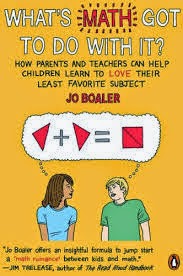
  • What's Math Got to Do with It?: How Parents and Teachers Can Help Children Learn to Love Their Least Favorite Subject, Jo Boaler (Amazon) [If I was picking one book for everybody this would be it. Dr. Boaler is doing a lot to research and shares how to make math better.] (FULL)
I was disappointed no one chose Kassia's or Max's great books - there was a bit of a follow the leader effect in choosing books. 

What follows is a poor transcript of the group discussion. On book club day, I ask students to bring in enough snacks for four people. They start in small groups with people who read the same book, then we have a discussion circle where each group shares and fields questions and I try to keep my mouth shut unless asked a direct question. (Group questions in italics.)


What's Math Got to Do With It? Jo Boaler
Anyone else hear Tina Turner
when they see this book?
I rated this book as must read, because it talks about what we grew up with, and what we should do. Connected with this class really well, and I’ve never had a class like this. The other way separates you by ability, makes the kids feel dumb or come to hate math. So then in life later, they can’t even think about careers that use them. “I wasn’t good at it I didn’t like it.”
Any specific lessons? Talked about research on the effects of this.
Also had kid perspective.
Did it address grading? Not as much as they could have. Did talk about what doesn’t work with tests and encouraged smaller assessments that aren’t a big deal. 


From Mark Bennet's visual reading notes
A Mathematician's Lament, Paul Lockhart Our book talked about teaching styles, too. His big point was that math is an art. Example: triangle area and formula. By giving problem and answer in one you’re cheating the kids. 2nd part was all about how he loves math. Redundant or over my head.
Students need to get to play around with it. Example of art class, where students aren’t told how to do each brush stroke. I like that, but 
It wasn’t very practical. We don’t have time to have each kid discover the area of a triangle. It really connected with me how I was taught. My high school geometry… my face got red as I read. 
Any solution at all? Really, no.
Also not fair to teachers to blame them entirely. Brought up issues, just wish there was more solution. I liked the book but kinda hated it. 
Was he a teacher? Sort of… 

How is he teaching?
Lockhart says, 'I want to know what you think of this. If you’re a student I send my condolences. Ignore the absurdity you’re taught in your math class.' 
You can’t be a teacher and tell students to ignore their teachers. I hated math, ignored my teacher, and got switched to a slower class - it didn’t work.
Kind of puts himself on a pedestal. 
Talked about textbooks, and how math is stuck in the 19th century. We can’t get out of it because then schools adopt these books. You read that, get fired up, but then what do you want to do. 

Talking Heads
(obviously)
Making Sense, by Fennema, Carpenter,  Fuson, Hiebert, Murray, Wearne  
We want to teach all students so that they make sense of mathematics. 5 dimensions. How to communicate teacher to student.
The book was helpful, set up logically, good examples of classrooms, but then repetitive. Everyone should read the first chapter, and then read more about one dimension.
At the end, giving examples of classrooms in different modes. But just stories - a detailed description would be better. Got tedious, chapters 7-10 were repetitive. Nice, but can’t tell the difference between some of them. Did tell how each related to topics in chapters 2-6. 
It was good. 

Intentional Talk, Hintz and Kazemi

Sets up different strategies, open discussion, targeted, gave strategies to assess and fix discussions. The examples were actual dialogues. Then they looked back and identified, here she was identifying goals, here she was introducing math ideas. Good strategies on how to make the classroom safe for discussion. The ideas and participation of all students are valued. So even wrong answers, it gave you lots of ways to use that and build from it. 
The book showed how you plan discussions. Gave a template, helped you think about how to plan it before, going from what you think they are going to say. 
I gave it a 5 because it was really helpful, I want to reread before I student teach. You wanted to take notes as you were reading.
Open strategy sharing. Like kids giving different ways to multiply, we need to think about different strategies so everyone has a way to learn.
That’s like at Family Math, we have 5 pizzas with 4 pepperonis. What’s a math problem like that? “Well we have 5 groups of 4…” I never thought about it that way when I was kid.
They give you talk moves, so you have ways to move it forward. 

Smarty Pants, by Marilyn Burns
On Etsy.
Our book was not about how to teach. It was just problems. Different kind of problems.  Listening to other people talk - I didn’t get that much out of this one. It was interesting, and fun to read through, but you don’t get a lot out of it except different kind of problems. 
Each part has a ton of new problems and cartoons.
Parents could use it as a supplement. 
My sister doesn’t know my nephews math, he’s like 14. They call me… could parents use that to practice.
This is younger, but more about abstract thinking. They got me thinking, but it doesn’t explain why it works out.
How do they take into account kids who are not ready for abstract thinking. They have specifics to do in the problem, but then it abstracts…
It is literally just a book of problems. I liked it. It was interesting. I enjoyed reading it.
Would it show them how to teach, like addition? There was a section on tricks to multiply, but it was just hints and different strategies.
It reminds me of problems of the week. I used to get my family doing them.
Even the answers were hard - upside down and backward. 

Accessible Mathematics, by Steve Leinwand
We played his Ignite on
"It's Instruction, Stupid!"
afterwards, so they could read in his voice.
This gives what’s wrong with math and gives different positive approaches. 
I really liked it. So straightforward, 10 shifts to do. Emphasizes how to always be asking questions. I’d recommend reading it. So practical, check homework more effective, using problems of the day. 

(Not much discussion, but a lot of interest in reading it afterwards.)

Their Summary My questions for them for the summary.

What would you like to read?
I’d want to read Accessible Mathematics. Like music ed, know the beats as a pattern… that’s doing math.
I’d want to read intentional Talk, because of good ways to get you to get students thinking. For teachers that are just starting out, it has very practical.
What’s Math Got to Do With It - practical, actual ways to teach.
Smarty Pants - I want to see the activities. How could you incorporate them into the classroom.
Variety or one book? Variety!  
Assigned or pick your own? 
Choice! Now we know multiple books, which one connects, time thing. 
We get to focus on one book, get more in depth, get to borrow.

My Summary
This worked out well.  I'm going to do it again, and try it in more classes. They did a nice job with this summary day, and I was convinced of their interest and investment.

I ask them to make a reading plan once books are chosen, with the end date in mind. I ask them to keep reading notes, for accountability and retention, that include a summary and a response to each session of reading. I don't grade those, but just check when done. I emphasize this as a rough draft of doing book studies as teachers, and like that we're arming them with some different book choices for those future book clubs. 

Saturday, August 23, 2014

Elementary Read

Planning my fall pre-service elementary math course, I was thinking about books. In the distant past we've read Deb Schifter's What's Happening in Math Class? (strong teacher narratives), and more recently Jo Boaler's What's Math Got to Do It. (Here's a recount of one of our book discussions about it.) But in my other classes, it's been very good to offer choice to students. (Here's a post about that.) I'm a big believer that teacher-to-teacher reflective conversation is the best PD, and book discussions make good context for those discussions. (A pdf of some research on this by Burbank, Kurchauk and Bates in The New Educator.)

I was finalizing my list for them to choose among, and thought to ask on Twitter. As usual, unexpected generosity in people thinking and answering. (I don't know why it's still unexpected.) Here's the responses:


A Mathematician's Lament.

I don't have a long list I'm drawing from, but Marilyn Burns' "Math for Smarty Pants" comes to mind. 


@j_lanier I second this. Have ordered to share with my elementary teachers in the district.


Rudin! Go big or go home ;-)

Children's Mathematics. 

Euclid’s Elements, because it’s comprehensive :P


Powerful Problem Solving. Lots of great examples.

 
Young Children Reinvent Arithmetic: Implications of Piaget's Theory by Constance Kamii


maybe "Creative Problem Solving in School Mathematics" by George Lenchner.


I second but I also like 10 Instructional Shifts by @steve_leinwand

making sense:teaching & learning with understanding by James Hiebert - geared k-8 but great for all math teachers


#1 for me is What's Math Got to Do With It? by , #2 is Knowing and Teaching Elementary Mathematics by Liping Ma ... #3 is Thinking Mathematically: Integrating Arithmetic and Algebra in Elementary School by Carpenter, Frankl, and Levi


Van de Walle, Teaching Student Centered Mathematics 

What a great bunch of suggestions. So my final list for them to choose from is below. I'm requiring at least two people per book, at most four. (24 students) In addition to the benefits of choice, I'm hoping that a variety of books enriches our classroom discussion.
  • Accessible Mathematics: Ten Instructional Shifts That Raise Student Achievement, Steven Leinwand, (Amazon) [Practical, pre-service teacher approved)]
  • Intentional Talk: How to Structure and Lead Productive Mathematical Discussions, Kazemi & Hintz, (Amazon) [Applies to more than math; good support for helping students learn to converse productively]
  • Making Sense: Teaching and Learning Mathematics with Understanding, Carpenter, Fennema, Fuson, Hiebert, Murray & Wearne (Amazon) [Writers and researchers of the best elementary math curricula around tell what they think is important.]
  • Math Exchanges: Guiding Young Mathematicians in Small Group Meetings, Kassia Omohundro Wedekind, (Amazon) [Similar to intentional talk, more strongly based in literacy routines.]
  • Math for Smarty Pants, Marilyn Burns (Amazon) [Collection of entertaining problems across all kinds of math from a master math teacher.]
  • A Mathematician's Lament: How School Cheats Us Out of Our Most Fascinating and Imaginative Art Form, Paul Lockhart (Amazon) [Not sure about putting this on. Many readers are disappointed in the 2nd part, but the 1st part people see as a powerful argument for why math teaching has to change.]
  • Powerful Problem Solving, Max Ray (Amazon) [New book from a very deep thinker about how to teach math.] 
  • What's Math Got to Do with It?: How Parents and Teachers Can Help Children Learn to Love Their Least Favorite Subject, Jo Boaler (Amazon) [If I was picking one book for everybody this would be it. Dr. Boaler is doing a lot to research and share how to make math better.]
Last cuts: Moebius Noodles,  The Math Book by Clifford Pickover (beautiful history of math), and Deb Schifter's What's happening in Math Class.

5 Practices by Smith and Stein (dropped for Intentional Talk and Exchanges) and the NCTM's Principle to Actions were just not accessible enough in this structure. I think if everyone was reading the same book, those would work better.

This course focuses on pattern, geometry and statistics, with number and operation in another course. Otherwise CGI would be on for sure. The Young Mathematicians at Work books are a fine series we use with our elementary teacher math majors.

P.S. And then, like any modern story, it ends with a sequel invitation...

Good question, extend. If you could get your child's HS math teacher to read one book, what would it be?