A blog for sharing my math interests on the web, to post new materials for elementary, secondary and teacher ed, and vent mathematical steam when needed.
Thanks for visiting!
It is no secret to my students how much I love the Product Game. It is fun, not just fun for, you know, a math class. The strategy required is at least as good as Connect Four, which is a surprisingly deep game. The practice value is huge, as students have to compute many, many more products than would ever be done on worksheets. The mathematics has connections, as the products lead to factorization, which enhances the strategies available. But even the pedagogical structure is nice, as you consider moving one factor leads to considering families of multiples that are good for learning multiplication facts in a way that promotes fluency and efficiency. The first I saw of it was from the Middle Grades Mathematics Project, the precursor of the excellent Connected Mathematics Project middle school curriculum. (Which still has the game.)
So I love to adapt it. It's never quite as good as the original, but often the great structure of the original allows new features to come to light. Here's a previous handout that has the original Product Game and and Integer variation.
The fifth grade class I'm working with is beginning multiplication of decimals, by considering whole number times decimals that include tenths. They're starting the whole counting up the decimal places routine, without much though of unitization. If you have 5 bags with 4 apples each, you've got 20 apples. If you have 5 groups with 4 tenths each, you've got 20 tenths... it's just that we don't often look at 2-point-OH as 20 tenths. With my class I'd be looking for a context to start at this - probably money.
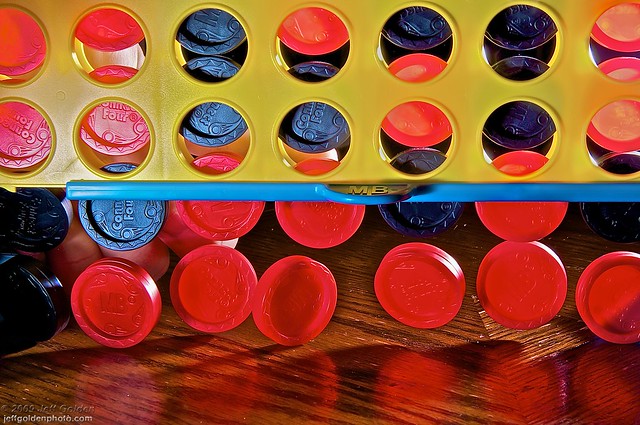
This class expects games from me, though. I thought we had played the product game already (that was last year, Mr. Golden!) - oops. In this version of the game, there's markers to make for your team. I didn't have my usual two color counters available, but I've also learned that making markers or game pieces is a point of engagement and pride for some of the students. Others are content with a quickly scrawled initial, and that's okay, too. Mr. Schiller set a time limit of 3 minutes for making your markers, which was a good idea and the right amount of time.
We were to start by playing me vs. the class, so I could model some of the multiplying strategies I wanted to share. But my son made me some excellent University of Michigan and Michigan State markers, and, being a proud alum, I had to be State. There were students who couldn't bring themselves to being on U of M's team, and how could I argue? So we played Spartans vs. Wolverines.
The group play got us through all the rules and allowed us to model a lot of the whole x tenths. But we never got up to the hundredths. So we discussed how to get those. I think they knew on some level it was tenths times tenths, but had a bit of the 'we haven't been taught this yet' syndrome. I used the analogy of a dime being a tenth of a dollar, so what's a tenth of a dime? "A penny!" And what part of a dollar is a penny? How many does it take to make one dollar? It is terrific that they are used to seeing one cent written as .01
It was interesting seeing them play. They started out almost entirely in whole x whole, and then were forced to the whole x tenths by the game play. And if the game went on long enough, to the hundredths. Several people got calculators to explore this, and a couple got to the calculators and then beyond them in the space of the hour. Some students were done with the game after one session, but others were definitely up for more. Hope you get a chance to try it and get a little bit addicted.
Photo credits: From Flickr, jeff_golden, 24oranges.nl and fireflythegreat.
As we consider games for the classroom, there are several possible purposes:
they’re fun.
skill practice with engagement that worksheets can’t match.
sometimes the game can support the underlying concept development.
sometimes they can be the context to help conceptual understanding.
provide an opportunity for problem solving in the context of game playing strategy.
I often launch a game by playing me vs. the entire class. It tends to communicate more of the rules than just explaining them. I’ll often have students play in two person teams to start, as their discussion helps work out understanding of the game and the mathematics. After the lesson, I’ll try to engage students in a conversation about what they noticed, what their strategy was, and if they would change anything about the game.
The games for today: you will rotate through the tables, spending a few minutes trying out the game at each stop. This may not be enough to finish a game, but will hopefully give you an opportunity to get a good taste.
Game - Presenter - Content
Consecutive Capture - Emily Trybus - Integer representation on the numberline
Tug of War - Anne Harkema - Integer small number addition, especially positive + negative.
Close to Zero - Jill Beauchamp - Two digit integer addition, especially positive + negative
Zero Rummy - Cassie Becker - Integer addition with more than two summands, especially zero pairs and sums.
Honeycomb - Nick Smith (game coauthor) - Integer multiplication and addition
+/−24 - Emily Scothorn - Integer operations mixed plus order of operations
At the end we’ll try to come back together to discuss which games you liked the best for your classroom and why.
Files for the day. Click on these links to see or download the games. (Finally updated to Google Drive to get rid of Scribd links. Some PDF, some Word.)
Handout - including the Product Game and adapted Integer Product Game
I tinkered a lot with the Product Game to adapt it for integers, and then found the exact same version I came to on the Connected Math Project website. Sigh.
The most interesting games to me are Gridfight and Honeycomb. My preservice middle school math teachers helped with the playtesting of these games, and gave a lot of valuable feedback. Consecutive Capture is a nice variation of Fraction Catch... which I was about to link to, but I guess I haven't written about yet... and the preservice teachers were fond of it. Most of the games had someone who really liked them, with the possible exception of Treasure Hunt, which is meant to be a quick and easy introduction game, and indeed the preservice teachers found it simple.
The idea behind Gridfight came from wanting to get at the area model for multiplication. I like the way it kind of presages Algebra Tiles. The goal of filling in rows enables you to win even when the other person gets more areas to fill in. The strategy of it appealed to students, and it had a lot of replay value.
Nick Smith, one of the preservice teachers and the presenter for the game, came up with a lot of the idea for Honeycomb. He was sold on the hexagonal grid, and had the idea of flipping and replicating stacks of two color chips to get the feel for multiplication by a negative. We wound up making it a pen and paper game as it was clumsy with the chips. It's got a large luck component with the dice, but enough strategy to keep people engaged. This is a game I'd be interested in seeing implemented on the computer.
I hope you enjoy the games, and would love to hear what you think if you get a chance to try them.
In a gig with Mr. Schiller's 5th grade last week, I was overcome with indecision. They'd been working on fraction multiplication and I had three related activities, and asked the teacher to pick based on what he wanted for the class. The first was just skill practice. (This is the option Mr. Schiller chose.) I had never made it, but was confident that you could make a good fraction version of the Product Game. This is almost what I made:
The only change is that I originally left off 5/12, but the fifth graders convinced me that it should be on. My thinking was that it would be nice if one unsimplified product was not available, creating a situation where players had to consider equivalent fractions. But the game itself brought it up enough that I think it's unnecessary. Click on the image for the full size image which should print properly.
These students have been practicing fraction multiplication, and simplifying and 'unsimplifying' the result. They have played the Product Game, which is the greatest math practice game ever. (In the Connected Mathematics Project Prime Time module now, may be from the Middle Grades Mathematics Project before that.)
I launched the game by playing me vs. the class. Reemphasizing that you only get to change one factor at a time, the goal is to get four in a row, and the new idea that there are equivalent fractions. If you multiply and get 6/12, you can cover 1/2, and vice versa. Then the students played pair vs. pair. At the end we summarized by discussing what they noticed about the game, and what they thought made for a good strategy. I did point out to them that someone would tell them fraction division was hard, but they've already done it when they're figuring what to multiply 3/4 by to get 6/12.
The second idea was to have the students develop the ability to make sense of their answers through a constructive representation. Right now, I think the students are mechanically carrying out the multiplication, without much intuition to inform them if their answers are sensible. These questions are adapted from an activity I do with my preservice elementary teachers.
I like playing the video before the activity, but that is obviously optional.
Potatoes
"Potatoes, mash em, boil em, stick em in a stew.” – Samwise Gamgee.
Things are _______ (awful, bad, okay, good, great) because you have potatoes! Draw a picture to justify each answer. Write an equation or number sentence for each story, if you can.
Find how many pounds of potatoes you’ve got if you search the cupboards and find…
1) 1/2 a bag of potatoes, which started with 2 pounds of potatoes.
2) 1/2 a bag of potatoes, which started with 2/3 pound of potatoes.
3) 3/4 a bag of potatoes, which started with 2/3 pound of potatoes.
4) 1 ½ bags of potatoes, which each started with 2/3 pound of potatoes.
5) 1 ½ bags of potatoes, which each started with 3/4 pound of potatoes.
6) 4 bags of potatoes, which each started with 1 1/3 pound of potatoes.
7) 2 2/3 bags of potatoes, which each started with 3 ¼ pound of potatoes.
8) ____ bags of potatoes, which each started with ____ pounds of potatoes.
(You make the problem!)
The numbers are chosen pretty intentionally to allow for some connections and the possibility of relating the quantities to each other. I like potatoes (of course) because they can be used for a discrete or an area model or a nice casserole. My plan was to start with problem 2, demonstrating for the class a couple different models, and then have them start on number 1.
The third option was to get at a new context for multiplication. As anyone following the Keith Devlin multiplication fiasco knows, the prevalent contexts for multiplication involve repeated groups. One of the other contexts that is often nice for rational numbers is the idea of stretching and shrinking. That always puts me in mind of Alice, and how her terrific adventures began.
Go Ask Alice
“One pill makes you larger, And one pill makes you small
And the ones that mother gives you, Don't do anything at all
Go ask Alice, When she's ten feet tall” – Jefferson Airplane
Sort of from “Using Alice in Wonderland to teach Multiplication of Fractions,” Susan Taber, MTMS, Dec 2006
“There seemed to be no use in waiting by the little door, so she went back to the table, half hoping she might find another key on it, or at time she found a little bottle on it, ('which certainly was not here before,' said Alice,) and round the neck of the bottle was a paper label, with the words 'DRINK ME' beautifully printed on it in large letters.” Alice in Wonderland, Lewis Carroll.
It turns out that she drinks it, and shrinks to 1/6th her former size. Now she later finds a cake…
“She ate a little bit, and said anxiously to herself, 'Which way? Which way?', holding her hand on the top of her head to feel which way it was growing, and she was quite surprised to find that she remained the same size: to be sure, this generally happens when one eats cake, but Alice had got so much into the way of expecting nothing but out-of-the-way things to happen, that it seemed quite dull and stupid for life to go on in the common way.” But soon, “Just then her head struck against the roof of the hall: in fact she was now more than nine feet high, and she at once took up the little golden key and hurried off to the garden door.”
It made her grow almost 12 times larger.
1) What height would she be if at 10 ft tall she took a sip of on-sixth potion?
2) If she started at 5 ft tall, and then took a sip of one-sixth potion, how tall would she be? In feet? In inches?
3) If she took a bite of ten times cake and then a sip of potion, would she be the same height as what she did, which was take a sip and then take a bite?
4) Having had one sip and then one bite, how close can she get back to her original size?
Let’s add to the story shall we? Suppose she finds a times-three cookie, and a one-fourth soda.
5) Starting at 5 feet, what height does the one-fourth soda make her?
6) What effect would the times three cookie have, followed by the one sixth potion?
7) If she starts at 5 feet and wants to be 6 feet tall at the end of it, what should she eat?
8) In the story she wishes to pass through a 15” door. If she had the choice of all four magic items, what should she do, starting off at 5 feet tall?
9) What other mixtures are possible with all four items?
What does this have to do with fraction multiplying?
What did you learn from these problems?
It's just such an amazing context, and that's without getting into the mushroom, which she uses for more controlled growing and shrinking later on. Of course when my son is ready for these problems (soon, I think) we'll have to switch the context.




 Posts
Posts


