Showing posts with label teacher education. Show all posts

Tuesday, April 28, 2020

A Mathematics for Teaching Reflection

Mediated Field Experience is the term my colleague Esther Billings is using for our preservice elementary math education course that takes place in the schools. The schools have made a classroom open to us, and we teach weekly. What makes it mediated is they use and modify lessons the profs provide, and we observe them and give feedback. When it works out, we also have a student assistant who observes and gives format using a short reflection heuristic. This is a bit of a contrast to many of their school experiences as preservice teachers before their internship, where their time with students is unstructured or less supported. 

This semester both of my sections taught two 3rd grade classes, usually repeating the lesson with their other group. Pairs of college teachers worked with 2 to 4 kids, grouped by the teachers, for 45 min. Before they taught, I did a number talk with the whole class for 10 minutes. (Problem strings, quick images, numberless problems, story problems, etc.) Here's our lessons from this semester.

There is a flipgrid of many of these students talking about their experience, and why they think other students should choose this over the regular college course (which is still an option).

This semester, despite the interruption, I hit on a simple end of semester reflection that surprised me with the connections that these teachers made. I've had trouble giving the principles for effective math teaching much life in an academic setting (or the even harder to communicate high leverage practices). So I thought I would share a representative sample.

I asked: "Read these 8 principles for effective teaching of mathematics. For each, give an example of when you as a teacher did, we as a class did, or read about a teacher doing that principle. (list)" Everything in the bullets is a direct quote from a preservice teacher.

Establish mathematics goals to focus learning

  • As a class, we accomplished this task through the content journals that were assigned throughout the semester. The content journals were focused on content standards which stated clearly the goals of each day we spent together in the class. By explicitly stating the standards in text, the instructional goals were shared with each of us. This not only allowed us to have a clear understanding of what we were going to be learning, but also allowed us to understand the content in a more concise way. We then put this principle to work by using the content journals to determine our understanding of each of the goals. For each of the content journals, we were given the standard that pertained to the classwork and classroom learning we had done and asked to show our understanding of that standard.
  • Everytime my teaching partner and I meant with the students we were working with before we did our warm up activity we would tell them the goals for the day. We never would say by the end of the activity that they should have full understanding or grasp on the topic, but rather we would say such things as, our goal for today’s activity is to think of addition/subtraction, place value, etc. strategies.


Implement tasks that promote reasoning and problem solving

  • As a teacher I have done this multiple times with my lessons. When working with groups of students, not everyone has the same way of getting an answer so I make sure that everyone has a chance to say how he/she solved the problem. If they all have the say way of getting to it I would ask them if they knew another way to solve it or how else they could get the same answer (I would ask this even if they didn’t all take the same path of solving)
  • An example of this is when we created the wordless story problems. We also read about the teacher in Chapter six [Tracy Zager's Becoming the Math Teacher You Wish You'd Had, our text] who gave problems with multiple entry points
  • We did a lot of story problems with one of our groups because we could see their thinking better. A lot of the times they would disagree on what the correct answer was so they would have a discussion with each other for how they got their answer. This helped them show their solution and problem solving through their work.

Use and connect mathematical representations

  • A time I used this as a teacher was when my students and I were doing a number line on a white board, we started at a certain number and I had them added the same number to the prior number, taking turns in a circle. After going around a few times I gave them a number to get to and they had to figure out different ways to solve it. They subtracted the number they ended with from the number I gave them, they added by 10s or 20s until they got close to the given number and figured out the remainder. One of my groups of students even made the connection that adding the number 7 three times is also multiplying 7 by 3. 
  • I saw this principle most while we were learning about teaching fractions as a class. We learned about teaching fractions by making sense instead of just teaching algorithms which don’t strengthen student understanding. We learned to make connections for solving to find if one fraction is smaller than another by seeing how close each fraction is to easier fractions such as ½. There is also an activity where each part of a fraction is a cut up circle, so ⅛ would be shown as a circle cut into 8 equal slices. Then students are able to layer the fractions on top of each other to compare and find out questions such as which is larger. This also helps them see that the larger the denominator, the smaller the individual piece / the smaller the fraction will be.
  • I am brought back to the video that provided an example of representing fractions through a context. Each group of kids were able to come up with their own method of describing how the subs were split up. I remember commenting that there are so many different ways to understand and compute fractions. I find myself struggling to find the best way to solve a problem. I understand the importance of illustrating different ways to solve a problem as a teacher. This allows for students to freely represent their thinking in a way that works with their mindset. And that is what occurred with this particular example.
  • In lesson 8, we focused on practicing multiplication using representations and connections. We played a game where the students drew numbers and made rectangles with the dimensions of those numbers, and multiplied them together to find the area of these. During the game, Joaquin discovered that “multiplication is just like addition” and so I had him explain to the other students why he thought that, using the rectangles as representations. 


Facilitate meaningful mathematical discourse

  • Reading the Becoming book I really liked the story from chapter 13 the teacher Ann’s story with the Powerball. It was exciting to see all of those kids questioning and looking at a whole new view of a question not even the teacher hadn’t thought about before so it brought a lot of meaningful conversation into their classroom even before class was actually started.
  • A specific example of this happened during lesson 7 when we briefly showed our students a picture of a piece of toast with blueberries on it and then they had to tell us how many blueberries were on the toast. We had the students share how many they counted and how they did. They both counted 12, but differently. They talked amongst each other about the ways they had counted, and each acknowledged that both ways were effective, but decided that one's student way was more effective. Count the number of rows and times it by the number of columns.
  • This reminded me of when after we met with our third graders for the day we would share stories about what happened that day. I really think this was helpful because if it was a Tuesday and my group had a rough day with the lesson but another group shared how they had a successful day, I could use their ideas for my lesson on Thursday so it would be more successful. 
  • This is something my partner and I did a lot to keep the students engaged, to build relationships, and to listen for reasoning. During many of our lessons we asked our students to share outloud how they thought about something or their approach to a problem. We encouraged them to share their thinking and to used it as a way to talk about new approaches and different strategies. There was many times that one student answered a problem a different way than another student. We wanted our students to talk to each and learn from each other. Sometimes we can learn the most from our students or from our peers. 


Pose purposeful questions

  • I think our numberless story problems are a great example of this, I had never had experience with them as a student but I love them and when I am a math teacher one day I will definitely use them. The reason I like them so much is because it slowly introduces the idea of the problem and the context of the story before throwing too much at  them by giving them everything all at once. 
  • An example of something I did as a teacher to fulfill this principle was asking the question “how do you know that?”. I had listened to Professor Golden ask us this question in class, so I made an effort to use it when working with the students. This question is simple yet it invites the student to consider their thought process and how they arrived at their understanding. This question is purposeful because not only does it allow the teacher to have a greater understanding of the student’s understanding based on their reasoning, but it also gives the student the opportunity to self-assess and consider their own thought processes and reasoning when learning mathematics and interacting with problems. 
  • Professor Golden's number talks with the children to begin each session with them was a great way to get a routine down with students that help them be able to recognize procedures and ideas about math. The number talks were good ways to emphasize all students' thinking and model and represent the various strategies and thoughts students have on the problem at hand. It is also an inclusion and safe space to talk about wrong or right answers, modeling that mistakes are okay and that struggle to find multiple strategies will come with time.
  • I enjoyed the Notice and Wonder that was encountered in our MTH 222 classroom. From Homework to the discourse we had in class/with our tutees, questions were facilitated in this pattern. It was especially incremental with our Numberless stories! The basic structure of Notice and Wonder follows from ch. 7 of our Becoming Textbook: 
    • Give students an image or scenario without a question. If you like, you can use problems from your curriculum and obscure or delete the question.
    • Ask them, “What do you notice?” (You might want to use think-pair-shares at each step to increase engagement and thoughtfulness.) Record their noticings so students can see them. 
    • Ask students, “What are you wondering?” Record their wonderings.
    • Ask students, “Is there anything up here that you are wondering about? Anything you need clarified?” Pursue any follow-up questions.
    • Once students have had ample time for noticing and wondering, you can either reveal a question you’d like them to solve or have students come up with a question by asking, “If this story were the beginning of a math problem, what could the math problem be?”
  • This reminded me of when after we met with our third graders for the day we would share stories about what happened that day. I really think this was helpful because if it was a Tuesday and my group had a rough day with the lesson but another group shared how they had a successful day, I could use their ideas for my lesson on Thursday so it would be more successful. 

Build procedural fluency from conceptual understanding

  • By picking apart both addition strategies and subtraction strategies, both in class and in the homework in articles and in the book- we learned about a lot of procedures and created fluency in those procedures, from understanding how different methods work and the underlying meanings of the numbers and their many properties. By understanding place value, and the numbers, and groupings and factors of numbers, we are better at understanding and applying those concepts together to understand both the procedures and strategies of, say, addition or subtraction, and develop fluency from correlational learning.
  • This was something I noticed about my own learning. I think I came into the class knowing mathematical procedures for a lot of concepts. I left the class knowing why I do a mathematical procedure here, and how I can use my problem solving skills to build on what I already know. For example, I learned a lot about story problems. I knew how to answer story problems but I didn’t understand how they work and really the differences between them. There are a few different kinds and while they focus on different things they are meant to be used as a mathematical tool. Story problems are designed to make students stop and think about what the question is asking them. They are also used to help students visualize a situation and determine the right approach to it. I used to have the mentality that you should find and pull out the numbers and do something with them like add, subtract, or multiply. I now know to stop, slow down, and think first. 
  • One of my students, ____, had a hard time doing addition. We tried a lot of different techniques and ideas with her, but one class she just decided to try a problem using her own technique and she got the answer correct. She was flexible and once she was able to do it her way, she began to understand the ways that we were presenting to her. 


Support productive struggle in learning mathematics

  • This we used in class and myself as a teacher. This was helpful with the number circle because we were doing this with difficult numbers to see if my students and myself were able to find easier or different ways to find the next number. We supported answers and time to think and did not shout out and point out if the students added or subtracted incorrectly. Figuring out problems in your head and by yourself is more productive in learning new ideas/concepts.
  • This was something I had to learn to do. After Ms. Cordy came and talked to us in class. I got a better understanding on how to do it. A productive struggle is so important in helping a student being able to learn a topic that might be hard for them to grasp, you can't just bail them out with their first answer, or “I don’t know” and move on from the topic, you want to make sure that know what they are talking about, or else you could just move on leaving them behind.
  • We gave our students the problem 123/10 to do, and they were discouraged at first due to the big numbers and division, _____ even said “this is too hard, we can’t do this!”. However, we let the students sit and think for a while, trying out many different strategies and giving encouragement when they seemed stuck on an idea. Eventually, they focused on counting up and down by 10s to find the answer, and were debating whether it is 13 or 12. Hannah and I reminded them there can be a remainder and this helped them decide the answer was 12 with a remainder of 3. They all had tried multiple methods of solving, and Hannah and I encouraged them to keep trying until they figured it out, and they seemed to feel very accomplished after doing so. 
  • A way we supported productive struggle when learning mathematics was by not just giving them the answer when they were wrong. We would ask how they got the answer they got and we would discuss it as a class, hearing ideas from multiple students. We also let everyone know that it is okay to not always get the answer right, and everyone can learn from the mistakes they make including the teachers. We also make mistakes and are learning as we go on, this helped not put so much pressure on them to just “be right” but to actually understand the content they are learning and feel comfortable asking questions. 


Elicit and use evidence of student thinking

  • Throughout the semester I kept a lot of evidence of students thinking through photos as well as notes.  I began writing down student thinking on a white board to help myself understand the student’s thought process.  This proved to be an excellent resource to look back at and analyze.  Oftentimes I learn a lot from the students and they showed me ways of thinking that I would never have thought of.
  • Something I think I developed a lot over the semester was to ask better questions to the students. I wanted them to be able to explain their thoughts to me. I would often ask, “how did you get that?” “why?” “is there another way?” I remember constantly saying, “I want to see your thinking.” That’s where I got a lot of feedback from the students. 
  • The logs we kept on each meeting and observations we made about each individual student helped us pick activities that challenged them appropriately.
  • Hannah and I realized that our students in Mrs. Caterino’s class had a hard time subtracting when the number being subtracted had a larger first digit than the first number (ex 32-18). We decided to change some games from addition to subtraction to help add practice of that, and adjusted them so there were more problems like this so the students could work on doing subtraction problems like that. 
  • Since all of our students were on such a variety of different levels we had to develop our lessons to make sure that everyone would be able to try it and be challenged mathematically. So we’d have follow up questions for our student who would fly through problems and made sure our student who was struggling understood what he was doing mathematically and why.
  • We would evaluate students' work from past weeks and what they were knowledgeable on, and use this student's thinking to tailor our future lessons and make them accessible to all the students.

I was pleased to see connections to our reading, our content time, the number talks they observed, and some progress in their thinking and use of these ideas over the semester. I think the principles became real for them in a way that I haven't seen in traditional teacher prep.

Friday, February 15, 2019

#AMTE2019 #MTEchat

Last weekend I was at the AMTE 2019 Conference. Paul Yu (GVSU colleague) and I were presenting a brief report on a project where we looked at how our different classes impacted preservice elementary TPACK. (Technological Pedagogical Content Knowledge.) Wait where are you going?

(The materials are here if you're interested.)

That's actually my reaction, too. I have a weird love hate relationship with research. I think it's important, I love to read it, but so much of it is irrelevant or over-applied. And almost all of us there have the job of preparing future teachers, and there's little talk of practice. I so much prefer going to meetings with teachers where we talk about teaching.  (Twitter Math Camp being the peak experience.)

There was some teaching talk. My colleague Esther was part of a session on mediated field experiences (being in the school with preservice teachers) that had a variety of people working in related contexts to talk together about what we're trying. But there were no resources to share or way to continue the conversation afterward.

The AMTE Equity Committee led a session on on addressing novice teachers understanding and readiness to teach diverse students. (Here's my twitter notes.)  At the end, there was a question would people be interested in a syllabus or reading list... Hell, yes! So maybe we'll get it somewhere, some how.

Headed into Denise Spangler's Judith Jacob lecture, I was pretty fed up with it. But I bumped into Joanne Vaskil, who was part of our brief report session. (She is part of a group using Twitter with their preservice teachers for responding to assignments.) Talking about it - she is an excellent interviewer - she got all of this out of me. And I was comparing this with the #MTBoS, which, to me, is built on sharing practice and questions about it. Joanne pushed for doing something about it. We thought about hashtags, and #MTEchat seemed about right. Being at the Association for Mathematics Teacher Educators, people were referring to us at MTEs. (#ITeachMathTeachers seemed a little too Sixth Sense.) Turns out people were already using it for this. Logical people are logical.

One of the values/ professional practices I try to instill in novice teachers is to not try to go it alone. Collaborate, find support, and share with others. Sometimes it happens in your school, which is the best option, but even then, think about being active at the district, state or national level. What is good for our students' learning is good for our learning. In turn, what is good for our student teachers' learning is good for our MTE learning.

Joanne already got the ball rolling. So... why don't you join us?  How are you preparing teachers? Share stories, questions, images, blogposts. If Twitter isn't your bag, help us figure out what the proper place will be. Glenn Waddell, researching teacher use of Twitter, could see that there was a healthy slice of people on Twitter at the conference. But they were most were isolated.

Let's get together!

Tuesday, January 30, 2018

Chris Emdin #HipHopEd

Last night I got to hear Christopher Emdin in my own back yard. He was brought in to GVSU by the Black Student Union for Black History Month, without the College of Education or science educators even knowing about it. This is not going to be as much a recap as a response. I overtweeted during it as I think about that as my note taking now. (Here's the thread.) Saying he is a dynamic speaker is an understatement. He's the best presenter I've ever seen. It's a performance, it's heightened prose, it's preaching. Here's his SXSW keynote if you want a sample. And you want a sample. (Also his book, of course.)

So my response?

HELL YEAH.

This is my vision of education, expressed better than I ever could. It is about acceptance of all the varieties of giftedness and personhood and a chance for them to do deep, meaningful learning as themselves.

Dr. Emdin's emphasis on story telling as a way to share your own ratchetness and enter into your learners' world really resonates with me. David Coffey and I have been talking lately about just how can teachers share what they do. A Teach Off giving a lecture? No. Telling the story of what they do and why they do it and with whom they are doing it? Yes.

Part of making space for that story is accepting the pain of those rejected and making space for it and the healing. I love his idea of swag/cool/ratchet as the in-between of wound and healing. It makes sense to me and ties in to some pretty deep beliefs I have about redemption.

Chris warns against going into the hood (which can be anywhere that people are marginalized) armed only with the pedagogies of oppression. Dewey and Piaget and Vygotsky are still heroes to me, but that means we must contextualize them as well.

He offers no panacea, but inspiration. Progress is possible. Learning is local. And embrace your own ratchetness.

Tuesday, December 6, 2016

Why Math?

I'm teaching a preservice teacher math for high school course this semester. You wouldn't know, since I've been so bad at blogging this semester. This is the best group of writers collectively I've ever had, I think.

There's an odd issue, though. They're already leaving the profession! Here's some last blog posts:

Then Dan Meyer had this amazing group keynote at CMC-some direction. We need math teachers to teach good reasoning so that people will not spread fake news. And a lot of other good reasons. And Bowman Dickson wrote his teaching philosophy, which motivates me just reading it.

I think about why teaching a fair amount, but don't know that I think about why math teaching. I'm so far in, there's no getting out. But what about our students? One thing I'm hearing more and more is how many people are telling young people to not go into teaching. But if they are persevering in pursuing teaching, why should they teach math?

Math is power for their students. If they are successful in math, their choices for future careers expand. If they learn the mathematical practices, they will be more successful in any career. But beyond that, it will support them in living a better life, making better choices and being more informed.

The very first course I taught (30+ years ago!), and I use taught loosely because I was not a good teacher, I was impressed by how after a good lesson, students could do something that they could not do beforehand. They had literally expanded their capabilities. What a privilege to teach a subject like that.

Math is beautiful. It's not often taught that way, but the sheer power of the ideas that underly what is taught is bewildering. The complexities of the infinitely small and large, the realms of pure thought can be traversed, and the ineffable mysteries of what is possible. WOW. Eugenia Cheng describes math as the logical study of logical things. How does that humble beginning become star-spanning cosmologies and quantum field theories? Jamie Radcliffe described math as a language in which you can only write poetry. There is some bad poetry, but the best has a power and grace that is preserved through the centuries.

I teach math because it is worth knowing and I want to share it. Because I want more people with whom to play!


Tuesday, May 3, 2016

Teacher Preappreciation

Yesterday's post was feedback from a group of students that I want to do better for. That applies to this group of preservice teachers as well, but today's post is just going to be some bon mots from these guys about teaching.

I am such a teacher fan boy; I consider myself so fortunate to spend so much of my time working with people who are dedicating themselves to others. Hopefully this post shows that this extends even to before they're in the classroom. I encourage you to click on the link to their blogs and poke around a bit. I hope you have the time to read these - it's like getting a dozen semesters of elementary math ed. And you'll be able to see why I am going to miss these guys.

Kalyn gets us started: "Getting together a small group of soon-to-be teachers with the goal of having students understand and even like math more than what typical stereotypes say, creates a strong classroom. During the semester we had the opportunity to work with different people and learn from each other. We didn’t always agree on what we thought the answer was or on a particular way to solve a problem, but that was kind of the point of the class. We learned to express our ideas, and hear others ideas, and LEARN from each other. The ideas that many of my colleagues had were great and it is said that two works better than one, and I am pretty sure that 13 works even better than 2." 
     One exemplar: "Half of It: The last writing I want to submit is based on a problem that I explored. The problem was simple in nature, but contained a lot of strategy and mathematical thinking. Breaking down a problem and writing about it was something that I never did before this class, and I felt that I learned a lot from it. http://kalynjoy.weebly.com/blog/half-of-it"

Dayna: "One of the main ideas i learned from this class is to let the kids make discoveries about the content. I am now a firm believer in that students learn a lot when working with new things on their own. this also goes with being able to work with others. We demonstrated this idea in class everyday and i found myself learning so many new ideas and methods from everyone in our class. I also learned about time and how it is going to take every student a different amount of time to do their math problems."
     One exemplar: CGI story types. http://daynaball.weebly.com/mth223/through-the-eyes-of-a-teacher, "I choose this blog because i think it is a great take away from a class that confused me. I think it is important to know these strategies and making sense of them so i can help my students make sense of them in the future."

Dana: "The big idea I will take away from this class is that we need to delve into the student's thinking.  It is not enough for students to get the right answer on math problems, they need to be able to think mathematically and explain their answer.  I never thought about asking a student for their thinking before this class, and now I cannot imagine teaching math without do so"
    One exemplar on Sorting Geometery. http://danamspielberger.weebly.com/blog/the-unasked-question "For this one, I liked the challenge of writing a math blog post.  On all of my other posts, I think I tried to stay way from talking about anything that had something to do with math, but for this one I was specifically challenged to do the opposite.  This allowed me to explore math problems and pick one that I thought was interesting.  This post is one of my best because I was able to talk about something interesting to me while still being challenged."

Sarah: "This course has made me re-evaluate teaching and see the impact of looking deeper into mathematical concepts. Even the concepts that we consider simple and elementary level contains patterns and characteristics that we never evaluated as a child. An example would be double-digit subtraction. If a student asked me exactly why do we borrow, would I be able to give them a complete answer? When I think about it, I was never taught why and I honestly never questioned it. Math is so full of “just do it” and any questions are often answered with “because you just do.” How can you teach children to do it without fully understanding it yourself? This class has made me explore concepts deeper so that I can answer those difficult questions."
     One exemplar, Teaching with a Purpose: https://sarahacoutts.wordpress.com/2016/03/19/teaching-for-a-purpose/, "because I was the most passionate about this writing. I wrote it shortly after my mission trip over spring break and I reflected on my time in Dallas while also connecting it to the kind of teacher I want to be."

Amber: "Students have fixed mindsets when they shut down with math. They might be convinced that they are not ‘math people,’ be afraid of failure, or have outside sources telling them that math is unattainable. Students often shut down, and many associate math with torturous fact-memorizing and stressful timed tests. It is my role as the teacher to discourage this type of mindset in students. This means being flexible, accepting and encouraging mistakes, and modeling how fun math can be. This is especially important with people of color of women-all marginalized groups in math. I am all about equity and equal opportunities for all my students, and I can indirectly influence their future success by promoting math as a non-threatening, creative endeavor worth doing. There are no ‘math-people.’ There are just people and math, and everyone should find value in math."
     One exemplar, Whole Number Sense. http://ambergerrits.weebly.com/blog/february-07th-2016, "this one is so different from my other posts. It is an in-depth analysis that I honestly put a lot of work and time into (probably at least 4 hours of work). Like you mentioned in your comment, after writing about the whole number concepts, I have internalized them even more. There is more to write about with respect to instruction, but that is a whole other post. I edited it slightly-I proof read it and added spaces between paragraphs for clarity."

Ally: "Children are crazy creatures. They're just tiny little adults, but you know really small. Then, something I've learned from this class is that although they're small, they're mighty. They are SO smart. When we went to teach them I had this preconceived idea that they wouldn't understand some of the math that we were trying to teach them. For example, the last time we went to teach them, so on Friday. We had a set ratio, but the children needed to get the amount of sticky notes that used that ratio. At first, I had a hard time trying to figure out how that was going to work, let alone a child that is half my age trying to figure it out. I walked into that class room Friday morning having very little faith in them. This I understand is awful and I shouldn't think this way, but if I couldn't figure it out, how could they? Then, one group by one group they were understanding... WHAT?! I was amazed. This was fantastic."
     One exemplar, Flip for Math. http://allyboomsma.weebly.com/blog/i-flip-for-math-or-do-i "My last post I believe is one of my best because I was creative, and full of detail about my person gymnast life. This was the first blog post we did and I was happy that you enjoyed it too." 

Chris: "When we began our first counting circle on the first day of class, I was immediately nervous because I was afraid of being put on the spot. However, I learned quickly that this class, like the counting circle was open for mistakes, and was accepting of all kinds of input. This is encouraging for someone who is naturally introverted. Being able to come to class and worry about the important topics and not about the atmosphere of the classroom seems like a small aspect, but it makes a huge difference in my learning. It has also opened my eyes to the way I want my future classrooms to feel. This class has truly helped me foster an open mind about making mistakes, and using them to grow."
     One exemplar: Letter to a Concerned Parent. http://stromelemntarymathblog.weebly.com/blog/making-sense-of-new-methods "I worked hard to write a piece that combined daily life for me into my passion to teach and what we have learned in class thus far. I think this writing accomplishes taking the class to the next level. I did my best to take a scenario that I think teachers today are facing and came up with a solution that applied both the mathematical strategies and other teaching strategies I adopted from the class. I think this paper is decently written, and shows my understanding of what we have learned in class in a unique way."

Danielle: "Throughout this semester we have discussed several content areas that intimidate me, mostly because of my experiences learning them in elementary school. When we covered an area of concern for me I always learned new methods for approaching and solving the problems. Coming away from this class I feel much more comfortable and confident in my teaching abilities because I feel more comfortable and confident in my understanding and ability to solve the problems."
     One exemplar, Relearning How To Multiply. https://minsterd.wordpress.com/2016/01/27/relearning-how-to-multiply/ "I believe that this is an exemplar because I was able to reflect upon my previous knowledge, what I learned in our class discussions, and how I want to teach in the future to write on a subject that I struggled the most on and showed several ways someone can use to solve a problem."

Kathleen: "What I've learned about teaching is how to take a student's thought and write it down. Being able to record what someone is thinking is very hard. I want to know what they're thinking. I don't want to assume anything. As a teacher I need to be able to express what they're thinking. I never want them to feel cheated, or like I'm not understanding them."
     One exemplar, Math and Gym, http://mathleen.weebly.com/blog/lesson-idea-math-and-gym "an actual lesson I've done and put together for another class here at GV and I like the way it incorporates gym and math."

Oriana: "I chose a math major because I want to teach in elementary schools and show young learners what fun and amazing things we can do in math. Math consists of creativity, exploring, and not just one right answer every single time. I want to create an environment where math is fun and intriguing. Here at Grand Valley, as I go through different math classes, I feel as if am equipped with tools to share and create an environment that portrays the fun, and exciting side of mathematics."
     One exemplar, Learn the Facts. http://obenin.weebly.com/blog/learn-the-facts "I chose this one because I've tutored in elementary classrooms and helped children who struggle in math. One of the ideas that kids keep coming to me for is no knowing their facts. It's been hard for me before this class because I tried to explain repeated addition, but they still struggled because students didn't have them memorized. This topic really hit home and is applicable. I know methods to help students out."

Brittany: "For me that really hit home because as a student I HATED math. I was the quite student in the classroom that teachers liked to call on to hear me say something in class. I was terrified by that at all times but especially so during math class, because I didn't think I was any good at it and didn't want everyone in my class to know that. I would spend hours at home sitting trying to do my homework, and trying to get help from my parent, who didn't either understand what I was doing or didn't know how to explain it to me so I would understand. Now I'm not going to go into that right now because that is a whole other bag of worms that I won't open up today, but those are real issues that I had and my future students will have."
     One exemplar, Math as a Foreign Language. brittanykloe.weebly.com/blog/math-foreign-language "I picked this one because it really speaks to who I am and what I think."

Stephanie: "My favorite aspect of the class was the openness, and the acceptance of everyone. No one judged anyone for being wrong, or for not understand something no matter how easy the topic might have seemed. We were able to learn from our mistakes instead of being yelled at or put down for not being perfect all of the time."
     One exemplar, Why so negative? http://stephanieepetersen.weebly.com/blog/thoughts-can-be-deceiving was one of my best works because it was something that hit home with me, and I was able to relate with the topic really well. I am very passionate about rooting for the underdog, so actually read text proving my point on how we always give up on the underdog so easily was a fun read, and it made writing the blog very easy.

Heather's one exemplar is her course reflection, and she has a fitting conclusion: "Often I found myself questioning everything I had previously known about math and education. I know that the main purpose of this course was to give us future educators the chance to learn techniques and practice teaching math to young children, however I found that many of the things that we were taught I can use in my life. ... Above all else it was respect that made this class stand out in my mind. A true respect for my peers and knowing that I had their respect in return, as well as our respect for the professor and most importantly his respect for us as students and future educators. He truly took in our ideas, helped us develop them into something even better. It was this same respect that helped us blossom throughout the year, questioning more and becoming more confident in ourselves rather than seeking approval."

I am officially verklempt.


Saturday, February 14, 2015

Skemp & Fractions


While my desert island article is the one where Brian Cambourne shares the Conditions of Learning, Richard Skemp's Relational Understanding and Instrumental Understanding” (reprinted in Mathematics Teaching in the Middle School, September 2006) is not far behind. And it may be better to discuss with preservice math teachers, since it doesn't require transfer from literacy to math. Despite being a rather difficult read, it never fails to provoke good discussion and deep thinking.

Previously on the blog I have: interviewed a baseball coach/math teacher about relational understanding, recorded student discussions, and a post about the article. So thisis only the fourth post, it's not like I'm obsessed.

I don't give a formal homework assignment too frequently, but still do for this reading as support is helpful. (Assignment.) I also have a workshop for use in class:


After time to work through the questions, Sam led the start of the discussion. She hit the ideas of relational and instrumental, and solicited examples of the contrast for fraction addition and subtraction. But as she noted - it felt like multiplication and division was where the really interesting bits would be. So I split up the groups among multiplication and division and then recorded their quick explanations.


Loved that the key question "3/2 of what?" came up here. I was fascinated by the "sometimes it works, sometimes it won't" idea. That's a real vestige of instrumental understanding, when we are given rules but often not the conditions under which they apply.


We discussed the grid here for what might confuse students, and tried to connect back to context. Students often want to draw a picture for all the quantities, even though there is not 1/6 of a whole here, but they were taking 1/6 of 1/2.


The lack of a picture was good here, and we discussed how relational doesn't mean with pictures. I tend to ask them about pictures to push their understanding because they are more likely to have rules for the numeric than the visual. Although the grid method can become very rule driven, just like the numberline for integers. This discussion was also grounds for discussing the difference between explaining why a method works and justifying that it does work. 


In the last explanation we were getting close on time, but they posed a couple good why questions to which they struggled to good answers. 

One thing about university classes is that it can be hard to get them to ask each other questions as the duck and cover principle is well learned. I try to stress that the discussion is one of our best tools for pushing understanding, and in math ed classes, I try to frame it as teacher training - you need to practice posing questions. Still tough sometimes.

I'm satisfied that they see a difference in the modes of understanding. Fractions are just such good content for this, as math majors' computational fluency is strong, but they can tell there are things they don't get. One of the gratifying parts is how much they want to get it, and take on the goal of getting their students there as well.

Bonus: as they write their next blogposts, we might see some writing on this as well. First one in is from Matt - Instrumental vs Relational.


Friday, September 28, 2012

Put Me in Coach

I took my new inequality game (that was the fruit of my planning last post) to Dave Coffey's and Hope Gerson's student teacher assistant seminar. The idea was to teach a lesson, and then get coached as a model for the TAs.  GVSU has a great education program where our student teachers have a full semester of being in the schools all morning before a more traditional student teaching semester. They get supervisors from the College of Education and, for secondary, from their major content area for both semesters.

Inspired by the Learning Network and the Cognitive Coaching model, as well as the Instructional Coaching model from Jim Knight et al, we've moved away from an evaluative assessment model for observations to a collaborative improvement model.  Dave has written a few excellent posts on coaching. One of the things we try to do for the TAs is a coaching demonstration, where they can see what this process is like. Very understandably, they are nervous about being observed. This semester, I've came in and taught a lesson as if to my preservice secondary teachers, and then we debriefed for the demonstration.

We ask the students for whatever they're using for teaching notes (as opposed to expecting a lesson plan) and for them to fill out an action plan. My lesson plan is pretty bare bones... many student teachers wanted to know if that was okay. Yup. The principle is do what is helpful to you. What I brought:
Greater Than Lesson Plan
Math 229, 9/26/12

Objective: understand nature of inequalities and their interaction with operations; apply to measurement

Agenda
5 Start Up, DOS, share HW
45 Greater Than Game
SA: Fill in blanks: 3 ___ 10; -3 ___ 2; -1 ____ -3;
F: explain game rules, play a round vs whole class
A: they play; pose question “what effect did operations have on inequalities?”
R: (10 min) discuss
•    what effect did operations have on inequalities?
•    strategies in game
•    suggestions for improving the game

50 Error analysis investigation
SA: Measuring a line with +/-
F: overview of measuring stations; introduce contest
A:
-they measure volumes and areas
-class-wide table of results
R: explain how did they compute errors for their measurements
5 Contest reveal; debate winning conditions if there’s an opportunity
5 Concerns/ Wrap Up

To Do:
Observation Journal WS
101qs.com how many/how much investigation

Materials:
playing cards
rulers/measuring tape
contest jar
I realized I omitted the lesson objective of analyzing an activity as a teacher, and put that in for the teaching of the lesson 'for real.'  We only did a representation of the first part of the lesson for the coaching. Here's the action plan:


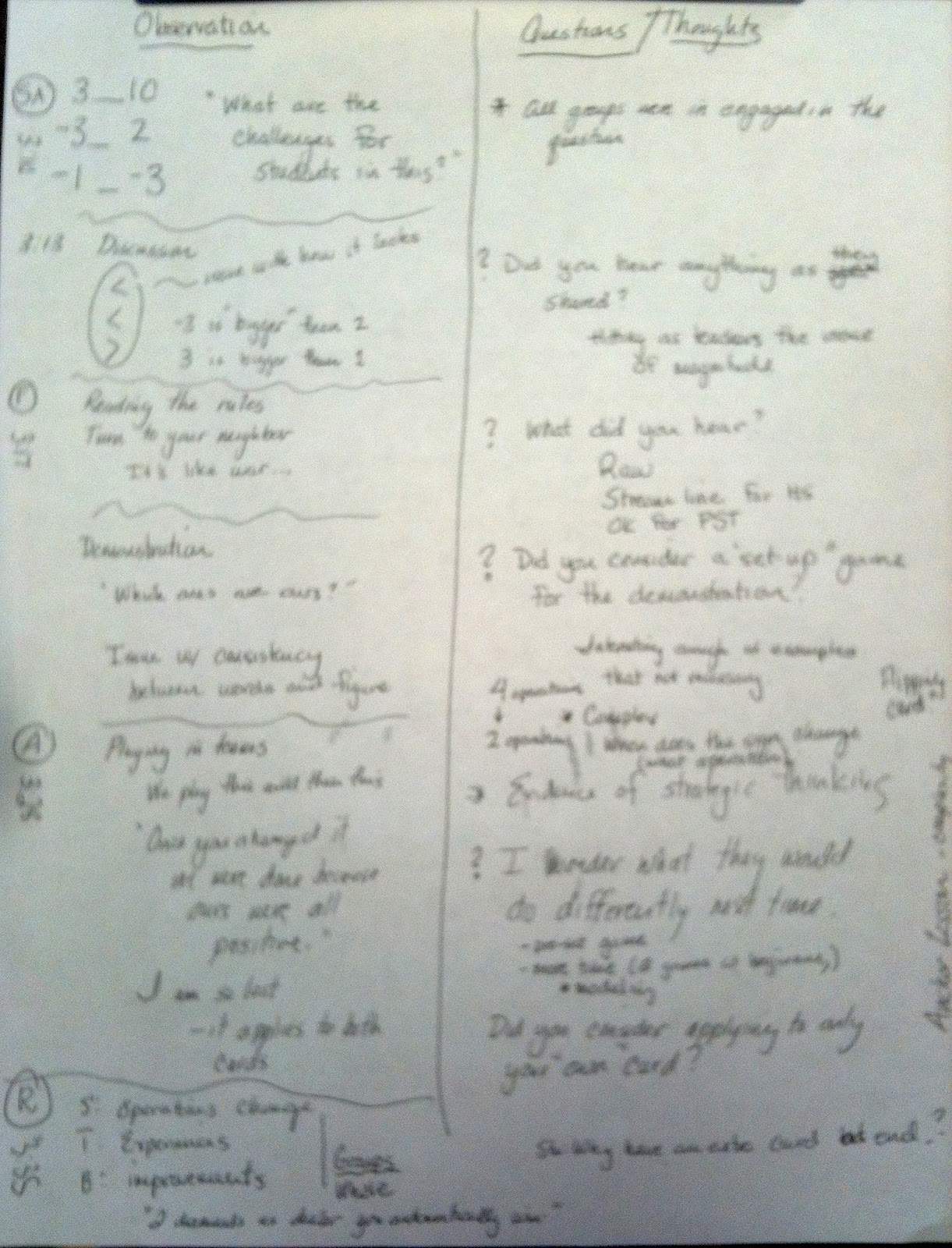
Dave took notes while I was teaching. (He may produce a sharper version of this.) When we're taking notes we often make note of other things to talk or think about aside from the action plan, but don't necessarily bring them up unless it is something that could greatly help the observed.

The dialogues following an observation are some of my favorite times at work. Discussing teaching with another professional based on something that we both just saw happen is amazing. Exciting as a teacher and satisfying and growing as a colleague.  We've tried to think of a way to encourage this kind of teacher to teacher interaction at the university, but it hasn't happened yet.


The video of this coaching isn't exactly like what it is when not for demonstration, but what is here is pretty authentic. (For one thing, the discussion is usually 30 min to an hour.) I did make some of the changes that were suggested here or in the discussion afterward with TAs participating in the coaching. They recognized the value of positive feedback, seemed less intimidated by the prospect, and were interested in how the person being coached does more of the talking.

What: the game does work for generating experiences to consider inequalities. I think it also works on the level of an activity for novice teachers to evaluate for use in class. It raises the issues of materials, effort to implement, and when a game might be good in class.  (Some of this is based on my use of the game with my PSTs.) I did hear a couple things that made me think about how do I make sure more of the connections that I'm thinking of get shared in class, for example the connection to War.  I do like the structure of the game.

So what: I want to consider the idea of generating a good demonstration game vs authentically playing a game to model.  I feel hesitant to stage a game, and I'm not sure why.  I want to think more about when should a game be well-determined and cleanly set, and when should a game be something that you kind of unroll over a few days.
        The idea of being clearer with preservice teachers about the difference between how things work in our college classroom and how it would be with K-12 students is definitely a valuable one. 

Now what: I did clean up the instructions as they suggested. I think the game is good as is for high school. The choice of cards vs flipping off the top helps emphasize that the only thing that flips the inequality is multiplying by a negative. The flipping is a nice variation for younger students who are focused more on operations with signed number. As a game I have to think more about the full strategy version. Is there a way to make it a real game?
        It's a constant danger that PSTs will decide our experiences are irrelevant when confronted with the schools as they are. So thinking about this transition and connection piece from teacher education to teacher reality should always be considered.  I also want to continue to be sensitive to the idea of big shifts and subtle shifts. Subtle shift - questioning, medium - finding a game online, big - designing your own game or writing your own curriculum.

Note: I'll shortly have a post up that's just about the game with the current version.

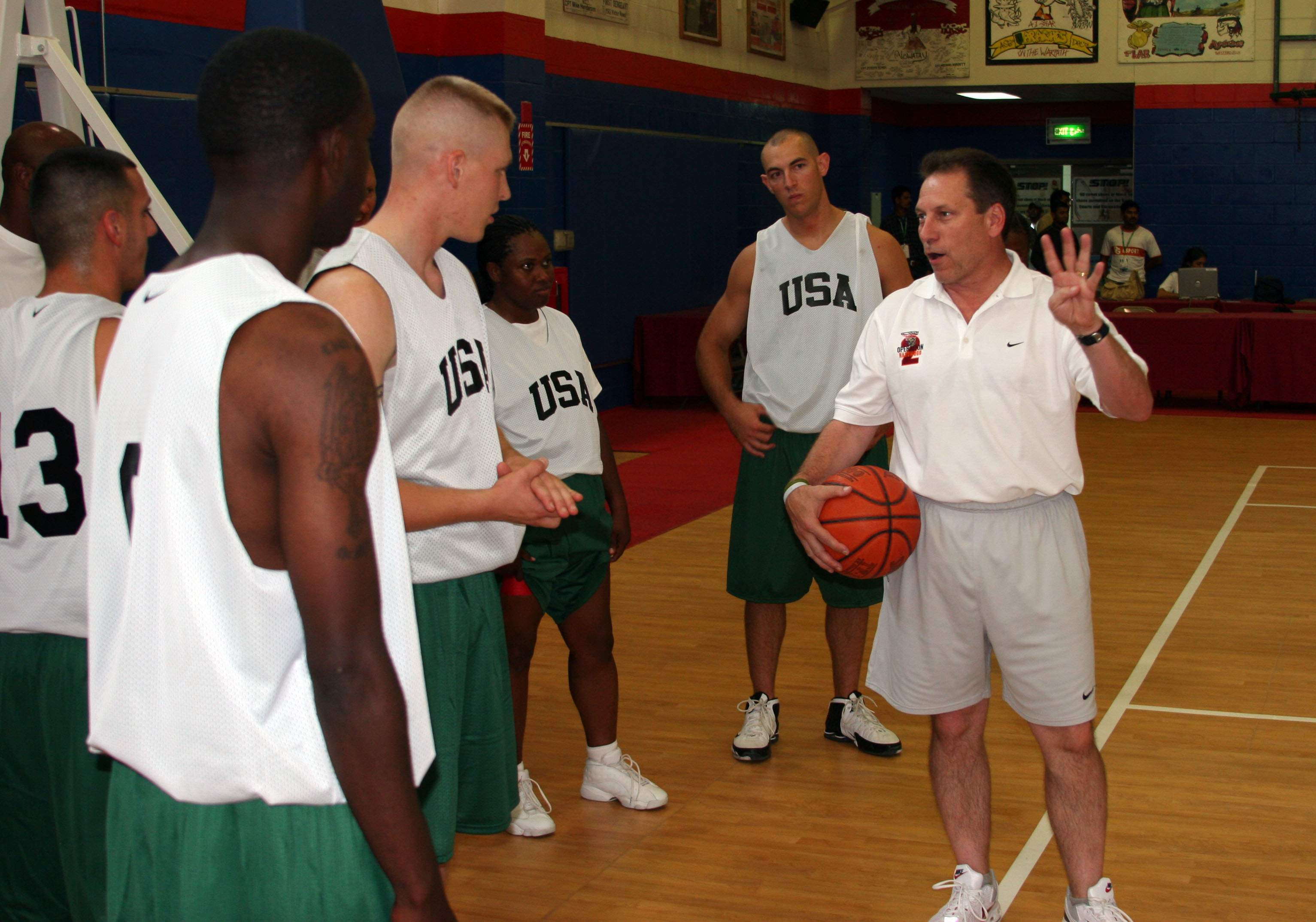
Image credit: By Sgt. Robert Adams [Public domain], via Wikimedia Commons


Tuesday, April 24, 2012

Alex Asks: What's My Job?

@AlexKraker
Guest Post by Alex Kraker. This post is lightly adapted from Alex's teaching philosophy for his teacher assisting portfolio. Teacher assisting is a kind of half-time student teacher experience that our novice teachers do before a more traditional student teaching semester. I found this very uplifting, and he was willing to share with you all.

Teaching Philosophy
The teacher should be a beacon of knowledge, like a lighthouse, whose sole purpose is to shine their all-knowing cone of light round and round to each student and burn the desired and necessary knowledge into the eyes and brains of students.  The teacher holds all of the knowledge and it is their job to dole out the material and skills that are “necessary” to the students.  Nobody shall get to the knowledge, except through the teacher.

It seems as though too often we as society, parents, and even students fall into the trap of believing that nonsense in italics.  The job of a teacher is not to teach at all; to me it seems like such a misnomer.  When I consider what I need to, want to, and should be doing as a teacher, I feel like I am much more of a facilitator than a teacher.  I don’t want to be standing up in the front of the classroom mindlessly droning on about what a y-intercept is…that’s not my job!  My job is to be on the front lines, fielding questions, guiding inquiries, and motivating students to discover and learn all these new, wonderful ideas that they have yet to encounter.  I should be much less of a teacher and more of a tour guide.  I should be pointing out things that students may not have noticed, give ideas on what they could try to help solidify understanding, and challenging them to do, not just learn.

I feel as though students do not learn well when someone is just imparting knowledge to them.  Lectures are boring.  Students struggle to pay attention and get all of the material when it is just being thrown at them.  The best learning comes when students get their hands dirty.  When they’re given a question they can’t yet solve.  When they have to think about what they already know and how they can use it to find out what they need to know, that’s when learning occurs.  I believe learning is not a linear process.  Acquiring new knowledge always seems to come first, but that’s not real learning.  Learning occurs when we assimilate our knowledge, make connections, and understand what we just found out.  Learning is so much more than just finding something out that we didn’t previously know. It is a process, we acquire new knowledge, and build upon that.  Then once we are comfortable with what we have just figured out, we build more on that, so on and so forth until we go from just a few simple ideas to a whole web of knowledge, connections, ideas, and discoveries.  That whole process is learning, and that web represents our progress.

There are a few necessary components to learning.  I feel in order for learning to occur, students have to be engaged, involved in discovery, and entertained.  I’m not trying to say school always has to be fun, but it is so much more difficult to forget something that you enjoyed being a part of discovering.  And when you realize how you discovered it, you can go back through that process and discover it again if you forget specific facts.  Memorizing formulas for the volume of three dimensional figures isn’t learning.  Using manipulatives and two dimensional formulas to figure out how we derive the three dimensional ones leads to students being able to rediscover the exact formulas themselves if they forget what exact numbers we use.  It is my job as a “teacher” to help students understand why.  However, my job doesn’t stop there, it doesn’t even start there.  I have to help them care; see why it’s important, how we use our material and how it can help them.  I need to help them figure it out, answer questions, guide thinking and discussion, encourage participation.  I have to help them sort out what they just answered, see where it comes from, how it connects and what it can do for them.  My job is not to impart knowledge, but to feed the desire to learn and know.

As such, I must always be thinking of new ways to inspire, motivate and make students care.  I must identify areas where they may struggle, or things that can cause roadblocks in our journey to know more.  I have to be prepared for anything and everything and really know my students.  My job should never be the same from year to year.  I need to constantly adapt to my students.  I need to learn how they learn, know what they know, struggle to find where they will struggle.  Different students will need different types of instruction.  Leading them to discoveries will work well for some students, but other students may struggle with seeing connections between what we are doing and why it is important.  For some students, I will have to take a more direct approach.  I will have to simply teach them some things, and work on making connections once they feel comfortable with the material.   Not every student will be motivated, so I will have to find a way to motivate them outside of grades or the simple pursuit of knowledge.  Sometimes I will have to simply fall back on the old expectations of a teacher, and I will have to lecture on occasion.  However, it is my job to never fall back on lecturing and simply trying to force the knowledge from my head to theirs.

I want to shake things up.  I want my students to look forward to my class.  I want my students to feel like they are teaching themselves, like they are the catalyst for their learning.  I am looking forward to the challenge, and I am up to the task.  My teaching philosophy is that I am not a teacher, but so much more.

Image credits: ~John~ & JTKnull @ Flickr

Saturday, March 17, 2012

Instruction

While I'm less intentional about literally following the cycle around multiple times with our preservice Teacher Assistants, the teaching-learning cycle is still formative to how I think about teaching about teaching.

This past week we were focusing on instruction. We started by skimming two of my favorite Carol Ann Tomlinson articles on differentiation. (Instructor hope: they will read more when they have time.)

Then came the videos. We watched five bits of video on instruction as discussion fodder, and to think about just what instruction is. (I've been thinking a lot about this lately, too, spurred on by Dave Coffey as he thinks about renaming the instruction phase on the cycle.)

Week 10 Agenda


Objective: TLW synthesize thoughts and observations on instruction.


15 Skim Differentiation Articles


  • "Grading and Differentiation: Paradox or Good Practice," Carol Ann Tomlinson, Theory Into Practice, 44(3), 262-269
  • "Reconcilable Differences? Standards-Based Teaching and Differentiation," Carol Ann Tomlinson,  Educational Leadership, September 2000

60 Instruction: watch (or watch parts)
The famous geometry lesson from The Teaching Gap. I always feel bad showing it, because it is awful, but the teacher seems like a nice fellow that I would like, and very well intentioned.  
The first five minutes is plenty, although there is a spectacular bit in minutes 37 and 38 where he tries to give a hint.

Preservice teachers noticed a lot of things that they wanted to avoid, but also acknowledged how familiar this looks. And recognized this in their own practices.
One of the many excellent videos available from Annenberg's learner.org.  Teachers responded positively to this video, found things to emulate, and particularly like his connections and his use of manipulatives.


Fisher and Frey are the authors (or popularizers) of the Gradual Release of Responsibility framework, which is very constructive.The TA response to this video was surprising to me. They like a lot of the lesson design and teacher practice here, especially the thought behind the poster project, but found the teacher off-putting and disengaging. Possibly because she's mellow? (Definitely be interested in your thoughts in the comments.)

Caution: not sure of what to warn you, but watch out. OK? You've been warned.


Wow! This evokes a huge reaction from any audience. I admire it for being the logical extreme of the direction in which they are going. PST are torn between the "obvious engagement" of the students and the obvious fact that they're being trained "like dogs." Interesting because they see many things that they like but it's in a context that they hate. And an excellent point for discussing the difference betweeen obedience and engagement.


This came the closest to how the students thought of themselves as teachers. They liked the way she used manipulatives and made connections to multiple representations, but also thought about the transition away from the manipulative.

The discussion was really cooking. But I had wanted to do a sample 3 act lesson also... they were really synthesizing, making connections... keep with the discussion.

OMITTED: 30 3-Act: A ticket to ride http://threeacts.mrmeyer.com/


During the discussion one of the TAs mentioned the idea of "well, I wouldn't want to be that teacher, but..." which prompted me asking them that about all the teachers.  After we had discussed a lot, I asked them to try and make a whole class concept map for instruction. Guided by the question, how can these radically different things we watched all fall under the category 'instruction'  In particular, I asked them to think about criteria that we used to evaluate instruction, features that we use to describe instruction, beliefs and questions they have about it. This is what they assembled: (click for full size)

 
5 Class Concerns (That's when we discuss what's to do the following week and clear up any remaining questions.) I asked for some quick, informal feedback from them about the lesson, and the mean and median were 4 fingers (out of 5) for usefulness.

Sunday, May 29, 2011

Who Are the New Teachers? The Long Story

At our university, content educators are mostly in their respective content departments, which is why we have a dozen or so math educators in our math department.  In our secondary teacher prep, we have three courses that are our "Math Ed" courses: Math 229, which is HS content focused, Math 329 - which is MS content focused, and Ed 331 - which is our content seminar for teacher assisting, when the novice teachers are in schools for the mornings and teaching at least a unit.  We are in negotiations to see them during student teaching, which will be excellent.

This is another guest post from a student assistant: Brock Walsh.  He paused school for a bit, but then came back with a very clear motivation about wanting to be a teacher.  Dave Coffey already posted a bit from him, where he used the NCTM process standards as an outside resources.

In his teacher assistant portfolio, he reused a bit from his 229 class, and I thought it was a neat opportunity to follow a student from early on until later in their teacher education. As an add on, I also included his piece from this past semester on the Conditions of Learning, which Dave recently posted in the Learning Museum.

Equity - Insights from the Past

(The following is a paper that was written for MTH 229, in which I had looked into the principle of equity as I related it to my experience of a nine week observation.)

Articles: Excellence in the high school classroom is something that teachers strive for. Sometimes conducting a learning filled classroom can be easy, but other times a teacher might not fully see and take advantage of teachable moments for all students. Being aware of and preparing for these teachable opportunities for all students to learn at a higher cognitive level is vital and defined under the Equity Principle of the high school principles and standards.

The article “Focusing on students’ Mathematical Thinking” by M. Lynn Breyfogle and Beth A. Herbel-Eisenmann focuses on trying to understand the thought processes of a student’s reasoning instead of relying on a student’s answer. Reasoning occurs when a student has time to think and then explain their thoughts. The time that is given after a question and before an answer is known as “wait time” and within this time, a student’s cognitive thoughts will increase. In the article, the authors emphasize an important detail. They quote from their findings, “Although most teachers are aware of the importance of waiting after they have asked a question, the importance of waiting after a student responds has received less emphasis (Rowe 1986). This all relates to students maximizing their learning by having the time given to them so they can process ideas for themselves.

The article goes further to say that when a student has given a correct answer, we as teachers should question them as to how they arrived at that. Students will often learn the most from themselves or when another student explains their reasoning. Asking for justification is a great way to evaluate not only a student, but the class as a whole when they respond and get involved in the discussion. Putting both “wait time” and “justification” together strongly represents the idea of equity and its importance in class.

The article “Unveiling Student Understanding: The Role of Questioning in Instruction” by Azita Manouchehri and Douglas A. Lapp relates to the Equity Principle directly by emphasizing the point that we as teachers need to ask the right questions for optimizing a lesson. Our questions need to facilitate learning and with the right questions being asked we can pull out conceptual reasoning from the entire class.
Magoo0311 @ Flickr

Personal: The only class in high school that ever truly challenged my reasoning was AP Calculus. Not because it was a hard class, but because the teacher invested so much into our learning and asked questions that forced us to explain ourselves. The mathematics classes that I have taken in college act the same way. The professors ask questions that require my justification. Sometimes I don’t fully know how to justify my answer and that can be blamed on the fact that I never had to do it through grade school. The in-class illustrations from the articles represent teachers asking questions that facilitate class, but do not emphasize reasoning like the classes that I have taken in college.

One specific instance of equity that I can remember my AP Calculus teacher applying was related to group work. The class was split into groups of fours and had to present on asymptotic behavior. Each person in the group had to focus on one specific aspect to present to the class and the groups had to hold each other accountable for their work. I can remember that there was a ton of questioning that occurred which felt like a debate. Within that debate, a lot of reasoning was taking place and uncertainties were being explained! The class as a whole was involved, and that is something special when an entire class is participating in discussion. In general, any time a teacher is at the front of a classroom instructing or going through a worksheet, and maybe only asking questions that a few students answer is a case of poor equity and should be avoided.

Observation: I conducted my observation at a well funded school with nice facilities. I observed a teacher and her freshmen/sophomore Geometry class during sixth period on Tuesdays and Thursdays. The class was primarily of white ethnicity, but there was one black boy and girl, and a hispanic girl. There were 15 females and 12 males in the class. The three learning objectives that I observed were review on algebraic properties, theorems about angles, and the last day was devoted to preparing for an upcoming test.

The questions posed in class were probably 50/50 for being open or closed. I noticed that when a question was presented in open form, there would generally be justification with the response. I compared notes with Susie K. from class to find a comparison between in class questioning. She told me that from her observation at Jenison High School, students were asked open questions about half the time in an algebra class but in the geometry class there were generally more open-ended questions. This makes sense to me as it seems fit that the higher level class should be challenged by the questions they get asked. A teacher should expect that as a student’s cognitive level grows; then they should also be able to reason more in depth. The wait time in the class I observed was generally around 3-4 seconds. This is reasonably good, but like the article proposed, there was really no wait time after a student responded. A good way that the teacher made sure each student in the class would have time before a response was by saying, “Everyone think about the problem by yourselves and then compare with a neighbor.” This way, students have time to learn by themselves and from their peers.

Further identifying the questions asked in class, about 22 percent of them required justification. I consider this to be a relatively adequate amount for a Geometry class, but would be something I would like to see get higher in preparation for more advanced math classes. A good example of an open-ended question that required justification was, “What justification do we get for AB+BC=AC?” I realize this seems obvious but sometimes that is exactly what is needed. She also asked, “If both L1+L2=180 and L2+L3=180, then shouldn’t they equal each other? Explain how you know this.” This question set-up made the students think about the properties and theorems that apply to these statements. These types of questions force students to think about possibilities. When called to answer, then the student can explain their best reasoning for an answer. Justifying yourself will sometimes correlate directly with equity if an explanation is clear and insightful so that the whole class learns from the response to the question. All of this stems from the question though, if a good open-ended question was not asked to begin with, then the opportunity for and learning in general has been lost. A good open-ended question posed in class was, “When I say adjacent angles, can you picture that in your mind?” Another one was, “How do you prove something true? What does it take to accomplish this?”

Interview: I conducted my interview questions by simply asking a few questions after each class to get a general sense of what she expects form her students. About instruction and questions Cristina said, “When I generally ask questions, I expect the students to think before giving a response. I’ll ask for understanding from the entire class and if nobody has a question then we move on. I expect students to ask if they don’t know. For communicating, specifically in Geometry, I expect students to use the correct language and correct theorems/properties. It’s important for students to have this foundation.” For the workload she said, “Homework happens every night, and each student is expected to complete their work or at least give a good attempt towards answering the question. Of course, I want all of my students to do well. It is really up to the student to provide the effort, and I am here to help each individual student as much as possible.”

Outside Resource - Conditions of Learning

One Laptop Per Child @ Flickr
This is my opportunity to share my understanding for the “outside resources” portion of my portfolio. During the exit interview, I was asked to explain my reasoning for using the Process Standards from NCTM, and Cambourne’s Conditions of Learning. Somewhat confused by this inquiry, I responded that I included them because they are both a framework that I feel needs to be implemented in the classroom everyday. These are both a resource that I want to keep a focus on when I teach because when using them, I feel my learners will effectively learn more. I was told that these were not the usual types of resources that are used, but upon my explanation, John and Dave understood my intentions of having them included and commended me for seeing these outside resources as a means for having a framework that benefits me in the classroom. Including them in this portfolio is a way for me to have a constant reminder of them.