Showing posts with label Book Review. Show all posts

Thursday, December 19, 2019

Anti-Racist

Listening to Ibram X Kendi read his book, How to Be an Anti-Racist, and these are some notes along the way.

The introduction starts out with his humble admission of a speech he shared for a Martin Luther King Jr Day competition/celebration which he now views as racist. This leads into his focusing on the word racist, and how it has become viewed as an attack or a slur instead of a descriptor. Anything that blames a whole group for its problems is or can be racist. The struggle is to both be fully human and to treat others as fully human.

Which I love as basically the central problem of human existence. In a recent Zadie Smith interview, she responded to a question:
"You recently wrote about Toni Morrison that the thwarting of human potential was her great theme. What is yours? My own feeling is that it’s about the failure to be human. Everybody’s born and everybody exists. But to be fully human takes a little bit of effort. I think my novels are about the challenge of actually being human and not avoiding the responsibility of being human, which is very heavy. There’s a responsibility of the single person, the responsibility of the married person and of the person with children, the person without, of the dog lover — each tiny path has its kind of demands upon you, which are incredibly hard to fulfill."
Whew.

Dr. Kendi points out that racist acts or statements are often followed with denial. When we say we're not racist, we're joining in denial and warping the meaning of the term as a descriptor. The distinction is not between racist and not racist, but between racist and anti-racist. Not racist, Dr Kendi points out, is a denial, and racists are the first to deny. So denials are no way to distinguish. Denial is akin to colorblindness, and antiracists aren't ignoring important characteristics of people that have affected their lives. They are seeing the effects and working to counteract racist thought and action. 

Each chapter covers a different specific kind of racism and antiracism. Starts with definitions, tells stories, often personal, sometimes historical, and supports with science and statistics. Then he illustrates the definitions with examples of what a racist and antiracist do or say. It's a robust structure that really supports the book's aim, which is really just the title.

Group vs individuals is a major theme of the book. Racism is the historical most harmful way of grouping individuals that we have manufactured. Dr. Kendi makes clear that every time we think or use 'because they are <fill in race>' we are being racist. To be anti-racist is to break those narratives, to treat people as individuals, to work against the consequences that racism has caused. One of the major shifts in this way of thinking is that black people can be racist if they are engaged in this kind of thinking and action. His motivating example is his own anti-black racism, and he shares anti-white racism from his story as well. Including himself in this analysis is humility and truth speaking in action, and it is powerful. 


In most of the diversity and inclusion learning I have had up until this point, the focus has been on the inequities produced by individual and systemic oppression of non-white (even as that definition has shifted) people. In this view, the minority groups can not be racist because they have no authority or power to oppress. Bias has come to be the identifier for individual racial preference, explicit or implicit.  Dr. Kendi's vision is more powerful to me because it addresses the cause of the oppression and fights against the core of what went wrong as racism was constructed.

Recently, a friend and colleague asked me for resources for anti-racist math education resources and I couldn't really think of any. I made a Google Doc to gather the resources I do now about: http://bit.ly/antiracistmath Please feel free to add or comment. We do have people in the math ed community working toward this and I know I don't know the half of it.

As Dr. Kendi discusses education, he is particularly concerned with the "racial achievement gap". The whole concept is, necessarily, in his framework, a racist idea. To be antiracist is to believe that individuals face greater challenge in schools and each learner is capable of achievement. Here is a blogpost where he details the enraging history of the idea and the tests which maintain it today.

I've taken long enough to write this that Mindshift has a post today about these ideas applied to education.

This book was specifically helpful to me this semester. One of my classes was driving me a little crazy. Pre-service teachers who were not engaged, who didn't listen to instructions, who didn't seem to care even when it involved working with kids. But this book made me realize I was treating them monolithically. I was not treating them as individuals, I was not seeing and encouraging the work of those who were engaged, and I was lowering expectations. I am a spoiled college teacher with low numbers of classes and small class sizes and I was struggling with this most fundamental of my responsibilities. This realization helped me have a better attitude, helped me individualize my thinking towards the learners. 

I love the synergy between this view of antiracism and call to action. It feels of a piece with the call to rehumanize mathematics from Rochelle Gutierrez from Sam Shah's and Hema Khodai's Humanizing Mathematics Conference

Wednesday, May 2, 2018

Geometry Snacks

What a sweet book!


These are two amazingly creative and fun thinkers about math. I feel a bit like that theme in The Shack, where everybody is one of God's favorites, but these are two of my favorite people on math twitter.


I thought of Ed as @solvemymaths for years, with great resources, dead clever problems and, of course, the math Mr. Men.  Check his blog for all this and insightful writing on teaching and curriculum. He's inspired some GeoGebra work from me, too.


Vincent, @panlepan, I think, came to my attention through his math art tweets, but maybe it was in a Simon Gregg discussion, or possibly a tessellation deep dive... He's introduced me to many interesting bits of math history, art, and people on Twitter. He's always willing to think aloud and do problem solving in public.

So I was very positively predisposed to like a book from the two of them together, and I was not disappointed.

For more of a preview of the book, check Ed's Twitter feed, or an Alex Bellos introduction. But probably you should just go ahead and eat it, er, order it. Snacks this good will make you hungry for more.

These puzzles and problems are so good. It is composed of five sections, with the somewhat surprising order of What Fraction Is Shaded?, What's the Angle?, Prove It!, What's the Area? and Sangoku. Each section is followed by solutions. Not just answers, but real solutions that guide the reader through the thinking of one way to solve each problem. And these problems tend to admit multiple solutions each, so knowing way to solve a problem does not make it worth much less for thinking about.

The problems are all visually presented, in beautiful black red and grey, almost crossing the border into pop art. Often they are stark in their simplicity. "This can't be enough information to solve it!" But then one relationship occurs to you, then "if that's true, this must be the case, and what if I..." In other words, the visual problem posing invites connections and problem solving. In my classes, one of my favorite definitions of math is "Math is the study of what else do we know?" and this book exemplifies it. I am not sure about this, maybe it's just me, but there is almost a sense of humor in these problems. Maybe it's whimsy? Maybe just the authors' sense of delight in the mathematics coming through.

While I can conceive of another book of problems that are this accessible and engaging, what would still set this book apart is the organization. The sequencing of the problems is intuitive, almost curriculum-like, but in a good way. The principle that helps solve one problem is often applied in a new context in the next problem, or needs to be extended in an upcoming puzzle. The fraction problems familiarize you with the shapes in the angle problems. The sequenced reasoning about angles is a lead into the idea of other sequenced reasons in the proofs. The proof reasoning prepares the reader for computation with measurements in the area section. The Sangaku problems are not the classical how do you construct the image precisely, but problems posed about measurements and relationships in those harmonious arrangements.

A nice indicator of how accessible these problems are is that a similar problem of Ed's blew up into an internet sensation, the Pink Triangle. What fraction is shaded?
People have proposed roughly a jillion different ways to think about this, which explore traditional geometric techniques (add extra lines, transformations, similarity), estimates, discovering properties of partitioning fractions, and so on. Such a simple prompt, and I would argue even noticing the conditions is doing mathematics. This book encourages Polya's first phase: understand the problem, so often neglected.

So obviously I'm recommending this book. For yourself, for your role as a teacher or parent, or as an appreciator of the mathematical aesthetic. You will snack to satisfaction and return for more.

It was that or end with Bon Appetit, which I'm sure has been used in a healthy fraction of reviews for this book already.

Saturday, March 10, 2018

Funville Adventures

This has been a long time coming. Funville Adventures by A.O. (Sasha) Fradkin and A.B. Bishop is full of fun adventures.

Sasha is a Twitter acquaintance, an elementary math enrichment teacher with an amazing personal math journey, and I probably heard about the Kickstarter from there. I love to encourage these passion projects in general, but this book is especially delightful. (Sasha on Twitter & her blog.)

As a story, it may remind you in flavor of The Phantom Tollboth or Dragon Tales. Emmy and Leo are kids transported to an allegorical land, Funville. Kids in Funville each have a special ability. The story makes sense and is enjoyable without even knowing the math in a formal way, because the math is the idea behind the people they meet, but not how it's discussed.  These quirky characters are brought to life in quick vignettes and charming illustrations.

Part of the charm is that, since there are mathematical ideas behind the kids of Funville, the way they work and interact is surprising but logical.  Readers can predict what's going to happen or wonder what would happen.
“Yeah,” said Harvey as if it was the most natural thing in the world to have a power. “My power is to halve things in size.” 
“Halve?” inquired Emmy. “But he is no more than a tenth of what he was!” 
“That’s because ...
What do you think happened? Small mysteries like that. Big mysteries, like how will Leo get back to full size? Harvey has a brother Doug - will that relate? And the biggest: how will they get home?

Want to know more? There's a whole Funville Blog Tour, with lots of perspectives. As with a couple of those, you might find yourself wanting to make your own Funville characters. Even now, whom do you think Emmy and Leo might meet?

I have one here... Fan Funville Fiction!

Dylan's Dangling 

Emmy and Leo worked hard all week to get done with school work and chores, so they would have an afternoon free to visit their friends in Funville. They had developed the habit of tucking things into an old rucksack that would be interesting to see just how their friends' powers would work on them. This time the rucksack held a tiny Ant Man action figure, an elephant toy, a stretchable rubber snake, and an assortment of snacks.

Emmy was particularly interested in Fay's and Randy's powers and how they interacted with other powers. So she was always glad to see them at the other end of the slide down the Thief. But she and Leo were both surprised to see someone new in the playground.

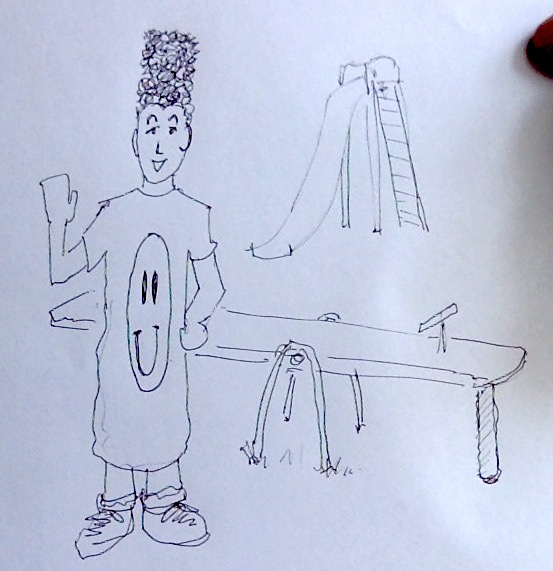
He was sitting on one half of a see-saw, but was up in the air instead of down on the ground. Maybe Heather had been here? He had on a shirt that was way too long, but otherwise seemed to fit him well. Adding to his stretched out appearance was a very tall cylinder of curly black hair.

Leo ran over to him immediately. "I'm Leo!" he announced, and the boy answered him. "Oh, I know. I came down here to meet you two because I was so interested in the stories that everyone told about you. People without powers, but you're fun anyway? And Pencilvania? Wherever that is!"

"Pennsylvania," Emmy corrected, "but that's a good synonym! You probably know I'm Emmy, but who are you?"

"Dylan," Dylan answered, "and I'm stuck up here. I was playing with- "

"Heather?" Emmy interrupted.

"Exactly!" said Dylan. "But her mother was calling, and she hopped off, and didn't notice that she made that end so heavy, and ... long story short, here I am."

"How can we help?" asked Leo.

"Do you have anything small enough to stand up under the other end?" wondered Dylan.

"Sure!" said Leo, and rummaged in the rucksack for a perfect skipping stone he was hoping Cory would be willing to use his power on. He slid it under the down side of the see saw. "Like this?"

"Mmmmmm hmmmmm," said Dylan, who was already concentrating. Slowly the see saw seat lifted up, pushed by the stone, which was growing. But not getting like a bigger stone - more like a tree. Once the see saw got level, Dylan hopped off.

"So your power is growing things?" asked Emmy.

"Not exactly..."


Tuesday, January 30, 2018

Book Club Fall 17

One of the many fun parts about teaching our capstone course, the Nature of Modern Mathematics, is the reading. Instead of me mandating a book (most instructors choose the excellent Journey Through Genius, by William Dunham), the learners can choose a book. Comes a day, we then have a book club class where people get to discuss with others reading their book, then share with the class what they thought. I try to keep notes, demonstrating poor steno skills.

The possibles this year are on this Google doc, which gets revised year to year.

How to Bake π, Eugenia Cheng


Connected all our classes, abstracted ideas but then super concrete accessible examples. Everything came together. Author is a little scatter brained: 15 subsections in each chapter. Even the toughest of concepts can be broken down. Two parts: what is math? What is category theory? Good connections.


Is God a Mathematician?,


History of math, Newton, Aristotle, Descartes… not proving that God is a mathematician, but looks at the beliefs of all these people. How does math intertwine with science, physics, biology… Example, knot theory. Is math discovered or invented?


Journey through Genius, Dunham
Miciah


Goes through theorem by theorem. Some was over my head, but the writer makes it very understandable. Example, quadrature of the lune. Most interesting was about Archimedes proof of the area of the circle.  Recommend it because it ties into a lot of things throughout our math classes, but you learn something.


The Teaching Gap


Compares German, Japanese and American lesson plans and how we teach. But mostly contrasting Japanese and American. In Japan they encourage more struggle. “US teachers are just not smart enough to teach the way researchers recommend.”


Joy of X, Steven Strogatz
Brian, Angel


Not especially challenging, written for a general audience. Longest chapter, 10 pages. Covers a lot of different areas of mathematics. Example, dating life. First half, playing the field, 2nd half find someone better than the first half… Snell’s law, ‘light behaves as if it was considering all possible paths … nature seems to know calculus.’ The focal points of the ellipse of Grand Central Station. Infinity. Is it odd or even? Recommend it. Even makes Hilbert’s Hotel understandable.


Fermat’s Enigma, Simon Singh
Proof of Fermat’s last theorem. Left so many conjectures, but the last one was a doozy. Made it as understandable as possible.


Genius at Play, Siobhan Roberts
Kelsey, Tony
More of a biography. He hasn’t published a lot, but his ideas are everywhere. He doesn’t like being known for the game of life. It’s hard to read, because the math problems are so hard. But you get to know his personality. See and say sequence from a student was frustrating, but then a source of great mathematics.


Quite Right, Norman Biggs
A history of time, … money. But 70% math. Start with caveman, then follow it forward. How to divide evenly, then follows through other cultures to modern math. Gives a sense of where math came from, but not all of it.


Finding Fibonacci, Keith Devlin


Story of Devlin finding the history of Leonardo of Pisa. Not recognized for his accomplishments. He didn’t really discover anything, but introduced real arithmetic and algebra. Son of a merchant. Really started a revolution. Only 14 copies of Liber Abaci in the world. Fibonacci sequence was just a puzzle in the book. Golden ratio, limit of the Fibonacci sequence. Does appear in nature, but not as much as people say.


e: the Story of a Number, Eli Maor
Most of the chapters don’t even mention e, but then it brings it back. Funny stories about many mathematicians (Bernoullis, Napier, …) Just a general  history, with some more focus on math. e is discovered, transcendental number…


Math Girls, Hiroshi Yuki
Math, but always in a story. Girls solve problems that have an easy access launch.  Someone who read this for a second book said it's mostly about the math content, but that content is deep and interesting.


The Man Who Loved Only Numbers
About Paul Erdös, an interesting, different, cool guy. Never owned many possessions, traveled from host to host working on mathematics. Took a lot of espresso and drugs, proved that he wasn’t an addict by stopping, but his math stopped, too. So he started back up. I really liked the prime number section.

I was able to entice a couple futute teachers to read José Vilson's This Is Not a Test for their 2nd book, and they were captivated, with strong recommendations.

...much time passes ...

I just now, in the next year, realize I never pushed send on this one! So >push<

Tuesday, June 17, 2014

Capstone Book Club - Summer 14

Time for another installment of Read 'Em and Weep... no, that doesn't sound right. See a previous edition here.  Students grouped with others who read the same book, plus a group of readers with unique books. After they have a chance to discuss for a good bit, I ask the groups to think of what they want to say to the whole class about it. In a whole class circle, we discuss each book in turn. These notes are from the whole class discussion.

Accessible Mathematics:
shifts emphasize how to adjust your classroom… eg. multiple representations. Liked it b/c it wasn’t just changes. Like minimizing what is no longer important; calculators for example. A lot of specific examples… real life. $1.89 v easy numbers…
Review:
Love and Math:
Good for non-math majors so they can understand what we’re talking about. Example of symmetry: which is more symmetric a circular table or a round table? If you left the room and I turned. More of a story and Frenkel’s search for knowledge.
Reviews:
e: the Story of a Number
We agree that the beginning - the history of the mathematicians who worked on it - was very accessible. Could not follow the shifting representations of problems in the last few chapters. The end was significantly harder to understand. The part about the personal life of mathematicians was cool, and who winds up getting credit for achievements. Publish or perish keeps some people who deserve credit from getting it. Qualified recommendation. Music and logarithms. Some review that was helpful. Interesting to see how they discovered what we study, and how hard it was to find some of what we take for granted.
Reviews:
Euler: the Master of us All
Is Euler human? Today you have to be very specific, but Euler did so much in so many areas. He goes by topic, what was known before Euler, hen what Euler did. Proofs, but open to people who can handle logs and series. Highly, highly recommended. Popularized complex numbers. His proof writing was like Romeo and Juliet; the balcony just works. Blind for a lot of his life…
Review: Kyle Ferguson: plus some extenisve book notes.
    Gödel, Escher, Bach
    Really about Gödel and the incompleteness theorem. He’s trying to explain to a general audience. Tortoise and Achilles, a fable, then ties it into a serious discussion of the mathematics. He also ties in art, music, zen philosophy. Not a clear path to the Incompleteness Theorem, but about what is interesting along the way.

    A Journey through Genius
    Paint a picture of mathematics that is logically sound and aesthetically beautiful. He picks the best proofs, a bit of history about the man, then an explanation. You could read this in sections to understand something specific and the culture it came from. Not just about the applications, but appreciating it for what it is. Logic still holds true centuries later.
    Review: Jason Lohman

    The Mathematical Universe: An Alphabetical Journey Through the Great Proofs, Prob-
    lems, and Personalities by William Dunham
    Also by Dunham. Proofs and problems of mathematics, arranged alphabetically. Which is confusing vs historical order. Chose some really interesting proofs. Any natural number as distinct integers and odd integers.
    Review: Nate De Maagd. Includes some of his proofy highlights. (click through to Gdoc)
      Vision of Elementary Mathematics
      Good for non-math majors teaching elementary school. Good for visual learners, lots of diagrams. Also for getting kids to discover math on their own. Gives alternate perspectives that could help in talking to students. It’s a little repetitive. But we’d really recommend it.
      Reviews:
      Mathematician’s Lament
      Problems with math teaching as it is right now in schools. The differences between teaching art and teaching math. The creativity is taken out of the math. There’s nothing to explore or discover. Like teaching art with only paint by numbers. Couple issues with some of the arguments: like teachers try to make it interesting but it already is interesting. Or you learn when it’s relevant to you, but he had argued against relevance. Also doesn’t describe how to make it better. Says math should be a free for all - against all structure. Everything he’s telling us is pointless. He’s against drill but favors real world problems. We teach definitions for no reason. (Quadrilaterals, for example. But then how do we communicate math?) Has a mathematician’s perspective, but he didn’t have a teacher’s perspective. What he offers doesn’t seem appropriate to most schools. The conversations at the end of each chapter were confusing. “What to do with elementary students?” “Just have them play games.” Strong opinions but no evidence. You should read it but it will make you frustrated.

      I feel like how we’ve been taught to teach does help handle a lot of these issues. It would work if everybody loved math like he does.
      Reviews:
      The Joy of X
      Insightful and helps make math more accessible. Analogies from Sesame Street. “Fish, fish, fish, fish, fish, fish…” all the way up through complex numbers. Split up into 30 short chapters. From numbers to infinity. I liked the way he uses personal stories. Very readable. Not for diving into math but there’s a lot of stuff that helps clarify. Even for someone who struggled with math. But it won’t change your mind. Great book for college freshmen who have to start making some sense of math. Also good for middle school and high school teachers.
      Reviews:
      The Math Book
      Looks intimidating but it’s an easy to read. A page and a picture. Goes through history including lots of things that you would not think of as math, like tic tac toe or mancala. Also see a lot of mathematicians come up multiple times, which is neat to see
      Reviews:

      Students choose their own books and that really pays off. Very positive feedback this time around. We follow it up with a book swap, so you get to read a second book that is of interest to you, or at least to skim it. (That's why some people have more than one review linked.)

      Some of the reviews are fabulous; if you're interested by the blurb here I'd really recommend following up. And of course, if you have a chance to comment on a student blog, that's excellent.

      Tuesday, February 25, 2014

      Capstone Book Club

      One of the courses I'm teaching this semester is a capstone course for our majors. Rather than me picking the book, I let them choose from a list that the Math-Twitter-Blog-o-Sphere helped me put together. Last summer, The Mαth Book and Joy of X were the big hits, this semester, they made some very different choices. (Here's the list and their choices.) Having them choose makes me feel a little less like this:


      My notes of the discussion, with links to some of their blogposts. Since they're notes of a discussion, pretty terse. Also, not my point of view, this is the students'. The people who got the most new students interested in their book were those reading The Mathematician's Lament and e: the Story of a Number.

      Euler: Master of Us All. History at HS level, proofs at graduate school. Felt outclassed reading it. Simplify or explaining the proofs would have helped. Averaged a paper per week. Very dense.
      Review: Alex

      Visions of Infinity. Each chapter is a different idea, then has history and the author explains the important proofs about the idea. How mathematicians think vs what they thought about. Eg. squaring the circle, explained why you couldn't do it. Was advanced, but not frustrating. Recommend it to someone who knows about math. Last two chapters… where math is going. Strongly the author's point of view.
      Review: Kristine, Emily

      The Math Book: one discovery per page. Good if you like quick little synopsis of many topics. Different big discoveries. Learned a lot of little things, but so rudimentary in some places. There were some over your head, too. I would recommend it. Gives sources to dig deeper. Easy to make connections. Biased towards white Christian males.
      Pro reviews: Kenton, Erin. Con review: Brittney
      Journey through Genius: history, picks important results and proves them. No non-western mathematics. Tries to justify why no islamic mathematicians but comes across as a cop out. The Greeks asked why, but the Egyptians were satisfied with just working. Did give a personal view of the mathematicians. Recommended to people who want to get to know the mathematicians well.
      Review: Biz looks at it from a multicultural perspective.

      Accessible Mathematics: 10 instructional shifts. Works with field experience, works with math ed classes, what happens when you don't use these. Multiple representations, number sense. Good to examples and non-examples. Recommended to anyone going in to teaching or to teachers who need to change.
      Review: Danielle, Becky, Keegan

      Concepts of Modern Mathematics: overview of the math classes you have to take here. Like 310, statistics, history on those areas. People who have made significant work in that area. Some new to us, like topology. Pretty dry and boring. First chapter was the peak, then funniness ran out. Long lines of equations. Not a bad book for someone in 210, to know what's coming, but then it would be hard to understand. Examples are pretty simple - maybe even dumbed down. Pretty dull read. Good at explaining ideas like 1 to 1 and onto. Large scale review.
      Review: Bryce. Killer line: "Mr. Stewart slowly became less of my friend who I wanted to hang with and more of a dreaded professor whose class you have to sit through every week."

      Godel Escher Bach. It's about cognitive science, psychology, computer science, math. The Godel part is the most on math. You think because you are, but you have to be to think. Need a lot of time to dig in. Hurts to read, in a good way. Challenges the way you think. Connections with taoism and Buddhism. Isomorphisms and symbols… uses all these metaphors. Kind of like A Brief History of Time by Hawking or The Elegant Universe by Brian Green.
      The Joy of X. Goes from things people have been told is true to why they're true. Negative times a negative, infinity… goes further at the end.
      Short review but long notes: Jennifer
      Sensible Mathematics, sister to Accessible Mathematics. Written more to administrators than to math teachers. Why it's good to have students explore more. Convinces teachers and parents to go with modern views of learning and teaching mathematics.
      Review: Kerry
      Love and Math. Hard to understand because it's so into physics. His life story is interesting, discrimination against Jews in Russia as a backdrop.
      Kate's review says that you should like physics and math to pick up this book.
      The Mathematician's Lament. Talked about how math is an art. It's about discovery, and we need a big do over in education. We're just handed formulas, not told where they're from or who made them. Can't teach teaching. Recommend to any future teacher.We take away the art of math.
      Powerful review from Sara.
      e: the Story of a Number. I didn't know where e came from. That's why… the math amazes me more. Everything I learn unites math more. This book did that and combined it with physics, through the number e. Pascal's triangle, derivative of e^x is itself. My optics class is about that. The challenging thing the author had to face. Pi could fit in a few pages, but e, there's no place where it came from. Napier and his tables, and how logarithms require e; when you extend to continuous cases… Book does a good job of balancing history, different contributions. His jumps are really strange and don't make sense until you finish reading. Balances history with math, saves all the proofs for the appendix. Bernoulli's conversation with Bach about the space between notes, a logarithmic increase... that was amazing.
      Review: Duncan
      There wasn't a whole lot of discussion in the whole class setting, but the individual discussions among students who read the same books were deep and intense. Even the group of people who all had read unique (in our class) books.

      What do you think of their reactions? Any disagreements? Is there a new book in which you're interested?

      Monday, April 19, 2010

      Math Book Reviews Wanted

      Sol at Wild About Math has been doing a couple of neat things to help build or support the math/math ed blogging community.

      First, he offered to promote your website/math efforts through guest posts.

      Now he's offering to help you connect with publishers to review books of interest to you.  I've taken him up on it already... against his better judgment?  Surely you will do better than I could.  Drop him a line - his address is on the About page.

      From classic Peanuts at comics.com.

      Friday, December 4, 2009

      Why Pi?

      Quick book review.

      Why Pi? is a DK picture book/encylcopedia by Johnny Ball. The author sounds as if he was the Mr. Wizard of Great Britain in the 70s, and is the author of many books, several of which are math and science related. But this is my first of his.

      Xavier (9) says: it's really good. I bow to whoever suggested it. It was fun and funny.

      Ysabela (10) says: it's kind of funny, but in an interesting way. It's got a lot of information, but is definitely enjoyable reading. And it has Egyptians, awesome.

      John (45) says: the book was unexpectedly thorough. It has a lot of excellent math and science history, from several ancient cultures, and deeply explores the concept of measurement as it pertains to many topics. It is a great read, and a solid reference. Despite this exposure coming from the library, I will be looking to purchase it. As the kids have pointed out, it is long on humor, and deep in breadth. (Both difficult quantities to measure.)