My preservice elementary course this semester is an embedded field experience. Each week I write or find some lesson for the 3rd graders, and they teach in groups of 2 to 3 or 4 3rd graders, and then reteach in our next class period. Each class I sit in with a group, and everyone has some time to assess and reflect themselves and the learners while I debrief with that group. Before the first time teaching, at least, we try to rehearse together. As a whole, this is how I want to teach teacher prep from here on out. We're getting to less content, but I see so much more learning.
This week I had a lesson planned for Thursday, Pi Day, that had nothing to do with π. It was on these terrific Naoki Inaba place value puzzles that Jenna Laib shared. But with Pi Day approaching, and #MTBOS talk of activities and Scrooges, how could I help but think of a lesson?
Showing posts with label MTEchat. Show all posts
Showing posts with label MTEchat. Show all posts
Sunday, March 17, 2019


Friday, February 15, 2019
#AMTE2019 #MTEchat
Last weekend I was at the AMTE 2019 Conference. Paul Yu (GVSU colleague) and I were presenting a brief report on a project where we looked at how our different classes impacted preservice elementary TPACK. (Technological Pedagogical Content Knowledge.) Wait where are you going?
(The materials are here if you're interested.)
That's actually my reaction, too. I have a weird love hate relationship with research. I think it's important, I love to read it, but so much of it is irrelevant or over-applied. And almost all of us there have the job of preparing future teachers, and there's little talk of practice. I so much prefer going to meetings with teachers where we talk about teaching. (Twitter Math Camp being the peak experience.)
There was some teaching talk. My colleague Esther was part of a session on mediated field experiences (being in the school with preservice teachers) that had a variety of people working in related contexts to talk together about what we're trying. But there were no resources to share or way to continue the conversation afterward.
The AMTE Equity Committee led a session on on addressing novice teachers understanding and readiness to teach diverse students. (Here's my twitter notes.) At the end, there was a question would people be interested in a syllabus or reading list... Hell, yes! So maybe we'll get it somewhere, some how.
Headed into Denise Spangler's Judith Jacob lecture, I was pretty fed up with it. But I bumped into Joanne Vaskil, who was part of our brief report session. (She is part of a group using Twitter with their preservice teachers for responding to assignments.) Talking about it - she is an excellent interviewer - she got all of this out of me. And I was comparing this with the #MTBoS, which, to me, is built on sharing practice and questions about it. Joanne pushed for doing something about it. We thought about hashtags, and #MTEchat seemed about right. Being at the Association for Mathematics Teacher Educators, people were referring to us at MTEs. (#ITeachMathTeachers seemed a little too Sixth Sense.) Turns out people were already using it for this. Logical people are logical.
One of the values/ professional practices I try to instill in novice teachers is to not try to go it alone. Collaborate, find support, and share with others. Sometimes it happens in your school, which is the best option, but even then, think about being active at the district, state or national level. What is good for our students' learning is good for our learning. In turn, what is good for our student teachers' learning is good for our MTE learning.
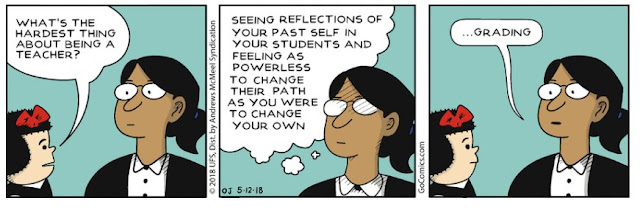 Joanne already got the ball rolling. So... why don't you join us? How are you preparing teachers? Share stories, questions, images, blogposts. If Twitter isn't your bag, help us figure out what the proper place will be. Glenn Waddell, researching teacher use of Twitter, could see that there was a healthy slice of people on Twitter at the conference. But they were most were isolated.
Let's get together!
(The materials are here if you're interested.)
That's actually my reaction, too. I have a weird love hate relationship with research. I think it's important, I love to read it, but so much of it is irrelevant or over-applied. And almost all of us there have the job of preparing future teachers, and there's little talk of practice. I so much prefer going to meetings with teachers where we talk about teaching. (Twitter Math Camp being the peak experience.)
There was some teaching talk. My colleague Esther was part of a session on mediated field experiences (being in the school with preservice teachers) that had a variety of people working in related contexts to talk together about what we're trying. But there were no resources to share or way to continue the conversation afterward.
The AMTE Equity Committee led a session on on addressing novice teachers understanding and readiness to teach diverse students. (Here's my twitter notes.) At the end, there was a question would people be interested in a syllabus or reading list... Hell, yes! So maybe we'll get it somewhere, some how.
Headed into Denise Spangler's Judith Jacob lecture, I was pretty fed up with it. But I bumped into Joanne Vaskil, who was part of our brief report session. (She is part of a group using Twitter with their preservice teachers for responding to assignments.) Talking about it - she is an excellent interviewer - she got all of this out of me. And I was comparing this with the #MTBoS, which, to me, is built on sharing practice and questions about it. Joanne pushed for doing something about it. We thought about hashtags, and #MTEchat seemed about right. Being at the Association for Mathematics Teacher Educators, people were referring to us at MTEs. (#ITeachMathTeachers seemed a little too Sixth Sense.) Turns out people were already using it for this. Logical people are logical.
One of the values/ professional practices I try to instill in novice teachers is to not try to go it alone. Collaborate, find support, and share with others. Sometimes it happens in your school, which is the best option, but even then, think about being active at the district, state or national level. What is good for our students' learning is good for our learning. In turn, what is good for our student teachers' learning is good for our MTE learning.

Let's get together!
Subscribe to:
Posts (Atom)


 Posts
Posts


