Showing posts with label spiral. Show all posts

Wednesday, May 25, 2016

Polygonal Spiral

I have a fascination with spirals. Exhibit 1, my GeoGebraTube materials, searched for spirals:

That's some of them...

By the way, if you haven't been following Megan Schmidt's spiral adventures, you're missing out.

I've been interested in polygonal spirals for a while, but then my student Andrew's tessellation got me thinking again.
It's Archimedean since the spirals have a kind of constant width. At first I thought it was triangular, but it's clearly hexagonal. Interesting that two of them fit together to fill the space... that's something I need to think about more.

To build them in GeoGebra I made a list of N directional unit vectors, and then a scaling sum to get a spiral of points, like 1*v_1, 1*v_1+2*v_2, 1*v_1+2*v_2+3*v_3, ... with a modular function to reuse vectors in order.


Then I connected up to points 1/Nth of the way to corresponding vertices to make trapezoids. Then I rotated them N times, around a center I located by intersecting the perpendicular bisectors of points I wanted to correspond.

GeoGebra geek paragraph: The colors are the hardest thing to get, because in GeoGebra you can't set the color of different elements of a list. My current workaround was suggest by someone on the GeoGebra forums a few years ago, and I keep reworking it.
Execute[Sequence["Delete[R_{"+i+"}]", i, 1, oldN]]
SetValue[oldN,N]
Execute[Sequence["R_{"+i+"}=Element[list8, "+i+"]", i, 1, N]]
Execute[Sequence["SetDynamicColor[R_{"+i+"},  "+i/8+","+(.5+(i*(-1)^i)/(2*N))+","+1-i/8+",.75]", i, 1, N]]
Essentially you constantly create and destroy objects from the elements in your list, and then set their color.

Usually I have a list of color names and run through them with the SetColor, but in this one I wanted a higher opacity, so made up a way to set R, G and B values in the SetDynamicColor command. 

Here's the result! It was hard to think about how else to dynamicize it, since it's a pretty rigid structure. Any ideas?

On GeoGebraTube, too.

Sunday, February 16, 2014

Fibonacci Week: Spiral Curriculum

We were discussing Leonardo of Pisa, Filius Bonacci, this week in class, and despite it being the least of his accomplishments, THE sequence always comes up. I finally wised up and, rather than fight it, separated out the sequence stuff into a day of its own.
Our Agenda:
  • The original puzzle
  • And Pascal, too?
  • Spirals & Golden Ratio: what is going on?
    • Vi Hart awesomeness: Part 1 of 3. WATCH at least part 1.
  • Extensions

Puzzle
The puzzle appeared in Fibonacci's momentous The Book of Calculation. In addition to lots of fine mathematics, examples of calculation algorithms, and applications, it has entertaining puzzles and activities. One of these was deeper than he could know.
“A certain man put a pair of rabbits in a place surrounded on all sides by a wall. How many pairs of rabbits can be produced from that pair in a year if it is supposed that every month each pair begets a new pair which from the second month on becomes productive?”
The students were awesome with this. They knew the sequence already, of course, but did a nice job fitting the sequence to the situation. What impressed me were their objections. What if the rabbits weren't split males and females? What about mortality? What about that rabbits can be pregnant with to litters at once? (Impressive. Turns out they can conceive the day they give birth, also impressive, and giving credence to LoP's 1 litter per month.) Also a student who tried to think about all possible pairs. Just good math thinking. The emphasis I tried to convey was making sense of the two representations: the tree diagram that helped most make sense, and the usual expression of the sequence summing two terms to get the next.

Pascal
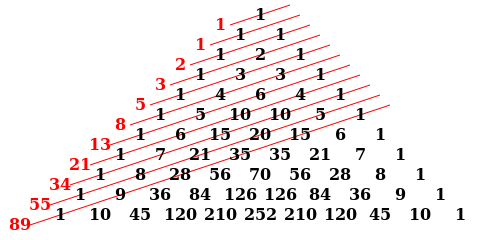
I love that the sequence shows up in diagonals of the other mystical math favorite: Pascal's Triangle.I challenged the students with the more important question: why? They both have the add two to get one idea - is that related?
(This image from mathispun.) Does anyone know ow to phrase a probability question that brings up this relationship?

Spiral
Ever since Susan Walborn and I did this with 5th graders for the Math in Art festival (art connection: Mondrian) I have loved this. It so naturally ties in with the near similarity, and then the fabled Golden Ratio.

One of the things I love is how fast the sequence converges even if you don't start with a square. Start with a very non-square 1x10 and ... well, just look. You can play with the spreadsheet on Google docs.


If you're talking Fibonacci Spirals, you have to watch some Vi Hart. They were properly amused and impressed.

Lastly
Explore on your own, of course. Ideas:
  • explore one of the connections
  • look into closed form generation of the numbers
  • explore golden ration connections
  • make Fibonacci themed art (Jennifer Silverman or a skyscape)
  • Prove a Fibonacci Proposition

Extra:

People tried more with the spiral, including on isometric dot paper.  Some played with the sequence and ratios.

Some tried to prove the provided propostions:  (senior math majors)
My extension
I was interested in the spiral, too. (It's a minor obsession.) One interesting thing is that it is an approximation of the Golden spiral (the logarithmic spiral built on Φ), but it has a beginning. However the Fibonacci sequence extends backwards, ...8, 5, 3, 2, 1, 1, 0, 1, -1, 2... so what would that look like for the Fibonacci spiral?

I made a tool in GeoGebra for adding arcs and the center of the next arc for a spiral growing counter clockwise without too much trouble. But it was hard to find a way to do the backwards step that was robust. I wound up going with a vector approach instead of geometric, to better simulate those alternating terms going backwards. It made for some pretty interesting curves!
This gif is showing the same curve depending on the starting ratio of the first two steps. 1:1 to 2:1. Sometimes you get cycles - that's what those four petal flowers are: like 0, 2, 0, 2, ... If you want to play with it yourself, the tools are in this sketch on GeoGebraTube. (Sometimes tools don't work well in the student worksheet and you have to download the .ggb file.)
 

I also fooled around to make some art for myself. That's in a Tumblr post.

Monday, February 11, 2013

Pyth On

Mel Bochner, Pythagoras (4)
from wikipaintings

Arithmetical Design (quite a fun tumblr) posted this beauty today...

I thought that this was something that screamed to be dynamic. Off to the GeoGebra Cave, old chum!


The sketch started with a right triangle, and then the regular polygon tool to make the squares on the side. I wanted the triangle connecting the next squares to be similar to the original, so I made the side of a square to be the new hypotenuse, rotated it by one of the non-right angles then used the perpendicular tool to make the similar right triangle. Finally, I constructed  the first two additional squares.

Clearly too much work to repeat in the dozens. To use the Create New Tool command you select item or items in the sketch. Then select the command from the tools menu. My first try I forgot that I would need the points to make subsequent squares. Delete the bad tool from the Tool Manager. (Can also rename there if you're trying for something more pythy than Tool 1.)


When I had the squares and vertices selected, the second step of the Create New Tool dialogue was to determine the inputs. GeoGebra will select some ancestors to start, but you can modify the inputs. In this case, GeoGebra selected my first two free points, which doesn't suit. I wanted the inputs to be the the endpoints of the hypotenuse. At the last step you select a name and can attach a custom icon if you're being tricksy.

Once I had the tool it was quick to construct the spirals, and then aesthetics like a coloring scheme and positioning. From the GeoGebra color dialogue you can click the plus, which brings up an RGB color input. (For those times when you need beige, 255-245-235.)


I was going to stop there, but decided that people needed to be able to make their own spirals how they wanted, so added a checkbox to go back to the beginning. (If you make something send me the pic and I'll add it to the post.) Sadly the new points show up with labels - I don't know how to turn that off. Maybe if the labels are off before I make the tool? Tried that and it works!

Here's the finished sketch at GeoGebraTube: teacher page or applet. Sadly, the custom tools don't seem to show up in the HTML5 mobile applets yet.

Bochner has several mathematically influenced paintings, as well as the first three Pythagoras painitings. Check them out at wikipaintings.


Sunday, January 8, 2012

Spiral - So-So

I've never seen a spiral board... wow!
Since Vi Hart released her Christmas time spiral celebration, I've been digging spirals again. I made a GeoGebra sketch to go with her video (link includes a link to her video), that I quite like. My tumblog is where I post one-off math and reblog other Tumblr math. So when I got the word from Mr. Schiller that this gameday the "Topic will be polygons/angles/rotational symmetry," it didn't take me too long to get to the idea of a spiral game.  The way it worked out, though, has me wondering: how good does an educational game have to be?
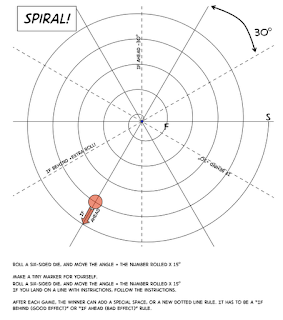
Click for full size
There are lots of things to recommend it: kids think spirals are cool, it makes a nice race track, it allows you to see circle connections to angle, and that angles have the same measure whether small or big in size. I like race games for practicing with quantities, because it gives some repeated experience with a variety of the quantity, and gives you a reason to talk about the quantities. The GeoGebra I used to make the Archimedean Spiral (as opposed to Vi's logarithmic spirals) is posted on Tumblr, too. Then I just used GeoGebra's export as image to get the track into Word.

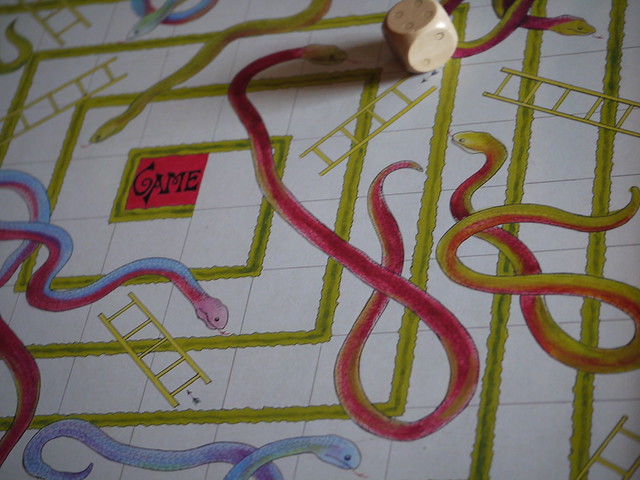
The problem with race games is that many of them devolve into chutes and ladders (American; snakes and ladders elsewhere).  This one definitely did. I thought a one die game might be easiest, and after some practice settled on moving 15º times the die roll. It included right angles and gave some nice opportunity for mental multiplication. I justified the simplicity of the game to myself by adding a game-design objective. The winner adds a rule; that rule has to help with the catch-up characteristic of the game.


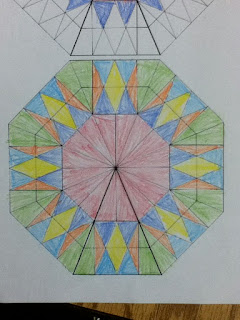
In addition - since the game was simple - I wanted to have another option. I brought some triangle grid paper and an eightfold diagram (links to Google docs) to support the students in making an art project with rotational symmetry.  As I told the students, math art is as close to my heart as math games. I explained how to color a piece and then imagine it turning, or on the 8-fold to color in 1, 2, or 4 wedges and then copy it.

The students gave the game a good try, and they seemed to meet many of the objectives quickly. Watching them play, the game seemed a bit too long. One student who had gotten disengaged was willing to collect data for me on how long a game took. His results: 27 turns for a full game. 16 turns for 1.5 loops shorter.  After one try, some people played on, many moved on to the math art, and a few pulled out the games they made in December.  Mr. Schiller and I agreed it was too long, though the class was just barely in favor of okay-as-is.  In terms of new rules, some students modified it to have 2 dice. Others added rules for if you land on someone +15º, an "if ahead, out one loop line," a -30º spot and similar. Several students were proud to share their art. Not many tried the triangle paper except for making free designs. 


A revised, shorter game is at the end of this post. In general, it was so-so. The whole experience really raised for me the question of how good does an educational game have to be. These students have played some really good games so far, and I think they were disappointed that this one was more regular.  I've definitely thought that educational games have a lower bar, since you're not interested in replay on many of them once your objective is met.  My experience has been that any sort of game is a welcome change.  But maybe if games are regularly played, the bar rises. I'd be interested in your opinions below, by twitter or email.

In terms of the game design framework I've been trying, and my rating of Spiral:
  1. Goal(s) - good concrete objectives.
  2. Structure - the spiral really fit the objectives well.My main question here is if the board should have angle measures on it. (Definitely, if polar coordinates are the objective.)
  3. Strategy - no real strategy. Real room for improvement here.
  4. Interaction - with no choices the interaction is limited to the racing.  It's a hook, but no way to effect your opponent.
  5. Surprise - not really relevant to this game.
  6. Catch-Up - this game has it, both through randomization of the die and the board structure; but it's of the candyland/chutes and ladders variety.
  7. Inertia - main reason for shortening the game. Overstayed it's welcomed. I think race games, in particular, probably need to be mindful of pace.
  8. Rules - clean, simple. The add-a-rule rule was a big hit. I'll be using that again.
  9. Context: Fun-Flavor-Hook. The spiral is a start to this, but some context for the spiral might have helped here. With all the spirals in nature, it shouldn't be too hard to add something. Maybe birds flying to the eye of a tornado? Hurricane?
The warning sign for this game is being weak in the green characteristics. Mr. Schiller and I were excited about it because of the strength in the yellow areas. If I was thinking about a commercial game,  I think I'd make a deck of cards for movement, that would give more strategy and interaction. But that's a lot of printing for a one-off classroom game. Maybe you could simulate that with multiple dice? Make the rules a bit more complex, but worth it for gains in the green. Maybe roll three dice, pick one to use that you'll reroll next time. Trade for an opponent's die with one of yours that is higher.  Worth a try! It will even increase angle use.

The modified game is up at Google docs.


Snakes & Ladders Image: Smabs Sputzer @ Flickr