Showing posts with label MTBoS. Show all posts

Sunday, July 29, 2018

Words with Friends

The heart of my TMC18 was giving a keynote with Glenn Waddell and Edmund Harriss. It was an enriching and amazing experience. Though I present at conferences a fair amount, 2-4 times/year, this was different in a number of ways. I wanted to share a little behind the scenes as an encouragement to others to find ways to speak up. Here's the keynote, and the associated links:  http://bit.ly/MoreAwesomeTMC18.


Besides not having enough double consonants to appear with these two, I really didn't feel worthy, to be blunt, to keynote with them. At first it was just to present together, great!, but Edmund knew from the start that this could be a keynote.  But there's never been a group keynote at Twitter Math Camp (or any conference I've been to, now that I think about it) so how much did I have to worry? But then it was approved.  Still not too worrisome, but when the keynotes were announced, there was an explosion of interest. (Listen to Edmund if he has ideas for topics.) And, whoosh, there again were the feelings of 'what do I have to add to these two?' (Then Julie's keynote the day before was on this exact point.)

But I love to collaborate. And I've had the chance to do great things with people for TMC. GeoGebra with Audrey and JedJames Cleveland, Joe Schwartz,  and the whole Tessellation Nation experience at TMC16 (Joe's coverage). This time, preparation was spread out over almost a year. We met in Google hangouts, and exchanged posts and articles, ideas and tweets. These conversations were invaluable to me. As I think I said in the keynote, though maybe it sounded like a joke, when Edmund proposed the talk 'Mathematics isn't everywhere' my first reaction was that I say the exact opposite. A lot. 

As we conversed, two themes emerged. The first revolved around what teachers are addressing when they say math is everywhere. We're justifying our courses. When am I going to use this? Why am I learning this? For me, teaching preservice teachers, the answer is the mathematical processes, the practices. It's doing mathematics. Dave Coffey and I gave a presentation once upon a time about verbing math. To math should be a verb, like to read. This has been a theme for me for decades. But still in discussing and preparing for this I realized the extent to which I still objectify the content.

At one point I told a story about one of my favorite pastors. (Aside: He never had printed sermons. Turns out when he was in seminary, he discovered he always froze if he had notes, fully written or even outlined. He was stiff and unnatural. Instead, he developed a routine of just reading, rereading and praying over the texts, and then just letting it go when it was time for the sermon. I think my teaching is a lot like that, actually. I really ruminate on what I'm teaching, how I think about it, why it matters and have the start of a lesson, but will follow it wherever it goes.) Jim gets up one sermon, and says, you may have heard, holding his hands up clasped, "here is the church, here is the steeple, open the doors and here's all the people!" Your grandmother probably taught you that. IT IS HERESY!
(Image source)

I felt like that is what we were doing. "Math is everywhere" is accepted doctrine, and we wanted to tell a room full of our friends that No, It Is Not. Fr. Jim's point was that the people were the church, not the building. And our point was it's your doing that is the mathematics.

Well, part of our point. One of my takeaways from this was thinking about mathematics as a way of knowing. At the moment I'm thinking about this as a kind of particle-wave duality. The wave is the doing of mathematics, and the particle is the field itself. One of the benefits of being in mathematics is how long a history we have of making progress and understanding. This side of our discussions became the Levels of Abstraction.

  1. Seeing mathematics in the world.
  2. Seeing the world through mathematics.
  3. Finding aspects of the world through mathematics and mathematics through the world.
  4. Finding aspects of mathematics through mathematics
  5. Finding the limits of thought itself!

I love the verbing here - even when we're looking at the particle, we see the wave. 
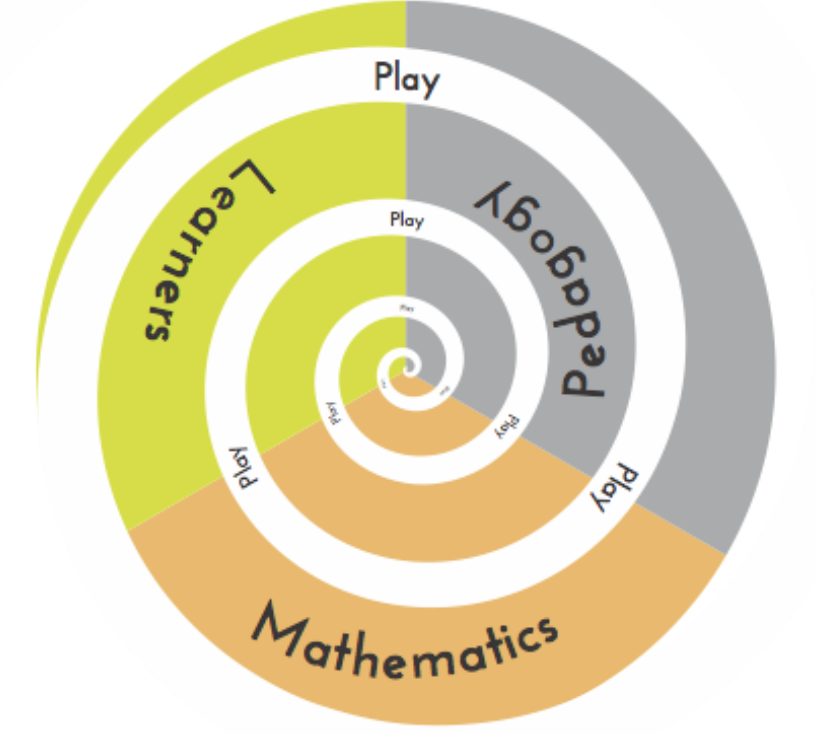
But at this point, the idea of the talk felt disjointed. We thought about a unifying theme of lines. But as we discussed, we found that there was a unifying theme. We wanted people to know we weren't adding to their burdens, this was something already present in what they were doing. Play is the element that connects the elements of great teaching.

Finally it was time for TMC18. We had slides, just. But had had no chance to practice. And TMC is busy. We talked it through twice more and planned out the timing. All while Marian delivered a quiet, intense, thoguhtful, heart felt challenge. Blew me away. Julie went full cheerleader/Oprah and encouraged everyone. How could we follow them? But the people were so generous and supportive, it all worked out.

So, I think you should present. Find people with whom to present, commit to it even if you're not ready, and give it a go. Regardless of the end, the work is worth it, and talking with other teachers or mathematicians is the way to get better. In your school, a local conference, NCTM regional or national. Ask someone you want to talk to, or say yes when someone asks you. I promise: you'll love it.

Monday, July 31, 2017

#ITeachMathLearners

(Have to read that post title Sixth Sense style.)

First do I write about: #iteachmath or Twitter Math Camp 17? ...  have to get the hashtag stuff off my chest.

I love that Dan is thinking about inclusivity, and it befits his problem solving orientation that he's willing to rethink any aspect of the situation.

I started blogging April 2009 with a 50 word post, just sharing a resource I liked. I thought I would use the blog to share the stuff I found around the web that I like or was thinking about how to use in my class. Ten posts later I finally shared an first activity that I did back then. A math game, of course.

This was a long time ago in internet years, and I understand that the world is different. I was inspired by what I was finding, and just wanted to join in.

First tweet, 2010.  (Find yours.)

I was at Maria Anderson's tech camp (@busynessgirl) and she suggested Twitter as a way to connect with student teachers. That's been great, but I wound up liking the math twitter/community plenty for myself.

When it was time, 2013, the community wondered how to refer to itself. They came up with Math-Twitter-Blog-o-Sphere, and I liked the silliness of it right off.

Is #MTBoS a barrier now? People are hurt by this suggestion, because they work like hell to make the community inviting and inclusive. And are always looking for more ways to do that better.

From where do the hard feelings come, then? I have theories. Basically this list is the consequence of people new to twitter don't know how it works yet.

  • some of the most followed people are friends. They take math with anyone, but also talk real life to each other. There's shared experiences, so they refer to things that not everyone was a part of. But because of the way Twitter is, we see some of those relationships. That could make you feel like (Justin Aion analogy) being at a party by yourself. As Justin says, at a party, they'd see you standing alone and approach you, but on Twitter, you can be invisible if you want.
    Remedy: new users can let people know they are there. 
  • People say 'Include #MTBoS and get your questions answered.' Sometimes? More people watch that tag and respond to new people than I think would ever happen in most communities, but not everyone gets responded to.
    Remedy: tweet @someone. If I see someone asking for a resource, I may not have a response, or know others who have better. But if you tweet @mathhombre, I reply. (I think?) I challenge you to find a community with a higher response rate.
  • #MTBoS is a community. We have relationships, shared values, and even meet when we can. If there's an in, there's an out.
    Remedy: come on in!
What I notice about these problems is that the remedies are all putting the burden on the people who feel outside, which is usually the hallmark of an exclusion problem. But that's where we need to see and popularize the efforts of Tina Cardone, Sam Shah, Lisa Henry et al. There wasn't an intention to brand anything, but having a name is part of making you a group, a tribe or a family. I would rather reassure people that this family wants you and is inviting you in, than worry about what the name connotes. 

It did feel autocratic, and like a dictate, but that's probably mostly because of his position in the community. He is the introduction to the MTBoS for most math teachers. He is going to hear the complaints the most, maybe? 

The timing was really unfortunate, as it distracted from the amazing keynote by Grace Chen. (Pts 1 and 2) (Which I will talk more about in the next post.) 
Andertoons

Dan is trying to connect people with #iteachmath. Great! I don't see how that solves any of the three bullet points above. Hopefully, the new tag will be successful. If it is, within a couple years people will feel like it's cliquish or there are rockstars and arguing for #mathlearnersunite. Great! 

I don't think of this as particularly important - or coherent - post, but this is a blog. I can work out my thinking here, and live long enough to be embarrassed of it. I can give a first take. No one else may read it or maybe it becomes the rare post that gets a comment. One of my Twitter Math Camp take aways, from Carl Oliver's sweet keynote (Pts 1, 2 and 3), is that it's important to push send. 

If you hear about the #MTBoS, my guess is that you will be curious enough to investigate. If you do investigate, you'll find things that will help your learners. If you value that, I encourage you to join in. The more you participate, the more you'll feel a part. If you can get to a Twitter Math Camp, you'll be stunned at the welcome. But nobody's going to make you.


Sunday, February 28, 2016

Exploring the #MTBoS

My elementary preservice teachers (PST) are exploring professional development this week. The first assignment was to do a webinar or our local conference, Math in Action. Global Math was Problem Strings with Pam Harris (awesome) and Christopher Danielson is keynoting Math in Action, so fortuitous timing, say no more. The second assignment is to find a blogpost to recommend to teachers, so I thought I would pass these along. The list of leads I gave them is:

Apologies for any exclusions. These are all people who's work has come up so far in class. What elementary blogs would you add?

Their recommendations:
Dana -  https://mathmindsblog.wordpress.com/2016/02/11/rhombus-vs-diamond/
Summary: This blog post is about a class of students looking at four different shapes, and trying to find the odd one out.
Review: I thought this blog was great because instead of simply telling the students the names of the different shapes, the teacher let them think and reason for themselves; she allowed them to come up with and defend their answer by themselves.

Dayna - This is a great lesson to combine English and math and get students excited to learn. My response to the lesson is that I love that as a teacher you get to see the students thought process when they are working on this problem. http://marilynburnsmathblog.com/wordpress/chrysanthemum-an-oldie-but-goodie/


Kalyn - https://tjzager.wordpress.com/2015/06/06/comparisons-a-little-bit-more-older/
This post talked about how comparison problem are everywhere, even outside of school. Although they can be difficult at first, the lightbulb goes off and the problem makes sense! I really enjoyed this post and the person example that it gives of her daughter and the conversation that they had about math, but also about life. A lot of good stuff here!

Ally - http://exit10a.blogspot.com/2015/12/22-30-50-100.html
This is a great blog. It's about how is he works with "Alex", going through counting. It was a great read.

Amber - For my blog post, I chose to look at some more of Graham Fletcher's stuff. And although we aren't learning about volume right now, I thought this post was a great representation, which shows real life problem solving. It offers that children are robbed when force fed uninteresting story problems from a text book, and Graham offers an interesting 3 ACT problem as a substitute. My reaction to this concise, yet powerful read is that I would like to try a problem like the one he brings up. I bet students would be very interested in it. http://gfletchy.com/2016/02/14/im-placing-a-hit-on-the-pseudo-context/

Sarah - https://mathmindsblog.wordpress.com/2016/02/05/obsessed-with-counting-collections/ Summary: Second graders explore sorting by counting by 2's, 5's, and 10's. A similar activity is conducted with first grade students. One students has difficulty counting when there is a leftover present. Review: This post really made me think deeply and question the use of ten frames. Kristin Gray does an excellent job of questioning the thinking of students and that is something that I, personally, need some work on. 

Chris - http://followinglearning.blogspot.com/2016/02/art-for-maths-sake.html
Summary: This blogpost is about an "artsy-mathy" activity he did with students involving creating trees out of factor trees.
Review: I absolutely loved this post because it addressed an issue with "artsy-mathy" activities, which is that they tend to be less artsy than an art lesson and less math than a math lesson. I enjoyed how he addressed the issue by making more out of the project and creating an exhibit where the students could teach to younger students.

Orina - http://marilynburnsmathblog.com/wordpress/four-strikes-and-youre-out/ I thought this game was really interesting and fun because students have to use number sense to try to win. A lot of students are familiar with hangman and it's a math way to play a fun game.She comments at the end about how this game is competitive and can be cooperative also. Playing games can bring more fun to the classrooms, but she comments that we must make sure there are some competitive and some that are about cooperation.

Kathleen - http://followinglearning.blogspot.fr/2016/02/quadrilateral-sets-lesson.html
this teacher was trying to get her students to understand grouping and have then work together to see what made the shapes different and what the noticed in general. a lot of then saw that there are many triangles in the rectangles.

Heather - http://gfletchy.com/2016/02/14/im-placing-a-hit-on-the-pseudo-context/ I really enjoyed this blog post because it addressed the question we all ask ourselves, when will I ever use this? I like the way he addresses practical examples and being able to take those practical examples and use those for practice problems not "mind numbing" problems. (John says: "be sure to see Joe's follow up.")

Stephanie - http://exit10a.blogspot.com/2016/02/a-post-about-counting-circles.html
Summary: Counting circles can serve as more than one purpose of just counting; it helps you practice standards, recognize patterns, etc.
Review: I never knew you could do a counting circle in some many different ways; the more questions you ask your students about it, the more they will think about it, and deeply understand the material better.

I admire their taste in posts! 

The other thing is how much I want to thank these bloggers. By sharing your classroom you are having a profound effect on other teachers - and on the future. It takes time and vulnerability for you to write, and I want to thank you for it.

Tuesday, January 12, 2016

Similar Triangles

So now I'm going to blog about something that I'm just starting to think about.

For two days, I've had a tab open with a neat Futility Closet post. (So many clever bits of mathematics and reasoning there.) It has this image:

A pleasing fact from David Wells’ Archimedes Mathematics Education Newsletter
I immediately made it up in GeoGebra, but being the start of a new semester, hadn't really thought about it yet. I didn't see what parallel lines had to do with it, nor being equilateral. About to close the tab finally, I shared it on Twitter. Boom!


Matt and John jumped in. And then HenrĂ­... 


I love the cycle of generalization in math! Get rid of this restriction, and that restriction.

Get rid of the 2nd line.
Get rid of the shared vertex.


And then the what ifs. What if we restricted a vertex in the preimage?

Surprise!

Lines and circles to lines and circles... must be complex. But John had already gotten there!
 

Then Simon found circles another way!


Now I'll go find someone to talk with locally about the complex transformations here. I could do it alone, but I prefer math in dialogue! I think I want to see someone else get excited the math, too.  I also enjoyed this coming up so soon after the post on Willingham's 4C's of story. Great illustration of the causality and complications inherent in an interesting mathematics situation.


It's available in GeoGebra if you want to play, too.

Thursday, August 13, 2015

Where Do I Start?

Oh, that's longer than a tweet my friend.

Jim Doherty, @mrdardy to you, recently got a lot of great responses to this (basically) question on Twitter (link to conversation). So I want to archive them someplace. My preservice HS teachers have a pretty good collection, but maybe I should think how I use them. The lists below are in order of how frequently I use them. I'm a weird one, though, so it's not meant to be a ranking on quality.

So I want to teach a new lesson about something. I go to...

Search

The Big Ones

  • NRICH - Cambridge's problem site that continues to grow and expand. Searchable by topic, age level, and challenge level.
  • Illustrative Mathematics, free ever-more-complete curriculum 
  • Shells Center/Mathematics Assessment Project, good as lessons, problems or assessments. Often with sample student work.
  • Georgia Standards, even if they're sadly going away from them. A complete, free Common Core curriculum, generally of more consistent quality than Engage NY.
  • Mathalicious, paysite but worth it.
  • Math Forum, in process of changing to being an NCTM program/ally/thing. I have high expectations.
Community Collections
  • Fawn Nguyen's Visual Patterns and Math Talks. I use Visual patterns a lot. Problems, investigations, resource for students... Math Talks I should use more. Great bits of dialogue and student thinking, on simple but rich questions.
  • Michael Pershan's Math Mistakes. Valuable as a teacher for thinking about misconceptions, good reasource for mistakes for students to look at to try to fix or look for reasoning.
  • Dan Meyer's Google spreadsheet of 3 Acts lessons 
  • Mary Bourassa's Which One Doesn't Belong. Built on the idea in Christopher Danielson's great shapes book, but expanded to many content areas. These are hard to make and great to have collected. 
  • Open Middle problems by Nanette, Robert and Bryan.
  • Desmos Activity Bank (new but I'm confident in greatness-to-come)
  • MTBoS Activity Bank (spreadsheet; we need something like this. Maybe this is it?)
  • #MTBoS collection of community efforts (some of the above and more...). Estimation 180 and Would You Rather? are both good sources of warm up/cool down questions.

Amazing Personal Work
  • Don Steward's Median. Lots of lessons, often with an interesting visual component, and very clever. Awesome variations on a them within each set of problems or activities.
  • James Tanton's Curriculum Resources. YouTube videos that are problem & thinking centered. I like that he separates the problem, and gives learners a chance to do it.
  • Brian Mark's Yummy Math, real real-life problems.

Outstanding Curation
  • Geof Krall's Problem Based Curriculum Maps, MS and HS, traditional and integrated. I use these regularly and recommend them frequently. So important, and done so well.
  • Sam Shah's Virtual Filing Cabinet, so many great lessons from the #MTBOS. Sam's taste is impeccable.
  • Tina Cardone's #matheme page (bunches of math teachers writing on selected, typically practical, themes.)
  • Jo Morgan @mathsjem's Resourceaholic. Weekly blogposts highlighting up to 5 new resources for teachers.

More Teachers' Virtual Filing Cabinet (Link Collections)
Miscellaneous
  • Inside Mathematics' Problems of the Month. Generally interesting, sorted by grade level. More at the Inside Mathematics site than these, too.
  • Brilliant.org. User submitted problems in multiple choice format. Inconsistent, but some are... well, you know.
New to Me (both from Jim's tweet, but solid recommenders.)
  • Math Bits via Wendy Menard
  • APlusClick via Megan Schmidt, problems sorted by grade and content
Games
  • I'll plug my math games page here, especially the links to others' games and review games.
  • James Cleveland's spreadsheet, trying to find math games for major content topics throughout high school. 
And that's not all, folks.  But at least it's a start, right? Please feel free to mention your starting points in the comments.

P.S. Glen Waddell wrote a nice Teachers Share with Teachers response to a poor NYT article. It has a lot of great resources with descriptions.

Wednesday, August 5, 2015

An Allegory of Passion


Saw this painting, An Allegory of Passion, at the Getty Museum on my way out of LA from TMC15. (By the way, the Getty's AMAZING. I'd go back to LA just to see it again.) Thought immediately that it was a good summation of camp.

My spouse gets endless amusement from
sending me to camp.
Last year I was looking forward to Twitter Math Camp, but nervous. I'm a stereotypically introverted math geek, and people... <shudder>. Of course, these are my people, and it was amazing. Things gleaned from that meeting include Counting Circles and Talking Points, which had huge impact on my practice last year. The subtler effect was making these people whose ideas and opinions matter to me more real, and the whole community as a consequence. I'm kind of a teacher fanboy, anyway, but these are special folks.

And if I thought expectations were high last year, sheesh. I spent a lot of the year telling people that this was the best professional gathering I had ever been to. How could it come close?

By being all these amazing people from this community. Such good folk, sharing their hearts for teaching and students.

Twitter Math Camp has a morning session that runs for 2 hours all three days. Goal is to collaborate on larger projects. Gathered as a whole group, there are My Favorites, 5 minute quick shares of something that makes a difference to your teaching. Each of the first 3 days has a keynote, and then two 1 hour sessions to follow up on work from the morning or on separate topics. Again, much more participatory than at your run of the mill conference. The Twitter Math Camp Wiki has a large portion of materials and resources from all the sessions, and this year a lot of video.

James Cleveland and I ran a morning session on making math games. It was great fun, and a learning experience for us, too. Separate post on that. (I hope.) The only drag about running a session was not being able to attend a session. I'd hear Elizabeth Statmore talk about anything, but the session on Exploratory Talk would be great. Talking points (I first saw at TMC14) was a big addition to my PD and teaching last year. Or to be in a room with the Desmos gurus...

I just want to share some of what has stuck with me.

Chris Shore did a My Favorites on Neuron Stickers. Here's a tip: if you ever have a chance to interact with this guy, do so. Amazing teacher and person. In this quick pitch, he described work with a group of students who had all failed 8th grade math, in an algebra class. He focused all year on growth mindset, and helped students develop their own culture of recognizing big ideas. Not just in math, either. Spoiler of the story: 100% pass rate. See also his Rally for Roatan.

Lani Horn gave the day 1 keynote. She's the very model of a modern math ed researcher. She focuses on important issues, goes about it in a holistic way that respects teachers, and has keen insights into the data she collects and conversations she holds. In particular here, she presented her best idea as to what separates good teachers and great teachers.
  • how do teachers describe teaching problems? Great teachers think of them in actionable terms.
  • how do teachers represent instruction? Great teachers are heavy on context and student voice.
  • how do teachers interpret their situations? Great teachers have beliefs built on connections amongst student learning, mathematics understanding, and ideas about teaching. She described this as ecological thinking. Research shows this is the most difficult thing to affect in teacher candidates.
The afternoon sessions were basically time with my favorite teachers. Megan Schmidt  led a session on powerlessness in teaching. It was a deeply moving session. I'm a big believer in 12 step programs, AA gave me 30 years with my father I would not have had otherwise, and Megan has been brave enough to bring that kind of grace and support to the MTBoS. Read her post about it. Sadie Estrella led another confidential session afterward, where she conducted a half hour of excellent and energizing teacher stories.  It was indeed a half hour of cool.

Day 1 closed with Art Benjamin's Mathemagic. I'm not super-keen on his TED talks, but wanted to give him a try in person. I still don't know what to make of him, and wonder whether he's confirming more biases, ruining more good problems, or just putting a fun face on math. He didn't seem to have a sense of the audience, though. I did make a GeoGebra version of his guessing game that doesn't give away the trick, though.

Some of the Day 2 favorites that stuck with me include: John Stevens and his MTBoS search engine. Great bit.ly address: . I use it all the time. Glen Waddell talked about the deep and relationship building practice of high fiving his students on the way into the class. Not because of a school policy, but because he commited to them to do it. When do you get a high five? When you do something awesome. Heather Kohn did a bit on her use of 3-D printing in a Desmos project. I've got to look into that. (That link goes into an effort for 3-D teachers to share resources.)

Day 2's keynote was Christopher Danielson. (Video, text) The most productive man in math ed. Books, new math memes, Desmos activities, Oreo controversies... what hasn't he done? His message was simple:
Find what you love.
Do more of that.

Which he then proceeded to model for us by showing how much of his work grows out of his love for ambiguity. This gets to the heart of one of my beliefs about teaching: it is personal. It's a deeply human activity. The best teachers are ones who have found a way to make their teaching true to themselves. Giving up authority - in the you're an author of your teaching sense - is a soul killer.

I think what I love about math is play and puzzle. In grad school I used to tell people they paid me (not much, of course) to play. There's a lot of play in my classes, but I need to work on the sharing of it.

In the afternoon, I went Lani's session on eliciting student thinking. She's writing a prequel (based on real classrooms, of course) to the great 5 Practices book. This will be good - especially for my preservice teachers, I think. Bottom line: foster intellectual risk taking. I followed that up with Robert Kaplinsky's session on formative assessment by questioning. Two pointers: avoid yes/no questions and hit the hows and whys. David Coffey (via Twitter) thought her list of "Belonging, competence, meaningful, autonomy" sounded a lot like Brian Cambourne's list of requirements for engagement.

This afternoon also saw the big news of Math Forum moving to the NCTM and Nguyen and Vaudrey as Barbie and Ken.
For some reason no one was taking pictures of Ken.

That night the California guys and Mathalicious put on a Bar-B-Que. I got to listen to Lisa Henry relate the tale of the Twitter Math Camp. This is a special community, but I don't think these would happen without her and her husband. Mil gracias, compañeros.

The third day keynote was Barbie herself. In an amazing performance of comedy merged with move you to tears love of students and community, Fawn presented teaching as a web of relationships. Parents, administrators, colleagues and students. Focus on what is important, make no excuses, and give your best. Because these parents have given you their best. If you have had any exchanges with Fawn, you respect her. If you only watch one of these, watch Fawn. You have to make it through some MTBoS stuff, but that is really making it clear how we are this community of colleagues. "Of course it's hard. It's not worth it if it's not hard"

In the afternoon, I got to meet Bruce Cohen who has some beautiful GeoGebra. And watch Dan Anderson recreate it in processing on the spot - man's got skills. Then we sat down in a mini GeoGebra user's group. Despite MTBoS being Desmos first, GeoGebra is still there.

Sunday is the wrap up, a few more favorites. I did a favorites on Tumblr, at Hedge's request. Made it in a Tumblr post. Are you on Tumblr? Let me know. There's the start of an Activity Bank - hope that develops. Curation is really an open problem to me still. Princess Choi gave a hilarious pitch for her student created videos. Lisa summed up, well and emotionally. And announced TMC16 in Minneapolis.


So see you next year in Minnesota!

PS. Many better reflection posts than this one at the archive. Elissa Miller was prolific in reflection. And Sam Shah's turned into a state of the MTBoS. Also has the TMC15 song...