A blog for sharing my math interests on the web, to post new materials for elementary, secondary and teacher ed, and vent mathematical steam when needed.
Thanks for visiting!
Beforehand I was wondering how much would be new? I love his two TED talks and the RSA animation and overshare them with students, but you do notice recurring ideas. Appropriately. I also was wondering if he was tall - as he looks imposing in his TED videos. (He's not just not tall, it turns out.)
He's charming, funny and a natural performer. Really funny, like Ricky Gervais as an academic. Inspiring, too, and if you get a chance to see him, take it. He has new PBS special coming up, for his new book, and I will be watching. He is a self-promoter, and has a robust ego, probably appropriately.
He incorporated his traditional messages:
creativity is important
all people are inherently creative
disbelieve the big three myths about creativity
creative people are the exception
creativity is only valid or valuable in the arts
your creativity is fixed
current education crushes creativity, or at least discourages it
people who find their element, the connection between their passion and their creativity, are happier, healthier, more productive and have greater impact.
we cannot plan our career, as we have no idea what's coming
His new push was to create a culture of innovation. He seems to see stages of development of creativity:
He applied this mostly to education, talking about Finland and the Blue School (a school designed by the Blue Man Group), and a USC art history grad who went on to become an art evaluator for an auction house, traveling the world.
His upcoming book answers my disappointment with The Element. It's Finding Your Element on how to develop that connection. He also mentioned a major rewrite for the new edition of Out of Our Minds.
My struggles are that his stories, like the art school grad, Blue Men, Johnny Ivo, Nobel winning chemists, etc., confirm the myth of exceptionalism. They don't remind us of the students in our classrooms that we can't get to try. They also tend to wind up with 'and now they're famous and rich.' That is not going to happen for everyone. It can not. Why does his vision look like for me? For that student? (You know the one.) I was glad to hear the Blue Man story, too, because so many of his stories are of the individual, while much of what I know about creativity relies on collaboration.
I'm also left wondering why we can't convince our politicians and decision-makers of the value of this approach to education. Someone asked a question about that, sort of, and Sir Ken joked a response that boiled down to we don't know how.
Yet, for a couple of hours last night at least, I felt like this is possible. And his encouragement for teachers who are trying to make this difference is very valuable. I was reminded of and consoled by the many teachers I know locally and through the mathtwitterblogosphere who are making these changes happen for real.
Hello! It's good to be writing again. We actually took a bit of a vacation, then, of course, it's crazy trying to catch up coming back from a break. There's a bit of writing inertia to overcome, but it's definitely better to be writing than not. Starting my math for high school class, we watched Ken Robinson's 2006 TED talk on how Schools Kill Creativity.
Through the blessing of a larger than expected number of mathematics student teacher assistants, I get to teach or coteach the whole secondary math ed program this semester. 329 - Math for Middle School Teachers, 229 - Math for Secondary Teachers (not renamed since before 329 existed) and Ed 331 - student teacher observation and seminar. As a department we've needed to review the sequence as a curriculum for coherence, so now it's a good opportunity. The content for the first two courses is almost obvious to divide, with the exception of linear equations and functions. The pedagogy... wow. That's thorny. The field experiences are centered on classroom observation in HS (229) and and individual student assessment in MS (329). Right now, the high school is centered around the NCTM Principles, and the NCTM process standards in the middle school. We're lucky enough to have Char Beckmann in our department, so there's texts that follow that plan.
At the initiative of my colleague Dave Coffey (who is just starting blogging - you should read it) I started thinking about math ed classes as having themes of doing mathematics, learning mathematics and teaching mathematics. For me, the correlation between that framework and the processes/principles should be where the instruction happens.
How do you teach preservice secondary teachers? Organize your curriculum? Emphasize as themes?
At this point, if you haven't watched Sir Ken, now's the time.
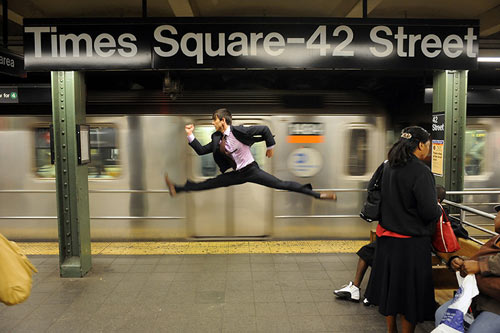
Having watched that, the students thought about what was important to them. What is creativity (original ideas that have value); the conditions for creativity (if you're not prepared to be wrong, you'll never come up with anything original); the diversity of intelligence; the importance of teaching to encourage and support students. Later this week, I watched Charles Limb's TEDx talk, "Your Brain on Improv." He was actually able to observe the self-critiquing and monitoring areas of the brain decrease function, and the expressive parts of the brain increase function during jazz and rap improvisation. (Worth watching just to see a neuroscientist rap.) Also stumbled across, again, Jordan Matter's Dancers Among Us photo series, which is great in light of Sir Ken's Gillian Lynne story.
We then considered the "So What?" What does this matter for math teachers? They did a great job thinking about this. It makes process more important; requires multiple modes of instruction; enhanced by more real life connections; values problem solving and reasoning; shows more than one way to do a problem. It was interesting to me the subtle bias from their education - these are all things the teacher does. Still no autonomy or choice for the learners.
I'm wary now of revving preservice teachers up too much. When we see graduates in the schools, one of the most common things to happen is to have them apologize. They apologize because I've given them guilt over that they should be doing more activities or writing their own problems or using more technology. Which really means I should be apologizing. (And I do.)
So we discussed that our response to this issue of change can be big or little. Subtle shifts or big changes. One of the examples that came up as restrictive was number computation. As an example of a subtle shift, we tried going from "what's the answer?" to "how else could we do it?" (Really a better question in terms of differentiation as well as mathematics content.) So what is 72x26, and how else could you do it? Firstly, students were suprised by how some people were taught, and secondly, they (who do already know how to multiply) really got into it. Coming up with new methods, seeing connections, making sense of what other people had done. Really doing math. I picked 72x26 because it was adjacent to doubling, to x25, etc.
In black are the responses to how they were taught. The first response was the partial product method, which dre some "weird" comments. Then the lattice just freaked them right out. How else got them thinking about strategies like the red. These were closer to their mental strategies. When their methods were exhausted, I shared the green strategies. There was some surprise at how different these were.
Next, for an example of a big change, I shared the example of coming up with a whole new activity. Writing curriculum (Curriculum is one of the NCTM Principles). As an example, we looked at What Can You Do With This. In particular David Cox's and Dan Meyer's WCYDWT toast. (David's original toast post, Dan's regression spectacular) I don't think it is reasonable to expect all teachers to create curricula. On this scale. But with our networked community, we don't have to.
Students watched patiently. "I never knew how long toast took." "Does my toaster take this long?" Even before the first piece popped, "how do the settings control the toast? Time? Heat?" And then a mountain of questions once the toast popped. From toaster design, to physics, to burner arrangement, to people's toast darkness preference, to what they noticed about the times in between, to why doesn't the bottom edge toast, etc. Possible answers to those questions. How they could collect data. The image of the toast set them off anew. What they noticed and what they wanted to know. The more they figured out, the more there was they wanted to know. That's a good sign that you're doing mathematics. More pleasing, they made strong connections to the ideas we discussed following Sir Ken. They saw the potential for buy in, the significance of student proposed questions.
It was a great start to class, but it left me a little nonplussed. This is what class could always be like if we weren't shackled with the expectations of previous generations. The math that was useful at the dawn of industrialization. It's like Jacob Marley in reverse, in this teaching life we will bear the chains our forebearers forged in theirs. But it also held the promise of Buffy. In each generation of teachers, some will be called. They can lead us out of the hellmouth and empower the generations that follow. (When you start mixing Dickens and Whedon, it's time to finish.)
And I think the journey might be fun. One of the students demanded the Toast Song for our recessional music.
So, like most semesters in most of my teacher prep classes, we started out by watching Sir Ken pose the question, "Do Schools Kill Creativity?" Especially for preservice elementary creatures, who often have trouble seeing themselves as math teachers, who often have had very negative math school experiences, and will even sometimes bust out with "I hate math" in front of their math teacher.
This semester's group got pretty into it: the story of Gillian Lynne was high impact, the idea that things need to change had traction, several recognized that they had been subject to this, and the desire to incorporate movement really resonated. (We have a drummer in class, so that might happen.) Some students wrote about creativity for their weekly work: Lauren and Kyrstin, for example.
One of the ways I'm trying to encourage creativity is a work structure (syllabus) like this:
Daily Work: I’m asking you for 1 hour per class. Document what you did somehow and keep in a binder. It is not evaluated on correctness, but on percent completed. Keep an index/table of contents for which days you have work for. This work should either be doing math or learning about the teaching of math. It is okay to double dip - use daily time for Family Math or weekly work. Just keep track of getting in your hours. I will offer suggestions, but this is your responsibility. It’s a good opportunity to practice generating ways to meaningfully work, which will be an important part of your work as a teacher.
Creating: from our work each week I am asking you to put an additional hour or two into deeper work of your choice. Revise or extend a daily work, play or make a math game, make some math art, find and read something in an area of interest, work on a math problem of interest or create a mathematical task… there is so much different work that teachers do. If you can connect it to our course work, it’s probably okay. Each week’s work will get feedback in terms of our rubric and qualitative. But those aren’t grades. At the end of the semester this weekly work will be evaluated ⅓ on completion (did you complete work for each week) and ⅔ on exemplars. You will pick two examplars of your doing math, and two examples of your preparing to teach math.
There's a urli.st of their weekly blogs The list helps me in finding them all for giving feedback, but I ask them to link posts to our Facebook group as well. That gets more readership amongst the class than I've ever had before. One of the purposes of blogging their work is to increase their sense of audience. So if you do take a peek, please comment!
The math content we paired with this is patterning. Our first activity (close to this previously blogged one) got us playing with the appropriately named pattern blocks, trying to get at the idea of what makes a pattern a pattern instead of a design. Our ultimate idea was that it needs to be extendable. Not necessarily predictable, but when you see what comes next it should make sense with what came before. They built and then we talked about repeating patterns and growing patterns and then sequential patterns. To emphasize the extendable idea, we built patterns, then rotated to have someone else add on. Clearly - time for pictures.
Clear to everyone
No discussion
People accepted extension, but felt like 3rd red block could go "anywhere"
Generated interest because the start was in a line, and the pattern was extended 2-dimensionally
Patter creator admitted they didn't know what came next, but liked the extension. Next: 3 blues top and bottom.
Arguments! Pattern creator wanted the trapezoids double each step, extender focused on blues "adding one" each time.
Is this a pattern? Designer claimed it was just a design. Extender felt like the red-blue-green were lines extending out each direction. All agreed: lovely!
The next day I wanted to build on the idea of the sequential growing patterns with explicit connections to algebra. My colleague Pam Wells has the best activity I know for this, adapted from a Mathscape activity. Here's my version. (As a Word doc, if you want to edit. Wasn't displaying correctly...)
Everytime I've used it the lesson has been engaging, provoking discussion, and very supportive of symbolic representation with the visual. Students wanted to work through all the letters on the front, though I only asked them to pick a couple. Many wanted to jump to building their own pattern immediately. Most glossed over the verbal description, so I pushed for that. In general with our pattern work, visual to verbal has been uncomfortable. This is a good activity for the connection between rate of change and the symbolic rule, as several students made that jump. Some students went from data to rule, and some from the visual.
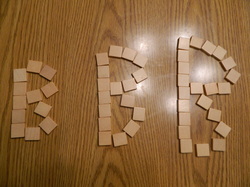
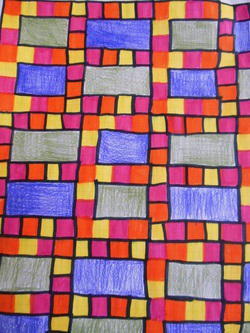
A couple students extended this for their weekly work. I based my sample weekly work on the letter patterns, so I expected more, actually; but that's why we give students choice. Brett extended the letter idea to his whole name, which is actually a pretty nice context for adding functions. (File that one away!) Emily did a really interesting project, making some mathart that had layers of patterns.
The lesson after this was dominoes - but that's clearly a story for another day. Later in the semester we'll do more patterns using ideas of perimeter, area and volume.
They were able to tap into the arguments that people have contrarily, though. Math is about number-crunching, plug and chug, is boring, about right and wrong. I asked them to discuss at there tables how to counter those arguments, and they said:
Everything can be mathematical - there are numbers everywhere. I think in numbers! Any lesson can tie in.
Numbers can be manipulated in many different and unique ways.
The basic skills are concrete, but the application is creative. Like physics: need math to describe creatively.
The reasoning is creative. People discovered mathematics.
The communication of math is creative. Explaining how things work.
Creative how mathematicians come up with the formulas. Might have just discovered it accidentally.
The different ways to represent: graphs, tables, etc.
Math is the universal language. Everyone can communicate in it.
Creativity is important to me (see these other posts) as a goal for my students, and I think opportunities for creativity add a lot to the likelihood of engagement.
It was very insightful to me how they focused on the communicative aspect of mathematics. If math is a language, it may or may not be creative, much as uses of language may or may not be creative. As we share our own genuine thinking, and the way we perceive the world (or a problem), we create opportunities for creative expression.
The class moved on to look at how they communicated their work on a problem of making quadrilaterals by folding a square (an extension of this nice 3rd grade problem filmed by Annenberg - Teaching Math, Lesson 20). And immediately focused on what the answer was and were they right. After our years of school mathematics, we have definitely been well trained.
In the second workshop, we considered the quadrilateral types, and in particular the idea of nested categories or hierarchical sorting. I show this weird little travelogue:
(I want to update it and maybe make that into an animoto, but the ppt file is corrupted, so it will be more work than I have time for right now.)
The students then made posters of some of the quadrilateral types, striving for a variety of examples, and to be creative in making the posters. Critique and discussion of the posters brought out the discussion points I was hoping for, like which properties are necessary, considering symmetry as an important characteristic, and whether trapezoids should have exactly or at least one pair of parallel sides.
Trying to make space for creativity is not going to be a one lesson effort, but hopefully a theme for the whole semester. I can't wait to see what happens.
EDIT: updated the slideshow to have more visual cues and a couple extension slides. I wanted there to be more to notice.
EDIT2: added student posters for the quadrilaterals. We worked on generating a variety of examples. Some made only the specific types, but some made a variety of types that fit the required properties. I like having both kinds of posters!
I've written about Ken Robinson a few times (One and Two). The idea of creativity in mathematics was a sub-theme for my summer calculus class. Students at the end felt that some of the open-ended assignments (projects of their choice), non-standard problems (like the mobiles) and emphasis on problem solving helped open them up to creativity in math. But they suggested more specific demonstrations of how to be creative. (Boy, is that insightful.)
TED occasionally has question and answer sessions with their speakers who really ignited something with their presentation, and Sir Ken recently did this. (Here's the article.) He addresses math specifically:
"If you want to promote creativity, you need, firstly, to stimulate kids minds with puzzles and questions which will intrigue them. Often that's best done by giving them problems, rather than just solutions. What often happens in classrooms is, kids sit there trying to learn in a drone-like way things of not much interest that have already been figured out.
The best math teachers I know, like the best English teachers, are always giving kids puzzles. They're given things to work on where math skills are required but may not be the focus of the activity. There giving them problems to solve. Or they're made to engage with age-old mathematical problems. For example, I'm thinking about the problem of latitude. How do you go about measuring the planet? I mean, somebody had to do that. How do you do it? Professional mathematicians have such a cornucopia of fascinating puzzles, questions, proposals and conundrums. A great math teacher really has endless opportunities to stimulate kids minds and get them engaged with things they'd probably never thought about before. Rather than just giving them techniques." -Ken Robinson
It's not hugely original, but it's nice to get confirmation of things we believe from outside sources. He touches on engagement several times in the Q&A, and I do believe that's the central issue in teaching, and I love to ponder what is the key for math. Going to more and more of these reading conferences, I am insanely jealous of the teachers who talk about the book that turned a student on to reading. Problems don't seem to have the same effect.
I like the theme of the first week of my Math for High School course to be teaching for creativity.
This semester's group did a nice job with Dan Meyer's Toast video. I had them ask questions and record what they noticed. There was a neat dichotomy: the WCYDWT responses were all pretty traditional math textbook questions. The what they noticed branched far afield, wondering what would make a good soundtrack, wondering about darkness of toast and toaster design.
We followed that with a workshop (I think based on an Esther Billings and Pam Wells workshop) based on verbalizing and algebrafying number patterns.
The last workshop of the day was planned to be this, which in the past has been a pretty good activity:
Objective: TLW develop mathematical patterns from the teacher’s perspective.
Schema Activation: when (if you do) do you notice patterns in real life?
Focus: What we talked about in Class 01 was really curriculum. What are we going to teach? Here’s the NCTM’s take:
The Curriculum Principle
A curriculum is more than a collection of activities: it must be coherent, focused on important mathematics, and well articulated across the grades. A school mathematics curriculum is a strong determinant of what students have an opportunity to learn and what they do learn. In a coherent curriculum, mathematical ideas are linked to and build on one another so that students' understanding and knowledge deepens and their ability to apply mathematics expands. An effective mathematics curriculum focuses on important mathematics—mathematics that will prepare students for continued study and for solving problems in a variety of school, home, and work settings. A well-articulated curriculum challenges students to learn increasingly more sophisticated mathematical ideas as they continue their studies. (From the Principles and Standards for School Mathematics (PSSM for short), NCTM. All these principles have expanded information and explanation at the NCTM website.)
As we discussed, there are small shifts and large shifts. This activity applies to both: it’s an easy activity that allows for creativity (subtle shift) but may lead to you designing your own problems and questions for students (big shift).
Activity: we have blocks. Play with them!
1. Make a pattern of images with the blocks. A successful pattern for this task is one in which the next shape is determined, or is reasonable.
2. Describe your pattern in words. What’s happening, what’s changing? What can you say about the next step compared to the previous? What will the 10th step be like? A general step?
3. Describe your pattern mathematically. What can you say about the next step compared to the previous? What will the 10th step be like? The Nth step?
4. What connections do you see amongst 1 (the visual), 2 (the verbal), and 3 (the symbolic or mathematical)?
5. Repeat as time allows.
Reflection: choose 2
• Was this task too open-ended? Does it need more structure?
• Was this task engaging? Was it mathematically worthwhile?
• What were the strongest or most interesting connections you saw in a step 4?
But we didn't have time for that! (Not to butter them up, but they were jamming on the toast and I didn't want to cut that short.)
So what we did was:
Schema Activation: whole class discussion - what makes a pattern a pattern?
Focus: Pattern blocks, make what you consider a pattern.
Activity:
1. Make patterns.
2. Put a piece of scrap paper by your pattern with a Y and an N.
3. Gallery walk. Put a hashmark by yes or no if you consider that a pattern or not.
4. Stop by someone else's pattern, add three blocks.
Reflection: whole class discussion about what happened.Record your personal definition of pattern as it is now.
I'm kicking myself now that I didn't take more pictures. Most students made repeating linear patterns, some tessellation patterns, one person made a circular pattern, and then there was...
This was the only pattern that students did not see as a pattern. It was described as just random fitting together, and someone asked about the yellow. "They were supposed to be orange." And then the author shared how they were lines of blocks fit together. Another student shared how to her it was a skewed checkerboard. Then the class unanimously agreed it was a pattern. I thought that was really interesting and asked how they would verbalize it. Good descriptions followed. Could they capture it symbolically? No, not that I expected it. So I shared a bit about the wallpaper groups, and how mathematicians seek the power of good notation so they can symbolically manipulate. I also shared how I had thought the yellow was a pattern in a pattern.
The characteristics of patterns they thought most important was that it can be explained (there is an idea or structure) and someone who understands it can extend it or fill in a missing piece.
If one week determines a pattern, it's going to be a good semester!
Photo credit: The tremendous image up top is from Tanya Khovanova, in this post. The original question was rather brilliant: "Which one of these things does not belong?" Many thanks to Sue, who pointed out the author below.
Remember about TED? I stumbled across Thomas Dolby's blog recently (I was a geek in the 80s, of course I like Dolby), and have been reading through back posts. He posted this link from TED that I thought was unreal. Ken Robinson is an expert on creativity, and funny besides. If Ricky Gervais had become an academic...
His point is about how we are born creative and educated out of it. An outside observer would think "The whole purpose of public education is to produce university professors." But he goes on to describe how we have convinced the majority of people that the things they are good at and interested in are not valued or even stigmatized.
So... what to do about it? I'm going to show this to my Calc 2 students on Monday and see what they think.
Pat Bellew has a good quotation in today's On This Day in Math:
By keenly confronting the enigmas that surround us, and by considering and analyzing the observations that I have made, I ended up in the domain of mathematics, Although I am absolutely without training in the exact sciences, I often seem to have more in common with mathematicians than with my fellow artists. - M. C. Escher, Quoted in To Infinity and Beyond, E Maor (Princeton 1991)
The best post I saw in advance was Evelyn Lamb's Look Down. (Which also sounds like it could make a good horror movie.) Also note the founder of this here holiday's post, Emily Grosvenor's post on making the holiday. Also also note that Eric Broug's TED-Ed on Islamic Tessellations came out in time for today.
Best way to see what is happening is probably the twitter hashtag #worldtessellationday. Lots of groovy there.
I had to make something, so here's a GeoGebra applet. Instead of an Escher-style, I made a square you can fill and then fill the plane in three different ways. The matching conditions make for some cool patterns to me, like infinity tiles. If you want an Escher style applet, check my collection of tessellation sketches.
My most recent tessellation work was with Heather Minnebo's art students. I helped some work out the mathematics, but got interested in her art directions.
I was having to eavesdrop while taking to other students, and we'll talk more about. But what I got was her talking about size of the tile compared to the final paper (encouraged to be quite large, like a meter by 1.5 m.) She talked about the designs within the tile, that were going to have to fill the whole paper. It struck me that the same things she was looking for are what I would want to emphasize the mathematical structure. Plus some nice visual estimation. Afterwards, she was highlighting craftsmanship as a growth area for some students, and I was wondering what that looks like in the math classroom. Heather says "craftsmanship for my kids (excluding some of my quirky friends who are owned by their ideas) comes down to ownership and then honing skills." She notes that at least half-ish of them were able to mesh conceptual understanding with some solid technical skills and creativity.
Heather notes: I have more questions than observations. I've taught this lesson now half a dozen times, how long before I really get a handle on how to best teach it? Every time I get an idea for how to improve the instruction and pacing, but it's a long ways from solid. (A solid chunk of this weakness/uncertainty is the knowledge that I don't have the full breadth of understanding of the mathematics behind it.) How do I get them to keep the spontaneity of their creativity and experimentation, but add in the understanding that this game has rules to follow. For instance, when I say midpoint I mean get a ruler and find the midpoint.
The enthusiasm and interest is palpable from the introduction – their minds are blown by the Islamic architecture and Escher's work – to their own initial trial and error. How do I encourage that same level of interest and enthusiasm all the way through to the end? I have two groups of kids who are able to do this from beginning to end: the ones who get it, own it, and have the discipline and mastery of skills to carry out their vision, and then there are my creative geniuses who are owned by their ideas and they are consumed with fulfilling the vision in their heads and I don't believe they see the issues of craftsmanship or skill we see. The bulk of the kids are in the middle – their enthusiasm and effort peters out (in varying degrees) as the repetition of shapes try their need for instant gratification, brains. This harsh judgment includes myself as I too often fall into this low attention span category.
Lastly and most complex, how do I convey the challenge to see each individual shape as a separate defined image/area, yet also view and plan them work together as a whole? Unbelievably, More than a few kids ignore the pattern they've established by tracing their shape, and they add color and additional patterns over all – sometimes obliterating the tessellating pattern they created. This blows my mind. I struggle against being frustrated as I think they absolutely must be missing something to choose to do that. Those are just a few challenges and questions I have… I'm sure there are many more this was just off the top of my head.
Wow. These are some of the biggest teaching questions that there are! Any suggestions or comment from readers?
I always love how bold elementary students are (compared with college) and willing to try when college students often need to know if it will work first.
Special opportunity today, to meet and greet the author of a fun new math book.
Emily Grosvenor (twitter, website) is a "reporter, travel writer and essayist" who has gotten all the way to Mathland with her illustrated children's book Tessalation!. After a successful Kickstarter, the book is available for pre-order or as an e-book at Amazon (free for Kindle Unlimited) and direct order from Waldorf Books. I am between having received my electronic and my physical copy, and find the book just charming.
Emily was willing to answer a few questions, so here we go!
Q. Do you remember when you first noticed tessellations?
No. I first learned about them in 4th grade -- every part of my creativity seems to have it seeds in the 4th grade, it must be a seminal year for development. We did an activity in gifted class where we made tessellations. I made an uninspired tessellation of a seal jumping out of the ocean. But it was fun. And clearly it stuck, since I was still thinking about it almost three decades later.
Q. Do you have a tessellation from someone else that you like especially? (Maybe a favorite Escher tessellation?)
I'm a big fan of Horseman But honestly, I think my favorite is just the simple hexagon tessellation. We just got bees at our home in McMinnville. I have great hopes I'll see one there, soon!
Q. What makes tessellations worth thinking about and exploring for you?
I find patterns soothing to look at. Honestly, visual culture bothers me a lot. Usually there is so much going on, and I get distracted easily. But with tessellation you can take in the chaos and then let the eye, and the mind, settle on an individual part. Also, I am very compelled by the idea of seeing myself as a part of a greater whole. Not just with my family, but with my community. One of themes behind Tessalation! is that the world is not as chaotic as it seems, that there is an inherent beauty and order to it, and we can be a part of it.
Q. What was your experience on the first World Tessellation Day?
It was a crazy day! My best friend was in town with her kids and husband and we threw a party at the McMinnville Public Library. We had a tessellation station, we screened the book on the wall, we had hexagon cookies, tiling turtles tessellated games, and coloring pages from the book. It was a BLAST! I was so tired. I probably should have been tweeting out tessellations all day, but there were a couple hundred people around the world who were posting images. In all, I was happy with the outcome. When I got a chance I checked in and retweeted, liked or posted what I could. People who like tessellations really love them. Also, it's a visual meme, which makes it easy to get behind.
Emily created World Tessellation Day, and used it to launch the book. She has a fun post about the book launch here. The twitter stream for #WorldTessellationDay had a ton of fun participation from genuinely around the world.
Q. Why should it be an annual event?
Why should anything? It's fun. Fun to post, fun to make, fun to see all of the creativity happening around the world. I was most impressed by the posts coming in from Spain showing all of the tessellated mosaics available in plain view in public spaces. There are a lot of silly holidays. We share World Tessellation Day with National Flip Flop Day, for example. Who cares about flip flops? Well, someone does. If anyone cares about something there should be a day for it.
Didn't realize it was also flip flop day - despite Danica McKellar's tweet. Doh.
Q. What’s challenging for you when you are developing a tessellation?
I actually don't do a lot of designing tessellations. Notice I did not make the illustrations in the book, for example. But I did try to create the feeling of tessellating in the rhyme scheme and overall meter of the book. I wanted there to be a strong connection between how the text feels when read out loud and what you are looking at. Can words tessellate? I think I tried to do that.
Q. Do you have a general process you follow?
The best part of this project has been how it has opened this entire world to me of math play, tessellation and visual culture. I launched this project thinking that tessellations are awesome but not really having any idea of the scope of talent out there or of the artists who are working in tessellation. I've been touched by people who have reached out from around the world to share in the excitement. But my favorite moments are when my 3-year-old, Griffin, finds them in plain sight. Just yesterday he got a new pair of Timberline sandals and said: Mama -- there's a tessellation on my foot!
Fascinating!
Thanks, Emily, for the book, and holiday and interview.
Oh! I should have asked how she got connected with her talented illustrator, Maima Widya Adiputri (Tumblr, FairyFrame).
Find out much more about this book from other stops on the booktour.
Or start immediately making your own! One of my most recent ones to play with on GeoGebra is a funky hexagon one, with a glide reflection similar to what the Horseman has.
PS>
#TessellationNation, now #tessnat, is coming at TwitterMathCamp16. Christopher Danielson was thinking it should be based on people's questions, so hop on Twitter to chip in, or share them here.
So far:
Christopher @Trianglemancsd
We proposed this session as one revolving around our questions. Maybe you could share of those here before TMC?
I would like to learn more about how to categorize tessellations.
I wonder about the relationship between "tiling" and "tessellation".
I am super curious about the tilings in mosques. Are they tessellations? Why do they so rarely appear in the math analyses of tessellations I've encountered?
#tessnat There's a start on where my mind is for #TMC16. What about you, Tessellation Nation?
Malke Rosenfeld @mathinyourfeet
1. Hi #tessnat. My goals: try & try again. I would like to play with diff kinds of tiles to help me ask new questions.
2. After I play I'd like to talk abt my notices/Qs and then design a tile that is simple but creates an interesting result/design #tessnat
3. I would also like to observe someone designing/creating an anthropomorphic tiling if that ends up happening. #tessnat
Megan Schmidt @Veganmathbeagle
@Trianglemancsd OH!
I want to draw the things, whatever that means. #tessnat
Ok. My needs are "be in the #tessnat morning session." :)
This game must exist in some form elsewhere, but it came to me yesterday and we worked out a good version of it with my preservice teachers this morning.
It starts with getting to do some of Malke Rosenfeld's Math in Your Feet this summer at Twitter Math Camp, and then subsequent discussions with her that have me thinking a lot about embodied cognition. The example of this in Math in Your Feet was knowing what I needed to do but the challenge of getting my body to do. Move left foot, move! In discussions, she connects this powerfully to research and writing of Seymour Papert. She said something like:
embodied vs “non-embodied” from the research: there is no non-embodied math. Either we’re pulling from previous lived-in-the-world experience to learn, or we’re actively constructing our understanding of self moving in space. We can harness that to give students an understanding of the world.
She's deep that way.
On our first day of class, one of the things we did was watch Ken Robinson's Do Schools Kill Creativity? (If you haven't watched it, give it a go. He's a powerful speaker on creativity, and as close to Ricky Gervais as we're going to get in academia.) The student response from my class was really focused on movement. The Gillian Lynne story especially seemed to resonate; good omens for some of the learning I hope to do this semester.
So today we're studying patterns. First activity was pulling out the pattern blocks. We used that to model how to introduce math manipulatives to elementary students, and introduce the principle that with a new manipulative you need free play. Either immediately or promise the students specifically when they will get it. (Good management meets good pedagogy.) We used free play to introduce the question: is this free play doing math? Which we discussed in Elizabeth's Talking Points structure. (Fabulous, even the first time out.) Then in whole group used our examples to discuss the difference between a design and a pattern. (Is there a difference to you? I'd love to know what you think about that.)
Then it was time to go outside...
Clap Hands
groups of 4 to 7 people
Arrange people in circles of about 6. The game is pretty simple:
Building
One player starts, introducing a motion. Like, for example, a simple clap. Going around the circle, each player does the motion.
After the starting player does the motion, the next player adds a motion. Clap hands, raise right hand. Each player does the 2 part sequence.
After the second player does their two, the next player adds a motion. Clap hands, raise right hand, turn around clockwise.
And so on, until each player has added a motion and it has gone around. Clap hands, raise right, spin right, jump, snap fingers, shake right foot twice.
Survivor
The goal is to get the pattern to go around twice more. When it does, that pattern is complete!
If a player messes up the sequence, they step out. Try to get twice around from there.
If you get down to two people, the pattern is done.
I didn't get video because I needed to play this! Thanks to Jordan and other students who had great suggestions. Reaction to the game was very positive, and people were quite engaged. There was much laughter, too. Keeper!
I'm interested in your feedback on the game, and how you present patterns. So if you have time to tweet or comment, let me know.
I must have three unfinished blogposts to get through, but this is what I keep coming back to this week.
Natasha Lewis Harrington is a doctoral psychology student who writes about my favorite game (Magic: the Gathering) in her spare time. Sometimes she crosses the stream to great effect. Like this week, when she wrote about why this game is so good at encouraging creativity among players. It's applying the work of (let me copy and paste here) Mihaly Csikzentmihalyi (specifically Creativity: Flow and the Psychology of Discovery and Invention [Google book preview]) to the question of how can we learn to engage more. I think it's well readable by non-Magic players, so please do peruse.
Here's the quick take:
(The little bit of art is from Flickr, Paolo Colacino who does what he calls generative art. Quite neat.)
Csikzentmihalyi has a TED talk about leaving boredom:
Why is this gripping me so? Because of the divide between math as taught and math as it could be.
Math, as it is often taught, violates all three of these principles. (1) We tell you the problems to do, (3) we insist on solo mastery and uniformity of method.
Wait, that's only two.
I'm wondering if I have, in my need to change (1) and (3), more than occasionally neglected (2). Is that the procedural knowledge which I de-emphasize? I usually do that in an attempt to get the pendulum swinging in the other direction, but in doing so am I denying needed support?
Maybe not. Maybe Learning the System in mathematics is not the procedural stuff. Maybe it's the processes, hidden behind the procedural emphasis. (The processes now appearing with their new band, the Standards for Mathematical Practice.)
Of course, there's hope. Teachers like Fawn Nguyen, Michael Pershan and Andrew Stadel are knocking this engagement issue out of the park on all three principles.
But, as Dave Coffey has cautioned, and convinced me, we need to teach our students to take control of their own engagement. So when they leave Jim Pai's classroom, they can be engaged the next year, too.
That's empowerment, and that's what I want for my students.
Katie Salen is a professor at DePaul in Design, and director of the non-profit Institute of Play, which runs two public game-centered schools in Chicago and New York called Quest to Learn. I have a fantasy of getting to work with these schools at some point, or being part of a similar project here.
She spoke this year at SXSW in Austin, and they put up the audio of her presentation. I was so interested and engaged I started taking notes. That led me to do some rewinding (so to speak) to get some of it right and listen with intent. Finally I decided to share them, in the hopes that it might support others in going to listen to the talk. If you're interested in applying lessons from other areas to teaching, this is for you. You do not have to be interested in games to get a lot out of her talk.
I was not so focused on whom she was quoting and missed some of the companies or games they made. Sorry!
Notes: Dr. Salen says...
Make learning irresistible now.
Not about preparation for the future
Not about efficiency and productivity of education (i.e. teaching more kids more quickly or for less money)
About engagement, present potential of people including children.
Play is rooted in the now.
Design principles: the idea is to take theory to forge design principles that synthesize and apply the theory.
Sometimes listening to a presentation, there’s a single sentence as a takeaway that helps. As she has listened to game designers, she's noted 'what do game designers think about that resonates with design for learning.' (This talk is her overview of the best takeaways she's found.)
how to engage people
structure for challenge, motivation, feedback, and to incentivize
Portal: Trying to move someone through a level, to hit the beats. There was an early level that players couldn’t get through. They can’t see the door directly in front of them, if there’s too much drama. What they learned was “Don’t shoot the player while they’re learning.” Create a safe-space when people are trying to learn.
Shift from design for learning to design for engagement.
Little Big Planet: created a badge for building levels so players built spam levels. Never incentivize things you expect players to do. Instead incentivize the unexpected and original.
Failure: practice as repeated failure. Musicians know bad practice and good practice. Take the thing you’re failing at, and keep hammering at it. Make it hard for yourself. This turns failure into a positive act of creativity. You make decisions about the things you need to fail at vs. failure as a thing to avoid at all costs. So start with state standards, but design classroom experiences that do not look like taking tests.
Media Molecule: in the original Little Big Planet there were not enough tutorials, because of the push to publish. But players chipped in. Now for Little Big Planet 2 they intentionally left space for contribution. They expected codesign. Supported it by having the “Elite Creators Group” in Little Big Planet 2 who designed great levels, but also tutorials at the same time. Leaving a gap. Applying to teaching, consider what can young people teach each other? Value peer to peer exchange. Design community. It’s not the product, that’s their material. If social interaction matters, you have to design the community for interaction. What do cemetery rows of desks support? Communication of one to many.
Valve: developing levels and puzzles, and how they are playtested. Single player puzzles were designable, but they couldn’t make the collaborative puzzles hard enough. Fundamentally different design problem. Most challenges today in classroom only deal with individual problem solving, fueled by individual assessments. Assessment people can’t solve the free rider problem, how do you know someone is not participating and letting others solve the problems. So they make assessments individual, secretive affairs.
LBP: share, communicate and collaborate is opposed to the idea of sorting and classifying, which is common in school, primarily because of assessment. The problems in design for community belong to design for interaction. (In general she kept referring to the design space for x belonging to the design space for y. I want to think some more about how this applies to teaching teachers, and how common teacher problems generalize.)
Design Principles
1) Create a need to know. (Games do this well.)
2) Create a need to share. (Opportunities and need.)
3) Create an infrastructure to enable sharing. (Designing mechanics.)
There were several comments that relate to assessment:
Valve: new feature allowing players to playtest each other’s levels. Game design isn’t theoretical, you have to build it and try it. Whole curricula are designed and distributed before testing.
John Beech: value of feedback to the designer. “A computer can’t say if art is amazing.”
Games are rich data spaces. The danger of moving to stat-driven models is focusing on what machines are good at assessing.
Alex: bias towards and emphasis on jamming. Jamming is a common game-design culture, but less common in education. Put in constraints. The original LBP had infinite depth, but the final version only had 3 levels, because the restriction pushed designers. Game designers understand the importance of rules. Rules are so natural they are unseen, or they push the players to develop excellence. Might go from a lot of rules to less; constraining how many things are possible. This increases challenge, laying the groundwork for jamming. (A problem worth solving. Lord knows that in education we have plenty of these.)
Some games work on the 3 Pass Rule for learning outcomes for players:
1) Learning one thing.
2) Practicing that thing and learning another.
3) Synthesizing what you’ve learned.
Are schools putting in constraints that push creativity or shut students down?
Design for collaboration is linked to design for play. Students feel imaginative, are hard working and collaborative. We want them thriving now, not being prepared to thrive.
Lonely Planet: Empowerment. Giving people the ability to make something. I remember making my first computer game in Basic on my first computer. Made copies and sold them at the playground for 1 lb a piece. That feeling for me is what I mean by empowerment.
Not about stuffing content in games, or games as a substitute for textbooks, but that feeling.
Takeaways. These are here big points gleaned from all these game designers.
1) Design for friendliness. Environments that are well and healthy. Interactions are reciprocal and positive. This doesn’t mean they are noncompetitive. (Starcraft 2)
2) Enable good practice. Students are skilled at finding out what’s on the test, which
3) Qualitative feedback.
4) Keep challenge constant.
5) Make sharing a gift.
6) Minding the gap. Design opportunities with holes that give students opportunities to fill the gap. Don’t make gaps around the wrong things.
7) Don’t shoot the player while they’re learning.
In the questions and comments, two particularly education relevant points were raised.
This is what Dewey was advocating at turn of the 20th century without the infrastructure to make it realizable.
Higher ed? Grad school has a lot of these features. Baccalaureate? Not so much.
Summary
Just having listened to this, it came up multiple times in response to an observation today. Some of the ideas are powerful, especially as relate to engagement. I encourage all teachers to give it a listen, as your students love the games these designers have made. But if you are also a fan of games or game design, or game use in education, it becomes a must listen.
Need video to pique your interest? Here's a couple year old clip of Dr. Salen from Edutopia.
Photo credits: Portal - hunterseekerhk, Sack Boy - Simon Owen Design, StarCraft - Kim Pierro; from Flickr.









 Posts
Posts