Through the blessing of a larger than expected number of mathematics student teacher assistants, I get to teach or coteach the whole secondary math ed program this semester. 329 - Math for Middle School Teachers, 229 - Math for Secondary Teachers (not renamed since before 329 existed) and Ed 331 - student teacher observation and seminar. As a department we've needed to review the sequence as a curriculum for coherence, so now it's a good opportunity. The content for the first two courses is almost obvious to divide, with the exception of linear equations and functions. The pedagogy... wow. That's thorny. The field experiences are centered on classroom observation in HS (229) and and individual student assessment in MS (329). Right now, the high school is centered around the NCTM Principles, and the NCTM process standards in the middle school. We're lucky enough to have Char Beckmann in our department, so there's texts that follow that plan.
At the initiative of my colleague Dave Coffey (who is just starting blogging - you should read it) I started thinking about math ed classes as having themes of doing mathematics, learning mathematics and teaching mathematics. For me, the correlation between that framework and the processes/principles should be where the instruction happens.
How do you teach preservice secondary teachers? Organize your curriculum? Emphasize as themes?
At this point, if you haven't watched Sir Ken, now's the time.
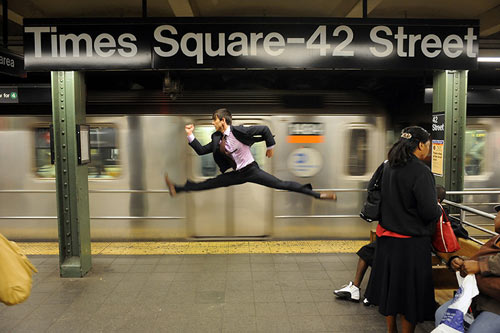 Having watched that, the students thought about what was important to them. What is creativity (original ideas that have value); the conditions for creativity (if you're not prepared to be wrong, you'll never come up with anything original); the diversity of intelligence; the importance of teaching to encourage and support students. Later this week, I watched Charles Limb's TEDx talk, "Your Brain on Improv." He was actually able to observe the self-critiquing and monitoring areas of the brain decrease function, and the expressive parts of the brain increase function during jazz and rap improvisation. (Worth watching just to see a neuroscientist rap.) Also stumbled across, again, Jordan Matter's Dancers Among Us photo series, which is great in light of Sir Ken's Gillian Lynne story.
 We then considered the "So What?" What does this matter for math teachers? They did a great job thinking about this. It makes process more important; requires multiple modes of instruction; enhanced by more real life connections; values problem solving and reasoning; shows more than one way to do a problem. It was interesting to me the subtle bias from their education - these are all things the teacher does. Still no autonomy or choice for the learners.
I'm wary now of revving preservice teachers up too much. When we see graduates in the schools, one of the most common things to happen is to have them apologize. They apologize because I've given them guilt over that they should be doing more activities or writing their own problems or using more technology. Which really means I should be apologizing. (And I do.)
So we discussed that our response to this issue of change can be big or little. Subtle shifts or big changes. One of the examples that came up as restrictive was number computation. As an example of a subtle shift, we tried going from "what's the answer?" to "how else could we do it?" (Really a better question in terms of differentiation as well as mathematics content.) So what is 72x26, and how else could you do it? Firstly, students were suprised by how some people were taught, and secondly, they (who do already know how to multiply) really got into it. Coming up with new methods, seeing connections, making sense of what other people had done. Really doing math. I picked 72x26 because it was adjacent to doubling, to x25, etc.

In black are the responses to how they were taught. The first response was the partial product method, which dre some "weird" comments. Then the lattice just freaked them right out. How else got them thinking about strategies like the red. These were closer to their mental strategies. When their methods were exhausted, I shared the green strategies. There was some surprise at how different these were.
Next, for an example of a big change, I shared the example of coming up with a whole new activity. Writing curriculum (Curriculum is one of the NCTM Principles). As an example, we looked at What Can You Do With This. In particular David Cox's and Dan Meyer's WCYDWT toast. (David's original toast post, Dan's regression spectacular) I don't think it is reasonable to expect all teachers to create curricula. On this scale. But with our networked community, we don't have to.

Students watched patiently. "I never knew how long toast took." "Does my toaster take this long?" Even before the first piece popped, "how do the settings control the toast? Time? Heat?" And then a mountain of questions once the toast popped. From toaster design, to physics, to burner arrangement, to people's toast darkness preference, to what they noticed about the times in between, to why doesn't the bottom edge toast, etc. Possible answers to those questions. How they could collect data. The image of the toast set them off anew. What they noticed and what they wanted to know. The more they figured out, the more there was they wanted to know. That's a good sign that you're doing mathematics. More pleasing, they made strong connections to the ideas we discussed following Sir Ken. They saw the potential for buy in, the significance of student proposed questions.
It was a great start to class, but it left me a little nonplussed. This is what class could always be like if we weren't shackled with the expectations of previous generations. The math that was useful at the dawn of industrialization. It's like Jacob Marley in reverse, in this teaching life we will bear the chains our forebearers forged in theirs. But it also held the promise of Buffy. In each generation of teachers, some will be called. They can lead us out of the hellmouth and empower the generations that follow. (When you start mixing Dickens and Whedon, it's time to finish.)
And I think the journey might be fun. One of the students demanded the Toast Song for our recessional music.


 Posts
Posts