Friday, July 27, 2012

Mystery Teacher Theatre 2000 - Episode 2


So when Dave and I filmed the first episode, we actually filmed two. Given where the whole thing has gone, more episodes seem unlikely from us. (Unless we could do something meta with it...)

Of course, this also means whatever you disliked about the first one you will also dislike at least as much in this one. Audio quality, snark, the guy on the left...

Editing this it struck me that really Sal Khan is a tutor. He's like the strong student in the class that is willing to share with other students how he sees it. So his mathematical viewpoint is a bit procedural, and his understanding of the ideas comes across as a novice. A skilled novice, but without depth. It was his discussion of matrices that really sealed this for me. Undoubtedly there are a lot of teachers who see a matrix as just a table of numbers, but there is so much more. It may be a teaching decision to not share that 'much more' in an introduction, or it may be he's just sharing his viewpoint.

If this is your first exposure to MTT2K, there's still time to look away. If you don't, you might want to read Dave's two posts on how it came to be (one and two) or watch the first episode.  I have a (first crack at a) storify with some of the brouhaha surrounding the first.


I'll just say here, I'm not against Khan Aademy, I'm not jealous, and I'm not against flipped classrooms. I am for quality materials, intentional teaching and learning, and open discussion of ideas. I do believe satire is an appropriate response to exaggerated publicity and overhype.  If I could sing, I'd explore a Tom Lehrer style song on the matter. It's gratifying that the first episode started a big discussion, but at some level this is two guys goofing around to make a point about good use of resources.

In contrast to many places discussing Khan Academy, the comments are open. I'll ask you to be as civil as you can, though, please. Snark, satire and sarcasm are strictly permitted.

Friday, July 20, 2012

GeoGebra with a Purpose

(Lost the source of this!)
I got to give a whiz-bang 60 minute (with an option for 30 extra minutes) intro to GeoGebra at the New Tech network conference this week. 50 plus tech-savvy teachers... so it was good. I am always worried that people expect me to tell them about GeoGebra for an hour, when purpose is to get them started using it on the spot, in ways that make sense of their potential use. (Note that if you are in driving distance, I am more than happy to come do this at your school. No GeoGebra lectures, however.)

Purposes. So what are the ways that people make use of it? Oh, let me count them:
  1. World's best graphing calculator. (A little weak on statistics and CAS, but that's improving quickly.) For you and your students. For algebra, calculus, or geometry.
  2. Mathematical image editor. For uses in reports, papers, handouts or assessments.
  3. Demonstration tool. Project a great visualization on your screen to show to or discuss with students.
  4. Focused mathematical activity for students.
  5. Open-ended inquiry tool. Pose a question and let students investigate.
Requirements. The AMAZING thing about this tool is that with version 4.0, all of these are accessible to teachers in that 60-90 minute start up.
  1. Open the program, start typing equations on the input bar.
  2. Needs some quick familiarity with the tool bar to make your image, then File > Export > Graphics View As A Picture.
  3. GeoGebraTube. If you have not looked at this, you are missing out. 14,000 sketches and counting; free accounts, search, likes, tagging and you can collect them in teacher mode or show collections in student friendly mode. This is why you need minimal expertise to start using the program deeply. If you can run YouTube and you are a teacher, you can do this.
  4. See #3. 
  5. Students today are geared for this kind of tool. You give them access, they'll figure things out about it that I don't know.
Really, any training beyond that first 90 min. is about if you want to become proficient in number 5, or if you want to be designing your own activities. Some teachers are doing that anyway by the end of an hour, most by the end of a half day.  Once you start using it, there's a big danger of being sucked in by the possibilities of what you can make. The power of dynamic examples is as much greater than static electronic images as static electronic images were than hand drawn. (My opinion. No research. Actually yes research, but they would never quantify so crazily.)

After my session, I got to go to Geoff Krall's (@emergentmath) session on formative assessment. He was using the MARS  MAP (Mathematics Assessment Resource Service - Mathematics Assessment Project) materials.  In particular, he used the Ferris Wheel lesson to get us collaborating and specific in discussion.

As we discussed, it really got me thinking about how I would use the task early on. It would make a good project or assessment, I think, but what about as an inquiry? The basic problem was to make a symbolic model [find a, b and c for a+b*cos(ct)] for the height of a car on a specific Ferris wheel. Then there was a card sort which got students comparing context, equation and graphs.

I've given many explorations before that got students experimenting with parameters to see the effect on graphs, but I love the idea of tying it to a context. That doubles up on the intuition they can apply - physical and visual. If the students had access to that, they might be able to do enough trials to start to generalize. Even without much trigonometry understanding, it's a nice context for graph transformations. For me, these kind of thoughts now lead to GeoGebra. I made a quick sketch, with the Ferris wheel in a 2nd graphics window, and was delighted to find that even the 2nd window worked on GeoGebraTube.

But since then I thought it would be worthwhile to develop a bit more. Both to familiarize myself with using the 2nd graphics window and to make the single model into a reusable activity. I knew I wanted to have either a customizable or random Ferris wheel, some animation of the situation and a way for the students to enter the equation.

That bore some thought: sliders, input boxes for parameters or an input box for the function?  Sliders are best for seeing continuously linked examples, but can make a problem like this too easy! The input boxes for the parameters helped support the idea of structure, require some thinking before making a new guess, and don't require as much typing as entering the whole function. Plus you can isolate one parameter and just adjust that. That might be a positive or negative.  It feels like a support for learners early in this, by encouraging them to focus on one parameter at a time.

The trick to working on two graphics views is the advanced tab of object properties. You can use any tools from the main window. Just select the tool and then use it in the 2nd graphics window. The objects you make there show up in the algebra view. But when you edit things, or create them in the input bar, they migrate or appear in the first graphics window. The solution is in the object properties, advanced tab; just check the box you need. Note that you can have something appear in both ... there just has to be a cool use of that.

I don't think there's anything else too tricky about the sketch. I used the Function[ , , ] to get the modeled equation to move with the tracing point, the ZoomIn[1] command on the button to clear traces, and the UpdateConstruction[] command to reset the Ferris wheel dimensions. (I had slick graphics window dimensions based on the Ferris wheel, but then the ZoomIn[1] command doesn't work. Ultimately I thought it was better to see the Ferris wheel changing sizes anyway.)


Unable to display content. Adobe Flash is required.


 The sketch is on GeoGebraTube: Teacher page for download or Student worksheet for in browser use. You have to click in the main window to get the animation button to show.

Thursday, July 12, 2012

#logarithms

I had one of those great twitter moments yesterday, completely by generosity of tweeps. This captures one aspect of why I introduce twitter to our preservice teachers in hopes that they will either enter in or give it a go later.

My summer intermediate algebra class is leisurely (12 weeks instead of 6) picking its way through the summer. Linear, quadratics, exponentials with tons of technology use, simulation and experiment and a dash of art. And then comes logarithms.

My emphasis on introduction is as a way to undo exponentiation. Not a big emphasis on inverse functions, because though we're using the language, we haven't really dove into function language yet. But doing and undoing we talk about a lot.

But after that reasonably good start, we come up against the log rules. Our introduction was Kate Nowak's log law introduction (which I found through Sam Shah's Virtual Filing Cabinet; why bookmark? Let Sam do it for you.) The idea is that you see lots of examples and then try to generalize into a pattern, which is the log law. Nice pedagogy!

Yesterdays lesson included connecting the exponent rules to the log laws.


Tough going.  In terms of gradual release, we had to back up to a lot of teacher support. But the most useful law was the toughest. So I came back from class and just tweeted, to ... vent, I guess. Commiserate. (Which is definitely a purpose of twitter.)

 Wasn't expecting any real response. But then, the great feedback and constructive suggestions began immediately.

This is where we should start. We - as a teaching culture - are so steeped in general then specific, abstract before concrete, that this is a good first check.

 They did understand the multiplication to addition rule better. Look for areas where students understand and build off of those. Connections strengthen learning.

 This is the connection I'm going to follow up on. Look for a way to get it across.


 Think about the broader context. How the logarithm lives as an inverse function, with a nice concrete place to start.


 Support that this is challenging, and not me just being stupid. Of course, I'm happy when people point out I'm just being stupid, too, since I don't want to be stupid.

Neat post.  It gives a lot of good thinking about introducing logs, being intentional, and paying attention to students making sense of notation. This is very close to how I introduce logs, and how it looks like Kate Nowak introduces them, too. I use to think this was inappropriate for high school but okay for college (because of their bad early experiences), but I'm beginning to think that's how we should handle bad math notation. Use constructive notation and then transition the students to traditional.

 I don't think this is accessible (YET), but I'm going to mention this, too. Part of the class is getting the students more comfortable with symbolic methods, and I like how this emphasizes the operational part of logarithms.

A reminder of where to start. This is the fundamental relationship for logarithms, and connecting back to it well and often is important for learning in both directions.

So now I have a place to go Monday, following this up as I promised the students.  Maybe I would have had some of these insights on my own - but I don't have to work and think alone about my teaching or the mathematics. It also really sparked some thinking to me about whether logs should be introduced as a function or an operation. I feel like exponentiation goes from being notation, to an operation, to a function. Logarithms could do the same. I'm thinking:
So then 2v2^3=3. As it should be. I'm kind of joking?

Anyway, excellent teaching advice. I am so glad to be connected to these excellent teachers. And even though I can't go to Twitter Math Camp, I still get to have the home game to play. Why don't you play along?

(Here's my brief intro to twitter for math teachers. ) Here's the activity I put together for the next class:

Thursday, June 28, 2012

Teaching is Not Telling

As an early proponent of Tau Day (okay, it was a circle post on June 28th) I feel justified in calling for the establishment of a new Tau Day tradition. The Sharing of Sense!

The whole motivation of Tau Day is to think about what makes sense. Pi is traditional, Tau is the product of reflection, a consideration of where we are now. There is room for both. Of course Pi looks like two Taus, but it's Tau that's twice Pi. Typical math reversism. The tradition that makes Festivus the great holiday it is is the Sharing of Grievances, and this makes a good bookend for that.

It has been a weird ten days. Dave and I filmed the now infamous video over a month ago, and it took me a while to get to the editing. He was patient with me as always. It took us a couple months to get to the filming. I expected a day of dust ups on Twitter, some people happy, some people unhappy, and that happened, though most were amused. Then Dan Meyer picked it up. Then Ed Week. Then Slate. And yesterday I was answering questions for the Chronicle of Higher Education. We've received great support, insightful criticism, boorish comments and threatening email.  Crazy, then surreal, then bizarre. There are many people with deep emotions involved.  It's like in Ken Robinson's first TED talk, people will pin you to the wall to talk about their education.

Dave has said that there is discussion among teachers, and that's a good thing.  As he's written in a couple comment threads:
Our primary purpose with this video was to get a conversation started. We realized that the satire would put some people off but many teachers have tried to engage Khan Academy in a reasonable discussion and present their case to the media about issues with this approach with little to show for it. Now that the conversation has started and Sal himself has said he is listening and looks forward to more critiques, the time has come to raise the level of the discussion. That is why several bloggers have suggested 101 Critiques and Lessons.

We are looking for at least 101 bloggers to offer a video critique of a Khan Academy video and then share an alternative lesson on that concept. The goal is for all the participants to post the critiques and lessons on August 14th (the day before the deadline for the MTT2K prize). Perhaps the sheer volume of resources will convince the media to acknowledge that while Sal Khan's approach has it's place, he could still learn something from teachers.
In the discussion with the Chronicle reporter, there were lots of questions about Mr. Khan, his academy and his videos, asked in terms of analyzing him, it or them as teachers/teaching.

That's not teaching.

Not to me, anyway.  If there's one idea I try to get at over and over (students chime in: "...and over and over") it's that teaching is more than the time with the students. Planning, assessment, and evaluation are a big part of it. And the time with the students is and should be so much more than the time when you're talking. The fundamental idea, for me, is that teaching is the practice of what we can do to support learning.  Telling can be supportive, maybe, sometimes, with some other help.

I did a project with Susan Walborn, one of my favorite teachers ever, before we went on to the Math Art festival. It was early on in my interest in math games. We got a group of 4th and 5th grade helpers who were struggling in math, to become teachers for 1st graders. We'd teach them the game for 15 minutes and then have the tutors play the games with small groups of the wee ones. It was often great.  The tutors loved being the experts in an area where they had had so much negative feedback, they often benefited from some remediation on early number ideas they had missed, and they were so supportive of the 1st graders that it was often touching.

The one teaching idea I emphasized the most with them they really got:

If you can ask, don't tell.

(This was before the similar phrase was politicized in a horrible compromise.)  The message I would want to share on Tau Day, for my bit of sense to share, is for all good citizens to understand this:

Teaching is not Telling
Telling is not Teaching

Thanks to everyone who's engaged politely in conversation about Mystery Teacher Theatre 2000, and I'm very grateful to the many who have been supportive.

Image credits: Festivus Pole by M. Keefe at Flickr. More anthropomorphic comic at the tumblr.


Sunday, June 24, 2012

Intermediate GeoGebra

So we had a small group in for GeoGebra learning this week, and I want to share what I've learned. One of the best ways to learn anything is to try and teach it, and this was true this week.  This post is a review of our approach with links to the materials, and some description of what the intermediate users were interested in: images, buttons, input boxes, and more.

http://bit.ly/ggbgv
First up is our revamped website. I'd really like this to be a resource for anyone learning or teaching GeoGebra to others, so please send feedback. The old website had gotten pretty clunky, as we modified and added to our materials, and it was time to start fresh. The website also includes a page with all of our handouts, and a nice Resource section.  Besides the website, we started a local GeoGebra Facebook page that we could use for links and resources.

This site has a clearer direction through it. Whether you are introducing GeoGebra to people with some time - say a two or three hour block - or in a quick one hour presentation, this is how I'd recommend starting:
The program is so intuitive to use, that many teachers can go from there. GeoGebraTube is such a huge sell, that I tried starting with it, but it turns out that it's even bigger when people know how easy and free the program is to get. They can explore the sketches on the tube better with just 5 minutes on using the program first. I separated that out into three pages at the website: Start Up, GeoGebraTube, and the Quick Introduction.  I asked participants to record the Tube finds they liked the best on a Google doc, but I've also just asked them to write the Tube number on the whiteboard.

If you'd like to add to the Google doc with your favorite Tube Finds, be my guest! (Here's the link.)


We covered search, tags and user profiles, all of which enable finding cool stuff.

For the Basics, the list of intro tasks has gone through several iterations and seems to work pretty well. Getting through those gave users a fair amount of control. The first non-basic topic most people are interested in is usually is using images in sketches (often inspired by the Dan Meyer inspired Dan and the Ball sketch). If it's not images, teachers are interested in the spreadsheet view. So we've got a guide to using images and a starter for the spreadsheet.  It's also important to cover the export menu.

Once users have gotten to making some pretty impressive setches, most of what the teacher or trainer has to provide are the commands to help in what they want to do. The two that have come up the most for me are:
  • RandomBetween[ ⟨ minimum integer ⟩ , ⟨ maximum integer ⟩ ] - does just what you'd think it would. Very useful for generating targets or random polynomials using this for coefficients. You get new values by choosing Recompute All Objects from the View menu.
  • Function[ ⟨ function ⟩ , ⟨ start x-value ⟩ , ⟨ end x-value ⟩ ] - limits the domain of a function. Best technique for this is often to define a function f(x)=... then make a limited version of the function using the Function[] command.
It seems the next matter for most users is to get experience with the Action Objects Tools,  sliders, input boxes, check boxes, and buttons. (That's the intuitive order for me.)


Richard Wade shared with me a neat challenge that provoked some good work as well as some instructions on animation, etc. This is my entry for a dynamic Olympic logo. I also think they should include a purple and orange ring, but I understand the importance of tradition. I wanted an interlocking rings effect, but couldn't figure out an over/under trick.

A note about embedding animated gifs: some services are weird about it. If you're having trouble, upload it to a photo sharing site (I use the mildly annoying photobucket) and put in the image by URL.
The main feature that's come up that we don't have a guide for yet is the dynamic text. Text is next.

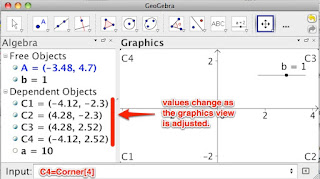
Whenever you get to work in a group with GeoGebra you learn something. The two tidbits I found most useful this time was the Corner[ ] command, which we found in an Anthony Or (orchiming on GGBT) sketch.   Someone asked "Well how did he make two sets of axes?" and the answer was clever use of the corners.
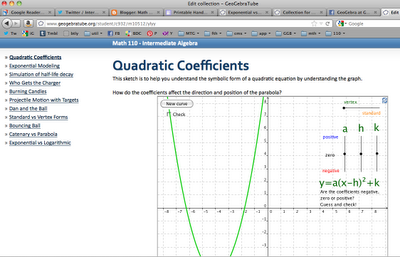
The other was instigated by a participant: looking into what that student option is in a GeoGebraTube collection. When you click Create version for students, you get a menu of choices.

You get a palette of sketches for students, like this.

That's going to be a great feature.

Hope this can be of use to you for your GeoGebra learning, or with fellow teachers or with your students.  I'm happy to share any materials electronically, or in person if you're within driving distance.  What would be helpful for you?


Monday, June 18, 2012

Mayim Bialik

Might as well go for Controversy Week on the blog, eh?

I like Mayim Bialik as an actor, totally think she improves Big Bang Theory, and think she has obvious science chops. I personally get pretty geared up about the immunization "controversy" (which I only think is a controversy in the same way as the climate change "controversy"), and was disappointed over her Science Friday brouhaha about immunization.

Then I got a promo from NCTM giving her top billing at a meeting.

I wrote:
To: NCTM Summing Up
Cc: NCTM
Subject: Re: NCTM Summing Up: June 5, 2012

Do you all know that Mayim Bialik is a supporter of the anti-immunization movement? Pretty disastrous for teachers, should she have her way. I don't think we as an organization should be legitimizing her as science-related, let alone promoting her. This was in the news recently because of her appearance on Science Friday.

-John Golden
The NCTM was nice enough to write back...

Mr. Golden,

I am sending the attached letter on behalf of NCTM President Linda Gojak, who is copied on this message, in response to your message below about Mayim Bialik.

Regards,
Ken Krehbiel
Associate Executive Director for Communications


Hmmm. So I wrote back,

Thanks for addressing this and for responding. I understand the tensions involved.

I do think there's a difference between having a Ph. D. and qualification in math ed. For example, the many Ph. D.s in mathematics who support Mathematically Correct would probably not be advertised by the NCTM in promotional materials.

May I share this letter with others?

Thanks,
John Golden
To which they quickly replied:
Hi John

Thank you for your thoughts.

Actually Mayim has been doing some work in mathematics education with a supportive stance on the importance of mathematics as fundamental to the foundation needed in STEM areas.

I think her message around mathematics is important as we move forward. Her personal stances on personal issues are exactly that...personal

I think the CCSSM provides us the opportunity to work together from a variety of viewpoints to work together to do what is best for our students. So it is no longer a divide between mathematically correct or not correct, rather it is about what prepares our students with multiples options in the workforce.

You can share the letter as you see appropriate.

Regards,

Linda Gojak
Nctm president
I'm very happy to be part of a group that attends to its members thoughts, and I do understand that decisions are not going to be by consensus most of the time.  I don't want uniformity, relish diversity, and think I'm probably being over-sensitive here because of how I feel about immunization.

What do you think? Would you put her on stage at your conference?

Mystery Teacher Theatre 2000

Welcome to our first episode. Recently, in the halls of School University, some teachers attempted some selfdirected professional development, encouraged by their principal and given hope by Sal Khan, a man described as "Bill Gate's favorite teacher" (from a TED endorsement), "very popular," "extremely popular," "an educational revolutionary," and being like "like a nerdy, South Asian-American Seinfeld." (I'm not making any of those up. The last is from Wired.)

Here's what happened.


So, obviously, as comedy improv actors we're a couple of math teachers.

We're very interested in your comments. What do you think of this video? Of the teaching? What did we miss in our commentary? 

Dave was the instigator here, but is too smart to put it up at Deltascape.