Saturday, May 19, 2012

Math Evolve

Math Evolve - a basic operations fluency game for iOS. Free Lite version to try out, full version $1.99.

Somehow Math Evolve came across my radar again this week; it's an iOS app for elementary math. I'm always willing to give those things a try. Tired, frustrated with other stuff, I tweet:

And didn't think any more about it.

The next day, Adam tweets back, very politely. Immediately I feel like a heel. If I was speaking to someone in person, I wouldn't express myself that way. So I want to apologize to Adam here.

I had high expectations because the app store page has the following:
★ Winner of BEST EDUCATIONAL GAME OF 2011 (2nd Place) in the Best App Ever Awards.
★ “The holy grail of edutainment math apps.” Editors Choice, 5/5 Score -Best Apps for Kids 
In Math Evolve you are an alien organism, completing number sentences on a quest to grow and return to your people. At the beginning of a level you fill in the first blank, then the second blank after the operation, then finally the result. Later you pick the first blank and the computer provides the second. (I always get the first one of those wrong as I don't notice when the switch occurs.)  All the while you are dodging combatants and trying to shoot them out of the way. You control your position on the screen by moving your character with a touch. Finally the boss appears and asks you to compute particulars.

Another part of why I expected/hoped for more is that it is slick. Trying to develop ParabolaX (or rather, watch while Alejo and Kevin program ParabolaX) has given me an appreciation for the work that goes into slickness in iOS.  Is there a role for a practice app? I think so, but I don't value it anywhere nearly as highly as one that helps students learn. After all, if they need practice, typically there's room for greater understanding.

I'd love a practice game that gave more for students to notice. Like asking 7+3, 6+4, 5+5, ... or 4x5, 5x5, 6x5... or 5x6, 6x6, 6x7... Noticing and generalizing are things that I value more about math.

Given the context, the practice mode could have meaning of the operation.  Gathering or eliminating to add or subtract, repeated groups for multiplication... lots of possibilities. I do like how at first you're gathering all the equation elements, then the game fills in the second spot, then the boss poses a computation. The incorrect answers are not particularly problematic, and the boss doesn't seem to use missed problems to pose problems. Maybe at higher levels? Ways for added difficulty could be including choices that are not computable, such as choices between 3, 6 and 7 when you have 21÷___.  I did only play the Lite version, so possibly some of these things come later.

Boss level.
I love how open and interested Adam is in improving the game, the context and game mechanics are well developed and suitable, and the game is fun enough that students will be happy to play. And he is obviously a far better internet citizen than I am, but hopefully he's taught me to watch my oafish responses.

As I think about evaluating math games and apps
Objective: facts practice, four operations, including negative numbers.
Gameplay: fun enough. Think Galaga/shoot 'em up.
Aesthetic: great. Cute characters, good effects.
Pedagogy: beyond difficulty selection, no visible fact strategies or support for learning. Minimal math practices.

I'd love to hear what you think of the app, and what do you feel like would make for a good facts learning game.


Thursday, May 10, 2012

Guess My Rule

Some activities seem ageless. They work in elementary, middle and beyond. Guess my rule I have played with very young students, and this week I got to try it with my summer intermediate algebra course.
Guess My Rule
Any number of players

A rulekeeper makes up a rule that gives a number output for a number input. (It should be a function.) Players take turns giving an input, and the rulekeeper tells them the output. If a player wants to guess the rule, they tell an input and what the output would be. If they're right, they guess the rule. Then that player makes the next rule.
I don't know who originated this game; it feels ancient and right, so kudos to whomever developed it. I let rulekeepers use a calculator, and I usually start out with a few rules until the guesser feels comfortable making up a rule.

Today I started with the number times two minus three.  (Highlight to see it, or guess from the table.) Inputs came from all over. 12,  5, 10, 1... some shock at a negative answer. I encourage the students to record the results, hoping that it will lead to some ideas about what inputs to suggest. Organizing data is not a natural tendency. At one point they started asking 30, 40, 50...
inputs125101304050
outputs21717-1577797

Oooh! That's a pattern. It goes up 20 when the input goes up 10. So they could predict the answer for multiples of ten. Thinking about that, they suggested a rule that worked. We looked at the rule to see from where the up by 20 pattern came.

The solver was not comfortable coming up with his own rule, so I chose another: eight minus the number
inputs711012203040
outputs17-2-4-12-22-32
\(7 \to 1 \) then \(1 \to 7\) drew an audible gasp/hmm. There was one student who loved asking for 12. The third multiple of 10 got the rule again. Subtract eight and then take the opposite of your answer. One of the reasons I love this game is that it always brings up equivalent expressions. I shared my original rule and we talked out the equivalence.


Now they were ready to suggest a few rules. A couple like my rules, then input times 5 divided by 2, which got a nice check of "oh, that is the same as the number plus half of it," and "I had the number times one and a half." Then one student came up with a stumper. When guesses were not focusing, I started taking notes on the board.


I also asked for what patterns they noticed. Some good stuff.  We got to the idea of asking inputs in a pattern, and I asked them to predict the output from 2 before Edras gave us the actual. (There's some really nice research on the power of prediction in math, some by my colleague Lisa Kasmer.) We spent some time on different expressions of the rule, like ___ x ___ + \(\frac{1}{2}\) ___ x ___, (___)^2 + ( ___)^2/2 and \( 1.5 x^2\).


For a last question, I asked them to find what input would give 100, and got unexpected riches. Students really worked hard, consulting group members. Several tried to solve symbolically, but didn't know what to do with the \( x^2 \). One student had an excellent guess and check. We spent some time discussing that, including what an excellent problem solving method it is, and how when I use it, using numbers gives me a much better feel of what's going on. Maybe they've been discouraged to use it by previous teachers, but it's a great strategy. We did discuss how to make our guess more accurate and efficient. Like was 8 or 9 closer to 100 in output?

Another then shared a traditional symbolic solution. One student asked, "why did you divide by 1.5 before you took the square root?"


"Because you have to."
"It has something to do with the order of operations..."
"Doesn't PEMDAS tell you what to do?"
"But you have to reverse it maybe..."

"Let's try it." (OK that was me.) They told me the steps and I wrote it down. Amazed to find the same answer. A good moment to point out to them that are almost always multiple methods in math. Teachers may have told them that there is only one way to do things in the past, but that is bullsh*t.

I should not swear in class. (In response to my usual 'jot down one thing you want to remember' there were many repetitions of that statement. In my defense, it is a college class. And the comedic potential was ripe.)

The next activity is adapted from Pam Wells' adaptation of an activity from the excellent Mathscape curriculum.


(Here's the Word file if you want to edit - it wasn't appearing correctly in the embed.)


It dovetailed very well into the Guess My Rule, allowing us time and grist to find many connections amongst tabular, symbolic and visual representations, reiterating the equivalent expressions and multiple solutions themes, and giving us a launching point for a definition. Using the Y pattern rule, I made a table for S=1, 4, 7 and 11. The changes in output were 9, 9 and 12... what went wrong? They found that the difference in the inputs was not constant, and when we changed 10 to 11, the output pattern worked. To me, that's the moment for the generalization.

We went on to launch Linear War, which gave me a chance to share why we use the term linear and some of what this stuff has to do with lines. Next class, we play!

All in all, it was a fun class. I was impressed with their willingness to try non-traditional problems, and they're gaining rapidly in ability to work cooperatively and make conjectures. The meta-messages about mathematics seem to be gaining some traction, too.


Tuesday, April 24, 2012

Alex Asks: What's My Job?

@AlexKraker
Guest Post by Alex Kraker. This post is lightly adapted from Alex's teaching philosophy for his teacher assisting portfolio. Teacher assisting is a kind of half-time student teacher experience that our novice teachers do before a more traditional student teaching semester. I found this very uplifting, and he was willing to share with you all.

Teaching Philosophy
The teacher should be a beacon of knowledge, like a lighthouse, whose sole purpose is to shine their all-knowing cone of light round and round to each student and burn the desired and necessary knowledge into the eyes and brains of students.  The teacher holds all of the knowledge and it is their job to dole out the material and skills that are “necessary” to the students.  Nobody shall get to the knowledge, except through the teacher.

It seems as though too often we as society, parents, and even students fall into the trap of believing that nonsense in italics.  The job of a teacher is not to teach at all; to me it seems like such a misnomer.  When I consider what I need to, want to, and should be doing as a teacher, I feel like I am much more of a facilitator than a teacher.  I don’t want to be standing up in the front of the classroom mindlessly droning on about what a y-intercept is…that’s not my job!  My job is to be on the front lines, fielding questions, guiding inquiries, and motivating students to discover and learn all these new, wonderful ideas that they have yet to encounter.  I should be much less of a teacher and more of a tour guide.  I should be pointing out things that students may not have noticed, give ideas on what they could try to help solidify understanding, and challenging them to do, not just learn.

I feel as though students do not learn well when someone is just imparting knowledge to them.  Lectures are boring.  Students struggle to pay attention and get all of the material when it is just being thrown at them.  The best learning comes when students get their hands dirty.  When they’re given a question they can’t yet solve.  When they have to think about what they already know and how they can use it to find out what they need to know, that’s when learning occurs.  I believe learning is not a linear process.  Acquiring new knowledge always seems to come first, but that’s not real learning.  Learning occurs when we assimilate our knowledge, make connections, and understand what we just found out.  Learning is so much more than just finding something out that we didn’t previously know. It is a process, we acquire new knowledge, and build upon that.  Then once we are comfortable with what we have just figured out, we build more on that, so on and so forth until we go from just a few simple ideas to a whole web of knowledge, connections, ideas, and discoveries.  That whole process is learning, and that web represents our progress.

There are a few necessary components to learning.  I feel in order for learning to occur, students have to be engaged, involved in discovery, and entertained.  I’m not trying to say school always has to be fun, but it is so much more difficult to forget something that you enjoyed being a part of discovering.  And when you realize how you discovered it, you can go back through that process and discover it again if you forget specific facts.  Memorizing formulas for the volume of three dimensional figures isn’t learning.  Using manipulatives and two dimensional formulas to figure out how we derive the three dimensional ones leads to students being able to rediscover the exact formulas themselves if they forget what exact numbers we use.  It is my job as a “teacher” to help students understand why.  However, my job doesn’t stop there, it doesn’t even start there.  I have to help them care; see why it’s important, how we use our material and how it can help them.  I need to help them figure it out, answer questions, guide thinking and discussion, encourage participation.  I have to help them sort out what they just answered, see where it comes from, how it connects and what it can do for them.  My job is not to impart knowledge, but to feed the desire to learn and know.

As such, I must always be thinking of new ways to inspire, motivate and make students care.  I must identify areas where they may struggle, or things that can cause roadblocks in our journey to know more.  I have to be prepared for anything and everything and really know my students.  My job should never be the same from year to year.  I need to constantly adapt to my students.  I need to learn how they learn, know what they know, struggle to find where they will struggle.  Different students will need different types of instruction.  Leading them to discoveries will work well for some students, but other students may struggle with seeing connections between what we are doing and why it is important.  For some students, I will have to take a more direct approach.  I will have to simply teach them some things, and work on making connections once they feel comfortable with the material.   Not every student will be motivated, so I will have to find a way to motivate them outside of grades or the simple pursuit of knowledge.  Sometimes I will have to simply fall back on the old expectations of a teacher, and I will have to lecture on occasion.  However, it is my job to never fall back on lecturing and simply trying to force the knowledge from my head to theirs.

I want to shake things up.  I want my students to look forward to my class.  I want my students to feel like they are teaching themselves, like they are the catalyst for their learning.  I am looking forward to the challenge, and I am up to the task.  My teaching philosophy is that I am not a teacher, but so much more.

Image credits: ~John~ & JTKnull @ Flickr

Sunday, April 22, 2012

Multiplying Game Possibilities

I saw this quick and clean multiplication game suggestion from the Math for Love blog, and really thought it had potential.


  • Roll three dice
  • Pick two to add
  • multiply times the third
A little bit of choice, clean mechanic... great. But I thought that it could be jazzed up a bit. Then I thought that this was a great opportunity for the students to do game design.

The warm up problem that Mr. Schiller had suggested was pure serendipity: what is the largest area rectangle with whole length sides and a perimeter of 30 units. Maximizing a product with a constraint on the factors with multiple choices - perfect! I couldn't resist asking them after they found 7 x 8, "what if it didn't have to be whole numbers?" One student said - maybe 7\(\frac{1}{2}\)? They verified the perimeter, and I showed them a way to find the area. (Area model for multiplication is definitely one of my favorite representations.)

I shared the game and introduced the idea that we could rebuild it, make it better than before, with these prompts.  (Here is the handout I gave them.)
  • Is there a context that would fit or a story to go with it? Climbing, racing, building, digging, fighting, shopping?
  • Should it be a set number of rounds? How many?
  • Or play to a total? What total?
  • Any special actions or situations or rules? 
  • Is there a way to get people to try and make something besides the biggest score? Like a bonus if you get to a total that ends in zero, or something that depends on the story.
They were bursting with ideas! We shared a couple and then they got working. They quickly decided 100 was too small. A few students went completely away from the idea. Rolling a die to shop from numbered stores, or just a roll and move that many spaces game. Still a lot of pride of ownership, and some good problem solving to make the game work. Others liked the game just fine the way it was, and figured out the right total to play to; as low as 200 and as high as 1000 depending on the group. Some instituted catch up rules for if you got too far behind. (Glad to see that come back from the Spiral Races.) Others added some player interaction by being able to buy out your opponent's roll.

One group made an Escape from Planet of the Apes game, where you race to 100 (pick the locks to escape the cages), then to 300 (escape the village), then to 600 (back to your space capsule for the final escape); this was humans escaping the apes. It's a madhouse! Actually another group also made a Planet of the Apes game, but they didn't share.

One group made a really complicated scheme where you start with 400 points, roll for more, and spend your points on chess pieces that represented bad things for your opponent. First player to zero loses. I would be very surprised if these guys are not future gamers.

Several players made gameboards for the race, with some special rules. One group's game that I got to play had a route through town with obstacles like a storm cloud, mud puddle, etc. that you had to use your points to buy, and you got points by rolling the dice. There was no really clear explanation on how you decided where you were on the path, other than gradually moving forward. These girls were less concerned with that, and it almost felt like a role-playing game. One of the designers repeatedly reassured me, "it's not rigged. At all!"


Another player made/recalled a game from her uncle, a press your luck game. I think you could make a multiplication game out of it.  Here are some slightly cleaned up rules. I love how she wrote an example.

Multiply or Bust!
Roll 5 dice. Scoring rolls are:
  • each 1 = 100
  • each 5 = 500
  • 3 or more 2's = #x200
  • 3 or more 3's = #x300
  • 3 or more 4's = #x400
  • 3 or more 6's = #x600
Set aside your scoring dice. You can reroll any remaining dice. If some of those score, add to your set aside dice. You can reroll non-scoring dice as much as you want, but if you ever roll no scoring dice, you end your turn with zero points. You can only keep scoring rolls, so you cannot set aside two 6's and hope to roll a third. Winner is first player to 5000, or the player with the most points if multiple players beat 5000.

A very really interesting idea came from a designer who wanted a guessing game. Her initial try involved turning out the lights, but after some discussion we got to a really fun little game. Not something either one of us would have thought of by ourselves.
Masquerade - 2 players
Roll three dice but keep them hidden. Add two then multiply by the third and tell your opponent the score. They get three guesses to try to win your dice. If they guess a number right, they get the die and score that many points. After the third guess, players switch who is the roller and the guesser. Each player gets five turns guessing. Highest point total wins.
We closed by students sharing their games. I often encouraged students to write out their rules, which was an interesting ELA activity.


I also had a couple ideas inspired by their warm up question. Here's what I would try.


The main benefit of the grid is to make non-maximal multiplications more interesting. Hopefully it adds a layer of strategy.

Of course, it would be a nice variation to play on the same grid. More interaction, more strategy, and I think the little products are bound to be better. I'll be trying these out!


The game design aspects of these 5th grade lessons has been pretty powerful. We lose a bit of focus on the mathematical objective compared to all playing a set game, but the engagement is high, and the mathematical practices are strongly present, as well as having more math done than in many traditional math lessons. Even comparing the energy the students invested in the warmup problem, which correlated roughly with their mathematical self-identity, with the very similar problem of figuring out the sum and product of the dice in the initial game was a stark contrast.

Friday, April 20, 2012

Bouncing: GeoGebra Think Aloud

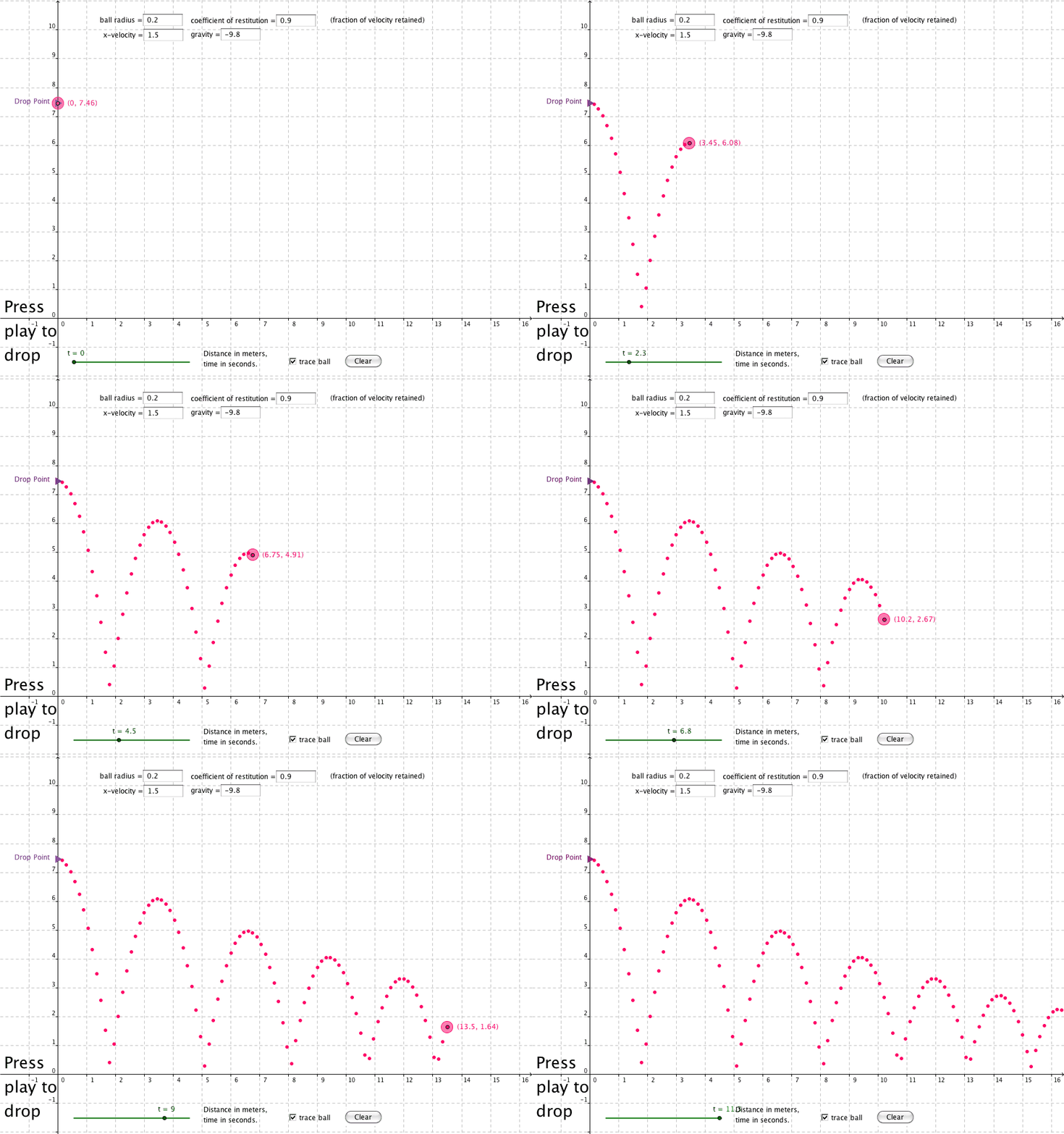
Following GeoGebra on Facebook or Twitter lets you see a lot of neat uses of the program. One recent one was this quick video of a ball bouncing under a table from Hugh Hunt.


There's lots to notice. I love how the ball starts spinning after impact. Is it physically accurate? There seems to be no gravity, making it more billiards. But the main thing for me is always "how did he do that?" The change of direction of the ball ... it's just a video as opposed to the sketch, so I had to skip the stage of monkeying around with the sketch, right to the "how would I do that?" stage.

Seems like a more natural problem for Scratch, where you can program the behavior of the ball. I was thinking about the problem with gravity, which always make me think about vectors. If you could parameterize the ball's motion... how would you have it react to boundaries? You need to have it switch somehow at that point...

I needed to think about a simpler problem. How to just draw a ball bouncing on the floor? I still don't know how to parameterize it (yet), but then you could just use a piecewise function... one way to define those in GeoGebra is with the If command; the third item in the bracket is the else result. For example:
f(x)=If[x<0,-x+3,If[x<3,3,x^2-6]]


Then I just have to solve when the bounce happens, to make the conditions for the piecewise function. As a beginning GeoGebraist, I would have plunged ahead here and then had to backtrack, but now I also think ahead of time about what I want people to be able to control. For this sketch:
  • time. To show motion in GeoGebra, my favorite technique is to use a slider. You can also animate sliders, which would help with the motion feeling. Initially I had this set for 20 seconds, but finally set it to allow for six bounces. You can set the limits of a slider to be a calculated quantity or a parameter that is set somewhere else.
  • gravity. The idea that students don't understand the difference between how things fall here and on the moon is one of my favorite examples of a misconception. Easy to build in.
  • ball size. I thought this might change students' perception of the resulting parabolas.
  • x-velocity. One of the math misconceptions I see most frequently about projectile motion is that all those height vs time graphs are height vs. horizontal distance. Maybe being able to control the horizontal speed will help with this. Set at zero, this is the experiment I do with algebra students to get a nice exponential pattern.
  • elasticity. How to model how bouncy the ball is? I made a parameter called elasticity, even though I knew that wasn't the physics typical terminology. Finally looked it up as the 'coefficient of restitution' I wanted it to be the portion of velocity that is retained, where I thought in physics I thought that they might actually measure the kinetic energy lost or something else. But it turned out that typically people do measure speed lost, especially for collision with a stationary object like the floor. (Found a neat little article by someone who got wondering if the coefficient of restitution was really a constant for a ball when I was investigating this.)
  • y-velocity. Do I want the ball to be dropped or thrown? I've already done some sketches to get at the projectile idea, and decided to omit it from this.
  • initial height. Have decided to make it a drop, it seemed like a good idea to let students control that, and it costs nothing in terms of complexity. Instead of an input box, it seemed more physical to have it be a point on the axis.

I programmed the first parabola, and then started to think about finding the time of impact and the speed at impact. That's still a job for pen and paper for me. Solving for the first impact point (when the height equals the ball radius) gives
$$ \frac{g {t_0}^2}{2}+h_0=r_{ball},\\
t_0 = \sqrt{2(r_{ball}-h_0) /g}$$.

The derivative (or formula for velocity, precalculus) gives the velocity at the first impact, modified by the coefficient of restitution, \( v_1 = eball \, g \, t_0\).

For the next parabola, the key to simplicity was to think about it as a graph transformation,
$$b_1(t)=\frac {g (t-t_0)^2}{2}+v_1 (t-t_0)+r_{ball}$$.
I was a bit surprised at how nice the expression for the next bounce point was, then:
$$(t-t_0)(\frac {g (t-t_0)}{2}+v_1)=0\\
t=t_0 \text{ or } t=t_0-2 v_1/g$$.
That's just nice! (Remember \(g\) is negative.)

Then the point for the ball is defined by using \(v_x \, t\) for the x-coordinate, and the piecewise-parabolas for the y-coordinate. I like how you can get the stationary drop by setting \(v_x =0\).
The tracing trick is one I use a lot. Define a new point equal to your old one, turn the trace on, and have the checkbox toggle which point is showing. (In the advanced settings, use the boolean variable, \( a \) in this sketch, for the tracing point, and the negation, \( \not a\), for the untraced point. The clear button is a trick that Linda Fahlberg shared, just a button with ZoomIn[1] as the GeoGebra script. I like the tracing so that the students have multiple ways to gather data, as well as for the nice visual.

Just a gif; Actual sketch

And then you've got your simulation! (Here's the teacher page on GeoGebraTube.) The recent update to the applet speed seems to make it much more reasonable to embed, but this one was a bit too big for the blogscreen.

I'd be interested in your feedback. Was this post helpful, or too obvious? Or did I not provide enough detail? It's also my first time using MathJax to display math, so please let me know if that is not working or is off putting. I'll be teaching algebra this summer, and will post notes on how the activity plays with students then.

Thursday, April 5, 2012

The Teaching Gap


The Teaching Gap by James Stigler and James Hiebert is one of the foundational books in math education. It grew out of research done in response to the Third International Mathematics and Science Study, more commonly called TIMMS. TIMSS, now Trends in International Mathematics and Science Study makes much of their data, materials and resources available for free at timss.org. It's really about systemically improving any kind of teaching, but lucky for us, it's in the context of mathematics teaching. Google Books has a pretty extensive preview.

We ask our student teachers to read The Teaching Gap and have tried various ways to have them read and discuss it. This semester, instead of using BlackBoard, I made a Facebook page for the course. BlackBoard is... okay. Lots of structure. But the discussion threads have never gotten much reading from other students. In the fall I gave Edmodo a try, and it was more functional. I wasn't using the assessment tools there, though, and had no other colleagues using it to share with. So the best features of it were the parts that were like Facebook. Except the students only checked it when they were posting their responses. Facebook has worked pretty well. I use links to Google docs instead of attaching files. Primarily, though, the TAs interacted with it more, had more comments on others' posts and recommended/shared more stuff than they ever did with Blackboard. A lot of our discussion of the Teaching Gap was on Facebook, so I thought I would share the highlights. All of their comments are on Google docs, if you're interested in the whole schmegagy. Dave Coffey, Rebecca Walker and I have developed these assignments over many semesters of working with our novice teachers.

Introduction and Chapters 1 and 2
Focus: Questioning to Make Connection
  • Effective readers ask questions that will activate relevant, prior knowledge before, during, and after reading text.
  • For example, as you read The Teaching Gap you might ask:
  1. How does this reading remind me of my personal experiences related to assessment?
  2. How does this reading relate to other things I’ve read regarding assessment?
  3. How will this reading connect with my efforts to be an effective teacher?
  • Use these questions or develop your own in order to actively engage with the content of The Teaching Gap as it relates to the concept of assessment.
Activity: The Teaching Gap
  • Read the preface and chapters one and two in text.
  • Keep track of examples in the text where you make connections to your experience, other readings, and your vision of effective teaching as it relates to the concept of assessment.
Reflection: Facebook: post your quick impression of the reading, and your thoughts on how you can assess teaching (your own in particular).
  • Jill Beauchamp:I loved the way the "The Teaching Gap" set out to examine teaching across various cultures. It surprised me to find out that teaching varied little within a culture and drastically between cultures. The text spoke about how Japan focuses so much on conceptual understanding and solving challenging problems opposed to spending time practicing procedural steps. This reminded me of what I learned in my COE seminar. We focus a lot on making a distinction between "what are the students going to do" verses "what are the students going to learn."
  • Zack Weber: I have heard from other professors that studies of this sort cannot be trusted because the US has the only true random sample of students while the other countries put forth their best students, it makes it difficult to know then if the study really drives these recommendations or not. But I think with them using the video research they have a more solid case for their ideas.

    And how can we assess teaching? I think the best way is to have someone assess you. Either have your CT, another TA, or a professor observe your lesson and keep track of what you did, said, explained, etc. I think if you then have a good discussion you will see things you like about your own teaching and things you don’t like about it, and that is from someone else’s viewpoint. I also think a good way to evaluate is by student’s work. Do they seem to understand or are they constantly questioning? Have you changed your class to fit their learning styles or are you using the same teaching style with no changes? I think answering simple questions like this can also help you assess your teaching because you have to provide for the students and unless you adapt then they will always be behind and stuck.
  • Abbey Foster: There is constant talk about the good and bad ways of teaching in the classroom, but there never seems to be a consensis about it. I am hoping from this book I learn new ways of what works and what doesn't. The first couple of chapters have talked a lot about how the methods are so different, but I hope they give specific examples of how the US is lagging behind the other countries. The books talks about how important it is to have quality teachers in the classroom. This is interesting to me as I look back on the past professors and teachers I have had. Most of the time, there is some sort of an evaluation, but are these 'quality' teachers really taking into consideration our feedback?
  • Allison Behr:  I was a little apprehensive about reading this book because I was under the impression that the book would undermine the teaching profession. However, I was pleasantly surprised when the book's preface spelled out the lack of recognition and the hard work that is involved with teaching. I also agree that the problem with education is how it is being taught. Using the same techniques that were used 75 years ago fails to address the current needs and capabilities of our students and ourselves as teachers.

Chapters 3 and 4
Activity: The Teaching Gap
  • Read chapters three and four.  Keep notes on your reading, in a journal, in the book or on stickies.
  • Bring your notes to seminar to discuss.
Reflection: Post to Facebook your reaction to these chapters. Is there something you want to know more about? Did it give you language to describe your experience or goals? Was there something useful to apply this semester? Share your thinking on one of these questions or one of your own. In addition, comment on someone else’s post.
  • Steve Suzio: Based on the reading, I found that the typical U.S. classroom of defining and demonstrating rules and procedures is exactly the scenario in my classroom. The students are given a worksheet and the teacher will go over a few demonstrated problems with them and at the top of that worksheet there is a suggested solution for them to look at if they are stuck. Then after about 15 minutes of lecture, they are given the rest of the time to work and ask questions. Any teaching the teacher does, requires very little thinking on the students part and they can give answers they have no clue to based on the tone and guidance of the teacher. This is not true learning, but more can you memorize a procedure and rule. The Japanese and German classrooms develop the mathematical ideas that are being presented, and students are asked to discover these concepts on their own. The teacher facilitates and lets them know what is important in their discoveries and then provides them with the challenging question.

    Thinking about how I can assess my own teaching, I would definitely try using video to record my lesson so I can go back and see what my tone is like asking questions, as well as what questions I asked. I could also review my lessons and see what types of problems I am giving students and how I am going about teaching those to students. If they are struggling, how am I helping them to solve it? Am I guiding them through it? or am I asking challenging questions. Anything that will get me to reflect and see what I am teaching and how I am teaching it will help me assess myself.
    • Kevin Squire: Great connection back to our classroom, Steve. I agree, the students aren't engaged during lessons. I hope you see that this is what I was attempting when I made the intro worksheet for Ratios (candy mix). I just wanted them to be doing something, too; instead of just watching me talk about math. And the tone thing...so true, man; so true. I catch myself doing this too often. It's pretty funny (in a sad way) when I am aware of this, though; the kids sit there waiting for something else. I think you do a pretty good job of staying aware of this. Probably why you thought to put it in the response, lol. Thanks for the insight, man.
  • Becky Marie: Chapters 3 and 4 of the Teaching Gap compare and contrast the teaching methods used within the Japanese, German, and United State’s classrooms. Personally, I found the most interesting contrast to be the amount of time that is spent on in depth, challenging problems in the Japanese classroom and how much time is spend in the US classroom working on definitions and procedures. In my current placement I find that this is very much the case. Much of the day is spent working on procedures, doing problems over and over again. When students take tests, however, their scores are show that they do not really understand the concepts. I am wondering that if more classroom time was spent on meaningful, explorative problems is they would be more apt to grasp a deeper meaning.
    • Kevin Squire: This whole "Quantity over Quality" mindset seems to get a bad reputation in many other areas. Why not in Americas classrooms?
    • Amy Lee Pickell: Agreed. In every other aspect of what is taught to American students it seems to me like it is quality over quantity except in math
    • Kevin Squire: I think that it is a problem of all subjects. I'll have to ponder whether or not this is most prevalent in math classes. i.e. there are A LOT of topics to cover in a typical science class. How many of those concepts are taught deeply, and how many are taught as memorization of facts. Thanks, Amy!
    • Brienne Tingley: I agree with this but the problem is how do we get the students to really engage and change their attitudes to wanting to learn to explore it? I feel like as soon as the answer is not given to them, they don't want to even try.

Chapters 5 and 6 
Activity: The Teaching Gap
  • Read chapters five and six.  Keep notes on your reading, in a journal, in the book or on stickies.
  • Bring your notes to seminar to discuss.
Reflection: Post to Facebook your reaction to these chapters. Did this reading matter to you? Help you understand anything you have seen in the classroom? Make you wonder about anything yet to come?
  • Stephanie Petersen: While reading these chapters I would find myself often agreeing with the observations being made and the things that need changing. I also found myself continually wondering how it is even possible to make these sort of changes. I hope that the coming chapters dive more into this! I really liked how the book described schools as systems and how we cannot change the whole system just by changing one part such as the way class is taught. The issue is much larger than just changing the way teachers present information because education is directly related to culture. Students have certain expectations for what will happen in school and how they will learn which is something very hard to change. I know that many of my students have a hard time with change in the classroom and they perform better when there is more structured, guided time. As I read this book, I find myself wanting to step out and make a difference or make a change but I feel that I wouldn't know where to start. How can we make changes in our educational system that might actually be effective? I also wonder why this type of information seems to be ignored or easily disregarded by our society because we have known for a long time that we are behind other countries in terms of education. I know changes are being made, but we need to really find a way to make an effective change that sticks rather than just trying small things that may make a difference for a little while and then just return to old habits.
  • Laura Todd: Chapters 5 and 6 in the Teaching Gap covered many questions that I had from the previous chapters, and from our in class discussion. The different ways that Japan and the US use visuals may seem unimportant, but these ways add to the culture differences between the two countries. In Japan students are scripted to be able to answer these complex questions because that is how they have been taught. The example of the teacher that tried introducing a complex problem, but students unable to solve this problem is a good example of of how both students and teachers need to work together to make cultural changes. As a teacher adopting some of the Japanese scripts of teaching can backfire on you because of the US culture and the way students have previously been taught. The survey on the “main thing” teachers wanted their students to get from a lesson was somewhat appalling. In the US teachers said they wanted their students to learn skills, whereas in Japan teachers wanted their students to think about math in a new way to see relationships. I think that younger teachers including our class would have a different view, than wanting students to learn skills.

Chapters 7 and 8
Activity: read the chapter, with an eye for what you can do personally, or what could be done at an individual school. Both should be practical and sustainable.

Reflection: Do you agree with the principles in Chapter 8? Post to Facebook whether you found anything that you think you could do yourself, once you’re teaching. If you were to recommend PD to principal, what would you recommend?

  • Brittney Mohnke: I agree with the principles presented in Chapter 8, but it is still hard to picture changes such as this actually happening in our society. If we focus on gradual improvement over time, I think we would eventually see very positive outcomes. However, would people actually act upon these principles? I agree that the most effective place to improve teaching is in the context of a classroom lesson. I think it makes a lot of sense for teachers to become more involved in the reform effort. Although educational researchers provide many good ideas, teachers are the ones who actually know what goes on in the classroom. I also believe that teacher collaboration and the formation of more professional-development groups would be a great idea. This is something I hope to focus on in my future teaching. I hope to improve and reflect on lessons with other teachers. I do not think that keeping the door shut and keeping teaching private is very beneficial. If I were to recommend PD to a principal, I would recommend maintaining a focus on student learning goals for reform. These learning goals should be shared across districts and focused on student learning in the classroom.
  • Steven Runkle: The US has been on a path of gradual improvement since the 80's (probably even early if you talk to some of the old timers). Several sets of standards and more and more HS drop outs later, we're farther behind than when we started. The problem with this idea is that people's opinions about education also change over time, and because of this, we reform our educational policies every 15 years or so.

    Say we "adopt" this idea of gradual change (and it wouldn't be the first time) and we set a goal to have a brand new curriculum implemented by 2020. I'm certain our goals and opinions about how to "fix the system" will change by then. I'm of the opinion that if we want to implement real curricular change, it has to be within 5 years. That is more than enough time for ed programs and current teachers to adjust.

    Like Kevin said, I think we could do this much quicker than people think. But, teachers and administrators have to be committed 100%. If schools can completely implement a completely new special education program within a year, I'm certain they can do the same with general education within 5 years. But everyone needs to be on the same page.
  • Luke Hagan: I fully support all of the principles outlines in Chapter 8 except for principle #5. Teachers are most often thought of as the only person in charge of a classroom. The principle seems to be a means to an end for principle #4 but I doubt that the implication can be made.

    As a counter example; A developmental psychologist could sit in on the classes of every teacher. This is an ensured in context type of PD and while highly theoretical, still serves as a justification for why teachers need not be straddled with the responsibility of improving the whole of education. It is a nice way to think about a teacher but some will not take to it.

    The Initiatives laid out are also completely understandable as well.
Chapters 9 and 10.
Post a discussion question to Facebook.  What do you want to know about what other people thought about this? Alternatively, answer someone else’s question by replying to it.

Write a paragraph for your teaching philosophy about how you will improve as a teacher, or how you feel like you can contribute to the profession, or both! (If you already have such a paragraph, edit it.)
  • Brittney Mohnke: Chapters 9 and 10: These chapters stressed the importance of teacher collaboration in improving lessons and subsequent student learning. I completely agree that improving teaching should lie in the hands of teachers, not educational researchers, since teachers are the ones who have experiences in actual classrooms. Thinking about teacher collaboration, though, made me think about the situation many of us are in this semester. Many of us are placed in a classroom with another teacher assistant where we have to team-teach and collaborate almost every day. Have you guys seen this as beneficial? Does it connect with what the Teaching Gap is proposing in terms of teacher collaboration? Also, can the time be found for teachers with such hectic schedules to collaborate and work on lessons together during the school week?
    • Jess Alexander: I really feel like having another TA in the classroom has been beneficial for me. Allison and I do collaborate and discuss everyday. I think that it could be connected to what the Teaching Gap says about lesson studies, but it would be a smaller version of that. After most lessons, we usually talk about what whether it went well or we give input on what could have been better. I find it very helpful to have a peer there to talk about my teaching and planning with. 
    • Abbey Foster: I am not placed with another TA in my placement, but I am constantly collaborating with my CT. She’s wonderful and so helpful! We are always bouncing ideas off of each other and trying new things. Time can be an issue, but this is our job and I feel in order to put our students first, we have to give them all of our efforts. If we don’t, I feel we are only holding our students back from reaching their full potential.
Summary
Hopefully you can see why we have found the book valuable. At one point we were going to stop (probably for variety's sake as much as anything else) and the previous students said we should definitely keep it. I also hope you can see the value of Facebook as a discussion forum, and are interested in the book if you haven't read it. Sorry the post was sooo long! Short compared to all the responses, but I probably could have consolidated more.

Thursday, March 29, 2012

Katie Salen

Katie Salen is a professor at DePaul in Design, and director of the non-profit Institute of Play, which runs two public game-centered schools in Chicago and New York called Quest to Learn. I have a fantasy of getting to work with these schools at some point, or being part of a similar project here.

She spoke this year at SXSW in Austin, and they put up the audio of her presentation. I was so interested and engaged I started taking notes. That led me to do some rewinding (so to speak) to get some of it right and listen with intent.  Finally I decided to share them, in the hopes that it might support others in going to listen to the talk. If you're interested in applying lessons from other areas to teaching, this is for you. You do not have to be interested in games to get a lot out of her talk.

I was not so focused on whom she was quoting and missed some of the companies or games they made. Sorry!

Notes:  Dr. Salen says...
Make learning irresistible now.
  • Not about preparation for the future
  • Not about efficiency and productivity of education (i.e. teaching more kids more quickly or for less money)
  • About engagement, present potential of people including children.
Play is rooted in the now.

Design principles: the idea is to take theory to forge design principles that synthesize and apply the theory.

Sometimes listening to a presentation, there’s a single sentence as a takeaway that helps. As she has listened to game designers, she's noted 'what do game designers think about that resonates with design for learning.' (This talk is her overview of the best takeaways she's found.)
  • how to engage people
  • structure for challenge, motivation, feedback, and to incentivize

Portal: Trying to move someone through a level, to hit the beats. There was an early level that players couldn’t get through. They can’t see the door directly in front of them, if there’s too much drama.  What they learned was “Don’t shoot the player while they’re learning.” Create a safe-space when people are trying to learn.

Shift from design for learning to design for engagement.

Little Big Planet: created a badge for building levels so players built spam levels. Never incentivize things you expect players to do. Instead incentivize the unexpected and original.

Failure: practice as repeated failure. Musicians know bad practice and good practice. Take the thing you’re failing at, and keep hammering at it. Make it hard for yourself. This turns failure into a positive act of creativity. You make decisions about the things you need to fail at vs. failure as a thing to avoid at all costs.  So start with state standards, but design classroom experiences that do not look like taking tests.

Media Molecule: in the original Little Big Planet there were not enough tutorials, because of the push to publish. But players chipped in. Now for Little Big Planet 2 they intentionally left space for contribution. They expected codesign. Supported it by having the “Elite Creators Group” in Little Big Planet 2 who designed great levels, but also tutorials at the same time. Leaving a gap. Applying to teaching, consider what can young people teach each other? Value peer to peer exchange. Design community. It’s not the product, that’s their material. If social interaction matters, you have to design the community for interaction. What do cemetery rows of desks support? Communication of one to many.

Valve: developing levels and puzzles, and how they are playtested. Single player puzzles were designable, but they couldn’t make the collaborative puzzles hard enough. Fundamentally different design problem. Most challenges today in classroom only deal with individual problem solving, fueled by individual assessments. Assessment people can’t solve the free rider problem, how do you know someone is not participating and letting others solve the problems. So they make assessments individual, secretive affairs.

LBP: share, communicate and collaborate is opposed to the idea of sorting and classifying, which is common in school, primarily because of assessment.  The problems in design for community belong to design for interaction. (In general she kept referring to the design space for x belonging to the design space for y. I want to think some more about how this applies to teaching teachers, and how common teacher problems generalize.)

Design Principles
1)    Create a need to know. (Games do this well.)
2)    Create a need to share. (Opportunities and need.)
3)    Create an infrastructure to enable sharing. (Designing mechanics.)

There were several comments that relate to assessment:
  • Valve: new feature allowing players to playtest each other’s levels. Game design isn’t theoretical, you have to build it and try it. Whole curricula are designed and distributed before testing.
  • John Beech: value of feedback to the designer. “A computer can’t say if art is amazing.”
  • Games are rich data spaces. The danger of moving to stat-driven models is focusing on what machines are good at assessing.
Alex: bias towards and emphasis on jamming. Jamming is a common game-design culture, but less common in education. Put in constraints. The original LBP had infinite depth, but the final version only had 3 levels, because the restriction pushed designers. Game designers understand the importance of rules. Rules are so natural they are unseen, or they push the players to develop excellence. Might go from a lot of rules to less; constraining how many things are possible. This increases challenge, laying the groundwork for jamming. (A problem worth solving. Lord knows that in education we have plenty of these.)

Some games work on the 3 Pass Rule for learning outcomes for players:
1)    Learning one thing.
2)    Practicing that thing and learning another.
3)    Synthesizing what you’ve learned.

Are schools putting in constraints that push creativity or shut students down?

Design for collaboration is linked to design for play. Students feel imaginative, are hard working and collaborative. We want them thriving now, not being prepared to thrive.

Lonely Planet: Empowerment. Giving people the ability to make something. I remember making my first computer game in Basic on my first computer. Made copies and sold them at the playground for 1 lb a piece. That feeling for me is what I mean by empowerment.

Not about stuffing content in games, or games as a substitute for textbooks, but that feeling.

Takeaways. These are here big points gleaned from all these game designers.
1)    Design for friendliness. Environments that are well and healthy. Interactions are reciprocal and positive. This doesn’t mean they are noncompetitive. (Starcraft 2)
2)    Enable good practice. Students are skilled at finding out what’s on the test, which
3)    Qualitative feedback.
4)    Keep challenge constant.
5)    Make sharing a gift.
6)    Minding the gap. Design opportunities with holes that give students opportunities to fill the gap. Don’t make gaps around the wrong things.
7)    Don’t shoot the player while they’re learning.


In the questions and comments, two particularly education relevant points were raised.
  • This is what Dewey was advocating at turn of the 20th century without the infrastructure to make it realizable.
  • Higher ed? Grad school has a lot of these features. Baccalaureate? Not so much.
Summary
Just having listened to this, it came up multiple times in response to an observation today. Some of the ideas are powerful, especially as relate to engagement. I encourage all teachers to give it a listen, as your students love the games these designers have made. But if you are also a fan of games or game design, or game use in education, it becomes a must listen.

Need video to pique your interest? Here's a couple year old clip of Dr. Salen from Edutopia.


Photo credits: Portal - hunterseekerhk, Sack Boy - Simon Owen Design, StarCraft - Kim Pierro; from Flickr.