Wednesday, January 26, 2011

Planning for Engagement

(This is me blogging Dave's lesson.  I like taking notes - probably the thing about class I miss most.)

We started class thinking about our six word teaching philosophies. How these can be the core of our planning, instruction and how we interact with students. Dave's - "Engagement that fosters capacity and agency."

From student blogs during the week, we know that the idea of evaluation was still in process for many of the student teachers.

Evaluation
  • What can we do?
  • What are we trying to do?
  • What comes next?
It's natural to start with ourselves, that's what we know best.  And we may be saddled with assessment data that's not accountable nor reliable.  Eg. Star Math (as a TA pointed out) or MEAP data (Michigan's state Grade 3-8 assessments).

Dave shared his early classroom management by carrot and stick, and mostly sticks; he relates that to an instinct to control.  There's a time for that, but it's not always.  Then the cajoling.  There's a place for that, but not always.  Want to get to a classroom where it's about choice.  Students choose to be a part of class.  It's not easy.

Cambourne's Conditions of Learning.  ("Toward an educationally relevant theory of literacy learning:  Twenty years of inquiry," Brian Cambourne, The Reading Teacher, 49(3), 182-190.) (paraphrased)

Engagement occurs when learners are convinced that:
  1. They are potential doers of these demonstrations they are observing.
  2. Engaging with these demonstrations will further their purposes for their lives.
  3. They can engage and try without fear of physical or psychological hurt if their attempts are not correct.
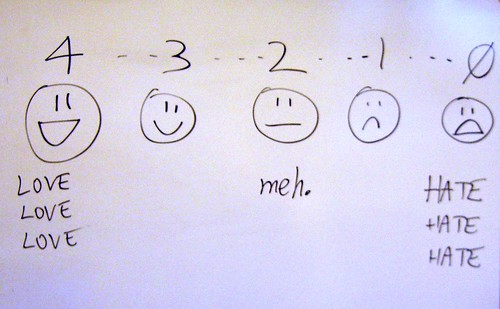
Students were asked to develop their rubrics on  Classroom Management:

:-) :-| :-(
  • Students do self-discovery activities.
  • Teacher uses 10 second rule.
  • Be able to get all students engaged.
  • Understanding directions and interested because they see importance.
  • The students are talking to other students about the lesson and asking questions.
  • Creates a safe/welcoming environment and fosters an "I want to try," or "I think I can" atmosphere.
  • Students excited to learn on their own.
  • Mostly teacher-centered.
  • Ignoring actions & sometimes loses cool.
  • Some students are engaged in lesson.
  • Understanding, but no interest while doing work.
  • They seem interested in what you are doing, but don't understand the lesson.
  • Provides a variety of activities and gives learners a choice.
  • Doing the work or trying, but not enjoying it.
  • Completely teacher-centered.
  • Teacher acts impulsively.
  • Majority of the students (or all)  aren't engaged.
  • Lack of understanding, confused as to what they are supposed to do.
  • The students are not talking to one another nor asking questions about the lesson.
  • Has a controlling environments.
  • Students not even trying.

He shared the post from miss brave, a 3rd grade teacher in NYC, on being disengaged.  Engagement as it relates to classroom management.

Finally, he demonstrated what his lesson planning was like in different stages of his career.  (Hopefully we'll have video of this, also.)  We can use the rubric as a landscape of progression.  What does it mean to plan? What am I focusing on at each stage?


:-)
  • "The learner will..." objectives! 
  • Letting learners take control of their learning. 
  • Tied everything to content, but also what you wanted your students to look at beyond that. 
  • Evaluation process with students: can, trying, next 
  • Better understanding of these particular learners, not just prior students.
:-|
  • Looked at what prior knowledge students might have and how it related. (Launch) 
  • Started to put more emphasis on reasoning and justification - process in general. 
  • More thinking about how students would respond. Changing questions to better suit students. 
  • Making changes based on what happened last time. 
  • Used words like 'construct' and 'consolidate.' More comfortable with some educational theory. 
  • More of probing for understanding. More assessment.
:-(
  • Focusing on yourself and what you were doing. Teacher centered. 
  • No objectives. 
  • Close to what the book had in place. 
  • There wasn't much wiggle room for how the lesson could be individualized, or varied depending on how the lesson goes. 
  • Lesson plan is vague. A substitute would have no idea what to expect in terms of student difficulties.

We have to start by beginning with ourselves.  Those are bad words - teacher centered - but it's where he had to start.  "Constructivism gone mad," when he tried to jump right to student centered.  I go through these stages more quickly, but still go through them.

A student pointed out that there should also be progress throughout the year. Yes!  Gradual release... but that's for another day.

Tuesday, January 18, 2011

Student Teacher Self-Evaluation

In seminar today, we tackled the idea of evaluation.  We contrasted the traditional evaluation of sorting (these students can, these students can't) with Vygotsky's (what can students do, what are they trying to do, what can they not do yet).  Dave shared sample rubrics that his wife developed with her first grade students.  (See them in this post.)

We asked the students to develop three panel rubrics in terms of Jim Knight's framework for coaching: What does effective teaching look like in these areas?


Classroom Management
:-) :-| :-(

Supporting learners to find meaning in math

Select activities learners would enjoy

Give candy to get learners to participate
Clear and consistent routine for students Inconsistent routine or unclear to students No routine for students
Content

:-) :-| :-(
Relational Understanding with learners in mind
    Relational Understanding
      Instrumental Understanding
        Instruction

        :-) :-| :-(
        Empowering Learners
          Uncovering Content
            Covering Content
              Assessment

              :-) :-| :-(
              Implementing a variety of assessment approaches and monitoring effectiveness
                Recognizing that I need to know more
                  Typical summative assessments without a purpose


                    The student teachers started off by focusing on the smiley faces, mostly on Classroom Management (the first one on the board).  Dave filled in the above as a demonstration off the top of his head.  And we realized that this was going way beyond today.  It was feeling more like a semester long project, as we collectively learn more about being effective teachers.  One TA later shared that she felt mostly she knew about the frowny faces.  Didn't know what she wanted to be yet, but had some ideas what she didn't want to be.  Makes sense to me.

                    I'll continue to share as these develop.  It would be terrific if any readers might share share elements of what would be on their rubric.


                    Photo credits: From Flickr - bryangeek, rutty, jamiemw

                    Sunday, January 16, 2011

                    Quest for the Holy Snail

                    We are beginning our middle school math for teachers course thinking about integers.  What a miserable topic, on the face of it. Trying to think about why K-12 students might need or see negative numbers, these pre-service teachers came up with three spot on suggestions:
                    • Answers unanswerable problems: 5-7
                    • Gives relative position or quantity
                    • Alternative way to think about subtraction
                    Really sharp thinking, I thought.  And if you think about why mathematicians invented them (or worked out how they work), this is definitely it.  Completeness and closure, and then a more sophisticated understanding of operations.  My suspicion is that these make poor justifications for middle school students.

                    As I thought through contexts, I thought that the relative position or quantity situations were the strongest.  Something got me thinking about keeping track of change as the most interesting of these.  That and our heavy family diet of fantasy led to this story.  Apologies to Mr. Python and to you, the reader.

                    Task:  Archaeologists definitely did not unearth this journal from the middle ages.  But as you read through the account of this thrilling fictional adventure, please keep track of the number of knights.  Make two graphs:
                    1. A graph of days on the quest vs. the number of knights.
                    2. A graph of days on the quest vs. the change in the number of knights from the previous day.
                    A mathematician would probably mark Jan. 11th  as day zero, but what you do is up to you.  As the graphs are finished, label the important points with what was happening in the story.  Which graph do you think shows most clearly what happened?  Why?

                    Quest for the Holy Snail
                    Diary of Sir Vaysez

                    Jan. 11th, year of our Lord 1011.
                    We set out for Gudtonoya today. Our company numbered 100 good knights, in search of the Holy Snail. It is hoped that recovery of the Holy Snail will bring peace to our land.

                    Jan 12th. As we topped the hill outside Dentite-on-Wails we encountered a party of Orcs. 10 men lost. Ran away screaming at the sight of the beasts. The orcs waved us on, wanted to know if we had extra biscuits. Not for their ilk!

                    Jan 13th. Faced an enemy party of evil knights from Notusistan. The blocked our path and challenged us to battle.  We shouted as loud as possible, they were overwhelmed and joined our party. 25 converts to our cause!

                    Jan. 14th. Sad morning. Turns out Notusistannis were playing a trick. They left and convinced 50 gullible men to go with them. Silly knights, such tricks are for children!  King seems depressed.

                    Jan 15th. Wandering through the Moors of Lesthan. Doing nothing for morale. More knights returned home today. The company is down to 35. Still mostly mighty!

                    Jan 16th. Surely this day shall be remembered always. Camped at the edge of a pond, the King heard a voice calling to him. When he looked into the water, a maiden stared back at him! (Not a reflection, as he is quite, um, "rugged" might be polite.) This maid said that the heavens did find favor with him, and she reached out from the water holding the Spear of Justice! Hurrah!

                    That said, 10 more men left. Mumbling something about “watery women handing out mystical weapons is no basis for any kind of representational government.” Good riddance, say I! 

                    Jan. 17th. 12 new knights have joined. We marched today to the Castle of Awwshux. The nobles there, inspired by our majestic liege and Expointsalot, have joined our quest. (That’s what he’s calling the spear; doesn’t seem like good namesmanship. What’s wrong with ‘Spear of Justice’?) They also had information that …

                    Jan. 18th. Sorry I never finished yesterday. Dragon attack!  Lost a few brave warriors, but the dragons were repelled. Our company numbers 33 hale and lightly toasted fellows.

                    Jan 19th. Marching on Notusistan, as the Shuxters are sure these dark knights hold the Snail. We’re worried, as we hear they eat snails. Might as well be French, right? Thrilled by promise of action, many knights have joined our company. We are 51 knights strong, and should enter Notusistan on the morrow.

                    Jan 20th. Exhausted.  This was a major battle.  Fully armored knights clashed, bashing sword on shield, lances driven forward. So glorious! Surprisingly, we still have 51 knights. Don’t think they lost any warriors either. But it was glorious, I say!

                    Jan 21st. Turns out Notusistannis are good cooks.  Might as well be French, right? They invited us in for a meal. We recounted the glorious deeds of the battle from the previous day. 8 men left because the food was "too spicy."  Have a palate, man! But 5 brave Notusistannis have joined us. Turns out they didn’t even know the Snail was here. They said that if it’s anywhere, it must be in the castle of the Wizard King of Wartshog.  It is rumoured we shall face the undead.  Then 6 more men left.

                    Jan. 22nd. I write these words weary, but victorious. 10 more knights joined us for the final assault. But the legion of skeleton fighters claimed heavy tolls.  Relentless, they were.  Then the Wizard King smashed 5 brave knights as we rushed him together. But 22 knights, including our King, Herbert, made it through. The King smashed the evil warlock's dread terrarium and recovered the Holy Snail!

                    Rejoice all you lovers of Blessed Mollusks!  Once more our land shall know peace.

                    Chapel of the Holy Snail

                    Writing this made me think of Denise and her adventure math stories.  Check them out at Let's Play Math!

                    Photo Credits (Flickr): GraphicReality, Ton MJ, ElitePete, estherase, modowd, greyloch, rogersanderson

                    Saturday, January 15, 2011

                    Creativity for Teachers

                    Hello!  It's good to be writing again.  We actually took a bit of a vacation, then, of course, it's crazy trying to catch up coming back from a break.  There's a bit of writing inertia to overcome, but it's definitely better to be writing than not.  Starting my math for high school class, we watched Ken Robinson's 2006 TED talk on how Schools Kill Creativity.

                    Through the blessing of a larger than expected number of mathematics student teacher assistants, I get to teach or coteach the whole secondary math ed program this semester.  329 - Math for Middle School Teachers, 229 - Math for Secondary Teachers (not renamed since before 329 existed) and Ed 331 - student teacher observation and seminar.  As a department we've needed to review the sequence as a curriculum for coherence, so now it's a good opportunity.  The content for the first two courses is almost obvious to divide, with the exception of linear equations and functions.  The pedagogy... wow.  That's thorny.  The field experiences are centered on classroom observation in HS (229) and and individual student assessment in MS (329).  Right now, the high school is centered around the NCTM Principles, and the NCTM process standards in the middle school.  We're lucky enough to have Char Beckmann in our department, so there's texts that follow that plan.

                    At the initiative of my colleague Dave Coffey (who is just starting blogging - you should read it) I started thinking about math ed classes as having themes of doing mathematics, learning mathematics and teaching mathematics.  For me, the correlation between that framework and the processes/principles should be where the instruction happens.

                    How do you teach preservice secondary teachers?  Organize your curriculum? Emphasize as themes?

                    At this point, if you haven't watched Sir Ken, now's the time.


                    Having watched that, the students thought about what was important to them. What is creativity (original ideas that have value); the conditions for creativity (if you're not prepared to be wrong, you'll never come up with anything original); the diversity of intelligence; the importance of teaching to encourage and support students. Later this week, I watched Charles Limb's TEDx talk, "Your Brain on Improv." He was actually able to observe the self-critiquing and monitoring areas of the brain decrease function, and the expressive parts of the brain increase function during jazz and rap improvisation. (Worth watching just to see a neuroscientist rap.) Also stumbled across, again, Jordan Matter's Dancers Among Us photo series, which is great in light of Sir Ken's Gillian Lynne story.

                    We then considered the "So What?"  What does this matter for math teachers?  They did a great job thinking about this.  It makes process more important; requires multiple modes of instruction; enhanced by more real life connections; values problem solving and reasoning; shows more than one way to do a problem.  It was interesting to me the subtle bias from their education - these are all things the teacher does.  Still no autonomy or choice for the learners.

                    I'm wary now of revving preservice teachers up too much.  When we see graduates in the schools, one of the most common things to happen is to have them apologize.  They apologize because I've given them guilt over that they should be doing more activities or writing their own problems or using more technology.  Which really means I should be apologizing.  (And I do.)

                    So we discussed that our response to this issue of change can be big or little.  Subtle shifts or big changes.  One of the examples that came up as restrictive was number computation.  As an example of a subtle shift, we tried going from "what's the answer?" to "how else could we do it?"  (Really a better question in terms of differentiation as well as mathematics content.)  So what is 72x26, and how else could you do it?  Firstly, students were suprised by how some people were taught, and secondly, they (who do already know how to multiply) really got into it.  Coming up with new methods, seeing connections, making sense of what other people had done.  Really doing math. I picked 72x26 because it was adjacent to doubling, to x25, etc.

                    In black are the responses to how they were taught.  The first response was the partial product method, which dre some "weird" comments.  Then the lattice just freaked them right out.  How else got them thinking about strategies like the red.  These were closer to their mental strategies.  When their methods were exhausted, I shared the green strategies.  There was some surprise at how different these were.

                    Next, for an example of a big change, I shared the example of coming up with a whole new activity.  Writing curriculum (Curriculum is one of the NCTM Principles).  As an example, we looked at What Can You Do With This.  In particular David Cox's and Dan Meyer's WCYDWT toast. (David's original toast post, Dan's regression spectacular) I don't think it is reasonable to expect all teachers to create curricula.  On this scale.  But with our networked community, we don't have to.


                    Meyer — Toaster Regression from Dan Meyer on Vimeo.


                    Students watched patiently.  "I never knew how long toast took."  "Does my toaster take this long?"  Even before the first piece popped, "how do the settings control the toast?  Time?  Heat?" And then a mountain of questions once the toast popped.  From toaster design, to physics, to burner arrangement, to people's toast darkness preference, to what they noticed about the times in between, to why doesn't the bottom edge toast, etc.  Possible answers to those questions. How they could collect data.  The image of the toast set them off anew.  What they noticed and what they wanted to know.  The more they figured out, the more there was they wanted to know.  That's a good sign that you're doing mathematics.  More pleasing, they made strong connections to the ideas we discussed following Sir Ken.  They saw the potential for buy in, the significance of student proposed questions.

                    It was a great start to class, but it left me a little nonplussed.  This is what class could always be like if we weren't shackled with the expectations of previous generations.  The math that was useful at the dawn of industrialization.  It's like Jacob Marley in reverse, in this teaching life we will bear the chains our forebearers forged in theirs.  But it also held the promise of Buffy.  In each generation of teachers, some will be called.  They can lead us out of the hellmouth and empower the generations that follow.  (When you start mixing Dickens and Whedon, it's time to finish.)

                    And I think the journey might be fun.  One of the students demanded the Toast Song for our recessional music. 


                    Sunday, December 26, 2010

                    Self-Assessment for Teachers

                    Merry Christmas to all!  (I offer these greetings sincerely and in peace, not trying to bludgen anyone with it.)

                    As my colleague David Coffey and I were planning for the winter student teachers, we were discussing ways to involve the student teachers in self-assessment.  Dave is quite the assessment guru, and we want to have them help develop the rubric, but at the same time support them with what we might develop.

                    Kathy Coffey, local first grade teacher par excellence, develops these amazing rubrics with her students.  If first graders can, I figure novice teachers have a shot.  (If only Kathy was teaching them...)

                    Of course, how to evaluate teaching is a thorny enough process that we are having a national hissy fit over it as a country. 

                    The best resources we've found so far are the NCTM professional standards (going on 20 years old at this point; need a membership to read the full thing, unfortunately), and the research Rebecca Walker noticed in JRME this past semester.  I wanted to share this stuff just to share, but also in hopes of feedback.  How do you evaluate other teachers, novice teachers, or support new teachers in self-evaluation?

                    Professional Standards: Evaluation
                    The Process of Evaluation

                    Standard 1: The Evaluation Cycle
                    Standard 2: Teachers as Participants in Evaluation
                    Standard 3: Sources of Information

                    The Foci of Evaluation

                    Standard 4: Mathematical Concepts, Procedures, and Connections
                    Assessment of the teaching of mathematical concepts, procedures, and connections should provide evidence that the teacher
                    • demonstrates a sound knowledge of mathematical concepts and procedures;
                    • represents mathematics as a network of interconnected concepts and procedures;
                    • emphasizes connections between mathematics and other disciplines and connections to daily living;
                    • engages students in tasks that promote the understanding of mathematical concepts, procedures, and connections;
                    • engages students in mathematical discourse that extends their understanding of mathematical concepts, procedures, and connections.
                    Standard 5: Mathematics as Problem Solving, Reasoning, and Communication
                    Assessment of teaching mathematics as a process involving problem solving, reasoning, and communication should provide evidence that the teacher-
                    • models and emphasizes aspects of problem solving, including formulating and posing problems, solving problems using different strategies, verifying and interpreting results, and generalizing solutions;
                    • demonstrates and emphasizes the role of mathematical reasoning;
                    • models and emphasizes mathematical communication using written, oral, and visual forms;
                    • engages students in tasks that involve problem solving, reasoning, and communication;
                    • engages students in mathematical discourse that extends their understanding of problem solving and their capacity to reason and communicate mathematically.
                    Standard 6: Promoting Mathematical Disposition
                    Assessment of a teacher's fostering of students' mathematical dispositions should provide evidence that the teacher-
                    • models a disposition to do mathematics;
                    • demonstrates the value of mathematics as a way of thinking and its application in other disciplines and in society;
                    • promotes students' confidence, flexibility, perseverance, curiosity, and inventiveness in doing mathematics through the use of appropriate tasks and by engaging students in mathematical discourse.
                    Standard 7: Assessing Students' Understanding of Mathematics
                    Assessing the means by which a teacher assesses students' understanding of mathematics should provide evidence that the teacher-
                    • uses a variety of assessment methods to determine students' understanding of mathematics;
                    • matches assessment methods with the developmental level, the mathematical maturity, and the cultural background of the student;
                    • aligns assessment methods with what is taught and how it is taught;
                    • analyzes individual students' understanding of, and disposition to do, mathematics so that information about their mathematical development can be provided to the students, their parents, and pertinent school personnel;
                    • bases instruction on information obtained from assessing students' understanding of, and disposition to do, mathematics.
                    Standard 8: Learning Environments
                    Assessment of the teacher's ability to create a learning environment that fosters the development of each students' mathematical power should provide evidence that the teacher-
                    • conveys the notion that mathematics is a subject to be explored and created both individually and in collaboration with others;
                    • respects students and their ideas and encourages curiosity and spontaneity;
                    • encourages students to draw and validate their own conclusions;
                    • selects tasks that allow students to construct new meaning by building on and extending their prior knowledge;
                    • makes appropriate use of available resources;
                    • respects and responds to students' diverse interests and linguistic, cultural, and socioeconomic backgrounds in designing mathematical tasks;
                    • affirms and encourages full participation and continued study of mathematics by all students. 

                    Japanese Principles of Instruction
                    “Are There Any Places That Students Use Their Heads? Principles Of High-Quality Japanese Mathematics Instruction,” Corey, Peterson, Lewis and Bukarau, JRME, v41, n5, 2010

                    Original
                    1. The Intellectual Engagement Principle: High-quality mathematics instruction intellectually engages students with important mathematics.
                    2. The Goal Principle: An ideal lesson is guided by an explicit and specific set of goals that address student motivation, student performance, and student understanding.
                    3. The Flow Principle: The flow of an ideal lesson is built from a question or a problem that students view as being problematic. As students intellectually engage in the problem, building on their previous knowledge, the students are supported in learning the lesson’s big mathematical idea.
                    4. The Unit Principle: A lesson is created in the framework of past and future lessons, particularly between lessons in a unit but also between units and grade levels. The lessons in a unit help students progress to ways of thinking, writing, and representing mathematics evident in the discipline of mathematics.
                    5. Adaptive Instruction Principle: High-quality instruction adapts so that all students are engaged in mathematical work that appropriately challenges their current understanding.
                    6. The Preparation Principle: High-quality instruction requires a well-thought-out, detailed lesson plan that addresses the previous five principles and interconnects them in a coherent lesson.

                    Draft version of this for our student teachers:
                    1. The Engagement Principle: math instruction should intellectually engage students with important mathematics that is relevant to their purposes.
                    2. The Goal Principle: A lesson is more effective when guided by an explicit and specific set of goals that address student motivation, performance, and understanding. Examples include: students’ progress to ways of thinking, writing, and representing mathematics the way professionals do.
                    3. The Problem Principle: A lesson is more effective when built from a question that students view as being problematic. As students build on their previous knowledge by means of the problem, the students are supported in learning the lesson's big mathematical idea.
                    4. The Connection Principle: Math instruction is more effective when units are a framework of connected lessons; ideally also with connections amongst units and even between grade levels.
                    5. The Support Principle: High-quality instruction adapts so that all students are engaged in mathematical work that appropriately challenges their current understanding.
                    6. The Assessment Principle: High-quality instruction includes gathering and analysis of data that measures student progress towards objectives, and use of that data in planning and adjusting instruction. An ultimate goal is that students will be equipped to self-assess and self-correct.
                    7. The Reflection Principle: High-quality instruction requires a well-thought-out, detailed lesson that addresses the previous principles and interconnects them in a coherent lesson.

                    As questions for starting conversations:
                    1. Why is this math content important? For what is it needed? Why is it worthwhile?
                    2. What do you want students to understand from this lesson? What should they be able to do? How will it help students progress to ways of thinking, writing, and representing mathematics like mathematicians?
                    3. Is this a problem or an exercise? What makes it problematic? What’s the hook of the problem?
                    4. How does this connect to what they’ve done before in this unit? In this year? In previous years? How will it connect going forward?
                    5. Are all students ready for this task? What kind of support do they need, as a group or as individuals? How will you tell?
                    6. What do students understand? How do you know? How can they get from what they know to what they need to know?
                    7. Does this lesson make sense as a whole? How would you or a student summarize it or reflect back on it?


                    billsophoto @ Flickr
                    Self Evaluation
                    As we think about the novice teachers self-evaluating, one of the relevant frameworks seems to be the Levels of Transfer from Joyce and Showers.  It's hard to use that in a grade situation because students want to jump to Executive Use, which is not how that works.  (Here's a nice blogpost by a teacher using them for self-evaluation; also a nice introduction to them.)


                    So how would this work for a self-evaluation rubric?

                    As teachers develop, they attend to different aspects of the profession:
                    • Focus on self:  What am I doing?  How did I do? 
                    • Focus on content:  What am I covering? What's a good activity or explanation for this?
                    • Focus on student performance:  What was the average?  What grades are they getting?
                    • Focus on student learning: What do they understand? What support do they need to do this?

                    What I like about this progression is that it's not from good to bad.  They are all aspects of teaching which are necessary to contemplate.  I think as teachers become more experienced, they progress through the levels more quickly and holistically.  I think novice teachers could recognize where they are at with respect to different aspects of teaching.  "In my planning I'm thinking about student learning, but in instruction I'm still concentrating on myself."

                    So how do you self-evaluate?  If you're a teacher educator, how do you assess your novices' teaching?  Do you have ways of supporting your teachers in self-evaluation?

                    Monday, December 13, 2010

                    Christmas Lights

                    aMacHan @ Flickr
                    Our family put up a Christmas tree this weekend, and it reminded me of one of my favorite problems ever! Students did great work on it, and developed a number of techniques.

                    On the weekend after Thanksgiving Karen put up a 2 meter tall Christmas tree, 170 cm wide at the base. She put an astounding 1500 lights on the tree. Write a story problem using this information.

                    One thing you should know about Karen's tree decorating is that she believes that lights should be distributed uniformly throughout the tree, not just on the surface. It's like the tree is full of lights. She started at the base, and put on 750 lights. Then she asked me how many will she need to finish? Now that we know she needed 1500, how far up from the ground did she get with those first 750 lights?

                    EDIT:
                    I saw that Abstruse Goose, an funny, edgy cartoon that's hip to math & physics also had some nice Christmas tree problems...

                    Sunday, December 12, 2010

                    Change the Channel

                    Yeah! The K-8 geometry video is ready for release! The students did a great job getting footage, and had lots of creative ideas that used their talents. I hope you enjoy it!  (The students would love it if you share the link.)


                    The video started back at the midsemester when students at our school were making a lipdub.  During my class.  "Can we go?" (GVSU lipdub - came out pretty well.)

                    "Not now - you had to be involved before."

                    "What's a lipdub?"

                    So I showed them what I consider the classic of the genre, Shorewood High School's reverse lipdub.  We were just starting our unit on teaching (following doing, preceding learning).  So we talked about how many teachers find it hard to get students to do any work, and yet here's a whole school working their butts off to make a video.  They had a great discussion about it, bringing up choice, student interest, engagement and other factors.  Then... "can we make one?"

                    Any reasonably bright teacher would have seen that coming, but not me.  "I'll think about it."

                    Starting our last unit, I brought it up.  If we're going to do it, it's time.  Discussion led them to believe that the reverse lipdub was right out, followed shortly by a lipdub.  Some students were really into the idea, most were in favor, and a few were dead against it.  There's a fair number of choice workshops in my courses, and I said most of the prep work would be choice.  They wouldn't be graded on the success or not.  The class voted on it with most in favor.  I started freaking out.  It was worth doing to me because:
                    • Student interest was high, 
                    • The idea of how to capture and communicate math is relevant to a math ed class,
                    • By the end of the semester it could be connected to review, and
                    • The preservice teachers wanted to be able to show it to their students to answer why they should be engaged.
                    But as the last couple weeks went by, only a few students were contributing.  (We had a google doc for students to add their ideas and development to.) My freak out got freakier.  Was it even going to be worth trying?  Part of this was also I wanted them to see a teacher giving something a go, taking a risk.  That's better if I'm uncomfortable, right?

                    We used our last class period to do the filming.  One of the cameras failed completely.  I just wheeled in all the manipulatives with which they had had the most fun.  Objective: get some good footage.

                    One student had written the Math, Math, Baby rap, and found someone to rap, so they started choreographing it.  Other students got building and drawing.  One student had come up with an I Love Charts style demonstration (on Jeggings, which you can buy but she proves do not exist), and another was ready to demonstrate our amazing rubber band enlarger.  The atmosphere got charged and they really got into the spirit.  In hindsight, we should have gotten this footage earlier, and then students could film and add to it.  Ultimately I had to do the first pass editing, but it was inspiring to do it because they got such good footage.  The Geometry song came from me noticing that it would fit to Adam Sandler's Hanukkah song, the guitarist learning it in 5 minutes from youtube, and the singer coming up with the lyrics (with some crowdsourcing) on the spot.

                    Even if there was no video result, I would have been happy to see the students so engaged in making math visible and engaging.  But it's better with the video!

                    Resources: Jamendo was a great place to find cc 3.0 music, and I think the songs from Antony Raijekov (jazz) and Josh Woodward (pop/folk) really help make it. They're not math songs, but nobody's perfect.