Tuesday, June 17, 2025

World Tessellation Day 2025

Emily Grosvenor, when she wrote her sweet children's book Tess Elation, had the idea to start World Tessellation Day, selecting M. C. Escher's birthday, June 17 (1898), as the logical day. That was 2016, making this the 10th!


From the man himself: I found two both labeled Development II, woodcut 1939.


The best place for regularly finding mathematically interesting tessellations that I have is the Mathematical Tiling and Tessellation Group on Facebook. (Right?)

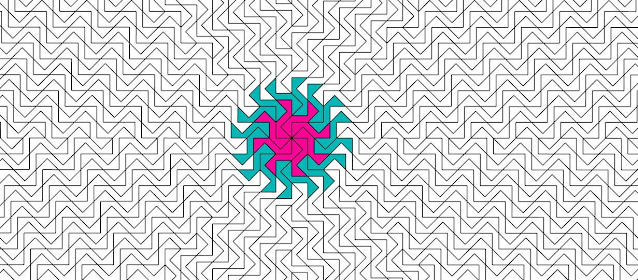
Miki Imura had a recent series there on her modulo wrinkle tiling


and has a website where you can play with it. So non-intuitive - would make a great physical tile with which to play!

Michael Cheshire blew me away with this WOOD INLAY


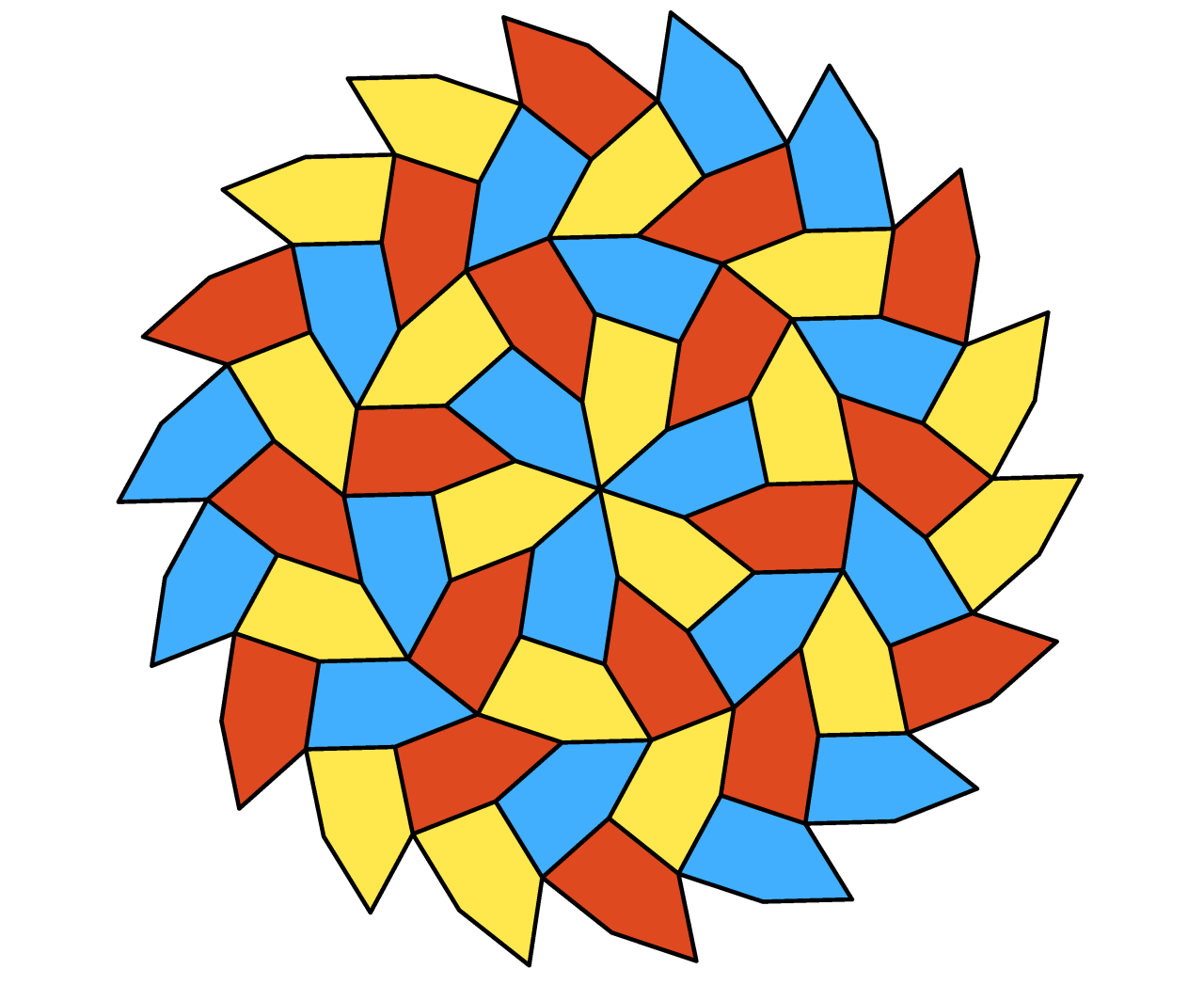
And moderator Ghee Bom Kim regularly amazes with fractal and radial tessellations.


Also Robert Fathauer, Dominic Pons, Michael Sterling Helso, Alan LeBudde, and more. Well worth your time.

Alex Romero, of Tile Farmer, nicely sent along a few of his recent made with TF: 


More BlueSky math folks:

Ally Kraus, a fiber artist

Joy Sprinkles does a lot of AI art but also hand drawn things like:

Alejandro Gallardo makes so many beautiful GeoGebra tilings, often inspired by historical tessellations.

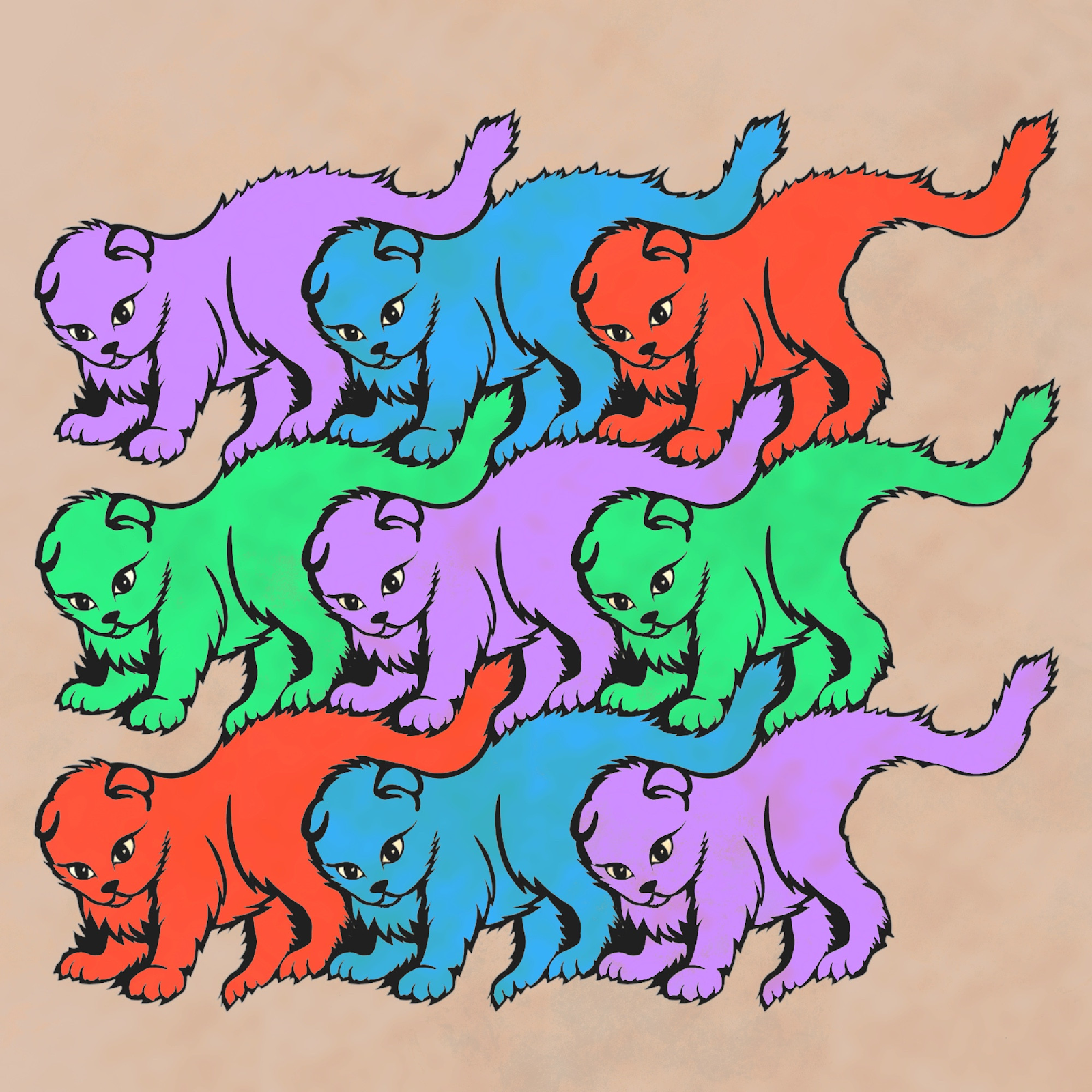
Richard Connors McConochie. I'm a sucker for a cat tessellation.

MisterCorzi share the classic Pringles tessellation from Theo Rooden.


From other places:
Gábor Damásdi had a beautiful post of "unusual tilings."

RobertLovesPi has many tessellations, often colored in MS Paint! (Find here on Bluesky)


Tudi regularly posts wearable Penrose tiles on Redbubble...

Xavier Golden is a HS art teacher, and his students had some sweet tessellations.


Most of the tessellations I make or find I post on Tumblr. Here's my top 3 of my own this year. Mostly I'm interested in making interactive ones where you can play, so the first link is to the GeoGebra and the second to what I did with it.


Two turn pentagonal tessellation, pictures, inspired by a Michael Helso post.


Pentagon hexagons tessellation, pictures, from a Gábor Damásdi dissection of a hexagon.

Did I say 3? One more.


Got any tessellations you've been making? Send them my way!

We'll leave with this amazing photo by Dan Kelley from the FB group, a sweet radial tessellation in metal!


Sunday, May 25, 2025

Star Patterns - a Mathart Lesson

One of my favorite courses to teach is our embedded elementary whole number and operation teacher prep course. Typically they teach every course day, twice a week. This semester, one section taught 1st and 3rd, and the other 2nd and 3rd. Pairs of teachers work with small groups of elementary learners for 30-50 minutes. Mostly our lessons are a number talk (or other instructional routine; WODB, same but different, Slow Reveal Graph, ...), a story problem and a game. But we try to do a couple of other formats, a three act lesson, a data collection lesson, etc.  At the end of the semester, I like to have a math and art lesson as a kind of celebration, and to get to experience making with the kids.

In the past, we've done Hundred Face (handout), but time-wise that was not going to work this year. I do recommend that lesson highly - always fun, so many ways to see 100 and think about exchanging different combinations to make the same number, great opportunity to do real art with significant restraints.

When I was thinking of a new lesson for the 1st and 2nd grades, I wanted something that involved counting, and could be done pretty quickly for the class with the time limit. 


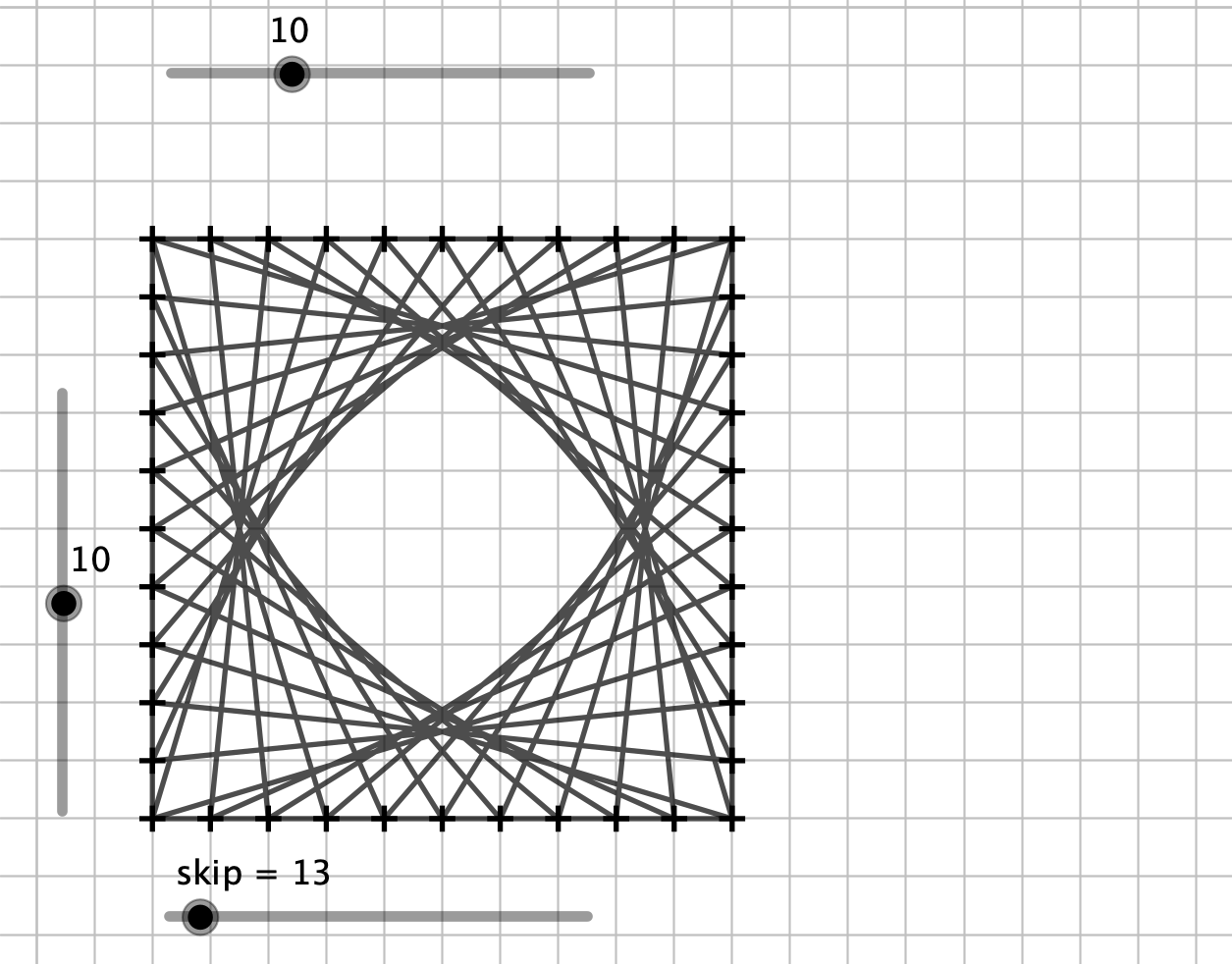
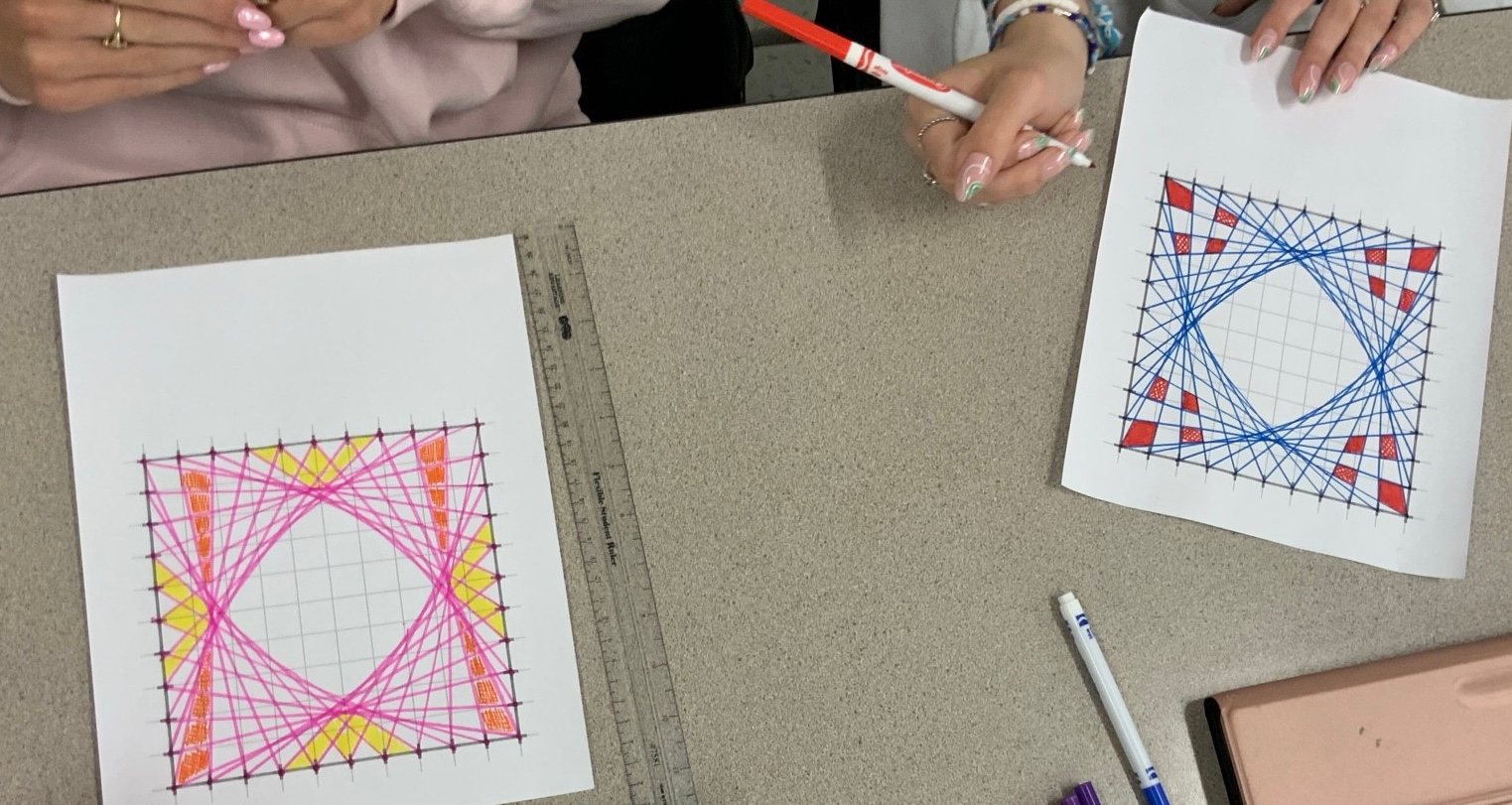
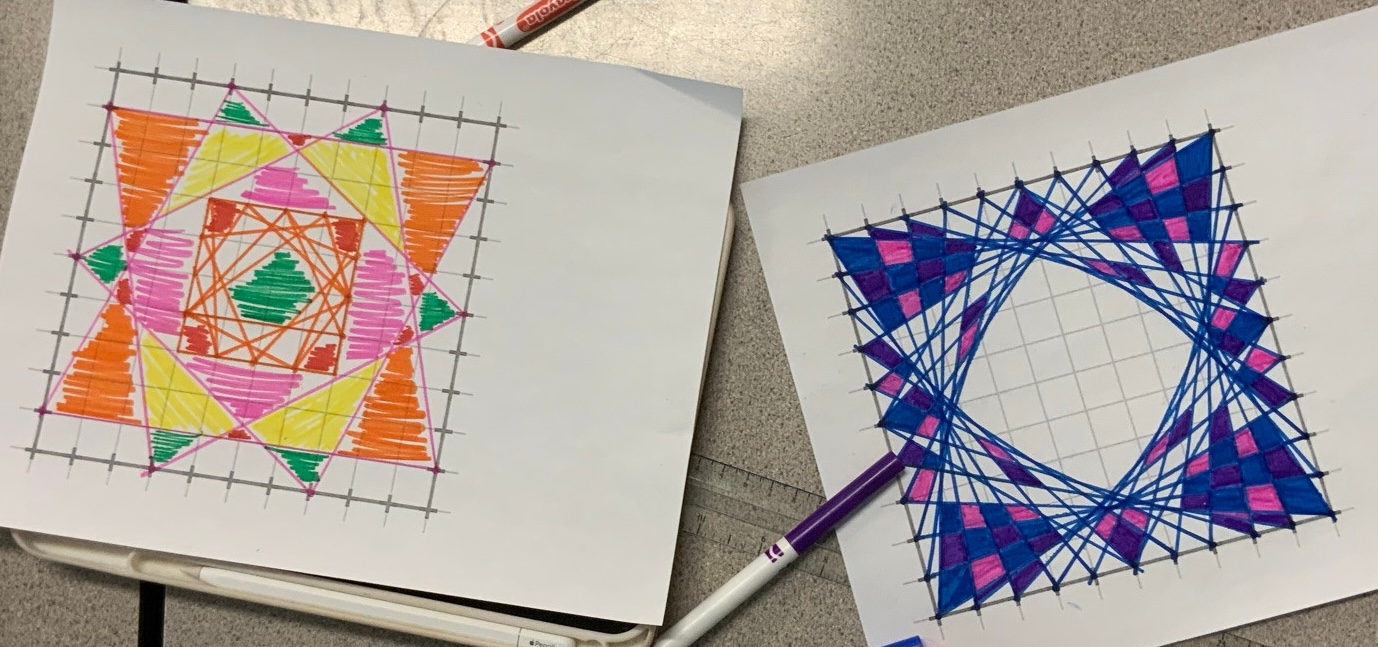
Eventually I landed on string art. I like this in general, I love all the things there are to notice. The mechanism is simple enough to communicate to young learners: choose a skip number and a place to start, connect those vertices, repeat. 

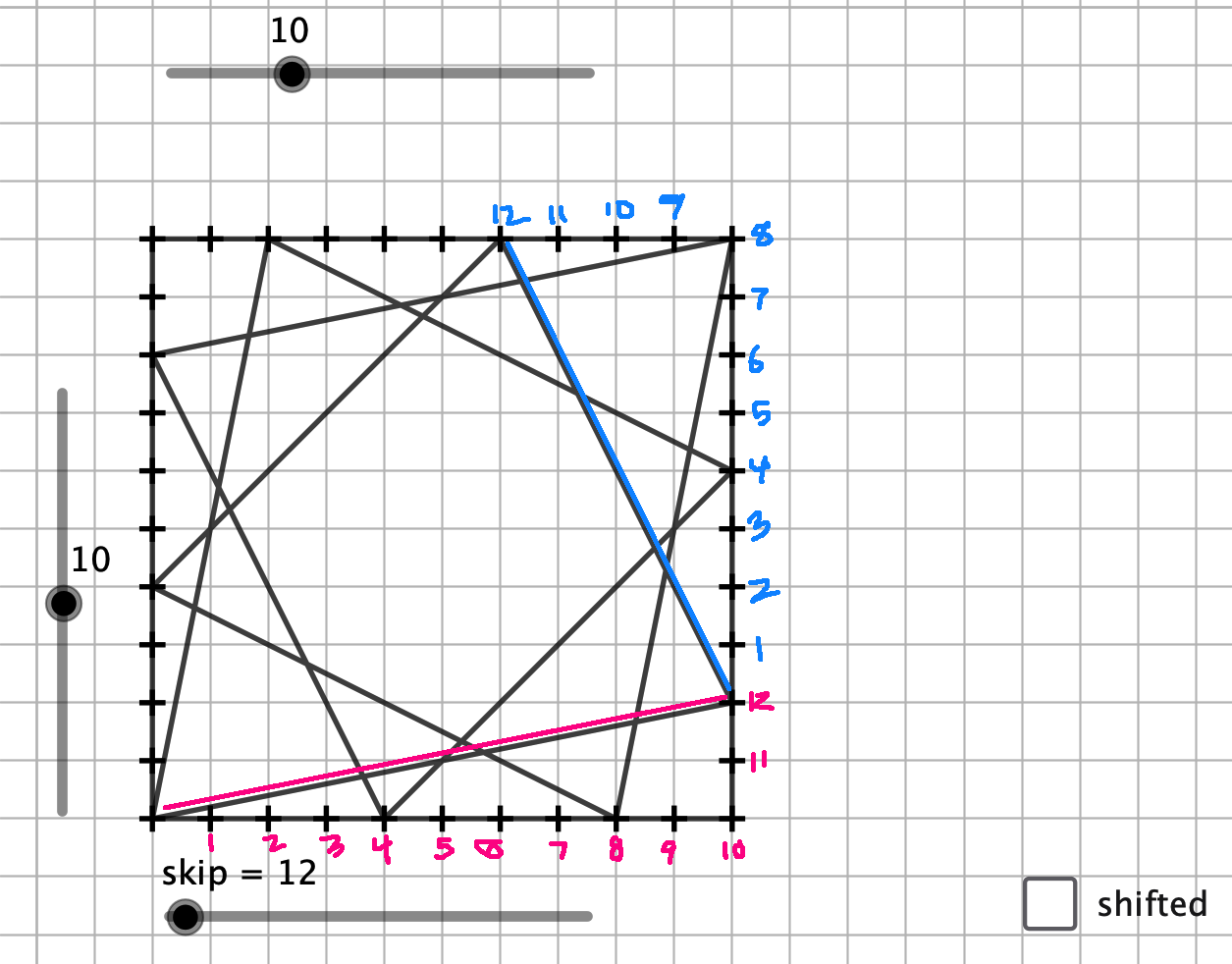
I made a GeoGebra applet for the teachers to play with, and, if time allowed, they could share with kids. We got the teachers to make some conjectures about the string art patterns from their noticing and playing. When does the pattern hit every node? When are there gaps? What difference does a smaller vs a larger skip number make?

For a couple years, I've been lucky to be able to do these lessons with the teachers during school spring break and have my son Xavier join us. He's a high school art teacher and the author/artist of our graphic novel. He talked to the teachers about line, as an element of art, and developed this slide show to share about Emma Kunz and Bridget Riley.

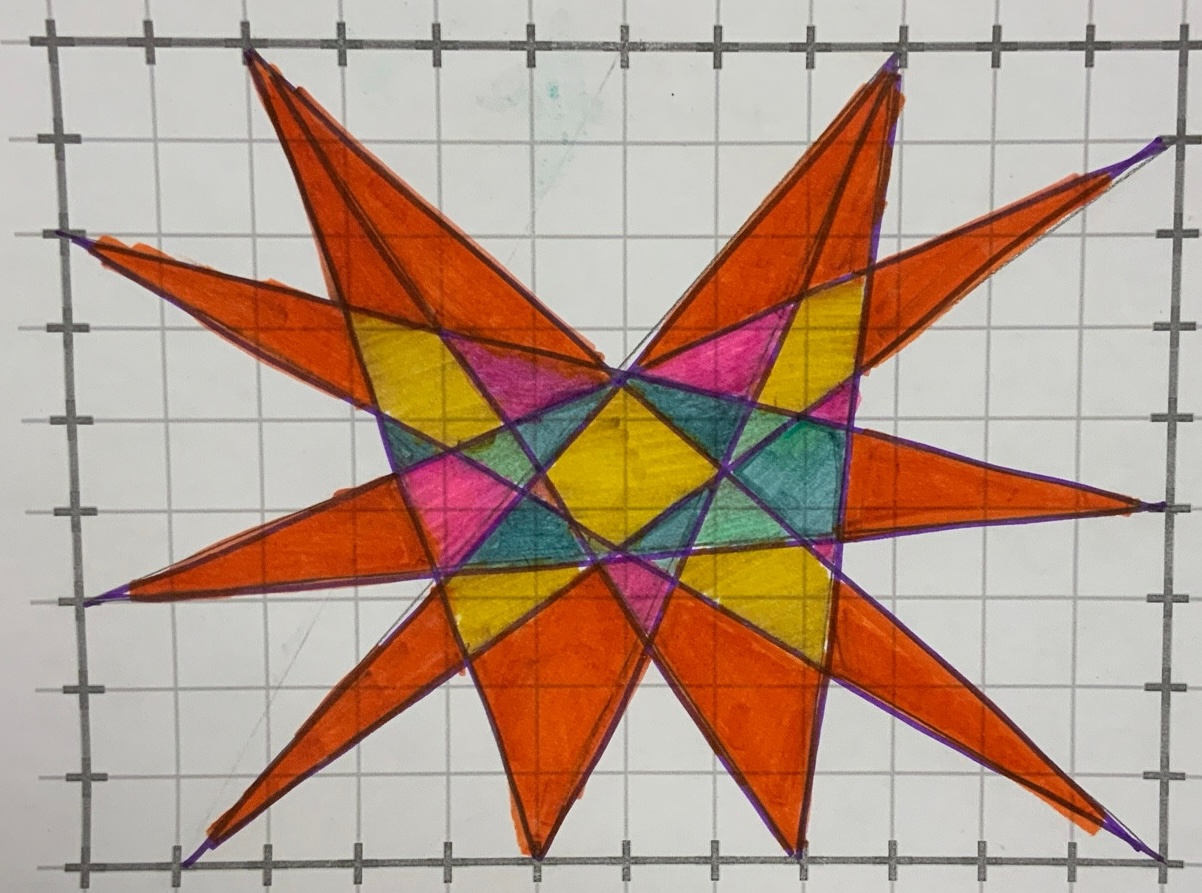
We talked about different ways to use the pattern to make art. Xavier suggested coloring so that not two adjacent areas shared a color.

Teacher art was interesting:


One of the things that I love about combining math and art is being able to address mistakes as happy little accidents. We adjust, incorporate it, use fix up strategies.

The lessons went very well with the 1st and 2nd grades, most kids were highly engaged. When we finished, we set out all the art work and did a gallery walk. Then the artists shared something they liked about someone else's work. Lots of great noticing, and they were very pleased when another kid found something in their work. There were a lot of great predictions about where the count was going to take them next, and some kids were confident enough to just draw the pattern. The physical skills of using the ruler and coloring were relevant. Xavier had given the teachers some tips about careful coloring and precision.


Altogether, this is one I'll use again. It would be interesting as two part lesson in middle school, with the first an investigation into the patterns, with connections to factors and multiples. The math was great, and the preservice teachers were impressed with the kids' interest, focus and creativity. As usual, the art connection engaged kids who are less interested in traditional math lessons.

Lesson Plan Crib Notes

Part 1

Share your examples of rectangle string art. What do they notice and wonder?


Part 2

Have them pick a starting grid and a skip number. (Handout) Help them get the first few lines. As they work, see what they notice about the pattern. Help them use the grid to count - especially on the 10x10 square. The bigger a factor the skip number shares with the total perimeter (40 for 10x10, 42 for 9x12) the fewer lines until it meets up with itself. So skip 13 will hit every point, skip 12 will have fewer lines. Pick any starting point - some people like starting in a corner - and continue connecting lines to the point your skip number of points away. You can do colored lines, black ink or pencil. Talk to them about the counting math, patterns they notice, what they see. DON’T WORRY ABOUT PERFECTION.


Part 3

Decorate!


Summary

Find out what they like about their art. Get a picture. Tell them something positive that you saw about them or their work. Be authentic!


Sunday, May 4, 2025

Playful Math Carnival 180

 May I March from April?

I was supposed to post the March/April Playful Math Carnival, but it's May! May the 4th even, happy Star Wars Day to them that celebrate it.

180 is a pretty amazing math number. 18 divisors, more than any smaller number. 18 divisors also makes it refactorable, divisible by the Very abundant, as you might guess. Harshad (or Niven) also, divisible by the sum of its digits. The sum of two squares (both squares of divisors!) For Euler's totient function, 

Of course, 180 is probably most famous in math for being the sum of the angles in a triangle, or have the degrees of a full turn. How would you prove the triangle relation? (I tell my math history students that is one of the few theorems every math major should be able to prove.)


Speaking of triangles and math history, Pat Bellew discusses Heron and his formulas.

Chris Luzniak read a book that made him realize he needs Math Therapy. Chris is hosts Debate Math podcast with Rob Baier. I loved their episode on comparing teaching reading and math with married couple Courtney and Ryan Flessner.

Denise Gaskins, the home and creator of this here blog carnival, had a math journaling post with three elementary math games. Also don't miss her Math Game Mondays.

Ann Elise Record shared a great padlet of math games. It includes a link to her podcast, discussing meaningful math games with Dr. Nicki Newton.

Rachel Lambert shared the start of some research into mathematical games and their use with teachers. Really exciting and I can't wait to see where it goes!

Howie Hua, modern master of math memes, had the fun Tom and Jerry meme above show up in a reddit Explain the Joke thread. Speaking of Howie, this Star Wars math made me think of another of his memes.


Chalkdust, one of my favorite math periodicals, had an article looking at the discrete math underlying Sudoku. (While you're there, be sure to check out Dear Dirichlet, the funniest mathiest advice column ever.)

One of the great math events this spring has been showings of Counted Out, a documentary examining the importance of math and math education in modern life, centering the work of Robert Moses. Here you can read more about the movie and the people featured. I have never had a stronger endorsement for an education documentary.

The delight of March for me was Ayliean MacDonald's Math Art March

One idea I tried out for Math Art March was a pattern themed Exquisite Corpse game. This is an art game where you fold a paper and each subsequent artist can only see the very end of the previous artist's work, and draws off of that.

Jenna Laib writes about Anderson's Endless Zeroes, an elementary math investigation into a unit conversion problem.

Daniel Scher created a sweet dynamic applet to use sliding rulers to think about integer addition and subtraction.

I was pretty happy with this Escherized version of a hexagon dissection I saw. Play yourself in GeoGebra

I've just started on these, but Arula Ratnakar writes mathematical fiction at ClarkesWorld.

The two most recent math books I'm most excited about were The Five Sides of Marjorie Rice, about one of my favorite mathematicians, and How Did You Count?, another great Christopher Danielson book that makes the reader the mathematician.

We'll close with the math blog-o-sphere's most reliable writer, Dylan Kane, who took a break from deep thinking about learning and teaching to share a fun folding problem from Play With Your Math.

Sorry again this was so delayed! If you're interested in hosting the Playful Math Carnival, give it a go! Share what you've loved. The previous was at Denise's Let's Play Math, and the next might also be Denise. 

Coming up on my blog this month will be two elementary math and art activities, and some great new math games from my senior seminar.

To close, I think I have to share one of the Star Wars Standards of Mathematical Practice memes that Dave Coffey got us making a few years ago.


Saturday, January 25, 2025

Make a Difference - Math Game

 I once again am getting to teach the math game design seminar (at some point they'll realize it's too fun to count for my workload) and I wanted to try and capture my design thinking on a promising new game.

Phil Shapiro shared on Bluesky his math pairs game. A randomized list of 1 to 100 where you find pairs that add up to 100. 

For whatever reason, that made me wonder about a game finding differences. In elementary there's often a default to subtraction=take-away (Separate Result Unknown si parlez vous CGI) (I don't speak French) So a game that focused on the difference would be a good thing. I thought, what if you roll a die and need to find a pair that is that far apart?

For kids I like a number board that has a structure, so kids can use patterns to find what they want. (Nothing against Phil's game, where the Where's Waldo feeling is a lot of the fun.) My first try was a double spiral.


It was a lovely pattern, and I liked how it put small and large numbers together. As the game play evolved, it became clear that I needed a normal grid. 

The other thing you can see here is pretty typical for me when I have a mechanic idea. Try out the mechanic and worry about the win condition as you go. The above image was my first try. I asked on Bluesky who won, and Phil responded probably yellow, since it seemed to have more territory. Biggest block of squares? Longest path? I stuck with that for a while. Eventually I realized the game is about differences, the win condition should be, too. What if the path with the biggest difference won?

Mechanically I really liked that. Then there's an advantage for the first player. And it raises questions: what's a path? I thought it should be only edge to edge, but it became too easy to cut someone off. Having squares connect corner to corner gave some of that Blokus energy. I did wonder about the sum of two paths, but that's unnecessarily complicated.

I'm still trying different play rules. Should one of your new squares have to be adjacent to one of your old squares? Currently I'm saying no, because that makes more interaction possible as well as opening up more strategy with more choice.

The board was 9x9 originally because I wanted that double spiral, so it had to be odd x odd. I can see this being on a hundred board. Great representation, and I love to have kids spend time with it. I like that +/-9 are above each other, because 10s are often comfortable already, and it feels like 9s still makes for lots of interesting patterns. It does make a game around 20 turns - which is long for 2nd & 3rd grade. Although kids play Joe Schwartz's Hundred Board Game (definitely a Best of Math Games awardee; video explaining it) is more turns, but the turns are quicker. 

Why I think this is worth developing is because as I play, I have to think! Looking for pairs, any in good strategic placement, what is possible... a lot to consider. Too much for middle elementary? I hate to underestimate the players. Towards the end of the game, there are surprisingly frequent times that you can't take the number you would first take. The number rolled makes a difference in play, as well as providing some variance that helps with surprise.

One thing that came up is what if there's a tie? Then the winner is the person with the biggest difference on their second path that doesn't overlap their first path. Maybe a second path that doesn't cross their first?

What should keep you playing after you have a maximal chain? I thought about a bonus for being the last player to play. But that feels fussy. How else can I make people care about finishing? Maybe they don't have to?

Current rules text: 

Two teams. Roll a 10 sided die (0=10) or flip a Tiny Polka Dot card. High number goes first and gets 10. Team 2 rolls and takes 90 and then 90 minus their number. 

On your turn, find two numbers whose difference is the number you rolled and color them in your color. After 10 and 90, teams can choose any pair of numbers with the difference they rolled.

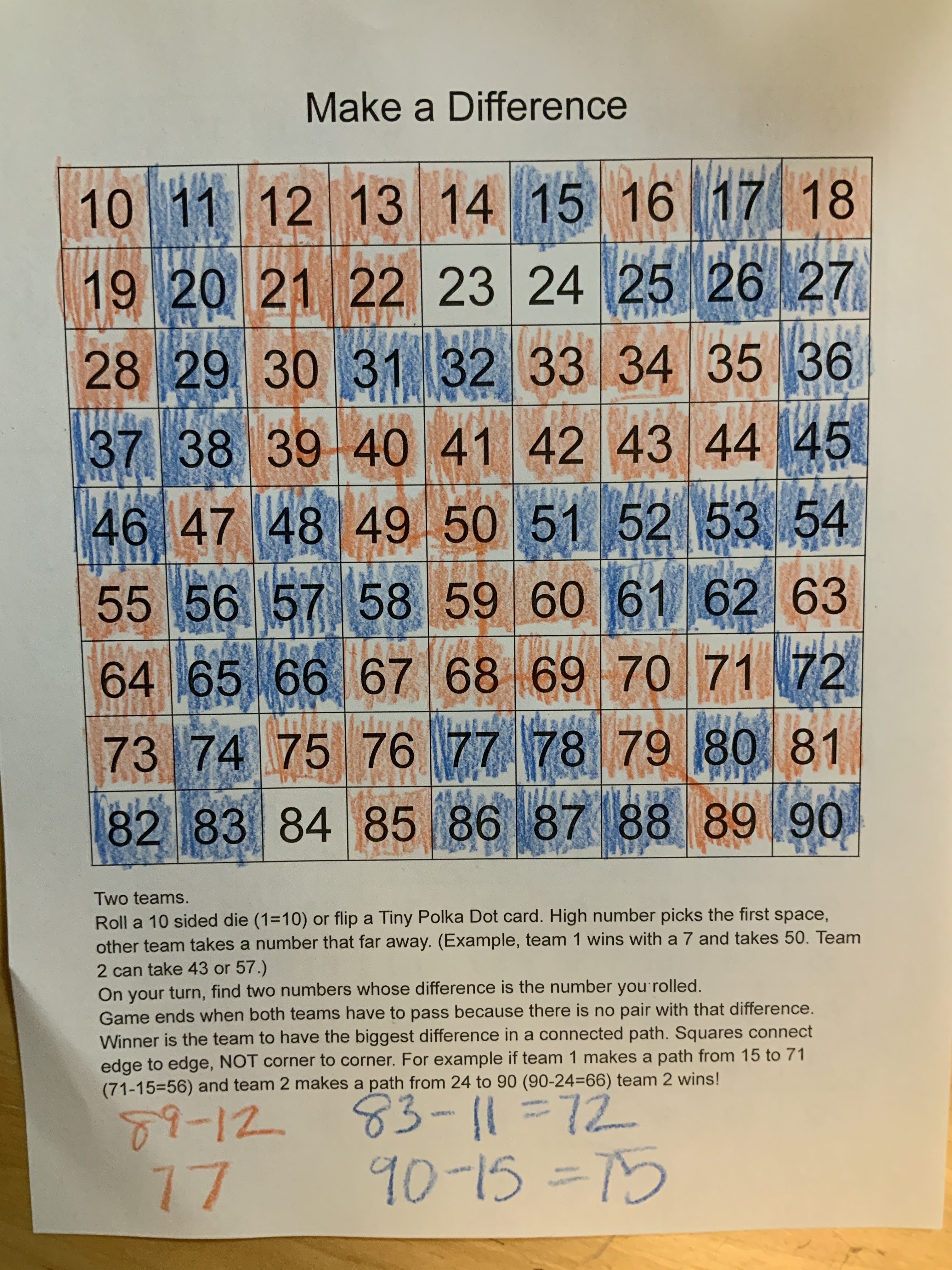
Game ends when both teams have to pass because there is no pair with that difference. Both teams draw a path connecting the biggest difference that can find. Squares connect edge to edge or corner to corner. Winner is the team to have the biggest difference in their path.  For example if team 1 makes a path from 10 to 71 (71-10=61) and team 2 makes a path from 24 to 90 (90-24=66) team 2 wins! If tied, the winner is the team with the longest 2nd path that doesn't overlap their first.

The 10 and 90 start is trying to remove that first turn advantage. It's also is a step towards understanding strategy, which can be nice to bake into the rules.

Definitely want to try with a d20 as well. Maybe as a 4th and 5th grade variation? On a 0 with Tiny Polka Dot cards, you could be allowed to pick a single number - which definitely could be useful. Another variation for high school + players could be the sum of two paths victory rule.

Current game board. If you try, I would love to hear what you think. I'll definitely play with my games seminar, and maybe with my elementary preservice teachers &/or 2nd and 3rd graders.

Two games with the most recent rules. 10/90 start is working well. 

PS. I make some references here to the criteria I use for thinking about games. Definitely a part of my design thinking.

PPS. I also like the name, which is unusual for me, but am open to suggestions. 


Thursday, December 19, 2024

Playful Math Carnival 177

Interesting time to be hosting this carnival! I feel like there's a small resurgence with blogging, and I want to be part of it. I've really missed writing informally professionally. I've been a part-time host since Math Teachers at Play 22, 14 years ago!, and a big part of the original purpose of the blog was to collect, curate and share things that delighted and supported me. If you're interested in hosting, contact Denise Gaskins, the founder of this here carnival. The January carnival will be at her blog, but I think February is open!

177 is semiprime, for which two primes? 

177 is the ninth Leyland number, of the form x^y+y^x. What are x & y for 177? They're both prime, which should be a special kind of Leyland I think.

177 is the first "non-trivial" 60-gonal number. (1 and 60 are too easy.) What is the next 60-gonal number? (Pictured) What does the sequence of the first non-trivial n-gonal numbers look like? (6, 9, ...)

177 is a Leonardo number, so named by Edsgard Dijkstra for their relation to the Fibonacci numbers. The first five are 1, 1, 3, 5, 9... can you determine the pattern?

But the coolest thing to me is that it's the magic constant of the smallest magic square of distinct primes! I'll get you started...
(Thanks to Jim Olsen who caught a istake in my original!)

Supposedly the 2nd highest dart score is 177 - but I need someone to explain that to me. Supposedly I used to play darts!

177 is getting too big for many interesting images on Google image search. So I tried AI. Give me 177 ants marching! 75 at most. Give me a stack of 177 balls. Hmm... I don't think so. That set me off to GeoGebra to make a visualization tool.

Things are hopping over on Bluesky. Most of these links are from there. Here's a math teacher starter pack, or a mathsky star pack part 1 or part 2 or an #elemmathchat starter pack. Other good tags to check are #mathsky, #iteachmath or #mathstoday. So far it's been positive and energetic.


Gamey

Denise shares a math game every Monday, like Area Block or Coin Chain.

Sara Van Der Werf reshared her amazing 5x5 game, for adding, multiplying and a bit of strategy.

Erick Lee and his son invented a sweet exponents game that I'm dying to try.

Some fine mathematicians seem to have proved that Henry Dudeney's famous equilateral to square dissection is minimal. I made a GeoGebra puzzle out of it to celebrate. That dissection is hinged and Manuel Sada made GeoGebra for that! Denise shared a Dudeney game I had never seen before.

I've really been enjoying the Celtix puzzle by Andrew Taylor. Great UI. Multiple solutions to each, but took me awhile to get the hang of just focusing on one color at a time. Here's two solutions to Puzzle 177. HT Ayliean.

Sarah Carter, queen of math puzzles, shared some winter themed Sudoku puzzles, also available in Christmas flavor.

Catriona Agg continues to invent the sweetest geometry puzzles. This one with four equilateral triangles was really neat.

I've always thought a card sort was an activity that invited play. Marilyn Burns continues to amaze me, like here when she tried her first card sort!

David Flynn shared a puzzle he made for 3rd graders. Get from start to finish using only right angles.


Artsy

Xavier Golden (full relation) found the classic Eames math shorts (plus more) in a single YouTube playlist.

Ben Orlin's math with Bad Drawings is a constant delight, but I especially loved his musings on Edgar Degas and math.

Erick also shared an old Bree Pickford-Murray post making posters for missing hexagons (after first inventing hexagon types).

Min Min shared an old post of Sarah's making slope-keyed nameplates

Paula Beardell Krieg has a bunch of upcoming workshops, but still found time to share this open and close pop up.

Grant Snider drew a sweet math fable. (Is it a rhombus, though?)

Sue Van Hattum's super cool Althea series is continuing. Here she shares a problem with a problem.


Teachy


Nat Banting blogged about an essential teaching reminder.

Dan Wekselgreene shared a routine that my preservice secondary teachers tried and liked, Correct, Incorrect, Incomplete.

Jenna Laib writes about students writing silly story problems.

Glenn Waddell did a whole series of quadratics this fall, wrapping up with the mystery of the b coefficient.

Dylan Kane never lost the beat, still the most consistent math teacher writer. Here he's thinking about Ben Orlin's book and Hemingway and Negative Numbers.


Extry

Maybe you're looking for last minute mathy gifts? Thanks, Aperiodical. Who wouldn't want a handmade zine? How you could wrap them from this post.

Ali Almossawi shares some math history about a few great mathematicians who were famously slow.

I didn't get many math comics made this #mathtober  but this was definitely the biggest hit.


That's it for me! See you next year. Coming soon, Xavier's and my math graphic novel, AL, Logical!


What? Are you still here? Then enjoy one of Howie Hua's many riffs on a holiday meme.


Thursday, November 14, 2024

Just Sitting Down

I had an elementary ed class canceled for low enrollment and got a calculus course instead. It's really been a teaching challenge, which is always good for a teacher educator. Usually when I teach calculus, I start with integration. It's more intuitive than derivatives, and a lot of our calc I students have had some calculus before and think they know it because they can take derivatives of polynomials. But I have the good fortune to be in a department with Matt Boelkins, who's written a terrific calculus book, free to students, so I'm trying to be more of a team player.

I have not been able to establish a good culture of collaboration, and say at least 20 times a class to talk to their tablemates as they work on activities. I'm using random grouping daily, and by now most have worked with most others. I'm disappointed in myself that I have not made more tasks into complex instruction tasks, which would help with interaction A LOT. But time is what it is.

The heart of the differential calculus part of the course to me is the optimization and related rates sections. Making sense of rate of change in context for optimization. And the power of the derivative idea in related rates. We can take the derivative with respect to time even when time is not a variable! Astounding!


After two days on optimization and two days on related rates I had not gotten a lot of the in class assessment options back, and I thought they were intimidated by the problems. So I took an extra day to do one more of each. Both pretty standard problems which I added some small wrinkles.


They all set to work, parallel play as always. I encouraged talk, which as usual got a minute of conversation, then back to themselves. I paused class to get some shared thinking on the whiteboard.

Finally I just started sitting down with the groups. Asked where they were, found out from each member, and asked questions that got them explaining to each other what they thought. Table by table, sat with everyone. I know, on some level, that if you want learners to do something you have to model it, but do I do it? The rest of the class conversation was pretty good.

The next class we started integration thinking, and discourse was better than average. So I think I'm going to continue sitting down on the job. As opportunity allows.

Sunday, February 18, 2024

Variable Kings - a Linear Equations Math Game

I'm still posting games from the Fall 2023 GAMES seminar at GVSU. This senior capstone was begun by Char Beckmann. See many of the games from her seminar in this YouTube playlist. Many of the games completed in my seminar are in this playlist. In the seminar, we play lots of games and math games, the future teachers make a first video to promote a class math game that already exists, we develop a group game (a monster-themed middle school Desmos escape room and Math Heads, a number mystery game this year), and they develop a game of their own.

Ryan Brummel made a video for Math Heads, our group game as mentioned above, a game he tested extensively with his algebra students.


Ryan's original game is a super cool algebra game where students make, evaluate and solve linear equations. The rules are surprisingly simple and the game play can be pretty intense. What follows is his story of making the game, and thoughts on math games in general.

When trying to come up with a math game, I wanted something that would apply to the math I was teaching my students.I happen to be teaching linear equations to my 8th Grade Algebra class, and my 8th grade Pre Algebra classes were going to get to linear equations later in the year. I wanted some kind of game I could use in my classroom. I wanted something simple that didn’t need lots of materials or printing out so I wondered if I could make a game where you build linear equations using a deck of cards. With decks of cards having cards with numbers 1-10 using the Ace I figured I could incorporate the face cards as variables somehow.
I brought this very rough idea to my Math 496 math games class at Grand Valley. From there my professor and classmates did a great job helping me brainstorm and try to arrange my setup so that it would be as user friendly as we would get it to be. We came to the conclusion of a rough idea of a game with two teams trying to solve a linear equation and create the biggest output.

I took that idea to my Honors class and had them try it. It went over surprisingly well, The students had a blast. They found holes in the game that needed to be addressed, and they begged me to play the next week. I brought their comments back to class and we continued to playtest and mess around with the rules and setup of the game. Once I thought we had a final product I brought it back to my students and had them play it one more time. Having honed in on some of the minor issues of the game a lot better, it went very well and my students were very self-sufficient and able to play in teams of 2-3 the whole hour without my help. That is when I knew the game was pretty well set in stone.

From there the game needed a name. My students did not have any bright ideas like I thought, however my 496 class gave me the idea of “Variable Kings” as the name since the game is all about winning variables and the king cards are the ones that count as variables. From that point I did what I never thought I would really do which was create my own math game that I can effectively use in my 8th grade classroom.

Why Play Math Games?

Coming into the Grand Valley education program I was completely foreign to the idea of math games in the classroom. I have a dad who just retired as a high school math teacher and spent 30 years in the classroom. I went all throughout my 12 year educational journey from kindergarten to high school not remembering any semblance of math games in the classroom as I know of them today. However now that I have taken math education courses, taken a math games course, and have taught in my own classroom I now can see the importance of games in the classroom.

Math classes at the primary or secondary level tend to get the reputation of being very boring. As someone who was good at math, I did well in my math classes and enjoyed them but I enjoyed them more because of my classmates and friends in the class rather than the content itself and the way the classes were run. There were some teachers that had good personalities that made the classes more engaging but again, that is nothing to do with the content and most of my classmates didn’t even feel the way I did. What happens when students say class is “boring”. That means they are not engaged, and don’t have any desire to be engaged. Students who are not engaged have no chance at success. These students who tend to not be engaged, whether it be in math or any class, are the students that are the toughest to reach, but the students we have to try and reach. What I have found when using math games in my classroom is that a lot of the students that normally tune out, or misbehave, will perk up when there is a game to be played rather than the traditional notes or worksheet. I believe the reason for this is that a lot of these games that teachers use in the classroom have a very low entry point. This means that students who feel like they struggle in math or don’t want to share for fear of getting an answer wrong, are much more likely to engage in mathematical conversation during a math game. Math games invite students of all achievement levels to participate and also have fun which is something not always associated with a math class.

The engagement piece is huge when it comes to math games in the classroom. However, if I played dodgeball every day in my Algebra class I’m sure students would be engaged, but they wouldn’t be learning any math. The thing that surprised me the most about math games is that I really feel like students get more out of it. When you pick a good math game it gets students to think deeper about mathematical concepts without even realizing it. With good scaffolding and discussion facilitation students really start to notice things about math while playing games that they wouldn’t using a textbook. The more students are engaged and are invested in the activity they are doing the more they will dig deeper and get out of said activity.

Overall I think that math games are super essential to any math classroom. Not every single part of every day has to be a game, but I think that using math games in your classroom is super beneficial to the students and the teacher. With my experience, math games cause engagement and the depth of mathematical thinking to skyrocket. Both of these are things that can be lacking in traditional math classrooms. I wish my teachers and classrooms would have incorporated math games a lot more in my education experience. And I know classmates that would have benefited greatly from that!