As my preservice teachers have had the opportunity to work with a K/1 classroom this year, I've been thinking a lot more about early math games. Mostly I'm trying to tie these to the components of number sense.
Number Sense
In our class we discuss these as:
- one-to-one correspondence - as learners count, they have one (and only one!) number assigned to each object being counted.
- hierarchical inclusion - (worst name candidate) the idea that a number contains smaller numbers. If you have 6 you also have 5, etc.
- subitizing - visual recognition of quantities. Perceptual subitizing is immediate recognition of quantities, most commonly up to 5 or 6. Conceptual subitizing is visual chunking of a collection into smaller groups that can be perceptually subitized.
- cardinality - the center and core. Recognition of numbers as quantities, a characteristic of a collection that doesn't change with rearrangement. Kids can have most of these other concepts but still not have assembled them into cardinality.
- magnitude/comparison - both being able to directly compare quantities, and identify relative size - like locating where 7 is between 5 and 15.
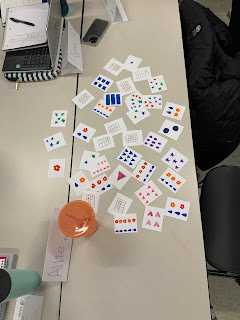 If possible, my favorite thing for many of these games is for kids to have number cards which they have a hand in making. Similar to Tiny Polka Dot cards, which are a great commercial version. The idea is to make four suits, 0 or 1 to 10, where the suits are different representations of the numbers. Ten frames, symbols or shapes organized into patterns, randomly placed or groups of shapes to encourage subitizing, etc. You can have numerals or tally marks or number words if that's something you want your learners working on. I tend to prefer cards that involve counting and supportive structures. I used to have my own cards I'd print, but the opportunity for creativity, ownership and doing mathematics is strong with kids making the cards. (Not to mention some sneaky assessment.)


Staircase (Counting, counting on, hiearchical inclusion)
Materials: optional gameboard, a lot of stacking cubes and a die.
Play: roll a die, and build a stack of that many cubes, then roll another (or reroll) and add that many, with the two summands in different colors. Put them on your team’s track on the sum. If you already have that number, that’s okay, put it on the same space. Winner is the first to get three spaces in a row (make a staircase). Some students lay them down, some stand them up. Variation 1: If the three step game is too short, play to four or five steps. Variation 2: if you roll a sum you already have, you can choose to remove the same sum from your opponents’ board. (Increases interaction.) Variation 3: Playing with number cards 1-10. If you get a 1 or a 2 first card, you must take another. Otherwise it’s your choice. Bigger than 12 is a bust, you lose your turn. Probably best with a four or five step win condition, and can be combined with variation 2 as well. Lots of opportunity to notice and wonder. Notice the different ways to get the same sum, wonder how much you have together, notice that 2+5 is the same as 5+2, ask what you hope to get on that second die roll…
- Join. One quantity, increasing over the story. Unknown could be the start, the change or the result.
- Separate. One quantity, decreasing over the story. Unknown could be the start, the change or the result.
- Comparison. Two quantities, related by the difference between them. Unknown could be the referent, the difference or the compared quantity.
- Part Part Whole. Two quantities that are part of a group. Unknown could be either part or the whole.
- Grouping. A number of groups, each group with a number of things, and a total. If the total is unknown, it's multiplication; if the number in the group is unknown, it's fair share/partative division; if the number of groups is unknown, it's measure/quotative division.
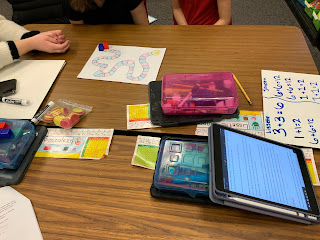
Play with your students, thinking aloud at how you get your sums. For most of the kids, counting on would be a good strategy. 3 & 5, 5 -> 6,7,8. If students could benefit from using manipulatives to count, have them take as many as each roll, then find the total.
Make Your Own
Notice how simple some of these are? Really, some of these tiny math games are just born from thinking what do I want learners experiencing, and then adding dice or cards. Competition is fine - and a reason to engage for some learners, but try to avoid rewarding speed and correctness. Add in a representation (cards or the gameboard or a manipulative) and you probably have a classic in the making. (Then send it to me!) The easy wrinkle to add to the strategy and thinking required is to add choice. Much like More or Less above is basically War - with two layers of choice added in. Instead of flip a card, have a hand of two or three and choose one. Try to make choices real choices though. In More or Less, the choice of more or less makes the choice of the card much more significant.
Give Me More
Just two resources to end.
- One of my favorite YouTube channels is Michael Minas, who makes up tiny math games with his kids and then demonstrates them. A lot of good games, but what's better is the spirit of invention.
- Jenna Laib has a few easy, high leverage games. She writes about making games and then shares her favorites. We've used Number Boxes a lot this year, from 1st to 5th grade, just altering for what content the kids are thinking about. (Really, just read everything she writes.)
Just this week we were using ___ x ___ – ___ with a trash can ___ with 3rd graders. I wanted it not to be just who gets the biggest numbers, so added in the subtraction. I like having a trash can because it adds some choice, which gives even kids who have all their facts something to think about. There is so much thinking you can see and assessing you can do even just watching kids play these, and if you get to play with them... forget about it!
Game on!











 Posts
Posts