A blog for sharing my math interests on the web, to post new materials for elementary, secondary and teacher ed, and vent mathematical steam when needed.
Thanks for visiting!
The origin of this game was trying to think about a game that helped give students enough experience to intuit the rules for how operations with signed numbers affect inequalities. I think this is doubly hard for students because they don't have much intuition for signed numbers, and learn both integer operation and inequality rules by memorization rather than understanding.
I love playing cards as a material for signed numbers because the red and black make such a nice positive and negative visual. (For more integer games, see this collection elsewhere on the blog.) I thought about students somehow constructing expressions, but I couldn't think of anything not clunky. I knew we wanted comparison, and I like War as a comparison structure. That made me think of the exciting moment of war, playing down extra cards on a tie.
When I played around with the cards, though, it didn't get at inequalities because each player was changing the value of only one side of the comparison. A big no-no in the context we want. So the played cards had to effect both players' values. It seemed confusing to have both players reveal at the same time, so I decided that - at least to start - players should take turns, even though that makes the optimal strategy pretty determinable. (If it's not a word it should be.)
After students get the strategy, go to the variation where both players flip at the same time or the dealer has one less card. If playing with middle schoolers for integer operations practice, try the flipping off the top variation.
I think this is a good educational game, but only close to a good strategy game. I can't quite figure out what's missing, so if you have a variation or adaptation to try, please let me know.
Goal(s). Gain experience with effect of integer operations on inequalities. Works well. Also good for gaining experience with integer computation.
Structure. The game generates a lot of these situations and the cards guarantee a mix of operations and values.
Strategy. Pretty simple. On variation becomes a pretty nice bluffing game, but not intensely strategic.
Interaction. What you do completely depends on opponent.
Surprise. Hidden information and opponent plus randomization of cards helps here.
Catch-Up. Victory is almost always possible.
Inertia. Might be too simple for loads of play, but good enough for the objective.
Rules. The idea of applying your card to both is non-intuitive, and remembering suits-operations connections is hard. You might want specialty cards
Context. No context, but all the variations generated engagement from the preservice teachers.
One thing I want from this experience is a deck with operations for suits. Not sure if it should have all 4 operations, or multiplication and addition with positive and negative numbers or some other variation. What do you think?
I took my new inequality game (that was the fruit of my planning last post) to Dave Coffey's and Hope Gerson's student teacher assistant seminar. The idea was to teach a lesson, and then get coached as a model for the TAs. GVSU has a great education program where our student teachers have a full semester of being in the schools all morning before a more traditional student teaching semester. They get supervisors from the College of Education and, for secondary, from their major content area for both semesters.
Inspired by the Learning Network and the Cognitive Coaching model, as well as the Instructional Coaching model from Jim Knight et al, we've moved away from an evaluative assessment model for observations to a collaborative improvement model. Dave has written a few excellent posts on coaching. One of the things we try to do for the TAs is a coaching demonstration, where they can see what this process is like. Very understandably, they are nervous about being observed. This semester, I've came in and taught a lesson as if to my preservice secondary teachers, and then we debriefed for the demonstration.
We ask the students for whatever they're using for teaching notes (as opposed to expecting a lesson plan) and for them to fill out an action plan. My lesson plan is pretty bare bones... many student teachers wanted to know if that was okay. Yup. The principle is do what is helpful to you. What I brought:
Greater Than Lesson Plan
Math 229, 9/26/12
Objective: understand nature of inequalities and their interaction with operations; apply to measurement
Agenda
5 Start Up, DOS, share HW
45 Greater Than Game
SA: Fill in blanks: 3 ___ 10; -3 ___ 2; -1 ____ -3;
F: explain game rules, play a round vs whole class
A: they play; pose question “what effect did operations have on inequalities?”
R: (10 min) discuss
• what effect did operations have on inequalities?
• strategies in game
• suggestions for improving the game
50 Error analysis investigation
SA: Measuring a line with +/-
F: overview of measuring stations; introduce contest
A:
-they measure volumes and areas
-class-wide table of results
R: explain how did they compute errors for their measurements
5 Contest reveal; debate winning conditions if there’s an opportunity
5 Concerns/ Wrap Up
To Do:
Observation Journal WS
101qs.com how many/how much investigation
Materials:
playing cards
rulers/measuring tape
contest jar
I realized I omitted the lesson objective of analyzing an activity as a teacher, and put that in for the teaching of the lesson 'for real.' We only did a representation of the first part of the lesson for the coaching. Here's the action plan:
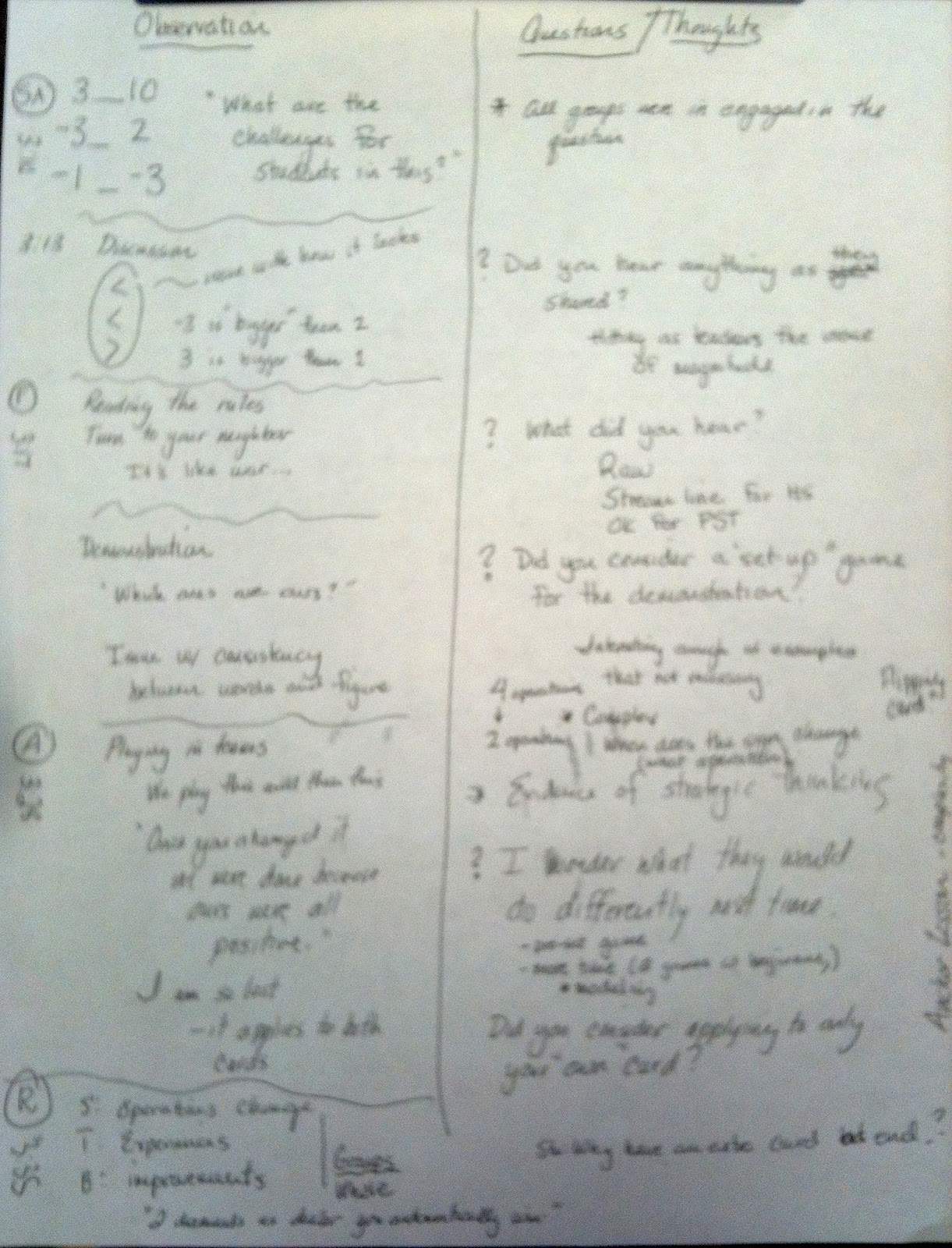
Dave took notes while I was teaching. (He may produce a sharper version of this.) When we're taking notes we often make note of other things to talk or think about aside from the action plan, but don't necessarily bring them up unless it is something that could greatly help the observed.
The dialogues following an observation are some of my favorite times at work. Discussing teaching with another professional based on something that we both just saw happen is amazing. Exciting as a teacher and satisfying and growing as a colleague. We've tried to think of a way to encourage this kind of teacher to teacher interaction at the university, but it hasn't happened yet.
The video of this coaching isn't exactly like what it is when not for demonstration, but what is here is pretty authentic. (For one thing, the discussion is usually 30 min to an hour.) I did make some of the changes that were suggested here or in the discussion afterward with TAs participating in the coaching. They recognized the value of positive feedback, seemed less intimidated by the prospect, and were interested in how the person being coached does more of the talking.
What: the game does work for generating experiences to consider inequalities. I think it also works on the level of an activity for novice teachers to evaluate for use in class. It raises the issues of materials, effort to implement, and when a game might be good in class. (Some of this is based on my use of the game with my PSTs.) I did hear a couple things that made me think about how do I make sure more of the connections that I'm thinking of get shared in class, for example the connection to War. I do like the structure of the game.
So what: I want to consider the idea of generating a good demonstration game vs authentically playing a game to model. I feel hesitant to stage a game, and I'm not sure why. I want to think more about when should a game be well-determined and cleanly set, and when should a game be something that you kind of unroll over a few days.
The idea of being clearer with preservice teachers about the difference between how things work in our college classroom and how it would be with K-12 students is definitely a valuable one.
Now what: I did clean up the instructions as they suggested. I think the game is good as is for high school. The choice of cards vs flipping off the top helps emphasize that the only thing that flips the inequality is multiplying by a negative. The flipping is a nice variation for younger students who are focused more on operations with signed number. As a game I have to think more about the full strategy version. Is there a way to make it a real game?
It's a constant danger that PSTs will decide our experiences are irrelevant when confronted with the schools as they are. So thinking about this transition and connection piece from teacher education to teacher reality should always be considered. I also want to continue to be sensitive to the idea of big shifts and subtle shifts. Subtle shift - questioning, medium - finding a game online, big - designing your own game or writing your own curriculum.
Note: I'll shortly have a post up that's just about the game with the current version.
Image credit: By Sgt. Robert Adams [Public domain], via Wikimedia Commons
In my preassessment for preservice teacher (PST) high school mathematics course, I had a new topic grab their attention - inequalities. In previous times teaching this course, that hasn't been an issue to which we've given much attention. My bad, as I've seen plenty of struggles with it in secondary classrooms. It's clearly an error where we retreat to instrumental understanding (using Skemp's terminology); rules, rules and more rules.
So what are the key ideas? It's an extension of the algebraic methods we're already using. So I want to focus more are the conceptual components of inequalities... which I haven't ever really deeply considered before.
The heart of inequalities is comparison, which is a key component of number sense. A key and often omitted component. Usually we introduce numbers (multi-digit, fractions, decimals, signed) and then are lucky if we even get representation work before we get to computation rules and rote. So that makes me think of a couple of my favorite games - Fraction Catch and Decimal Pickle. Probably not appropriate for a high school class, though I use them in the preservice middle school class to good effect. What would a high school version look like?
Hmm. It's the rules for changing the sign that get people all bothered. What if the players/teams started with a number, then multiplied or added to both players numbers... the goal could be to get the larger quantity in the end. You could make special cards... or (I love being able to use regular dice, cards, dominoes, etc.) have the suits imply the operations. I'd have to think of how many turns, how many cards to have, some of the game mechanics. But that idea might be worth the work of developing something new.
Before being in math ed, I worked in index theory, that includes plenty of analysis. Analysis, as a mathematical field, involves a lot of estimates. Think nitty-gritty epsilon-delta proofs. This is less that that, which is less than or equal to the other, which means the whole thing is less than... I loved that stuff. So is there a way to get students making those kind of estimates?
That makes me think about experimental error. Error analysis is nice because of the connections to measurement. That gets us into volume formulas. Could even do a guess how many kind of competition. Hmm. I took a picture of a neat set up like that at the ND-U of M football game over the weekend, but it came out too blurry. And I don't know the result! (I guessed 1337. [LEET.] The bottom pyramid was 10 balls wide and about 20 balls tall.) Lots of good images for that on 101qs.com. Could use in class or make a good HW assignment out of that, and get the PSTs looking at that great resource. It would also let us talk a bit about measuring technique - important to get in somewhere. Volume ties into some of the higher degree polynomial stuff we've been doing...
I think that would make for good foundational experiences, and then we could do a follow up day to see how the ideas of inequalities we see apply in traditional algebra and algebra 2 problems.
Now to get working on that game...
ps. What I didn't do here that I usually do when planning, is look around what other people have about inequalities. That usually involves a visit to Sam's virtual cabinet, searching reader, raiding Kate's archive, etc. Where do you look for inspiration, adaptation and out and out robbery? (Accredited, of course.)
This story continues in the post on coaching. With video of an actual dialogue!
I caught a great talk by Eugene Peterson this week. He's a pastor and spiritual writer who gave a talk at Valparaiso University in honor of Walter Wangerin, Jr. (who was also there); the talk was "What are writers good for?" (I found a pdf of a previous iteration of the talk.) There'll be mention of God below, but really, these are my connections from his talk to math teaching. I've written one other post inspired by Peterson, Jonah the Math Teacher.
Peterson's bottom line for writers is that they can reclaim language from debasing use. For religous writers this is particularly important, because we as a society have turned our spiritual words into godtalk that is easy to ignore and not worth our time. In other words,
Knowledge of speech, but not of silence;
Knowledge of words, and ignorance of the Word...
Where is the Life we have lost in living?
Where is the wisdom we have lost in knowledge?
Where is the knowledge we have lost in information?
-TS Eliot, Choruses from The Rock
Poems and Plays, 96
Important ideas, I think. And amazingly close to the challenges we face in mathematics teaching.
"So what are writers good for? It is our vocation to maintain and
practice this core, basic, revelational, personal nature of language,
living speech. In a world in which language has been uprooted from
its originating God soil and put to the use of information or
propaganda, it is the vocation of writers to represent and practice
language as revelation, to re-orient language into the personal world in
which men and women actually live—in their families, and neighborhoods
and workplaces," says Peterson.
What are math teachers called to do? To recover the debased math, practiced in schools for years, to bring it into the world in which the students live, to share math as it's truly done, to share learning that will make a difference in our students' life.
So how does a writer do it? For Peterson, the illustrating example is the middle parable section of the gospel of Luke. A lot of Jesus most powerful teaching. Stories with no explicit mention of God, no direct lesson. A story about fertilizing a tree instead of cutting it down. Told in Samaria to people who are not interested in his religion, and not fond of his people. He might as well have been a math teacher.
Not to double up on poetry, but Peterson also went to Dickinson.
Tell all the Truth but tell it slant –
Success in Circuit lies
Too bright for our infirm Delight
The Truth’s superb surprise
As Lightning to the Children eased
With explanation kind
The Truth must dazzle gradually
Or every man be blind
-Emily Dickinson
(Fantastic art by David Clemsha. Shows up in my Reader the next morning as a wonderful coincidence.)
How well does that capture the essence of good teaching? Peterson notes, "A parable keeps the message at a distance, in the shadows, slows down comprehension, blocks automatic prejudicial reactions, dismantles stereotypes. A parable comes up on listener obliquely, on the slant." A writer does this by having the reader come to them, going slow, countering the impatience of the age.
This leaves teachers the challenge of knowing what is best, in a culture that wants what is lesser. When we propose that there is better, they want solutions that are immediate and rushed. How can we convince them that the answer is slow? Real stories, finding the way themselves, experiencing the superb surprise. I think we have to just persist. Write our real lessons. Participate in the community. Share our success stories that will buoy us through a dozen bad days.
I've been asked multiple times this week about good iPad apps for math... so time to put together a list. I have not had an opportunity to use most of these with students yet, so I'm going on my impressions and recommendations. Many of these do have android versions. I'd love for you to add your experiences or recommendations or opinions in the comments. I have a previous post about iPad for teachers, too. My first response to people was to send this list from mathxtc, which has a lot of goodness on it. I'm particularly interested in Solids Elementary HD (explores nets and solid geometry) and the Mathination touch solver or Algebra Touch. Also note the official Apple collection of iPad math apps. (ITunes link. Most of the links in this post are web links.)
The big question to start with is "wifi or not wifi?" On the web, start with Wolfram|Alpha and Desmos.
I also have to give a shout out to GeoGebraTube which on a mobile device automatically optimizes sketches for mobile use. Input boxes and some other features don't work. It's worth noting here that there's a Kickstarter for a free GeoGebra for iPad app. I think they're having difficulty because it's hard to perk something which is going to be free. Very worth of our support as a community.
There's a lot of video lesson archives, such as ... you know, but I'm not going to cover them here for fear of terminal irony. Vijay recommended Fraction Basics which does interactives plus video and has some free samples. (There are a few with the model of free video app, buy the content.)
The Calculator
If you have an iOS device, you should not need a calculator anymore. However, I have yet to see a calculator that combines regression with the nice graphing and computation that's available. Who will finally save us from TI's decades of benevolent tyranny?
Wolfram|Alpha - the reasonably prided app. I also like the course focused variations that make the interface more direct for students. This I have used with students and it is powerful.
Quickgraph - free, also Quickgraph+ for 1.99. Good computation, nice interface, good touch interaction. (Worked with one of the authors, Alejo Montoya, on ParabolaX when he was at GVSU.)
Calculator Pro -free scientific calculator. No graphing but faster for computation than the others. Simple and clear.
Curriculum
Note that there are games here, but they are pseudo-games. The game structure is gamified content, as opposed to be a game that also addresses content. I obviously don't have a good way to describe this yet. I'm not against gamification, but think if it's overused it will have a short shelf-life.
Secondary
Dragon Box - winning awards and notice left and right. $3 or $6. Content: solution of linear equations. Should help students learn which manipulations are permissible, and maybe even choose which manipulation is desired, but I have qualms because there is no algebraic reasoning as to why we can do these things. My 8th grade daughter even noticed that she could figure out how to solve anything, but didn't know why anything worked. Transitions kids from pictures to regular algebraic notation. Clever and really well executed, but possibly dangerous as instruction. I'd use it as an alternate representation after some inquiry. Christian Bokhove is a big fan and pointed out that it's multi-platform.
ParabolaX - our GVSU contribution to algebra games. Content: factorable quadratics. Designed by Alejo with Char Beckmann. The idea of the game is to use game conditions to gain students experience that supports later symbolic understanding.
Sketchpad Explorer - free. Let's you explore Geometer's Sketchpad files on
the iPad. Key Curriculum was nice enough to send along the link to their
sketch sharing site: Sketch Exchange
Elementary
MathEvolve - Lite and $2. The Dragonbox of elementary number operations. I wrote a post about it already.
Everyday Math Games like Top It. Usually $2. Love it or hate the curriculum, they have some excellent number games for computation practice. They were an early leader in putting them online, but that was only accessible to schools using the curriculum. Now they're apps, so everyone can have access. Follow the iTunes links from Top It to see the full selection. (No easy way to link to that.
Number rack - free. Rekenrek with clicking beads, even. Great number representation.
Games
Motion Math - $2 each. Really a stand out in this category. Get the feeling of a game, use the full range of input of a mobile device and they're making several games that are new and great. Try starting with Motion Math fraction game.
24 game - $1. Great IRL and just as good as an app.
Set - $5. Remember that's cheaper than an actual set of Set.
iOrnament - $1. Great reflection and rotation symmetry art program, including all 17 wallpaper groups. I cannot stop playing with it. Kaleidoscope Drawing Pad is similar in spirit but more limited and free. (Still very fun, with different drawing action.)
Soulver - $3. Interesting effort to blend verbal and symbolic representations ... not sure if it's there yet, but I like where it is going.
Mobimath - Lite or $1. Needs cellular to do distance, but still does angle of elevation. This kind of real-time data collection will be awesome once it's smoothed out. Even just the angle of elevation bit is neat, though.
Loopy - free. Trying to push the boundary of an interactive virtual manipulative, but it doesn't quite work for me yet. They're onto something neat, though. Free, so give it a try.
In addition to all this, there are a lot of excellent puzzles that echo both classical math problems (like tangrams) and newer archetypes (rush hour). You might start with some of the neat Think Fun games, like Chocolate Fix.
This also doesn't get into the tools that students can use to record or create their own content. Paul Macneil recommended Explain Everything ($3).
Hopefully this is a good starter selection. What's missing? For what objective or classroom activity would you like to see an app? Do you know somewhere where the various instructional materials are written up?
So when Dave and I filmed the first episode, we actually filmed two. Given where the whole thing has gone, more episodes seem unlikely from us. (Unless we could do something meta with it...)
Of course, this also means whatever you disliked about the first one you will also dislike at least as much in this one. Audio quality, snark, the guy on the left...
Editing this it struck me that really Sal Khan is a tutor. He's like the strong student in the class that is willing to share with other students how he sees it. So his mathematical viewpoint is a bit procedural, and his understanding of the ideas comes across as a novice. A skilled novice, but without depth. It was his discussion of matrices that really sealed this for me. Undoubtedly there are a lot of teachers who see a matrix as just a table of numbers, but there is so much more. It may be a teaching decision to not share that 'much more' in an introduction, or it may be he's just sharing his viewpoint.
If this is your first exposure to MTT2K, there's still time to look away. If you don't, you might want to read Dave's two posts on how it came to be (one and two) or watch the first episode. I have a (first crack at a) storify with some of the brouhaha surrounding the first.
I'll just say here, I'm not against Khan Aademy, I'm not jealous, and I'm not against flipped classrooms. I am for quality materials, intentional teaching and learning, and open discussion of ideas. I do believe satire is an appropriate response to exaggerated publicity and overhype. If I could sing, I'd explore a Tom Lehrer style song on the matter. It's gratifying that the first episode started a big discussion, but at some level this is two guys goofing around to make a point about good use of resources.
In contrast to many places discussing Khan Academy, the comments are open. I'll ask you to be as civil as you can, though, please. Snark, satire and sarcasm are strictly permitted.
I got to give a whiz-bang 60 minute (with an option for 30 extra minutes) intro to GeoGebra at the New Tech network conference this week. 50 plus tech-savvy teachers... so it was good. I am always worried that people expect me to tell them about GeoGebra for an hour, when purpose is to get them started using it on the spot, in ways that make sense of their potential use. (Note that if you are in driving distance, I am more than happy to come do this at your school. No GeoGebra lectures, however.)
Purposes. So what are the ways that people make use of it? Oh, let me count them:
World's best graphing calculator. (A little weak on statistics and CAS, but that's improving quickly.) For you and your students. For algebra, calculus, or geometry.
Mathematical image editor. For uses in reports, papers, handouts or assessments.
Demonstration tool. Project a great visualization on your screen to show to or discuss with students.
Focused mathematical activity for students.
Open-ended inquiry tool. Pose a question and let students investigate.
Requirements. The AMAZING thing about this tool is that with version 4.0, all of these are accessible to teachers in that 60-90 minute start up.
Open the program, start typing equations on the input bar.
Needs some quick familiarity with the tool bar to make your image, then File > Export > Graphics View As A Picture.
GeoGebraTube. If you have not looked at this, you are missing out. 14,000 sketches and counting; free accounts, search, likes, tagging and you can collect them in teacher mode or show collections in student friendly mode. This is why you need minimal expertise to start using the program deeply. If you can run YouTube and you are a teacher, you can do this.
See #3.
Students today are geared for this kind of tool. You give them access, they'll figure things out about it that I don't know.
Really, any training beyond that first 90 min. is about if you want to become proficient in number 5, or if you want to be designing your own activities. Some teachers are doing that anyway by the end of an hour, most by the end of a half day. Once you start using it, there's a big danger of being sucked in by the possibilities of what you can make. The power of dynamic examples is as much greater than static electronic images as static electronic images were than hand drawn. (My opinion. No research. Actually yes research, but they would never quantify so crazily.)
After my session, I got to go to Geoff Krall's (@emergentmath) session on formative assessment. He was using the MARS MAP (Mathematics Assessment Resource Service - Mathematics Assessment Project) materials. In particular, he used the Ferris Wheel lesson to get us collaborating and specific in discussion.
As we discussed, it really got me thinking about how I would use the task early on. It would make a good project or assessment, I think, but what about as an inquiry? The basic problem was to make a symbolic model [find a, b and c for a+b*cos(ct)] for the height of a car on a specific Ferris wheel. Then there was a card sort which got students comparing context, equation and graphs.
I've given many explorations before that got students experimenting with parameters to see the effect on graphs, but I love the idea of tying it to a context. That doubles up on the intuition they can apply - physical and visual. If the students had access to that, they might be able to do enough trials to start to generalize. Even without much trigonometry understanding, it's a nice context for graph transformations. For me, these kind of thoughts now lead to GeoGebra. I made a quick sketch, with the Ferris wheel in a 2nd graphics window, and was delighted to find that even the 2nd window worked on GeoGebraTube.
But since then I thought it would be worthwhile to develop a bit more. Both to familiarize myself with using the 2nd graphics window and to make the single model into a reusable activity. I knew I wanted to have either a customizable or random Ferris wheel, some animation of the situation and a way for the students to enter the equation.
That bore some thought: sliders, input boxes for parameters or an input box for the function? Sliders are best for seeing continuously linked examples, but can make a problem like this too easy! The input boxes for the parameters helped support the idea of structure, require some thinking before making a new guess, and don't require as much typing as entering the whole function. Plus you can isolate one parameter and just adjust that. That might be a positive or negative. It feels like a support for learners early in this, by encouraging them to focus on one parameter at a time.
The trick to working on two graphics views is the advanced tab of object properties. You can use any tools from the main window. Just select the tool and then use it in the 2nd graphics window. The objects you make there show up in the algebra view. But when you edit things, or create them in the input bar, they migrate or appear in the first graphics window. The solution is in the object properties, advanced tab; just check the box you need. Note that you can have something appear in both ... there just has to be a cool use of that.
I don't think there's anything else too tricky about the sketch. I used the Function[ , , ] to get the modeled equation to move with the tracing point, the ZoomIn[1] command on the button to clear traces, and the UpdateConstruction[] command to reset the Ferris wheel dimensions. (I had slick graphics window dimensions based on the Ferris wheel, but then the ZoomIn[1] command doesn't work. Ultimately I thought it was better to see the Ferris wheel changing sizes anyway.)
The sketch is on GeoGebraTube: Teacher page for download or Student worksheet for in browser use. You have to click in the main window to get the animation button to show.




 Posts
Posts